Conceptual design of a building with columns and shear walls
Q1
Aim:- To distinguish between the three alternatives of providing shear walls with respect to technical aspects like lateral stiffness and torsion etc
| technical aspects | shear wall arrangement (a) | shear wall arrangement (b) | shear wall arrangement (c) |
| restraint to shrinkage | as we can see in the image all the corners are fully restrained | in this case, corners are left free but the structure is restrained along the edges | the structure is restrained non uniformly so we can conclude that there will be less possibility of cracks |
| lateral stiffness | less lateral stiffness along both X-direction and y-direction | since the shear walls are provided uniformly and symmetrically comparatively there will be higher stiffness along both directions | in this case, shear walls are provided non uniformly so there will be non-uniform lateral stiffness |
| torsion with respect to the vertical axis | since the structure is restrained along corners there will be high resistance to torsion | edge walls provide good resistance | irregular walls may not resist the torsional effects |
| static eccentricity | shear walls are placed structurally symmetric | shear walls are placed structurally symmetric |
shear walls are placed structurally unsymmetric so this arrangement of the shear wall will have static eccentricity |
| redundancy | uniform placement of lateral load supports in both the axes | uniform placement of lateral load supports in both the axes | concentrated lateral load supports in both the axes |
| architectural constraints | in this case, walls are provided at the corners so it will be accepted architecturally | walls are provided along the edges which obstruct access to the building | walls are provided along the edges which obstruct access to the building |
| foundation systems | due to the geometry of the shear walls, the layout of the foundation is difficult | since the walls are provided symmetrically along the edges the foundation design is easy | since the walls are concentrated the design of the foundation is critical |
Q2
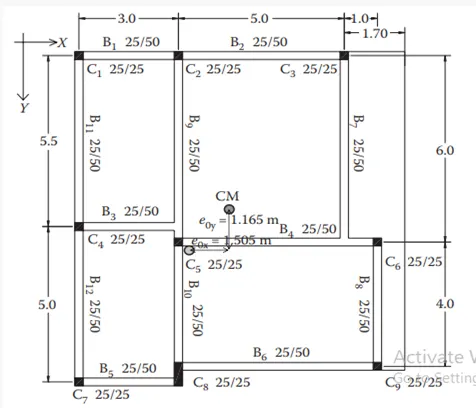
- diversion of lateral forces
in the structural plan shown we can observe that the beams and columns are not connected concentrically
B3 is resting on B9 and B7 is testing on B4, this will result in the diversion of loads when the structure is subjected to lateral loads
- eccentricity
since the center of mass of the structure and centroid of the frame are not coinciding the structure may be subjected to torsional moments and when the lateral loads have applied the structure could not resist the loads and lead to the failure of the structure
- size of beam-column
we can observe that the size of the column is 25 x 25 and that of the beam is 25 x 50 which is deeper than the column section and the beam will have higher inertia compared to the column which will lead to the formation of a strong beam- weak column mechanism and results in the failure of the columns first
ALTERNATIVE OPTION OF FRAMING
- to avoid the collapse of columns first, more reinforcement should be provided in the columns
- the beams should be connected directly to the column and should not rest on other beams
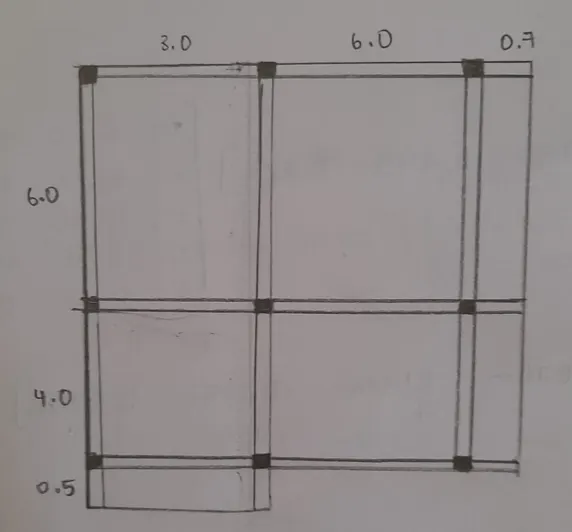
Q3
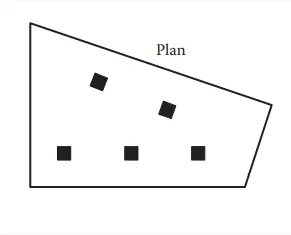
- FLOOR PLAN
the floor plan of the building is not uniform and symmetric so a special lateral load resisting system should be accommodated to resist the additional torsional moments
- INTERNAL COLUMNS
since the columns are placed randomly they could not resist any lateral loads so they are designed to carry only gravity loads
- VARIATION IN FLOOR PLAN
since the partition walls and beams are not in the proper position the structure cannot transfer the lateral loads efficiently because beams play a major role in the transfer of shear loads
ALTERNATE PLAN
- to resist torsional forces shear walls should be provided
- shear walls should be laid on box type foundation and they should be connected with each other by providing link beams to transfer loads
- internal columns should be supported by an isolated foundation
- the proportion of floor area is greater on the left side than the right side care should be taken to provide heavier members on the left side