Conceptual design of a building with columns and shear walls
Question 1:
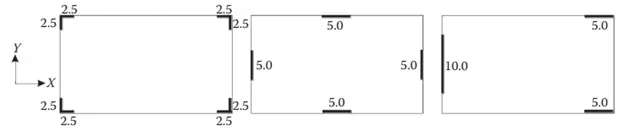
The building shown, 20 × 35 m in plan, has columns on a 5 × 5 m grid and shear walls (with dimensions shown in m, 250 mm in thickness) in three alternative arrangements, (a), (b), (c), all with the same total cross-sectional area of the shear walls. Compare the three alternatives, taking into account the restraint of floor shrinkage, the lateral stiffness and the torsional one with respect to the vertical axis, the vertical reinforcement required for the same total flexural capacity at the base, the static eccentricity, the system’s redundancy, foundation systems, architectural constraints etc.
AIM:
To compare the three alternatives, taking into account the restraint of floor shrinkage, the lateral stiffness and the torsional one with respect to the vertical axis, the vertical reinforcement required for the same total flexural capacity at the base, the static eccentricity, the system’s redundancy, foundation systems, architectural constraints etc.
ANSWER
Restraint of floor shrinkage:
As the structure is more restrained it will be more shrinking,expanding and cracking
There will be more floor shrinkage and expanding in structure a whereas there will be minimum cracks in structure B and C
The lateral stiffness:
There would be lower lateral stiffness in A in x and y direction. Uniform and comparitevely higer in in B in both x and y directions and in option C non uniform lateral stiffness in both the directions
For lateral stiffness structure B is more laterally stiff when comapred to the structure A and C because there will be an eccentricity in structure C in the left side where the length of the wall 10 m which cannot carry load equally in either direction
Placement of columns:
The shear walls in the structure also decide whether the floor vibration is more or less in the structure it will be better placing a column at the corners.So that it will reduce the cracks instead of having a shear walls at the corner in the structure
System redunancy:
The redundancy in structure A and B is more when compared to structure C because there will be an eccentricity in structure C in the left side where the length of the wall 10 m which cannot carry load equally in either direction
Static eccentricity:
Structure A and B are structrually symmetric and C is un symmetric
Structure A and B are less eccentricity and is significant
Foundation systems:
Due to L shaped walls,the geometry of foundation and its design will be critical.Walls are in line.Easy to fix the geometry and design of foundation.Walls are in line and concentrated.Easy to fix the geometry of foundation but critical in design
B and C shall be incoprated with isolated footings.A is recommended to have peripheral box foundation
Question 2:
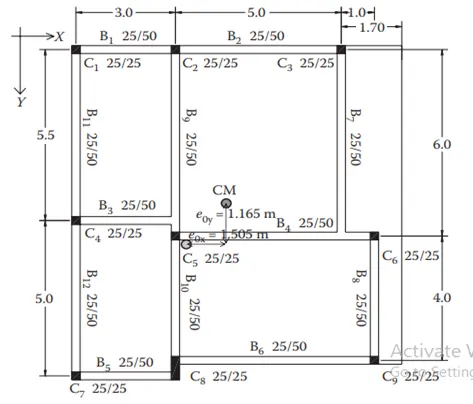
Discuss the suitability for earthquake resistance of the moment resisting framing plan of a three-storey building depicted here (cross-sectional dimensions in cm), the eccentricity of the centre of mass (as centroid of floor plan) to the centre of stiffness (from the moments of inertia of the columns) are shown. Suggest an alternative. Also, is there torsional flexibility? Are the two fundamental translational modes of vibration larger than the fundamental torsional mode of vibration. Discuss qualitatively.
AIM:
To discuss the suitability for earthquake resistance of the moment resisting framing plan of a three-storey building depicted here (cross-sectional dimensions in cm), the eccentricity of the centre of mass (as centroid of floor plan) to the centre of stiffness (from the moments of inertia of the columns) Suggest an alternative. Also, is there torsional flexibility? Are the two fundamental translational modes of vibration larger than the fundamental torsional mode of vibration
ANSWERS:
Eccentricity:
There is a two way eccentricity in the frame along X direction and Y direction also with stiffness the eccentricity in X direction is larger when compared to Y direction
There will be torsional flexibility in the structure.To avoid torsional restraints it is better to make the room dimensions even in both X and Y direction and placing the columns at the junction of two wall if it is feasible better to provide shear wall at appropriate location
The fundamental transition mode of vibration is larger than the fundamental torsional mode of vibration.
Indirect lateral load transfer in x and y
Threre is only two continous frames in the structure that is B1 and B2 in the X direction and B9,B10 and B11,B12 in the Y direction and all other beams are broken at the midway in the frame
Strong beam weak column possibility:
The size of the columns majorly mentioned as 25 cm x 25 cm. But all the beams have much deeper section.Inertia of beam .If the colum reinforcement is adequately greater than that of beams,we are okay and since we donot have reinforcement detail.It is recommended to have slight is visually higher than column
Question 3:
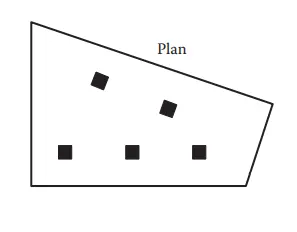
A multi-storey building with basement, with a quadrilateral (non symmetrical floor plan) plan as, has interior columns in an irregular (not in a grid) pattern in plan that serves architectural and functional considerations. Partition walls and interior beams supporting the slab have different layout in different stories. However, there is no constraint to the type, location and size of the lateral force resisting components and sub-systems on the perimeter. Proposals are to be made and justified for the choice of the lateral-load-resisting system and its foundation.
ANSWER:
The above plan that is given is totally unsuitable for normal areas and also in earthquake prone area
In seismic region the lateral and vertical loads play important criteria because it helps in resisting the failure against the earthquake as the loads.Resultant will not coincide with the center of the mass of the structure it becomes eccentric and not suitable for any type of areas
In this plan a flat slab is more appropriate than a regular beam column junction as it provides support to the column junction as it provides support to the column without any provision of the beam which reduces the weight of the building and also helps to maintain the structure in the earthquake prone areas
Apart from flat slab a wodden structure is also appropriate whicg reduces the weight of the building and also helps to maintain the structure in the earthquakeprone areas
For the solution of this structure, we provide the shear wall from the foundation of structure through vertical components, it should minimize the loss of sudden failure occur due to lateral force acting on structure