Concept on positioning of Columns
Question 1:
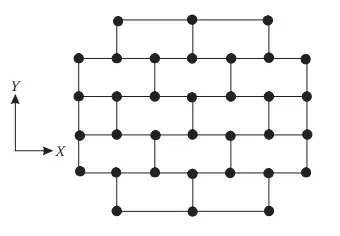
Comment on the layout of the framing plan concerning earthquake resistance in the two horizontal directions X or Y (dots are columns, lines depict beams). Look into aspects of symmetry, redundancy and bi-directional stiffness and ductility.
ANSWER :
Investigation of the framing plan with respect to Symmetry in X-direction:
- If we split the plan vertically half, it will look mirrored. So we conclude the given plan is symmetric in X-direction.
Investigation of the framing plan with respect to Symmetry in Y-direction:
- If we split the plan horizontally half, it will look mirrored. So we conclude the given plan is symmetric in Y-direction.
symmertry:
- It is observed that the distribution of mass,stiffness is across the plan has good symmetrical aspects.
- This tends to reduce the horizontal displacements in both of the two horizontal displacements in both of the two Orthogonal Horizontal Directions.
- It also has a very good uniformity also.
Redundancy:
- There are missing structural elements in the Periphery of the plan.This causes the uneven distribution of earthquake action effects in non linear range across the plan.
- The energy dissipation across the structure is very low which results in non -reliable structure.
Bi-directional Stifness:
- The building plan may not be able to resist the horizontal seismic actions in the shorter direction (Y-axis) and also the resistance and stiffness in the shorter direction (Y-axis) is less when compared to longer direction (X- axis).
Ductility:
- The building may not be able resist the elastic earthquake forces in shorter direction (Y- axis).So it may result in inelastic Response.
- The reduction in design force in the shorter direction (Y-axis) is to be compensated by Ductility.
Question 2:
What are the possible sources of irregularity in the building shown here? Explain how, as an engineer, each of these irregularities should be dealt with.

ANSWER :
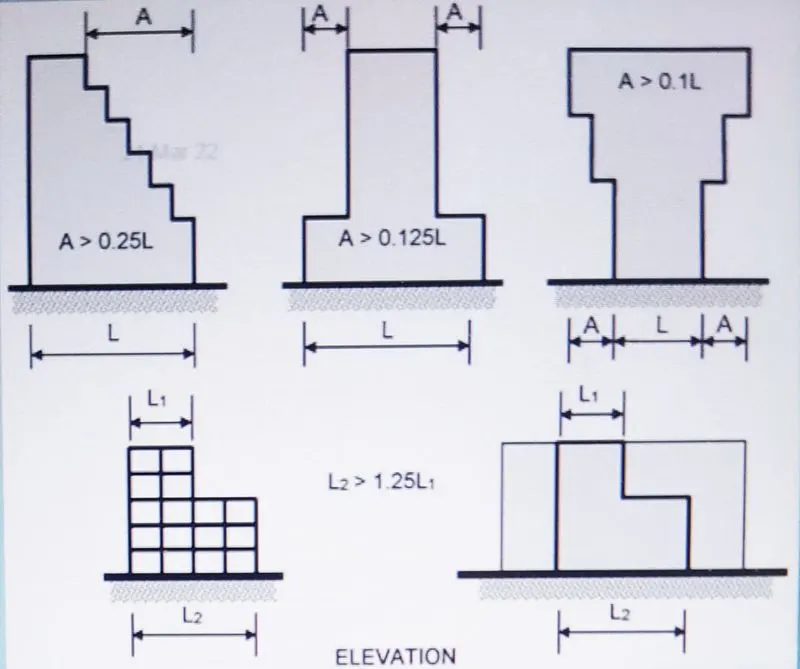
Vertical irregularity -
- The building plan area is large in bottom stories. The
floor plan areas are getting reduced with increase in height. These building
offsets has to be crosschecked with reference to IS-1893-2016 Table-6 serial
number (ii)
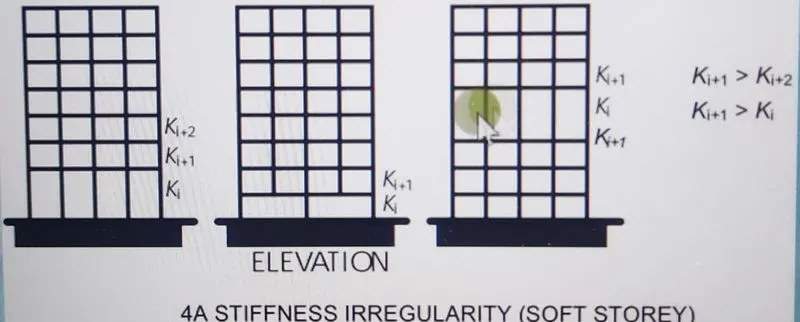
Soft storey-
- The building has uncovered opening space in 6th floor. As there
is no occupancy or a partition wall, this will lead to plastic hinge formation
at the columns (with reference to IS-1893-2016 Figure 4A). This has to be
checked and sufficiently designed.
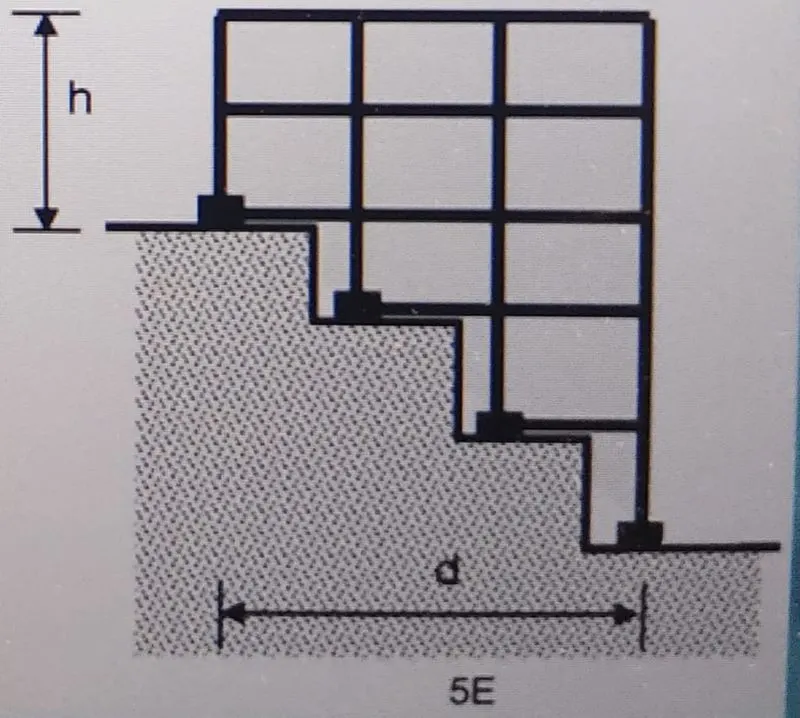
Slopy base -
- The building is constructed on a sloping ground at one side.
This will lead to significant variations in the stiffness (with reference to IS-
1893-2016 Figure 5E). Few levels may be subjected to soft storey mechanism.
- Vertical irregularity IS-1893-2016 Table-6 serial number (iii)
- Soft storey - IS-1893-2016 Figure 4A
- Slopy base-IS-1893-2016 Figure 5E
Question 3:
A 4-storey hotel building has an open ground floor for the restaurant. Story 2 to 4 have one row of rooms along each long side in plan, separated by a corridor. The two short sides of the perimeter are fully in-filled in all storeys, except for certain openings at the ends of the corridor at storeys 2 to 4 and along the right-hand side of the ground floor. There is a staircase near the upper left-hand corner, with straight flights between landings at floor levels and in-between floors. Cross-section dimensions are written next to the member no. in meters.
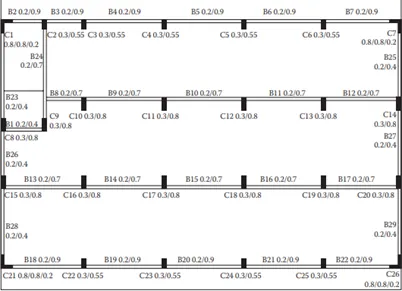
Comment on the features of the structural design and of the layout of infills which are important for earthquake resistance and seismic performance. How do they relate to the almost full collapse of this building (the extreme left-hand bay with the staircase survived, as well as one long-side façade in the rear end, and the frame along the right-hand side in plan).
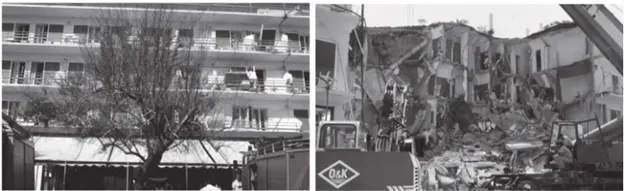
ANSWER :
- The structure's frame is not symmetrical.
- If the columns in this structure are not properly aligned in a symmetrical plane, then any lateral forces may cause damage.
- There is no proper masonry infill wall placement.
- In this structure. Redundancy in the vertical direction is inadequate.
- If the framed structure is capable of transferring the load from one direction to another of the foundation's structure.
- The columns in this layout are closely spaced, resulting in the formation of short paths for the transfer of stresses which is also an important factor in earthquake resistance.
- The interaction of the staircase with other parts of the three-dimensional structure, specifically the interaction with the beam, column, and shear wall. results in patterns of deformation that are not typically studied during the design process.
- The increased strength and stiffness of the structure in the stairway region, for example, will influence the seismic torsional distress of the structure and may load to shear failure of the staircase or other structural elements