Concept on positioning of Columns
Question 1:
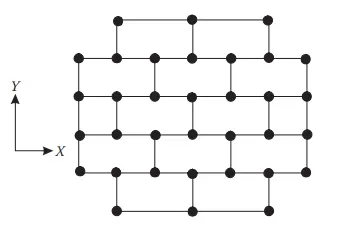
Comment on the layout of the framing plan concerning earthquake resistance in the two horizontal directions X or Y (dots are columns, lines depict beams). Look into aspects of symmetry, redundancy and bi-directional stiffness and ductility.
Answer:
1) Symmetry of the structure:
- When the plan of a structure is divided in 2 in both the directions, the plan looks to be seen symmetry. Hence the structure holds good in concern with earthquake resistance in concern with symmetry of the structure.
2) Redudancy of the structure:
- It is to be noticed that the numbers of column along X directions is more than y directions and the columns are uniformly positioned. Hence the structures are redudant but the structure in X direction is more redudant than Y directions.
3) Bi-directional stiffness.
- The bidrectional stifness along X-direction are stiffer and hold good with concern to earthquake resistance, this is due to the continous, straght beam connection. The force in this direction is easily tranfered.
- Where as, bidirectional stifness along Y-direction are not stiffer and do not hold good with concern to earthquake resistance, this is due to the non-continous, straght beam connection. The force in this direction do not transfer easily.
4) Ductility.
- The ductility of the structure in X-directions are very less as compared to Y-directions due to the continous beam connection.
Question 2:
What are the possible sources of irregularity in the building shown here? Explain how, as an engineer, each of these irregularities should be dealt with.

Answer:
This irregularities of this structure may be of the following:
- Stiffness iregularities (soft storey) - As it is to be noticed in the structure that the masonry infills are not provide at the mid of the structure, leading to soft storey structure. Hence this irregularities must be checked as per IS 1893 and design the structure.
- Mass irregularities (Soft storey)- It is even noticed that the storey after 5th storey have been architectural designed for large number of functionality.
- Vertical irregularities- The storey below 5th story consist large area of structure where as above it the structural area is reduce, may be leading to vertical irregularities.
- Sloped irregularities- we can see that the structured is built on the sloped landscape, which may be leading to sloped irregularities.
Hence, all the above irregularties should be configured as per IS1893 and design as per the specification to resist the earthquake.
Question 3:
A 4-storey hotel building has an open ground floor for the restaurant. Story 2 to 4 have one row of rooms along each long side in plan, separated by a corridor. The two short sides of the perimeter are fully in-filled in all storeys, except for certain openings at the ends of the corridor at storeys 2 to 4 and along the right-hand side of the ground floor. There is a staircase near the upper left-hand corner, with straight flights between landings at floor levels and in-between floors. Cross-section dimensions are written next to the member no. in meters.
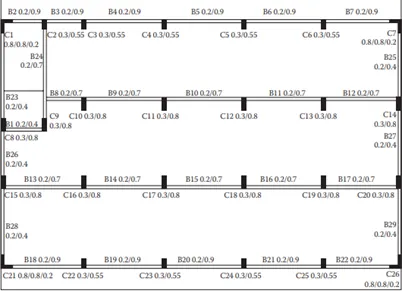
Comment on the features of the structural design and of the layout of infills which are important for earthquake resistance and seismic performance. How do they relate to the almost full collapse of this building (the extreme left-hand bay with the staircase survived, as well as one long-side façade in the rear end, and the frame along the right-hand side in plan).

Answer:
From the given questions and their images it is understood that the 4 storey hotel has collapsed due to earthquake and the main cause of instability of the resisting the earthquake force can be the following.
- From the given description, it is said that the structures had an open ground floor, hence this can lead to soft storey structure which may be the one reason for the structure to fail.
- The main reason for the structure to fail can be the absence of the beam in Y direction of the plan of the structure, by which the earthquake force to Y-direction was not feasibly transffered. Hence leading to high ductility and reduction in bi-directional lateral stiffness.