Concept on positioning of Columns
CHALLENGE 04
Question 1:
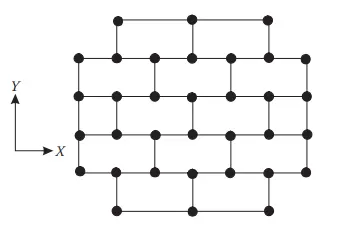
Comment on the layout of the framing plan concerning earthquake resistance in the two horizontal directions X or Y (dots are columns, lines depict beams). Look into aspects of symmetry, redundancy and bi-directional stiffness and ductility.
Symmetry:
If we split the plan vertically half, it will look mirrored. So we conclude the given plan is symmetric in X-direction. If we split the plan horizontally half, it will look mirrored. So we conclude the given plan is symmetric in Y-direction.
Redundancy:
The columns in X-direction are comparatively more and evenly spaced. So the structure is more redundant in X-direction. Except the top and bottom column rows having quite longer span. The columns in Y-direction are comparatively lesser but evenly spaced. So the structure is redundant but lesser than that of in X-direction.
Bi-directonal stiffness:
The columns in horizontal direction are connected with straight to straight beams. This means, any lateral load passing from the left end of the building will have its path straight till it reaches right end of the building. So np or less possibility of force diversion takes place.
The columns in vertical direction are not connected with straight to straight beams. So a lateral load passing from south side of building will get diverted to east and west direction to reach next bay. There will be major face diversion take place with seismic force in Y-direction. The framing plan is weak with respect to bi-directional stiffness in Y-direction.
Ductility:
The aspect ratio of the plan clearly hints more column in X-direction compared to Y-direction. It will result in higher stiffness of the building in X-direction, which would reduce ductility in X-axis.
Moreover, the X-force will easily pass from one bay to its next due to beam alignment. whereas, the Y-force will struggle to pass through. The north-south beams are arranged in zig-zag which leads to a discontinuous bracing.
We can conclude that the given framing plan is more ductile in Y-direction than that of in X-direction.
Question 2:
What are the possible sources of irregularity in the building shown here? Explain how, as an engineer, each of these irregularities should be dealt with.

Vertical irregularity:
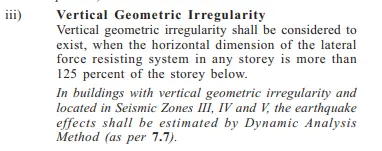
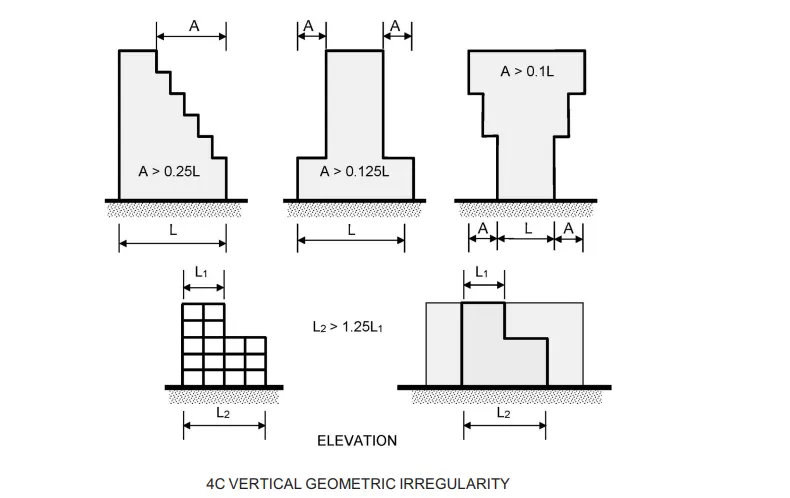
The building plan area is large in bottom stories. The floor plan areas are getting reduced with increase in height. These building offsets has to be crosschecked with reference to IS 1893-2016 table 6 serial number 3.
Soft storey:
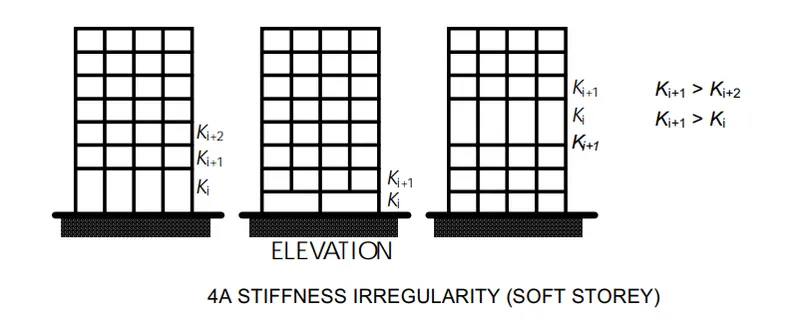
The building has uncovered opening space in 6th floor. As there is no occupancy or a partition wall, this will lead to plastic hinge formation at the columns ( with reference to IS 1893-2016 figure 4A). This has to be checked and sufficiently designed.
Slopy base:
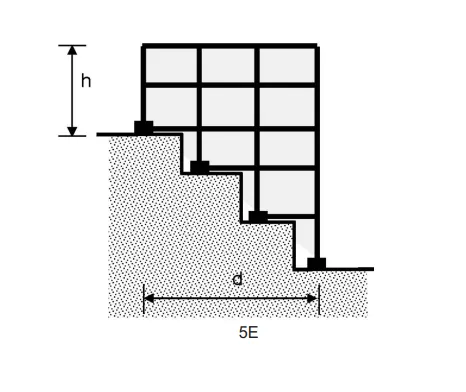
The building is constructed on a sloping ground at one side. This will lead to significant variations in the stiffness (with reference to IS 1893-2016 figure (5E). Few levels may be subjected to soft storey mechanism.
Question 3:
A 4-storey hotel building has an open ground floor for the restaurant. Story 2 to 4 have one row of rooms along each long side in plan, separated by a corridor. The two short sides of the perimeter are fully in-filled in all storeys, except for certain openings at the ends of the corridor at storeys 2 to 4 and along the right-hand side of the ground floor. There is a staircase near the upper left-hand corner, with straight flights between landings at floor levels and in-between floors. Cross-section dimensions are written next to the member no. in meters.
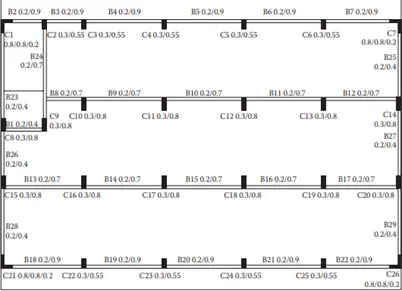
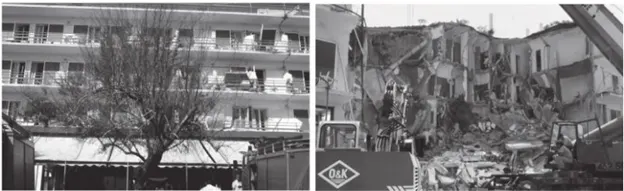
Comment on the features of the Structural design and of the layout of infills which are important for earthquake resistance and seismic performance. How do they relate to the almost full collapse of this building (the extreme left-hand bay with the staircase survived, as well as one long-side façade in the rear end, and the frame along the right-hand side in plan).
Open ground floor:
As mentioned in the question the ground floor of the building is open for restarunt. This denotes soft storey mechanism acting in the building.
Rooms along 2 bays seperated by an open corridor:
The bays filled with rooms will have higher mass compared to the middle bay left open for corridor. This includes mass irregularity along height uniformly.
Two short sides covered with infill walls:
This means the building's left and right sides periphery is more stiffer during seismic forces (especially along north-south)
Staircase portion at left top corner:
Usually staircase and lift portions are stiffer than other parts because of concentrated concrete elements. So the staircase portion contains more stiffness in the provided building plan.
No framing connection along Y-direction:
We could see no structural beams provided along the vertical direction between columns. This makes the building more vulnerable during the North-South seismic force.
Beams connected along column minor axes:
The columns are having longer dimensions in Y-direction. This means they are more stiffer along the y-direction. But the beams are running only along the x-direction which would attract much lesser lateral forces and hardly transfers it.
Variation in column sizes:
The internal columns are having higher sizes compared to exterior columns ( This is common because of higher load demands). But this will lead to a significant difference in the lateral drift of columns. So the concrete floor might have suffered heavy out-of-plane shear which would lead to collapse.