Challenge 6
Ans 1
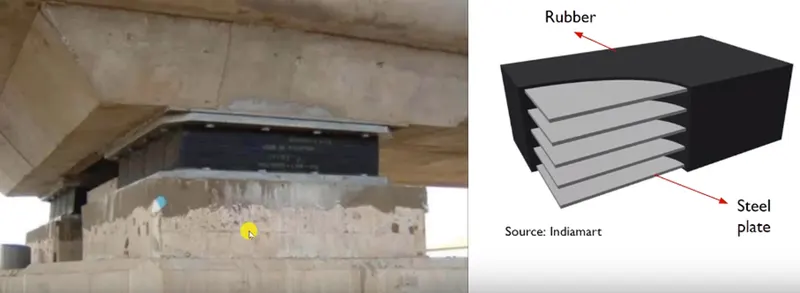
An elastomeric bearing is an important structural link placed between the superstructure and the substructure. In other words, they transfer the vertical and/or horizontal loads from the superstructure to the substructure.
The elastomeric bearings are generally made of alternate layers of steel and elastomer (rubber).
Uses:
- Main use is to transfer all the vertical loads from superstructure to substructure.
- Dissipate the horizontal loads from superstructure in longitudinal and transverse direction so that the substructure designed is economic and the superstructure loads are also relieved
- Make the overall bridge structure more durable by means of energy dissipation as anticipated by the design engineer.
- Avoid the cracking of the structure due to horizontal forces and stress concentrations.
Ans 2
Importance of elastomeric bearings in the metro viaduct:
- The most important function of a bearing in a metro viaduct is to transfer all the vertical loads from superstructure to substructure.
- If the bearing is not present and the concrete surfaces are directly in contact with each other, there will be stress concentrations on the structure and may lead to cracking of the structure. This in turn makes the structure less durable and the design life of the bridge is hampered.
- For horizontal forces such as wind, seismic, temperature, creep, etc. the substructure design is important as it creates large bending moments and shear forces. With the use of tailor-made bearings which allow the superstructure to move in the manner anticipated by design engineer, it becomes a great tool in the optimization of the substructure design.
- Bearings relieved in traffic direction are of utmost importance at locations of expansion joints so that they could serve their purpose of good riding quality in service.
- In case of a seismic event, the bearings may get damaged and can be replaced. Thus it saves the more important bridge structure.
Ans 3
Input parameters needed for design of elastomeric bearings:
- Span length of the bridge
- Offset distance from pier centre line to bearing centre line (c/c of bearings)
- Youngs modulus of concrete for a particular concrete grade
- Static shear modulus of the elastomeric bearing (Vendor)
- Dynamic shear modulus of the elastomeric bearing (Vendor)
- Moment of inertia of the I-girder at mid span
- Combined moment of inertia of the I-girder and deck slab at mid span
- Reaction on bearing due to DL (Girder + slab)
- Reaction on bearing due to SIDL
- Reaction on bearing due to Live load
- Rotation on bearing due to DL (Girder + slab)
- Rotation on bearing due to SIDL
- Rotation on bearing due to Live load
- Creep co-efficient
- Shrinkage co-efficient
- Co-efficient of thermal expansion
- Stiffness of the bearing (Vendor)
Out of the above, inputs to be provided by vendor:
- Static shear modulus of the elastomeric bearing
- Dynamic shear modulus of the elastomeric bearing
- Stiffness of the bearing
- Cross sectional area of the bearing
- Plan dimensions of the bearing as an assumption
Ans 4
Design loads taken from Grillage model of staad that are to be considered for the design of bearings are as follows:
- Dead load – I girders and deck slab.
- Super Imposed dead loads – plinth, rails, parapet, third rail, etc.
- Total slow vertical loads = a + b.
- Rapid maximum vertical loads (~mainly, live loads + vertical wind).
- Rotations due to slow vertical loads in radians
- Rotations due to rapid max vertical loads in radians
- Rotations due to position tolerance = 0.003 radians
Ans 5
Elastomeric bearing design: Refer attached Excel file - "Bearing design_challenge 6"
Ans 6
Types of bearings used in design of metro viaduct:
- Elastomeric bearings – alternate steel and rubber laminates, used for lesser spans and loads.
- Pot-PTFE bearings – alternate steel and rubber laminates confined by guide plates used in higher spans of ~ 50 – 60 m resulting in higher loads.
- Spherical bearings – Partial release of rotation/translation (long span bridges)
- Special uplift bearings – special long span bridges, rare
Elastomeric bearings-
Generally used in all types of simply supported standard spans of up to 30.0 m (maybe more) metro viaducts, road bridges, ROB’s, etc.
Elastomeric bearings provide good amount of both stiffness and elasticity due to presence of steel and rubber pads respectively. This enables it to absorb energy just so much that the design requires.
Expansion/contraction of the superstructure is possible without undue stress concentrations and unlikely deformations.
Even though they are not as durable as the main bridge material, they can be replaced as per inspection and their cost is low as compared to other bearings. Usually, the life of elastomer is ~ 5-40 years based on type of bridge, environmental conditions of site, actual loads experienced.
Ans 7
Advantages of PSC pier caps over RCC pier caps:
- A pre-stressed concrete section is always smaller that a RCC cross section. Savings in quantity for a number of pier caps.
- Lesser cross-sectional area in PSC concrete section leads to lesser weight of the cap as compared to bulkier RCC section. This makes the PSC cap comparatively easy for lifting and erecting by crane in case of a precast construction technique, especially in metro areas where the ROW is very precise and limited.
- Under service stage, the PSC pier caps are under minimal stress (just like the behaviour of a PSC I-girder)
- Concrete durability is better in PSC. In RCC, tension zone is always stressed leading to possible cracking and rebar corrosion.
- Slender cross sections of PSC always give an aesthetic look to the bridge substructure adding to the landscape of the city.
Ans 8
Basic purpose of pier caps:
1. Pier caps are part of a substructure which form base of the girders of a span.
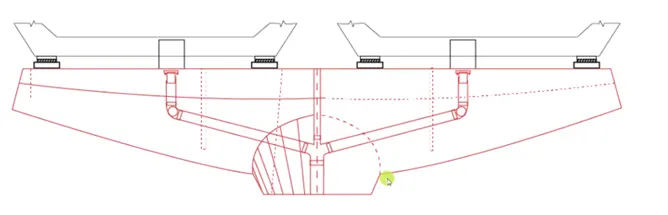
2. For 2 U-trough girders 4 bearings are resting on the pier cap whereas for a multiple I-girders all the bearings are resting on pier caps consisting of same no. of pedestals. (see fig)
3. Pier caps are used as base support for the jacks to take reaction from in cases where bearings are to be replaced or for other maintenance work.
4. Pier caps serve the purpose of discharging all the drainage water from the metro viaduct to the ground.
Components of pier caps, uses:
1. Bearing pedestals: Used for the seating of the bearings i.e. the bearings are housed on the concrete pedestals protruding out of the pier cap. These eventually transfer the loads of the superstructure to the pier column.
2. Lifting holes: Holes are left in the pier caps that are used for engaging the lifting rods / PT bars to lift the precast pier cap for final placing. The rods pass through the holes and are tightened at the bottom of the pier cap.
3. Drainage spout holes: These are the components that house the drainage pipes for collecting the storm water from the deck and carrying it to the ground.
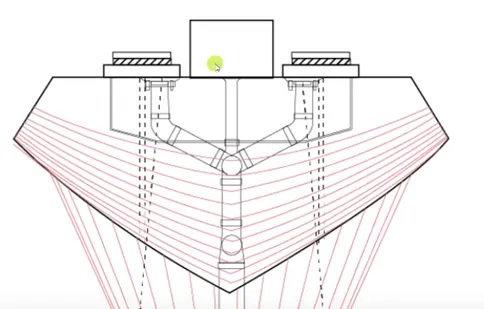
4. Shear keys: Shear keys are structural concrete elements protruding out of pier caps to lock the superstructure in place in case the deck tries to move longitudinally. Thus, it prevents the structure from getting dislodged from pier cap by transferring all the forces.