Calculation of Stiffness in Structural elements
Q1
Aim:- To calculate the lateral stiffness of the frame shown
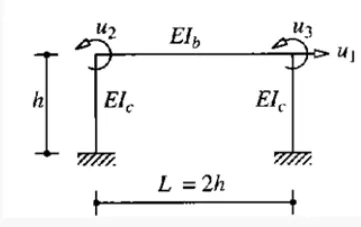
step 1:- consider unit deformation at u1
- stiffness coefficient of the column is 12EI/h^3
- stiffness coefficient of the beam rotation is EI/h^3
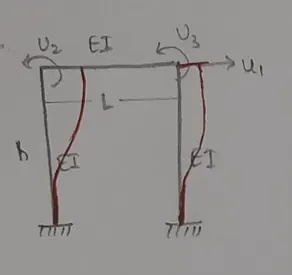
step 2:- consider unit deformation at u2
- stiffness coefficient of the column at u2 is 6EI/h^2
- stiffness coefficient at u2 because of the beam rotation and column rotation is 4EI/h + 4EI/ L
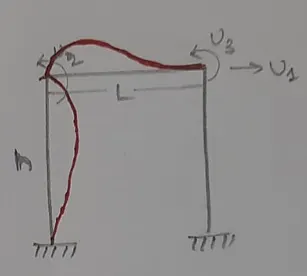
step 3:- consider unit deformation at u3
- stiffness coefficient of the column at u3 is 6EI/h^2
- stiffness coefficient at u2 because of the beam rotation and column rotation is 4EI/h + 4EI/ L
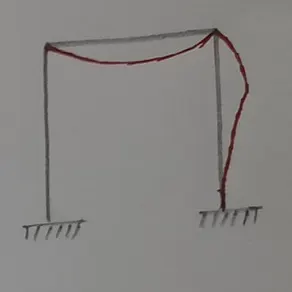
- write the stiffness matrix
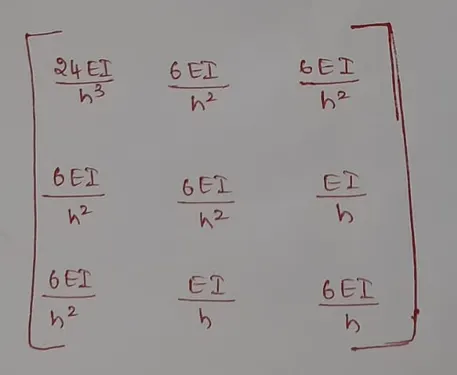
- then we have fs=k.u
after solving the matrix form and equations stiffness can be determined
Q2
Aim:- To determine the degree of freedom, establish the equation of motion and calculate natural frequencies
(A)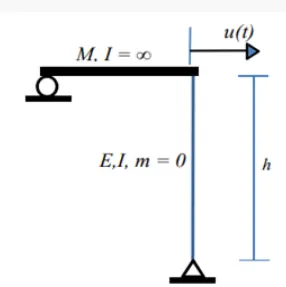
- from the frame given it can be inferred by the observation that the frame has a single degree of freedom i.e., horizontal deformation
- the given column is hinged at the bottom
- so the stiffness of the column
K= 3EI/ `h^3`
- EQUATION OF MOTION
mu+fd+fs=p(t) neglect fd since there is no dynamic element
mu+fs=p(t)
mu+(3EI/ `h^3)u =p(t)
- NATURAL FREQUENCY
=`√ K/M
=``√3EI/ `h^3M
(B)
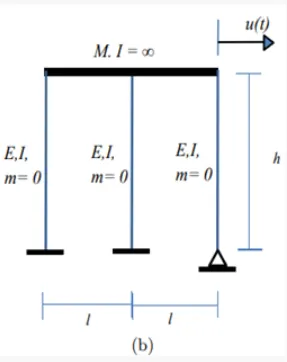
- from the frame given it can be inferred by the observation that the frame has a single degree of freedom i.e., horizontal deformation
- given 2 columns are fixed at the end and 1 column is hinged
- since the translation in the beam is uniform, the translation in the column will occur simultaneously
- so for parallel columns, equivalent stiffness is Ke= K1+ K2+K3
- so the stiffness of the column
K1= 12EI/ `h^3` K2= 12EI/ `h^3` K= 3EI/ `h^3`
- equivalent stiffness Ke= 27EI/ `h^3`
- EQUATION OF MOTION
mu+fd+fs=p(t) neglect fd since there is no dynamic element
mu+fs=p(t)
mu+(27EI/ `h^3)u =p(t)
- NATURAL FREQUENCY
=`√ K/M
=``√27EI/ `h^3M
Q3
Aim:- to determine the natural period of the system given below
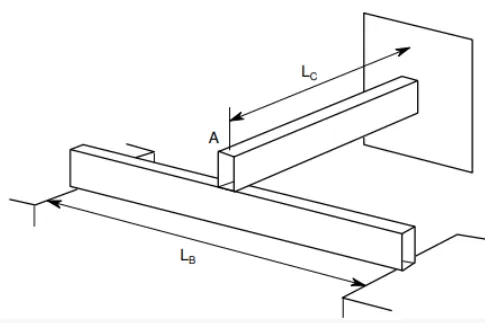
- stiffness of the horizontal member with length Lb is Kb=48EI/ `Lb^3
- stiffness of the lateral member with length Lc is Kc= 3EI/ `Lc^3
Equivalent stiffness Ke= Kb+ Kc
Ke= 48EI/ `Lb^3 +3EI/ `Lc^3
- Natural frequency od the system = √ K/M
- time period of the system = 2`π`/ `ω`
Q4
Aim:- to write the effective stiffness of the frames shown
(A)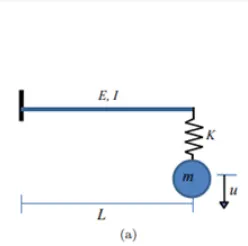
- stiffness of the beam is Kb=3EI/ `L^3
- stiffness of the spring is given as k
since the members are in series equivalent stiffness id is written as
1/Ke = 1/Kb +1/K
1/Ke=1/3EI/ `L^3 +1/K
(B)
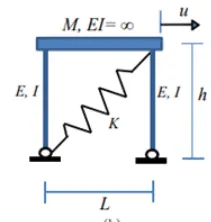
- the beam is rigid because the flexural rigidity is given as infinity
- the stiffness of the column elements is 3EI/ `L^3
- the stiffness of the inclined spring is k/cos^2 θ
equivalent or effective stiffness = Kc+ K
Ke= 3EI/ `L^3 + 3EI/ `L^3 + k/cos^2 θ
Ke= 6EI/ `L^3 + k/cos^2 θ
(C)
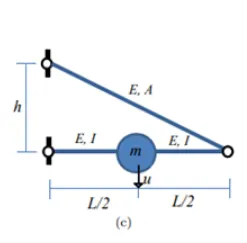
- stiffness of the beam which is pinned at both ends is given as Kb=48EI/ `L^3
- stiffness of the inclined strut is derived from the equation
stiffness = load/deformation
since the elements are connected in series
equivalent stiffness= 1/Ke = 1/Kb +1/K