Calculation of Stiffness in Structural elements
1.
Given:
L=2h & EIb = EIc
Soln
Let the Unit displacenet u1= 1
The Stiffness coefficient for Both columns = 2 (12 EI/h3)
Stiffness coefficient of beam = EI/h2
Let the Unit Rotation u2 = 1
The Stiffness coefficient column rotation at Right end = (6 EI/h2)
Stiffness coefficient of column + beam rotation at left end
= (4EI/h) +(4EI/L)
= (4EI/h) +(4EI/2h)
= 6EI/h
Let the Unit rotation u3 = 1
The Stiffness coefficient column rotation at left end = (6 EI/h2)
Stiffness coefficient of column + beam rotation at right end
= (4EI/h) +(4EI/L)
= (4EI/h) +(4EI/2h)
= 6EI/h
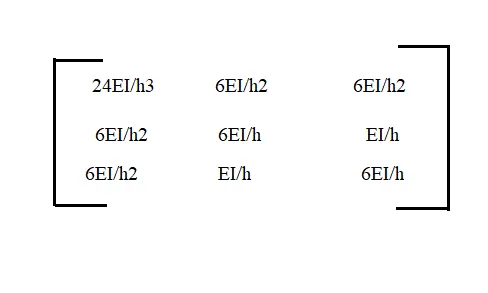
Fs = k u
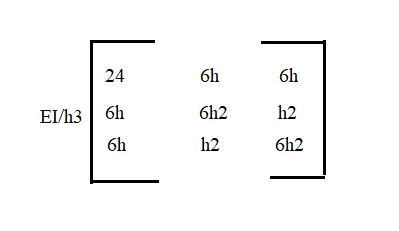
By applying static condensation method, we are deducting 3 unknown to 2 unknown eqn.
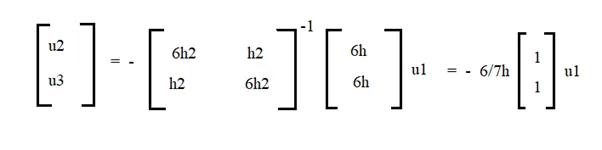
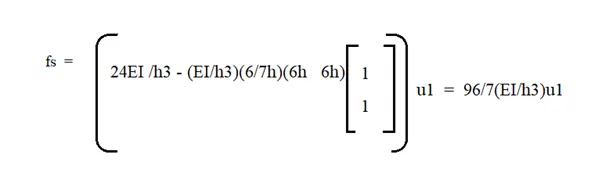
Stiffness is Amount of force required for unit displacement.
Fs /u1 = 96/7(EI/h3)
K = 96/7(EI/h3)
2.A
To Determine
Degree of Freedom
Equation of Motion
Natural Frequency
Soln
The system given is Single Degree of Freedom since there is only one motion u(t) Described in the figure.
The stiffness of column which is fixed at the bottom is given by
K = 3EI/h3
The equation of Motion is mu.. + ku = 0 , Since there is no Damping coefficient
Natural Frequency
Ω = Sqroot (k/m)
= Sqroot (3EI/mh3)
2. B
To Determine
Degree of Freedom
Equation of Motion
Natural Frequency
Soln
The system given is Single Degree of Freedom since there is only one motion u(t) Described in the figure.
Two columns are fixed at the bottoms and one column is hinged at the bottom hence the stiffness coefficient will be.
K1 = 12 EI/h3 K2 = 12 EI/h3 K3 = 3 EI/h3
The effective stiffness is ke = (k1 +k2 +k3)
= 27 EI/h3
The Equation of motion is mu.. + ku = 0 , Since there is no Damping coefficient
Natural Frequency
Ω = Sqroot(k/m)
= Sqroot (27EI/mh3)
3.
To Determine
Natural time Period.
Soln
Since both element have same material, hence it has same modulus of elasticity and moment of inertia.
When the mass m is applied at the point both the elements will respond simultaneously.it means they are connected in parallel.
The effective stiffness is is ke = (kb +kc)
Kb = 48EI/lb3 (Simply Supported beam subjected to concentrated load)
Kc = 3EI/lc3 (Column with one end fixed and other end is moving)
Ke = 3EI (1/ lc3+16/ lb3)
Natural Frequency Ω = Sqroot (k/m)
= Sqroot (3EI [1/ lc3+16/ lb3]/m)
Time Period T =2π/ω
4.A
To Determine
The Effective stiffness
Soln
The stiffness coefficient of beam is 3EI/l3
The stiffness of spring is K
The stiffness elements are in series.
1/ke = 1/kb+1/k
= l3/3EI + 1/k
= kl3 +3EI /3EIK
Ke = 3EIK/ kl3 +3EI
4.B
To determine
Effective Stiffness
Soln
The stiffness coefficient of both the columns are 3EI/l3 (Since the ends of the column are fixed)
The stiffness coefficient f Spring is k but the spring is inclined.
Inclined component of load P is P = P/cosθ
Inclined component of Deformation u = u Cosθ
Stiffness coefficient of spring is K = P/ u Cos2 θ
P/u = K Cos2 θ
Use Right angle Triangle
Cos2 θ = L2 / L2 + h2
Ks = k (L2 / L2 + h2)
The effective stiffness of the system is
Ke = 6EI/h3 + KL2 / (L2 + h2)
4. C
To determine
Effective Stiffness
Soln
The stiffness coefficient for pinned pinned condition is K1 = 48 EI/h3
Since the other end is inclined and connected so we consider the inclined end as vertical.
The deformation 1 = mgL3 / 48 EI where mg/2 is the force acting at the mid span.
The Deformation 2 = Deformation Vertical / 2
Mg/2 = Kea .ver x 2 x deformation 2
Mg / deformation 2 = 4 Kea. Ver
K2 = 4 Kea.ver
Since the connection is inclined use right angle to fine the inclined stiffness which is
Ks = KL2 /(L2 + h2)
Therefore,
K2 =kea h2 / (L2 + h2)
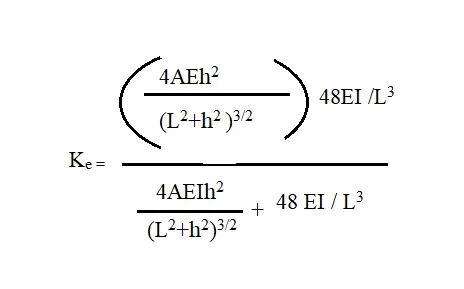
The effective stiffness is 1/Ke = 1/K1 +1/K2
On substituting the K1 and K2 values and solving,