Calculation of Stiffness in Structural elements
1.
Answer
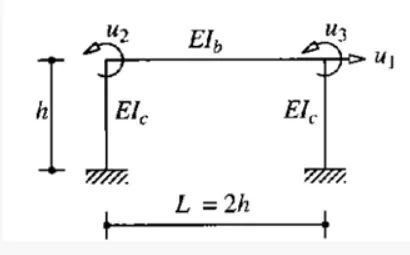
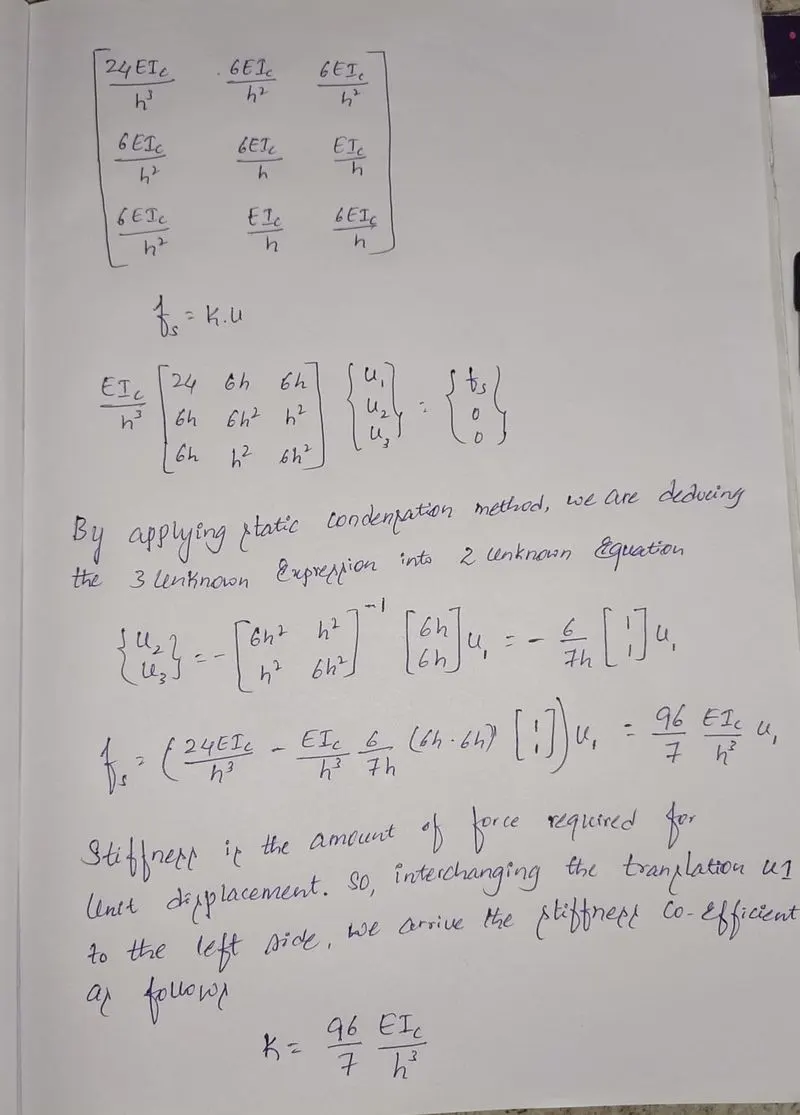
- Unit displacement u1 = 1
- Stiffness coefficient of column translation (2 similar) = 2 * 12EI/h^3
- Stiffness coefficient of beam rotation (2 ends) = EI/h^2
- Unit rotation u2 = 1
- Stiffness coefficient of column rotation at right end = 6EI/h^2
- Stiffness coefficient of column + beam rotation at left end = 4EI//h + 4EI/L = 4EI//h + 4EI/2h = 6EI/h
- Unit rotation u3 = 1
- Stiffness coefficient of column rotation at left end = 6EI/h^2
- Stiffness coefficient of column + beam rotation at right end = 4EI//h + 4EI/L = 4EI//h + 4EI/2h = 6EI/h
2.
a.
Answer:-
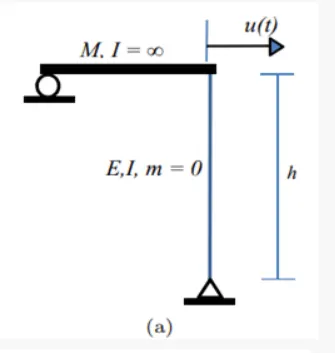
- Possition of the element can be described by one coordinate only u(t)
- The system has single degree of freedom structure
- The column has fixed end at the bottom. So the stiffness coefficient will be as follows
k = 3EI / h^3
- The equation of the motion shall be Mü+ku = 0
- Natural frequency formula ὠ = (k/m)^1/2 => (3EI/Mh^3)^1/2
b.
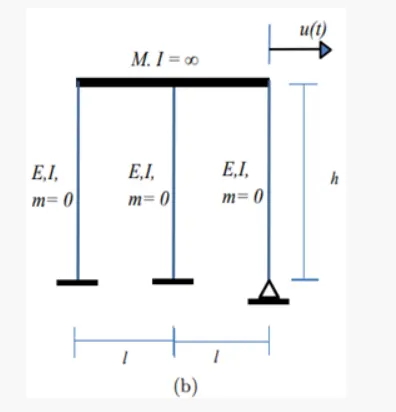
- Possition of the elements can be described by 1 coordinate only u(t) because beam with infinite stiffness will induse uniform translation in all columns
- The system has single degree of freedom structures
- Two columns are both end fixed and One column has pinned-fixed end. So the stiffess coefficient will be as follows
k1 = 12EI / h^3 k2 = 12EI / h^3 k3 = 3EI / h^3
For parallel stiiffness element ke = (k1+k2+k3) = 27EI/h^3
- The equation of the motion shall be Mü+ku = 0
- Natural frequency formula ὠ = (k/m)^1/2 => (27EI/Mh^3)^1/2
3.
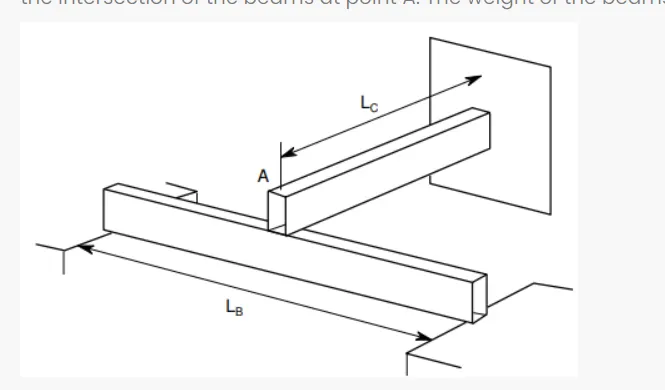
- Both the elements have same material and section. It means they have same modulus of elasticity and second moment of inertia. But the lengths are different
- When a mass M is applied at a point, both elements will respond simultaneously. It means they are connected in parallel
Effetive stiffness of the system ke = kb+kc
kb = 48EI / lb^3 kc = 3EI / lc^3
ke = 3EI(1/lc^3 + 16/lb^3)
Natural frequency formula ὠ = (k/m)^1/2 => (3EI(1/lc^3 + 16/lb^3) /M)^1/2
Time period T= 2π/ὠ
4.
a.
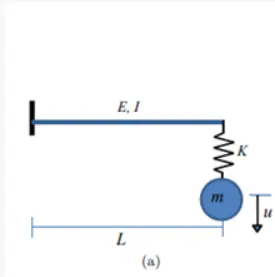
- The stiffness coefficient of the beam element is 3EI/L^3
- The stiffness coefficient of the spring is K
- The stiffness elements are in series
1/ke = L^3/3EI +1/K
1/ke = KL^3+3EI / 3EIK
ke = 3EIK/(kL^3+3EI)
b.
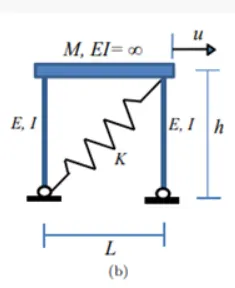
- The stiffness coefficient of both the column elements is 3EI/h^3
- The stiffness coefficient of the spring is K, but is inclined. So the horizontal force P and deformation u has to be resolved into inclinedd components to arrive actual coefficient of spring
Inclined component of load P = P/cosϴ
Inclined component deformation u = ucosϴ
Stiffness coefficient of spring,
K = P/u
K = P/ucos^2ϴ
p/u = ks = KCos^2ϴ
Cosϴ = L/(L^2+h^2)^1/2
Squaring on both side then
Cos^2ϴ = L^2/(L^2+h^2)
ks = K*L^2/(L^2+h^2)
The effective stiffness of the system, Ke = 6EI/h^3 + KL^2/L^2+h^2
c.
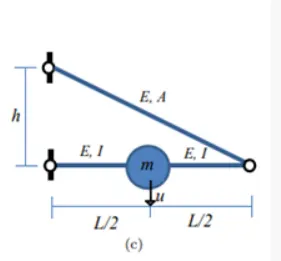
- The stiffness coefficient of the pinned to pinned beam is k1 = 48EI/L^3
- The effective stiffness coefficient for the system has to be formed by adding the relative axial stiffness provided by the inclined strut connected at the right end
- Force acting at the right end is mg/2 and the deformation caused by strut at the point of m is half of it's right end nodal deformation
mg/2 = kea,vert * 2 *Δ2
mg/Δ2 = 4 * kea,vert
k2 = 4 * kea,vert
We assume vertical axial stiffness is our calculation. But we have inclined axial stiffness in the given system, So we have to resolve the (kea,vert) into (kea)
k2 = 4keah^2/L^2+h^2
The effective stiffness shall be arrived as 1/ke = 1/k1 + 1/k2
1/kea = 1/(48EI/L^3) + 1/ (4kea*h^2/L^2+h^2)
1/kea = 1/(48EI/L^3) + 1/ (4EA*h^2/(L^2+h^2)^15)
ke = 4EA*h^2/(L^2+h^2)^3/2)*48EI/L^3 / 4EA*h^2/(L^2+h^2)^3/2)+48EI/L^3