Calculation of Stiffness in Structural elements
Q.1 Ans:
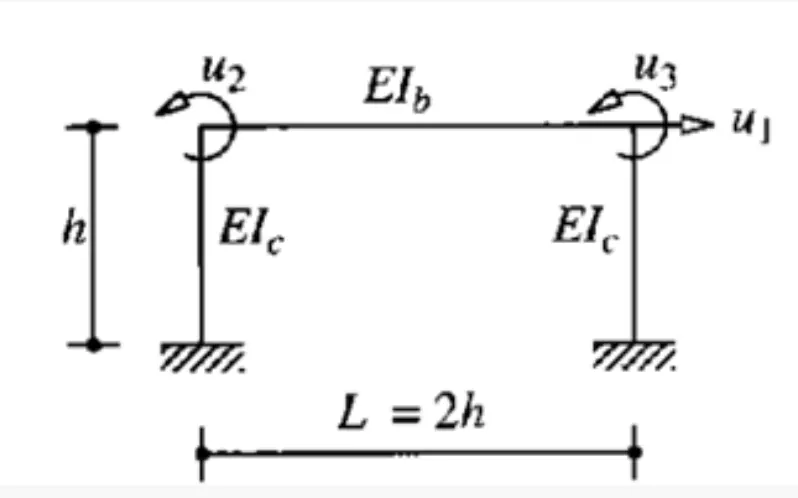
Aim: Compute lateral stiffness of the one story frame with an intermediate realistic stiffness of the beam.
Procedures:
Step 1:
It Includes the 3 Degree of Freedom.
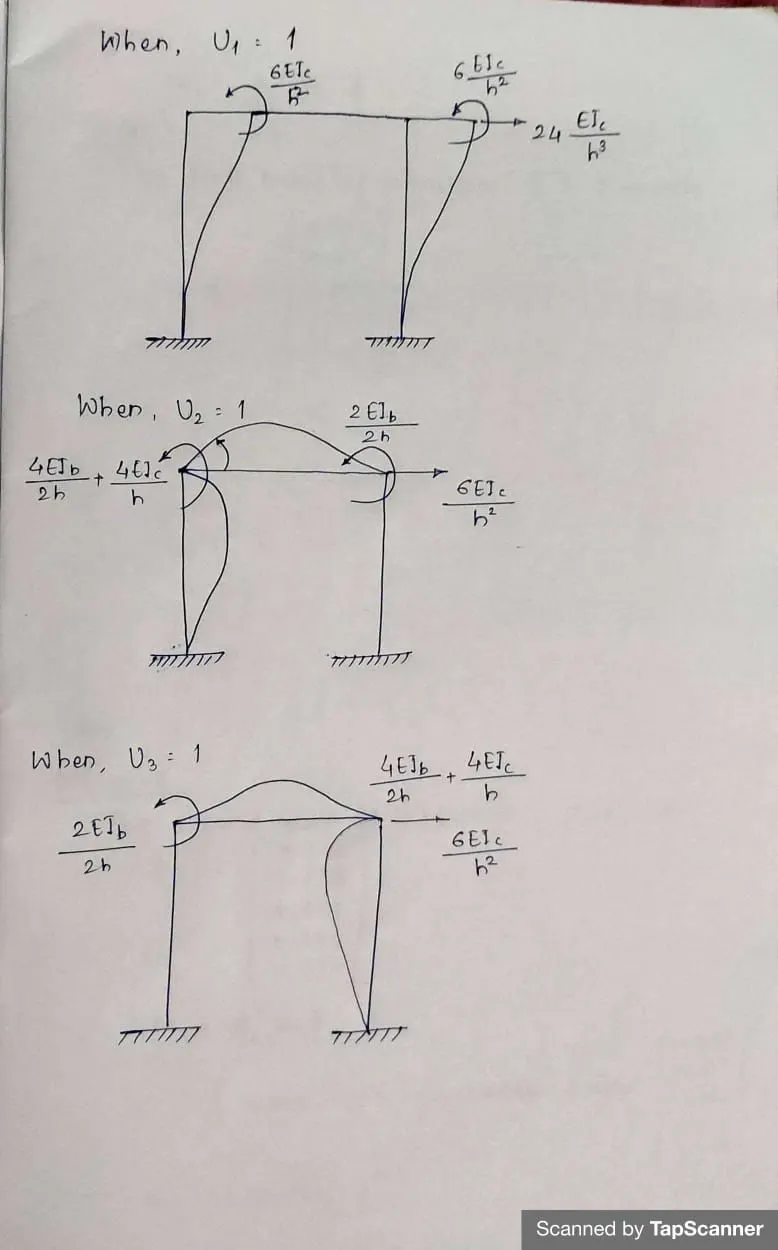
If u1=1,
U11= 24 `(EI_c)/(h^3)`
U21= 6`(EI_c)/(h^2)`
U31 = 6`(EI_c)/(h^2)`
So that, The First Equation will be:
(24 `(EI_c)/(h^3)` ) + (6 `(EI_c)/(h^2)`) + (6 `(EI_c)/(h^2)`)
Step 2:
If u2=1,
U12 = 6 `(EI_c)/(h^2)`
U22 = 4`(EI_b)/(2h)` + 4`(EI_b)/(2h)`
U32 = 2 `(EI_b)/(2h)`
So that, The second Equation will be:
(6 `(EI_c)/(h^2)`+ 4 `(EI_b)/(2h)` + 4 `(EI_b)/(2h)` + `(EI_b)/(h)`)
Step 3:
If u3=1,
U13 = 6 `(EI_c)/(h^2)`
U23 = 4 `(EI_b)/(2h)` + 4 `(EI_b)/(h)`
U33 = 2 `(EI_b)/(h)`
Step 4:
So that, The third equation will be:
( 6 `(EI_c)/(h^2)` + 4 `(EI_b)/(2h)` + 4 `(EI_b)/(h)` + 2 `(EI_b)/(h)`)
We have the three equations with three unknowns so that it will be solved by using matrix:
`(EI_c)/(h^3)` `[ [k11,k21,k31],[k12,k22,k32],[k13,k23,k33]]` `[[u_1],[u_2],[u3]]` = `[[f_s],[0],[0]]`
As per Stiffneses matrix method:
`((u_2),(u_3))` = - `[[6h^2,h^2],[h^2,6h^2] ]^-1` `((6h),(6h))``U1`
The solution will be:
`-(6)/(7h)((1),(1))u_1`
Substituting this equation to the following equation:
`f_s= (24U_1+6hU_2+6hU3)((EI_c)/(h^3))`
`f_s= (24 (EI_c)/(h^3)-6/(7h)(EI_c)/(h^3)[6h,6h] ((1),(1)))U_1`
`=((24EI_c)/(h^3)-6/(7h)(EI_c)/(h^3).12h)U1`
`= ((EI_c)/(h^3)(24-6/(7h)).12h)U1`
`= (EI_c)/(h^3)(24-72/7)U_1`
`f_s= (EI_c)/(h^3) 96/7U1`
Result:
`f_s= (EI_c)/(h^3) 96/7U1`
Q.2 Ans
Aim:
- Determine the number of degrees-of-freedom for dynamic analysis
- Establish the equation of motion
- Calculate their natural frequencies
Procedure:
Step 1:
a) The Degree of Freedom is 1.
As the Equation of motion is
`Mddot u + f_d+f_s=P(t)`
`M ddotu+ ku=P(t)`
`12 (EI)/(h^3) U + Mddotu=P(t)`
Natural Frequency
`F_n=1/(T_n)`
`:.T_n=(2pi)/w_n`
`F_n=(w_n)/(2pi)`
`:. w_n=sqrt(k/m)`
`F_n=sqrt(k/m).1/(2pi)`
`w_n=sqrt((12EI)/(h^3m))`
Result:
`w_n=sqrt((12EI)/(h^3m))`
b) The degree of freedom is 1.
`M.I=oo` (The beam is rigid so that the Flexural rigidity is Infinite.)
`K= sum_(column) (12EI)/h^3`
`= (36EI)/h^3`
As the equation of motion is
`M ddotu+f_d+f_s=P(t)`
`M ddotu+ku=P(t)`
`M ddotu+36(EI)/h^3 U =P(t)`
Natural Frequency
`F_n=1/T_n`
`:. T_n=(2pi)/(w_n)`
`F_n= (w_n)/(2pi)`
`:. w_n=sqrt(k/m)`
`F_n=sqrt(k/m).1/(2pi)`
`w_n=sqrt((36EI)/(h^3m))`
Result:
`w_n=sqrt((36EI)/(h^3m))`
Q.3 Ans
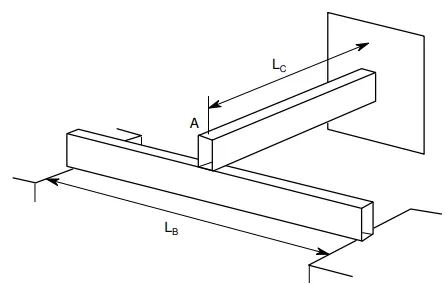
Aim: Determination of Natural frequency
Procedure:
Step 1:
`F_n=1/T_n`
`:. T_n=(2pi)/(w_n)`
`F_n= (w_n)/(2pi)`
`:. w_n=sqrt(k/m)`
`:. w_n=sqrt(g/u)`
`T_n=2pisqrt(u/g)`
Result:
`T_n=2pisqrt(u/g)`
Q.4 Ans
Aim: Determine an expression for the effective stiffness of the following systems.
Procedure:
Step 1:
a)
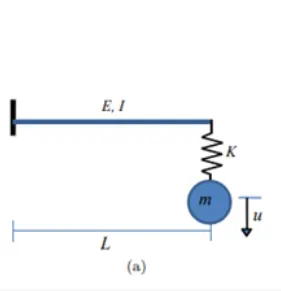
`f_s/K_e = f_s/k_s+f_s/k_b`
`K_e= (K_sK_b)/(K_s+K_b)`
`:.K_b=(3EL)/(L^3)`
`K_e=(K(3EI)/L^3)/K+(3EI)/L^3`
`K_e=(3EIK)/(3EI+L^3K)`
b)
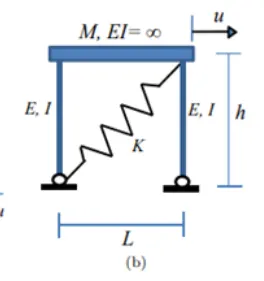
The Beam is rigid s that the EI=Infinite
`K=sum_(column) 12 (EI)/h^3`
`K_(column)= 24 (EI)/h^3`
`K_e=K+K_(column`
`K_e=K+24 (EI)/h^3`
`K_e= (Kh^3+24EI)/h^3`
C)
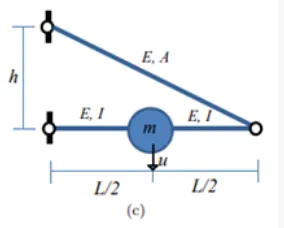
`K_e=K_a+K_b`
`K_e=(EA)/(sqrt(h^2+L^2) )+48 (EI)/L^3`