Calculation of Stiffness in Structural elements
Question 1:
Compute lateral stiffness of the one story frame with an intermediate realistic stiffness of the beam. The system has 3 DOFs as shown. Assume L = 2h and Elb = Elc
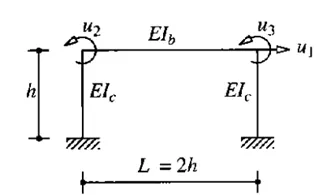
AIM:
To compute lateral stiffness of the one story frame with an intermediate realistic stiffness of the beam. The system has 3 DOFs as shown. Assume L = 2h and Elb = Elc
INTRODUCTION:
Lateral Stiffness
The ability of a body to resist lateral deflection when a lateral force is applied. This is also called as Storey Stiffness, wherein the lateral deflection is storey drift and lateral force is storey shear.
This structure can be analyzed by any of the standard methods including moment distribution. Here we can use the defnition of stifness influence coefficients to solve the problem.
Thus the 3x3 stiffnessmatrix of the structure is known and the equilibrum equations can be written. For a frame with Ib=Ic subjected to lateral force Fs they are
The degree of freedom is 3
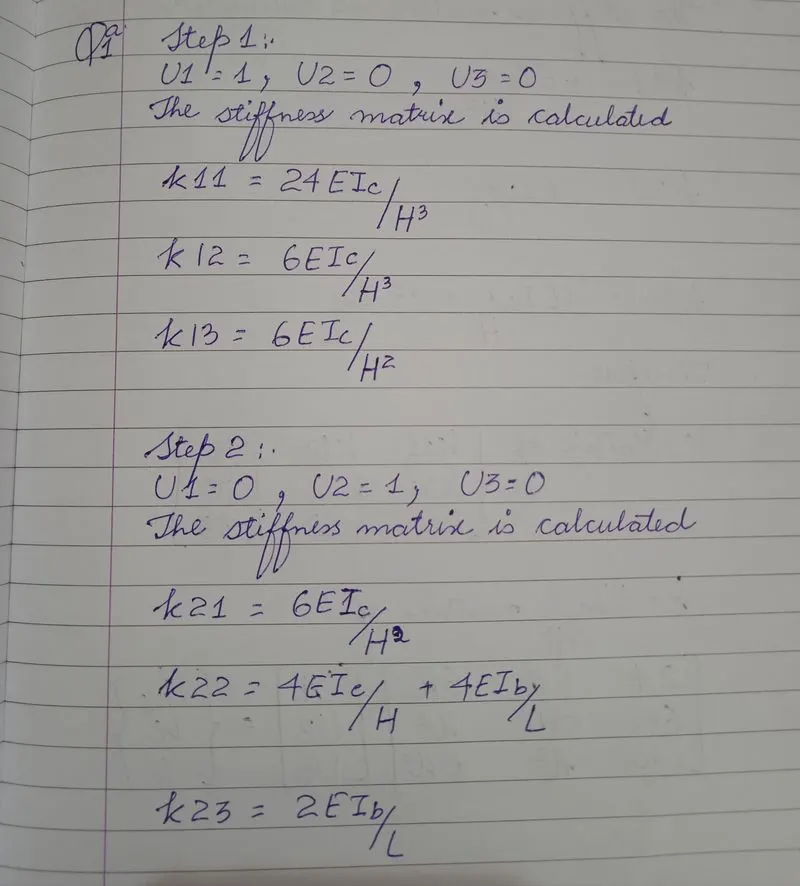
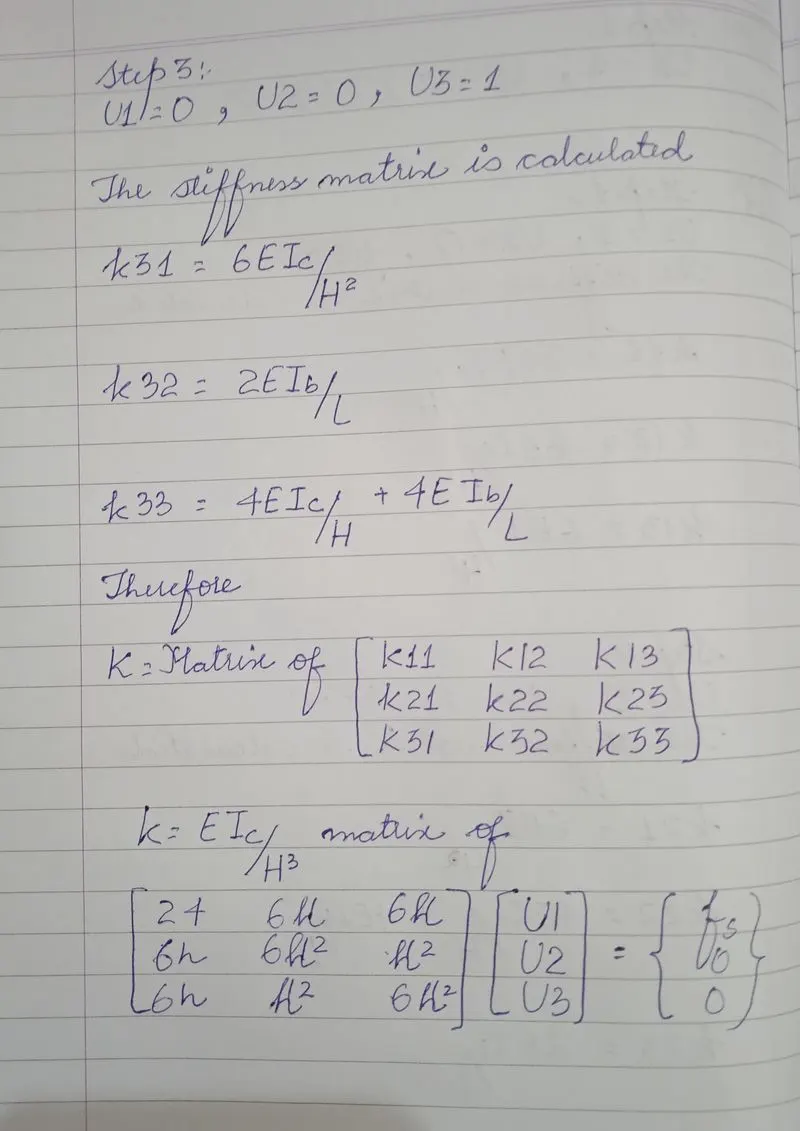
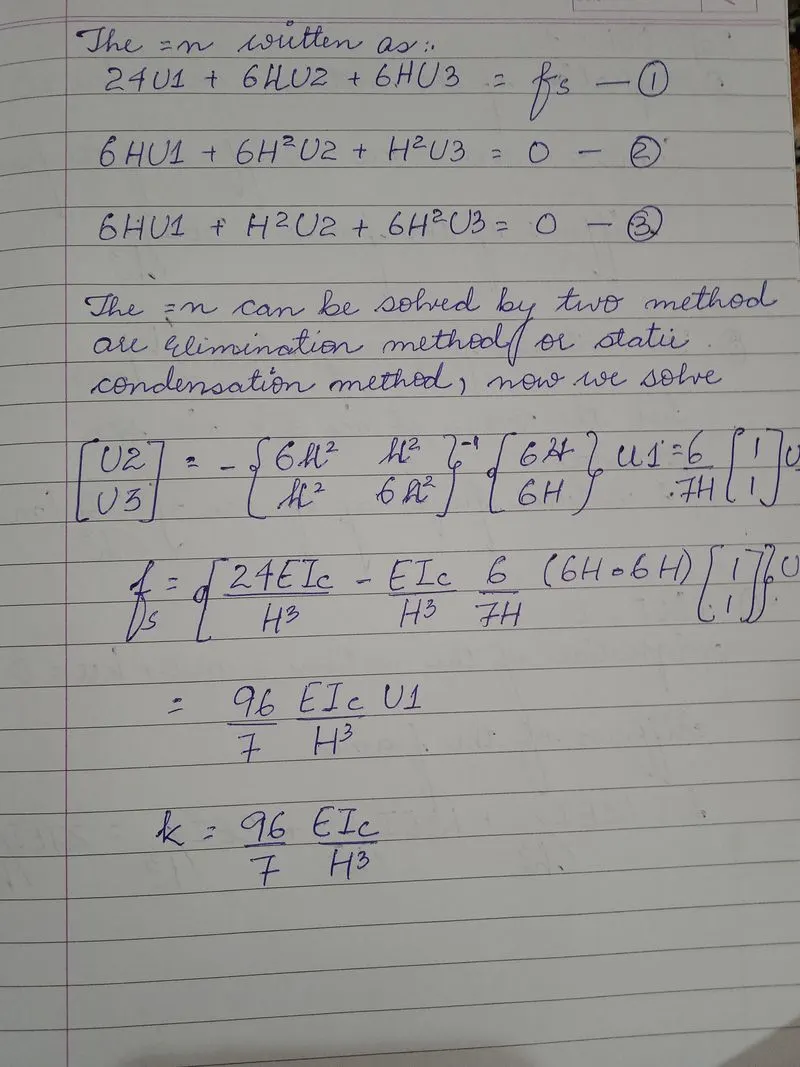
AIM:
For the following structures:
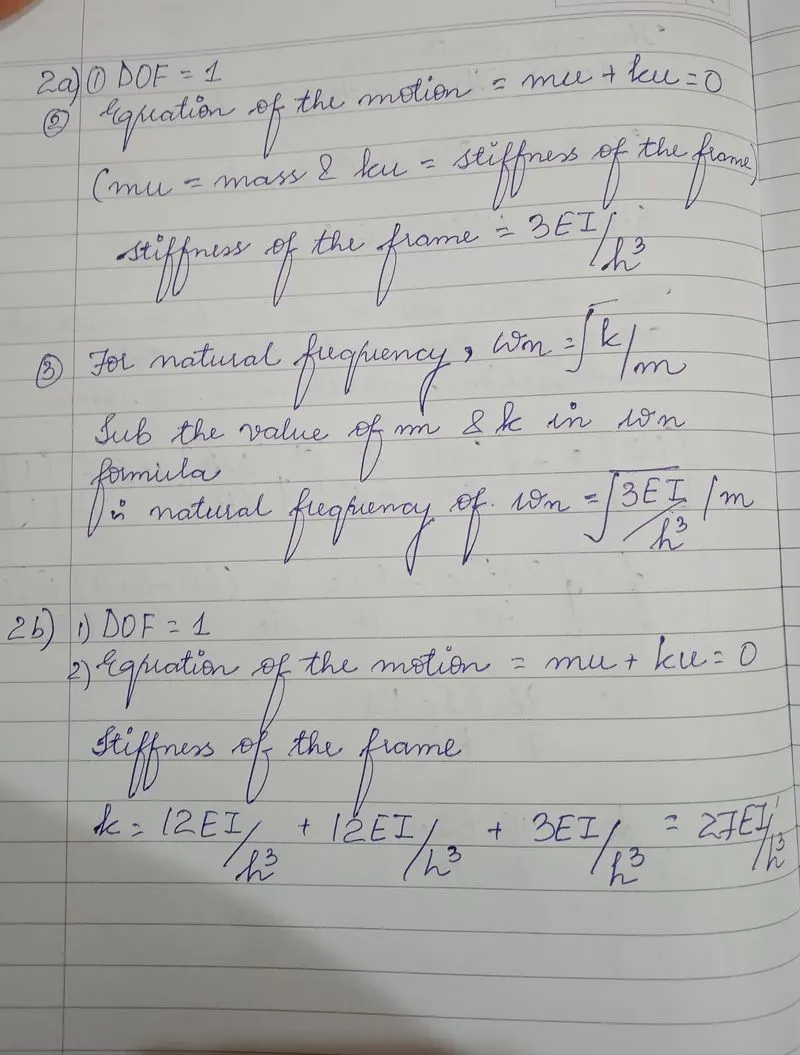
- Determine the number of degrees-of-freedom for dynamic analysis
- Establish the equation of motion
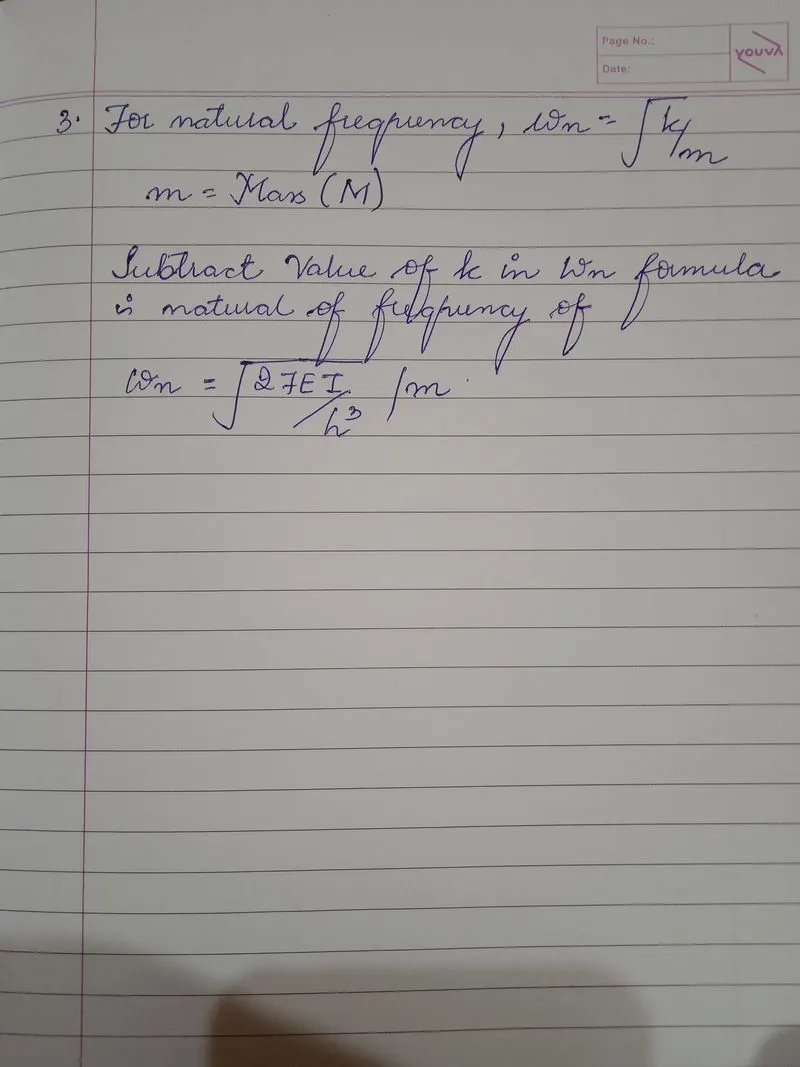
- Calculate their natural frequencies
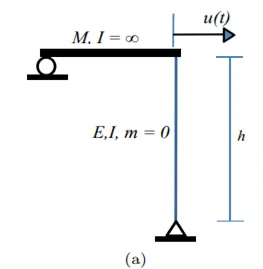
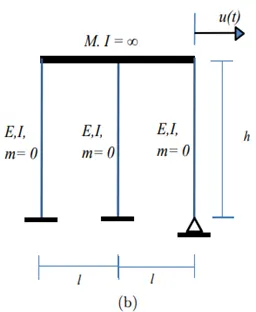
INTRODUCTION:
Structural dynamics is a type of structural analysis which covers the behavior of a structure subjected to dynamic (actions having high acceleration) loading. Dynamic loads include people, wind, waves, traffic, earthquakes, and blasts. Any structure can be subjected to dynamic loading. Dynamic analysis can be used to find dynamic displacements, time history, and modal analysis.
Structural analysis is mainly concerned with finding out the behavior of a physical structure when subjected to force. This action can be in the form of load due to the weight of things such as people, furniture, wind, snow, etc. or some other kind of excitation such as an earthquake, shaking of the ground due to a blast nearby, etc. In essence all these loads are dynamic, including the self-weight of the structure because at some point in time these loads were not there. The distinction is made between the dynamic and the static analysis on the basis of whether the applied action has enough acceleration in comparison to the structure's natural frequency. If a load is applied sufficiently slowly, the inertia forces can be ignored and the analysis can be simplified as static analysis.
PROCEDURE:
Question 3:
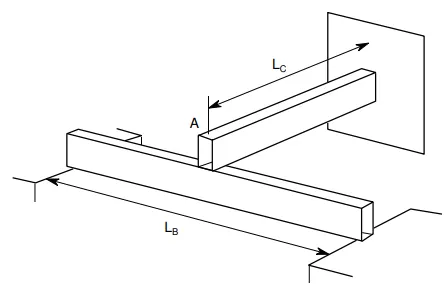
Consider the propped cantilever shown in the figure below. The beams are made from the same steel section and have lengths as shown on the diagram. Determine the natural period of this system if a large mass, M, is placed at the intersection of the beams at point A. The weight of the beams in comparison with the mass M is very small.
AIM:
To consider the propped cantilever shown in the figure below. The beams are made from the same steel section and have lengths as shown on the diagram. Determine the natural period of this system if a large mass, M, is placed at the intersection of the beams at point A. The weight of the beams in comparison with the mass M is very small.
INTRODUCTION:
The ability of a body to resist lateral deflection when a lateral force is applied. This is also called as Storey Stiffness, wherein the lateral deflection is storey drift and lateral force is storey shear.
This structure can be analyzed by any of the standard methods including moment distribution. Here we can use the defnition of stifness influence coefficients to solve the problem.
The lateral stiffness we need to add to both stiffness of beam therefore we know
The lateral stiffness of simply supported beam is K= 48EI/L^3
The lateral stiffness of cantilever supported beam is K= 3EI/L^3
Add both beam stiffness K = 48EI/L^3+3EI/L^3
= 51EI/L^3/m
Question 4
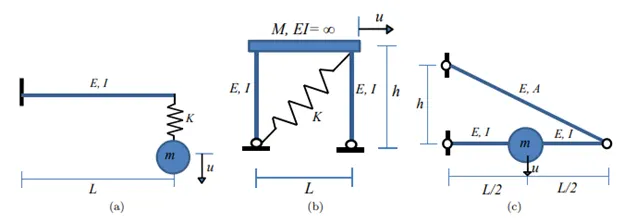
Determine an expression for the effective stiffness of the following systems:
AIM:
To determine an expression for the effective stiffness of the systems
INTRODUCTION:
We can redefine stiffness as the ability of a material to distribute a load and resist deformation. From this, we can get understand that stiffness depends on Forces and Deformations.
If we draw a curve for force and deformation, the initial slope of this curve is Stiffness. Remember, Young’s modulus is the initial slope of Stress and Strain Curve.
The effective stiffness of cantilever beam is K= 48EI/L^3
The effective stiffness of simply supported beam is K= 3EI/L^3
The effective stiffness of 2 simply supported beam is K= 3EI/L^3 + 3EI/L^3
= 6EI/L^3