Benchmarking
BENCHMARKING
Benchmarking is a process of measuring the performance of a company’s products, services, or processes against those of another business considered to be the best in the industry, “best in class.” The point of benchmarking is to identify internal opportunities for improvement. By studying companies with superior performance, breaking down what makes such superior performance possible, and then comparing those processes to how your business operates, you can implement changes that will yield significant improvements.
That might mean tweaking a product’s features to more closely match a competitor’s offering, or changing the scope of services you offer, or installing a new customer relationship management (CRM) system to enable more personalized communications with customers.
There are two basic kinds of improvement opportunities: continuous and dramatic. Continuous improvement is incremental, involving only small adjustments to reap sizable advances. Dramatic improvement can only come about through reengineering the whole internal work process.
Benchmarking has been classified into two distinct categories: technical and competitive. The House of Quality matrix and Gantt charts are often used to plot the benchmarking evaluation.
TECHNICAL BENCHMARKING
Technical benchmarking is performed by design staff to determine the capabilities of products or services, especially in comparison to the products or services of leading competitors. For example, on a scale of one to four, four being best, how do designers rank the properties of your organization’s products or services? If you cannot obtain hard data, the design efforts may be insufficient, and products or services may be inadequate to be competitive.
COMPETITIVE BENCHMARKING
Competitive benchmarking compares how well (or poorly) an organization is doing with respect to the leading competition, especially with respect to critically important attributes, functions, or values associated with the organization’s products or services. For example, on a scale of one to four, four being best, how do customers rank your organization’s products or services compared to those of the leading competition? If you cannot obtain hard data, marketing efforts may be misdirected and design efforts misguided.
BENCHMARKING PROCEDURE
Considerations
- Before an organization can achieve the full benefits of benchmarking, its own processes must be clearly understood and under control.
- Benchmarking studies require significant investments of manpower and time, so management must champion the process all the way through, including being ready and willing to make changes based on what is learned.
- Too broad a scope dooms the project to failure. A subject that is not critical to the organization’s success won’t return enough benefits to make the study worthwhile.
- Inadequate resources can also doom a benchmarking study by underestimating the effort involved or inadequate planning. The better you prepare, the more efficient your study will be.
Plan
- Define a tightly focused subject of the benchmarking study. Choose an issue critical to the organization’s success.
- Form a cross-functional team. During Step 1 and 2, management’s goals and support for the study must be firmly established.
- Study your own process. Know how the work is done and measurements of the output.
- Identify partner organizations that may have best practices.
Collect - Collect information directly from partner organizations. Collect both process descriptions and numeric data, using questionnaires, telephone interviews, and/or site visits.
Analyze - Compare the collected data, both numeric and descriptive.
- Determine gaps between your performance measurements and those of your partners.
- Determine the differences in practices that cause the gaps.
AdaptDevelop goals for your organization’s process.- Develop action plans to achieve to achive goal
Benchmarking a car according to the requriments of Mr. D.S. Pughazhyendhii.
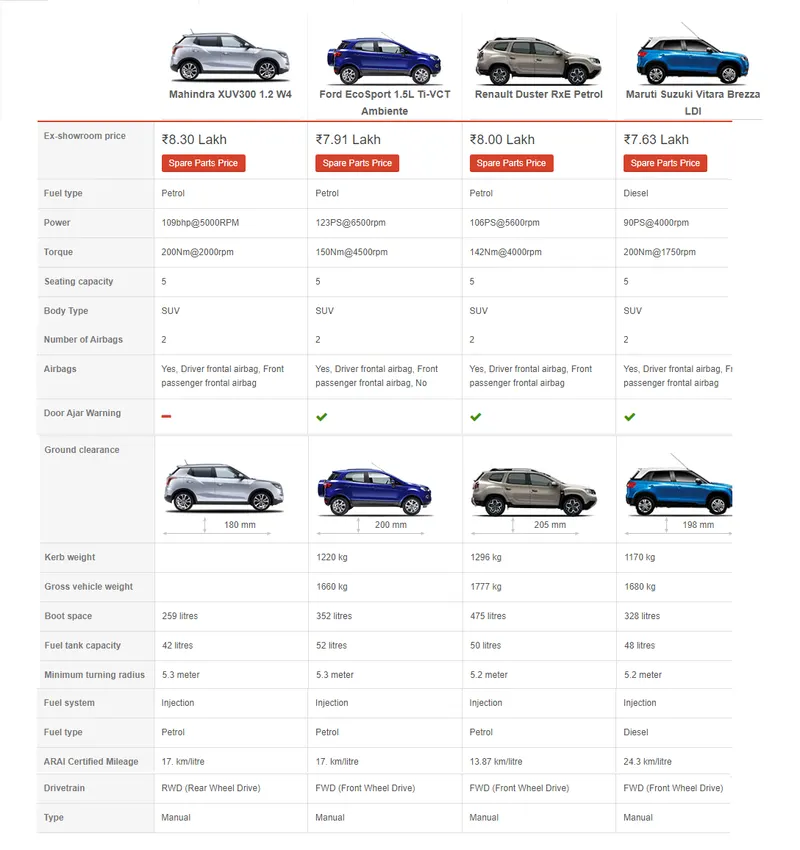
1.Mahindra XUV300

2.Renault Duster

3.Ford EcoSport

4.Maruti Suzuki Vitara Brezza

Conclusion : I suggest MARUTI SUZUKI VITARA BREEZA to Mr. D.S. Pughazhyendhii because it gives good milage, it is in his budget, a 5 seater and also it fullfil Mr. D.S. Pughazhyendhii’s taste of big cars.