Benchmarking
1. What is Benchmarking ?
Ans : Benchmarking is the process of improving performance by continuously identifying, understanding, and adapting outstanding practices and processes found inside and outside an organization. Benchmarking of business processes is usually done with top performing companies in other industry sectors. This is feasible because many business processes are essentially the same from sector to sector. Benchmarking focuses on the improvement of any given business process by exploiting "best practices" rather than merely measuring the best performance. Best practices are the cause of best performance. Companies studying best practices have the greatest opportunity for gaining a strategic, operational, and financial advantage. The systematic discipline of benchmarking is focused on identifying, studying, analysing, and adapting best practices and implementing the results. To consistently get the most value from the benchmarking process, senior management may discover the need for a significant culture change. That change, however, unleashes benchmarking’s full potential to generate large paybacks and strategic advantage. The benchmarking process involves comparing one’s firm performance on a set of measurable parameters of strategic importance against that of firms’ known to have chieved best performance on those indicators. Development of benchmarks is an iterative and ongoing process that is likely to involve sharing information with other organizations working with them towards an agreeable metrology. Benchmarking should be looked upon as a tool for improvement within a wider scope of customer focused improvement activities and should be driven by customer and internal organization needs. Benchmarking is the practice of being humble enough to admit that someone else is better at something and wise enough to learn how to match and even surpass them at it.
There are five phases for implementation of benchmarking :
A. PLANNING
During this phase the organization determines which process to benchmark and against what type of organization.
B. ANALYSIS
Following data acquisition, an analysis is performed for the performance gap between the source organization and the recipient organization. An indication of best practice is then evident.
C. INTEGRATION
It involves the preparation of the recipient for implementation of actions.
D. ACTION
This is the phase where the actions are implemented within the recipient organization.
E. MATURITY
This involves continuous monitoring of the process and enables continuous learning and provides input for continuous improvement within the recipient organization.
2. Vehicle Comparison
Ans :
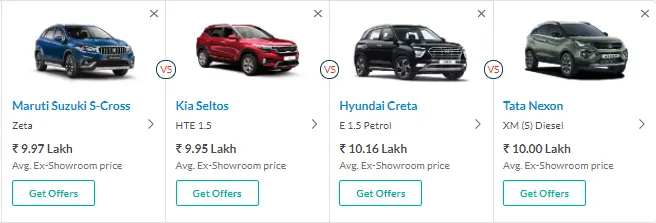
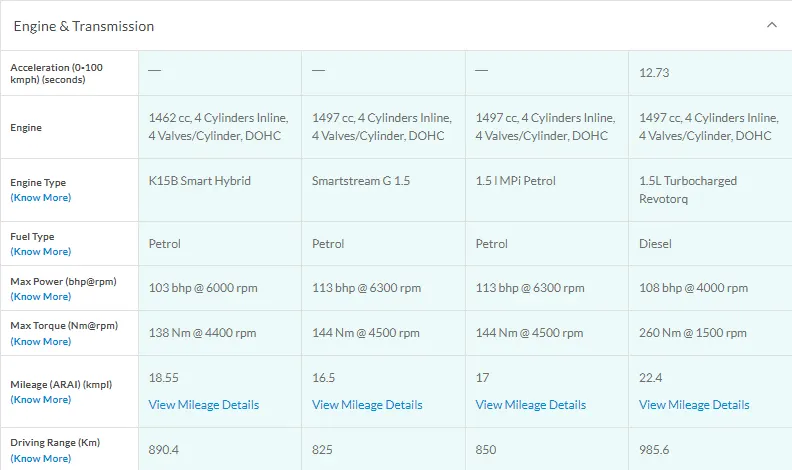
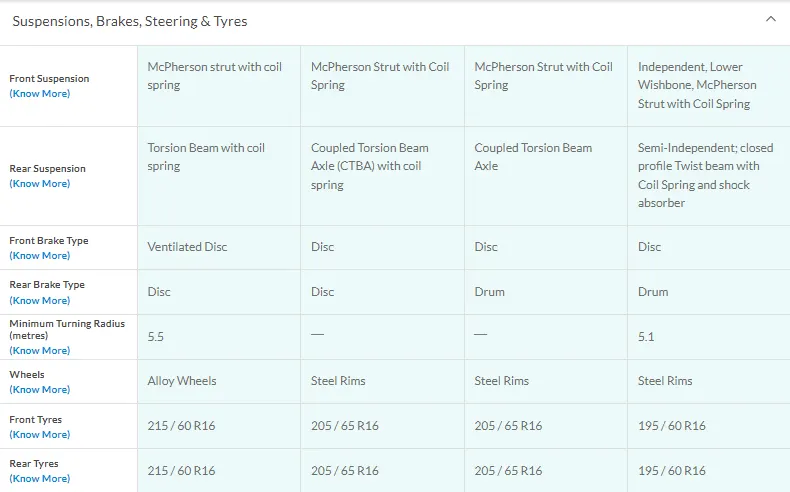
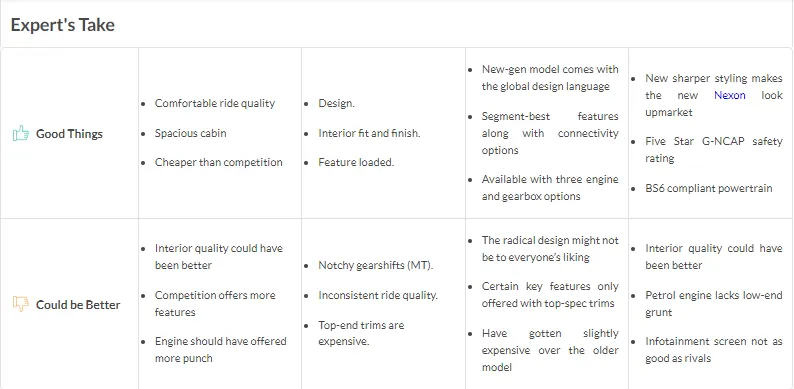
The suitable vehicle amongst the four is Tata Nexon because it is a very famous car throughout the country. It is the first INDIAN car to score 5 Stars in GLOBAL NCAP. When Nexon was launched in back 2017 it was the most refined car of Tata Motors. It is the best car to buy in that segment it has a very good pick up and control, nice Look, nice staring control, Fantastic ground clearance helps to drive in village roads with out any hesitation. Body is very strong which we can feel while opening the door itself.
Conclusion : By the above given comparison and specifications, TATA Nexon is the most suitable car which should be considered by Mr. D.S. Pughazhyendhii as the car has set its benchmark in its segment and giving a tough competition to the other cars in this segment.