Benchmarking
Benchmarking
Objective:
To provide an appropriate solution to the given problem using benchmarking.
Introduction:
In this report we solve a given problem with benchmarking in order to better understand the benchmark process in industrial environments.
Description:
Benchmarking:
- The benchmark process is used in Pre-designing and development stage.
- As the name suggests, benchmarking is about analysing and comparing various models of other companies in order to better understand the features and flaws of current products available in the market.
- This allows us to create a better product by enhancing the better features while also rectifying the flaws in order to provide better customer satisfaction than the other products.
- In industrial pre-design and development there are two stages of benchmarking. The first stage consists of general comparison of entire product in order to determine the features and specifications that can be used in the new product.
- The second stage is a detailed version of the first benchmark process. This process consists of detailed study of a single part of the entire product. A part is compared to its parent version as well as similar versions of other companies.
- The second benchmark provides a detailed visualization of every part that can be modelled as per the provided specifications.
Using the Benchmarking process, an appropriate vehicle is to be suggested based on the following points:
- D.S. Pughazhyendhii is a married man who lives in Bangalore which is a highly crowded city.
- Family comprises five members including his wife, five-year-old boy, his father, and his mother.
- He visits his native place Madurai which is 500kms away from Bangalore once in a month.
- He will be using his car to commute to his office. His budget falls between 8 to 10 lakhs on road.
- Pughazhyendhii is fond of big cars.
Based on the above points, 4 vehicles that fit the required specifications have been selected for further comparison.
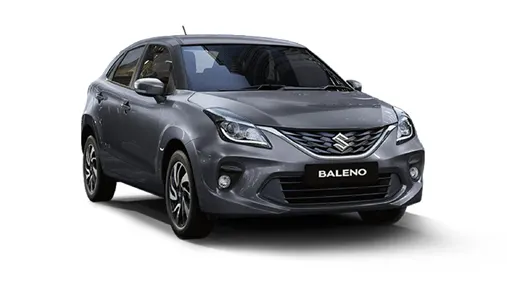
- Maruti Baleno Dual-jet Zeta:
On road price: 8,92,445Rs.
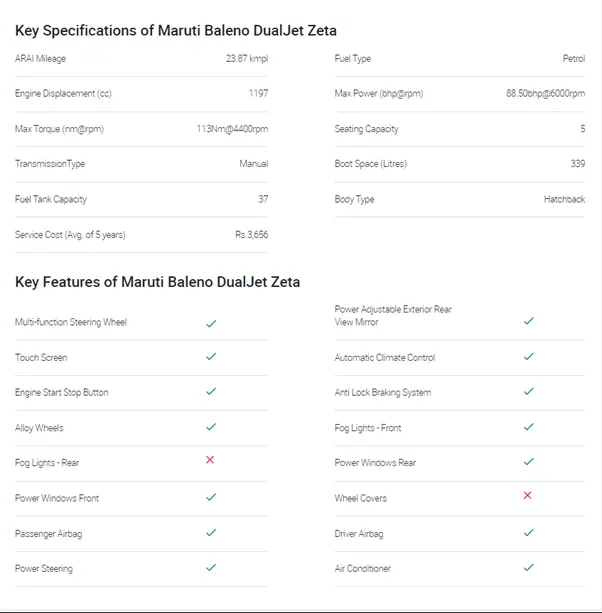
The dual-jet model consists of 1.2L Dual-Jet Dual VVT Engine. This car runs on petrol providing a milage of 15-17kmpl on road.
The complete spec sheet is provided below:
Pros:
- Better fuel efficiency from the dual-jet engine.
- More power as compared to other variants.
- Large boot space and wide bodied.
- Good pickup.
Cons:
- Lightweight because of thin metal body.
- Easily dented or scratched.
- No rear parking camera pre-installed.
- No rear a/c vents.
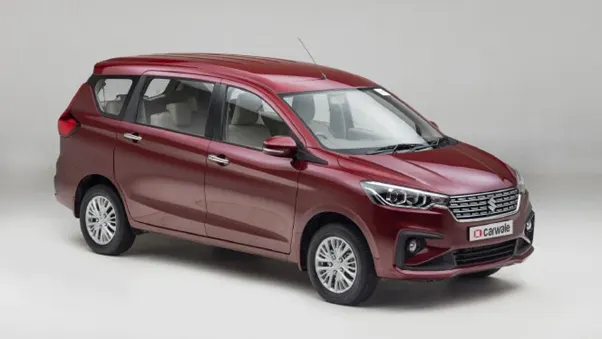
- Maruti Ertiga VXI:
On road price: 10,08,843Rs.
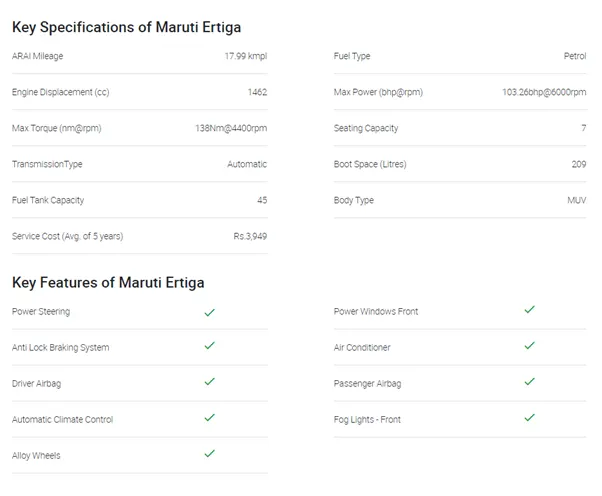
The Maruti Ertiga has a Petrol Engine. The Petrol engine is 1462cc. It is available with the Manual & Automatic transmission. The Ertiga has a mileage of 17.99 kmpl. It is a 7 seater and has length of 4395 mm, width of 1735 mm and a wheelbase of 2740 mm.
The spec sheet is given below:
Pros:
- Large Boot space and spacious.
- Easy to drive even in city.
- Good fuel efficiency for an MUV.
- Lightweight and rigid chassis.
Cons:
- Lower fuel economy as compared to a hatchback.
- Slightly congested 3rd row seating area.
- Mahindra KUV100 NXT G80:
On road price: 9,14,708Rs.
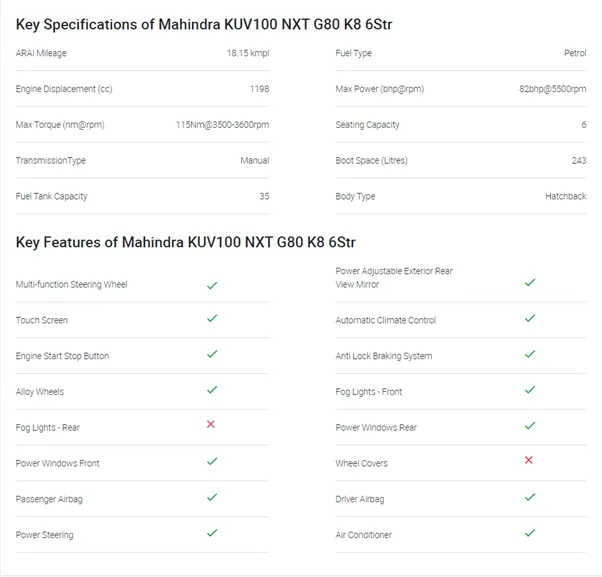
It provides an on-road milage of 14-17 kmpl. The KUV100 NXT is a 6-seater and has length of 3700mm, width of 1735mm and a wheelbase of 2385mm.
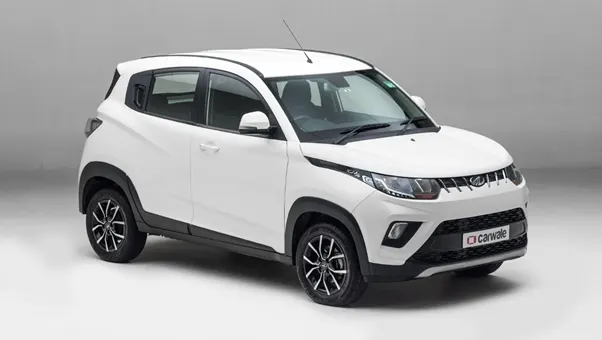
The spec sheet is given below:
Pros:
- Comfortable driving with large boot space.
- Good pickup for driving in cities.
- Has all the safety features.
Cons:
- Makes cabin noise while longer drives.
- Lower mileage in city as compared to other hatchbacks.
- Questionable customer service from the company.
- Renault Triber RXZ EASY-R AMT:
On road price: 9,18,231Rs.
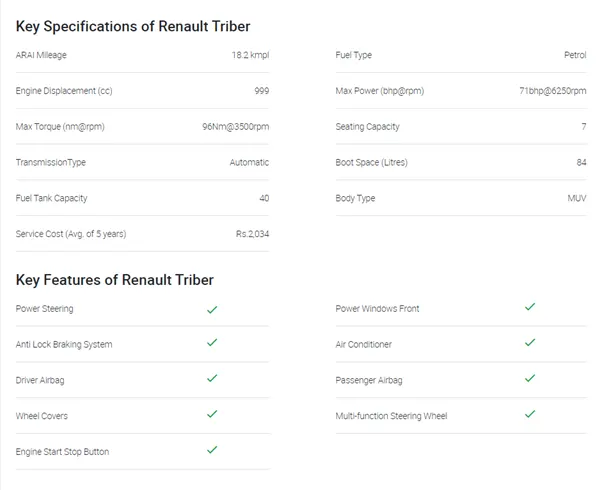
The Renault Triber is powered by a 1.0-litre three-cylinder petrol engine that generates 72bhp and 96Nm of torque.
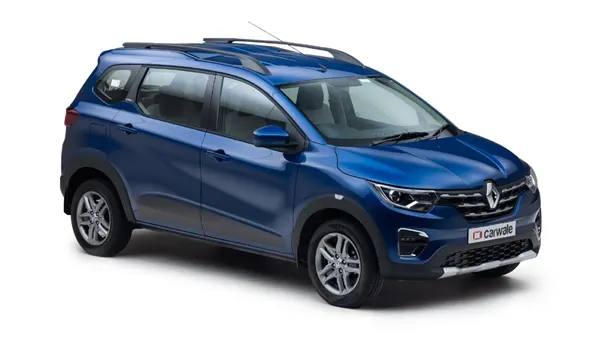
The spec sheet is given below:
Pros:
- It has an automatic transmission.
- Spacious front and rear leg rooms.
- Good performance in city.
- Provides good safety features.
Cons:
- Lower fuel efficiency for long drives.
- Not spacious enough for 7 people.
- Noisy engine at high speeds.
- Underpowered for a 7-seater.
Comparing all the models it can be said that Renault triber would be the best choice. It provides good mileage and power as a 5-seater instead of 7-seater. It has an automatic variant for comfortable long-distance travels. It is rigid enough to provide better safety at high speeds as compared to other models.
Conclusion:
After comparing all the above models and their specifications, it can be concluded that Renault triber would be the optimal choice for the given requirements.