Benchmarking
Selection of car:
- The car should be 5 seaters -- family
- Desiel -- travel once a month
- Budget -- b/w 8 - 10 lakhs
- Big cars
Based on these criteria we will be comparing 4 vehicles.
- Maruti Suzuki Vitara Brezza vDI
-
1.5L TDCi Trens Plus - Tata Nexon
- Hyundai Creta
Benchmarking
Benchmarking is a process of measuring and comparing a company's performance metrics against those of other companies in the same industry or sector. The goal of benchmarking is to identify areas where a company can improve its performance, reduce costs, increase revenue, and achieve a competitive advantage.
Types of Benchmarking:
-
Internal Benchmarking: It involves comparing the performance of different departments or business units within the same organization.
-
Competitive Benchmarking: It involves comparing the performance of a company against its direct competitors in the same industry.
-
Functional Benchmarking: It involves comparing the performance of a particular function or process in a company against the performance of the same function or process in other companies.
-
Generic Benchmarking: It involves comparing the performance of a company against the performance of companies in different industries but with similar processes or functions.
Process of Benchmarking:
-
Identify what to benchmark: The first step in benchmarking is to identify the process or function that needs improvement.
-
Select Benchmarking Partners: The next step is to select the companies that will be used as benchmarks. This can be done through industry associations, publications, or online research.
-
Collect Data: Once the benchmarking partners have been identified, the next step is to collect data on their performance metrics.
-
Analyze Data: The data collected from the benchmarking partners is then analyzed to identify areas where the company can improve its performance.
-
Implement Changes: Based on the analysis, the company can implement changes to improve its performance and achieve a competitive advantage.
Benefits of Benchmarking:
-
Identify Best Practices: Benchmarking helps a company identify best practices and adopt them in its own processes.
-
Improved Performance: Benchmarking helps a company improve its performance by identifying areas where it can reduce costs, increase revenue, and achieve a competitive advantage.
-
Competitive Advantage: Benchmarking helps a company achieve a competitive advantage by improving its performance and adopting best practices.
-
Collaboration: Benchmarking encourages collaboration between companies and promotes the exchange of ideas and best practices.
Conclusion:
Benchmarking is a powerful tool that can help companies identify areas where they can improve their performance and achieve a competitive advantage. By analyzing the performance metrics of other companies in the same industry or sector, companies can adopt best practices and improve their own processes to stay ahead of the competition.
Comparison
1.
Conclude:
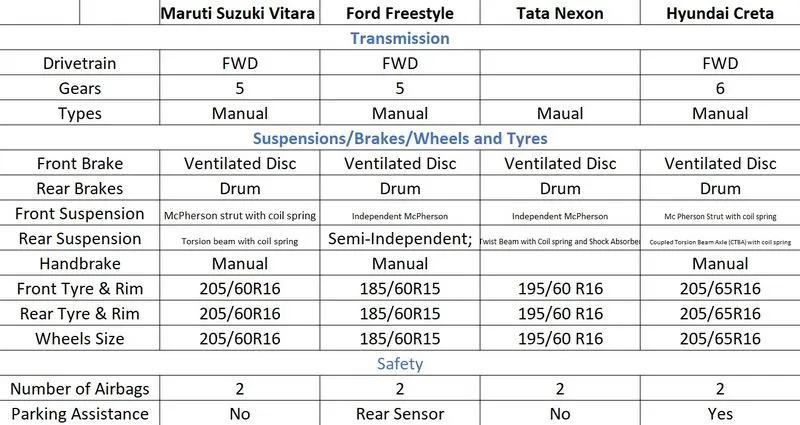
In this section, we clearly see that Hyundai Creta clearly won the battle due to its 6 gears and front and back suspension system.
Conclude:
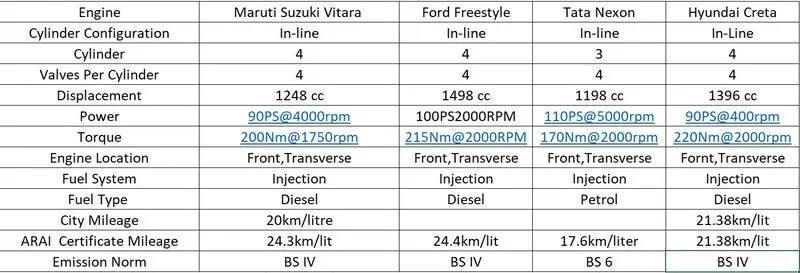
In this comparison, Ford freestyle wins the battle because of good mileage, power, and torque.

Conclude:
In this, all won the battle.




Conclusion:
- After comparing everything we have got 2 best among the 4 which are Hyundai Creta and Ford Freestyle.
- Now, based on availability and service one should be chosen among them.
- So, Hyundai Creata clearly won the battle in availability and service in Bengaluru.