Project 1 - Parsing NASA thermodynamic data
AIM - To write the code on Parsing NASA thermodynamic data file and then calculate the thermodynamic properties of various gas species.
OBJECTIVE
- Write a function that extracts the 14 coefficients and calculates the enthalpy, entropy, and specific heats for all the species in the data file.
- The formulas are

where,
R is the universal gas constant.
T is the temperature.
-
Calculate the molecular weight of each species and display it in the command window.
-
Plot the Cp, Enthalpy, and Entropy for the local temperature range (low temperature: high temperature) specific for each species.
-
Save the plots as images with appropriate names and dump them in separate folders for each species with a suitable name. All these should be generated automatically.
-
The main program that you will submit will just take the "THERMO.dat" file as an input and generate Cp, H, and S plots.
-
Please write a detailed report to describe your logic.
FILE PARSING
It refers to how information can be read from a particular text file and the information used in computer programs.
STEPS OF FILE PARSING
- Define the function
- Create an input parser object
- Add inputs to the scheme
- Set properties to adjust parsing
- parse the input
- Use the input in the function
- Calling function
NASA THERMODYNAMIC FILE
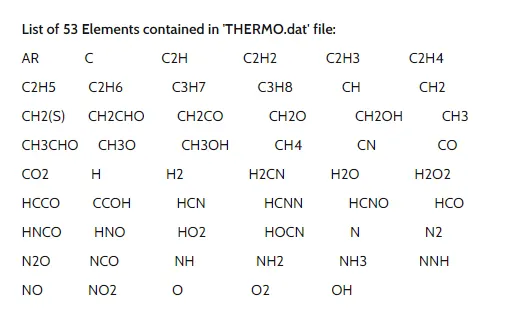
It is a data file that contains 14 coefficients for 53 different elements given by NASA. These are utilized to calculate the specific heat, enthalpy & entropy for a particular element. Each element has it own range of local temperature.
Thermodynamic data file :
ENTHALPY, ENTROPY & SPECIFIC HEAT
- Enthalpy is defined as follows H = E + PV. Enthalpy is the sum of the internal energy. and pressure times volume. We cannot measure the enthalpy of a system, but we can look at changes in enthalpy.
- The measure of a system's thermal energy per unit temperature that is unavailable for doing useful work. Because work is obtained from ordered molecular motion, the amount of entropy is also a measure of the molecular disorder, or randomness, of a system.
- Specific heat is defined by the amount of heat needed to raise the temperature of 1 gram of a substance 1 degree Celsius (°C). Water has a high specific heat, meaning it takes more energy to increase the temperature of water compared to other substances.
CODING
ENTHALPY
% Enthaphy Calculation Function

function H = Enthalpy(a1,a2,a3,a4,a5,a6,a8,a9,a10,a11,a12,a13,Temp,R,local_medium_temp)
% Comparing with local Temperature
% %If less than local temperature - minimum coffient are take
for i = 1:length(Temp)
if Temp(i) <= local_medium_temp
H(i) = R*Temp(i).*((a8 + (a9*Temp(i)/2)) + (a10*(Temp(i)^2)/3) + (a11*(Temp(i)^3)/4) + (a12*(Temp(i)^4)/5) +  (a13./Temp(i)));

% Else maximum coefficient are taken
else
H(i)= R*Temp(i).*((a1 + (a2*(Temp(i)/2)) + (a3*(Temp(i)^2)/3) + (a4*(Temp(i)^3)/4) + (a5*(Temp(i)^4)/5) + (a6./Temp(i))));
end
end
ENTROPY
%Entropy Calculation Function
function s = Entropy_calc(a1,a2,a3,a4,a5,a7,a8,a9,a10,a11,a12,a14,Temp,R,local_medium_temp)

%comparing with local tempreature
%If less than local temperature - minimum coffient are taken
for i = 1:length(Temp)
if Temp(i) >= local_medium_temp
    s(i) = R.*((a1.*log(Temp(i)))+(a2.*Temp(i))+(a3*((Temp(i).^2)/2))+(a4*((Temp(i).^3)/3))+(a5*((Temp(i).^4)/4)+a7));
%s(i) = R.*(a8.*log(Temp(i)))+(a9.*Temp(i))+(a10*(Temp(i).^2)/2)+(a11*(Temp(i).^3)/3)+(a12*((Temp(i).^4)/4)+a14);
else
    %Else - maximum coffient are taken
    s(i) = R.*((a8.*log(Temp(i)))+(a9.*Temp(i))+(a10*(Temp(i).^2)/2)+(a11*(Temp(i).^3)/3)+(a12*((Temp(i).^4)/4)+a14));
    %s(i) = R.*(a1.*log(Temp(i)))+(a2.*Temp(i))+(a3*((Temp(i).^2)/2))+(a4*((Temp(i).^3)/3))+(a5*((Temp(i).^4)/4)+a7);

end
end
SPECIFIC HEAT
function cp = Specific_heat(a1,a2,a3,a4,a5,a8,a9,a10,a11,a12,Temp,R,local_medium_temp)
%comparing with global tempeature
%If less than global temperature - minimum coffient are taken
for i = 1:length(Temp)
if Temp(i)<= local_medium_temp
cp(i) = R*(a8+(a9*Temp(i))+(a10*(Temp(i)).^2)+(a11*(Temp(i)).^3)+(a12*(Temp(i)).^4));
else
    cp(i) = R*(a1+(a2*Temp(i))+(a3*(Temp(i)).^2)+(a4*(Temp(i)).^3)+(a5*(Temp(i)).^4));
    %else maximam coffient are taken
end
end
MOLECULAR WEIGHT
% Molecular weight calculating function

function Molecularweight = Molecular_weight(Species_SP)
%standard - Atomic Name
atomic_name = ['H','C','O','N','A'];
% Hydrogen,Carbon,Oxygen,Nitrogen,Argon

fprintf('Molecular Weight of')
fprintf(Species_SP);
fprintf(':');
%standerd atomic weight
Atomic_Weight = [1.008 12.011 15.999 14.007 39.948];
% starting range of molecule
Molecularweight = 0;
% Adding Atomic number to obtain particular value
for i = 1:length(Species_SP)

    for j = 1:length(atomic_name)
        if strcmpi(Species_SP(i),atomic_name(j))
            Molecularweight = Molecularweight + Atomic_Weight(j);
            positon=j
        end

    end
    n=str2double(Species_SP(i))
    if n>1
     Molecularweight = Molecularweight + Atomic_Weight(positon)*(n-1)
    fprintf('molecular_weight :',Species_SP);
    fprintf('%d',Molecularweight);
    disp('');

end
end
MAIN CODE
clear all
close all
clc

%Reading data file - Nasa Thermodynamic
%Open a file & 'r' Open thefile for reading
f1=fopen('THERMO.dat','r');
gt = fgetl(f1);

%Obtaining temperatures - by reading headers information
local_temp=fgetl(f1);

%spliting
t=strsplit(local_temp);


%Universal gas Constant J/(mol-K)
R = 8.314;

%skipping three comment Liners in the file
for i = 1:3;
    gt=fgetl(f1);
end

for i = 1:53;
    gt=fgetl(f1);
    A=strsplit(gt,' ');
    Species_SP=(A{1});
    len=length(A);
    local_low_temp=str2num(A{len-3});
    local_high_temp=str2num(A{len-2});
    local_medium_temp=str2num(A{len-1});
    Temp = linspace(local_low_temp,local_high_temp,1000);
    line_1=fgetl(f1);
    a=strfind(line_1,'E');

    %Extrating higher and lower temperature coefficient
    %%Extracting 1st 7 coefficients i.e High-temperature Coefficient

   a1=line_1(1:a(1)+3);
   a1=str2num(a1);
   a2=line_1(a(1)+4:a(2)+ 3);
   a2=str2num(a2);
   a3=line_1(a(2)+4:a(3)+ 3);
   a3=str2num(a3);
   a4=line_1(a(3)+4:a(4)+ 3);
   a4=str2num(a4);
   a5=line_1(a(4)+4:a(5)+ 3);
   a5=str2num(a5);

   line_2=fgetl(f1);
   b=strfind(line_1,'E');
   a6=line_2(1:b(1)+3);
   a6=str2num(a6);
   a7=line_2(a(1)+4:b(2)+3);
   a7=str2num(a7);

   %Extracting  Second 7 coefficient - Low-Temperature coefficient

   a8=line_2(b(2)+4:b(3)+3);
   a8=str2num(a8);
   a9=line_2(b(3)+4:b(4)+3);
   a9=str2num(a9);
   a10=line_2(b(4)+4:b(5)+3);
   a10=str2num(a10);


   line_3=fgetl(f1);
   c=strfind(line_1,'E');

   a11=line_3(1:c(1)+3);
   a11=str2num(a11);
   a12=line_3(c(1)+4:c(2)+3);
   a12=str2num(a12);
   a13=line_3(c(2)+4:c(3)+3);
   a13=str2num(a13);
   a14=line_3(c(3)+4:c(4)+3);
   a14=str2num(a14);

   %Specific heat Calculation
   cp = Specific_heat(a1,a2,a3,a4,a5,a8,a9,a10,a11,a12,Temp,R,local_medium_temp)

   %enthalpy calculation
    H = Enthalpy(a1,a2,a3,a4,a5,a6,a8,a9,a10,a11,a12,a13,Temp,R,local_medium_temp)

   %entropy
   s = Entropy_calc(a1,a2,a3,a4,a5,a7,a8,a9,a10,a11,a12,a14,Temp,R,local_medium_temp)

    %calculation molecular weight of species
     Molecularweight = Molecular_weight(Species_SP);

     %read and write

     Molecular_list = fopen('Molecular_weight.txt','w');
     fprintf(Molecular_list,'Molecular weight of %s is %d ',Species_SP,Molecularweight);
     fclose(Molecular_list);

     %plotting(CP,H,S,Temp,Species_SP)
     %Saving as a folder

     mkdir(['C:\Users\Hp\Desktop\fileparsing\plots\',Species_SP]);
     cd(['C:\Users\Hp\Desktop\fileparsing\plots\',Species_SP]);


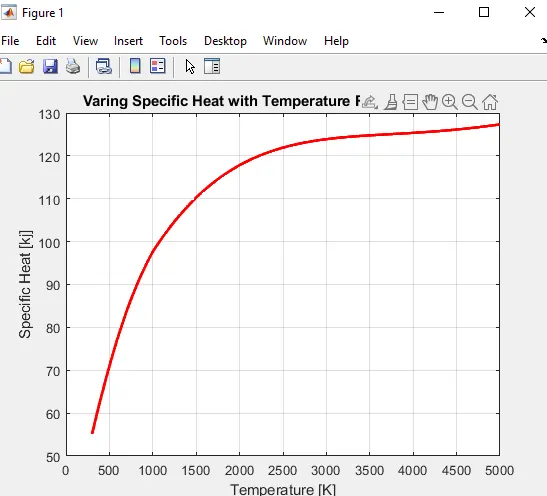
     %Plot 1,Specific heat (CP) vs Temperature Range (Temp)
     figure(1)
     plot(Temp,cp,'linewidth',2,'color','r');
     xlabel('Temperature [K]');
     ylabel('Specific Heat [kj]');
     title(sprintf('Varing Specific Heat with Temperature Range of %s',Species_SP));
     grid on
     saveas(figure(1),'Specific Heat.jpg');

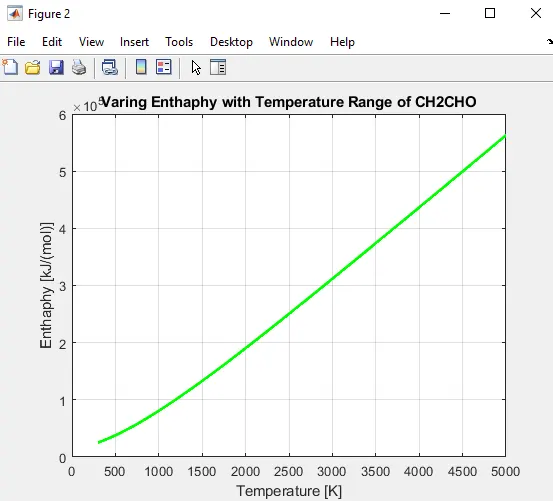
     %Plot 2, Enthaphy (H) vs Temperature Range (Temp)

     figure(2)
     plot(Temp,H,'LineWidth',2,'Color','g');
     xlabel('Temperature [K]');
     ylabel('Enthaphy [kJ/(mol)]');
     title(sprintf('Varing Enthaphy with Temperature Range of %s',Species_SP));
     grid on
     saveas(figure(2),'Enthaphy.jpg');

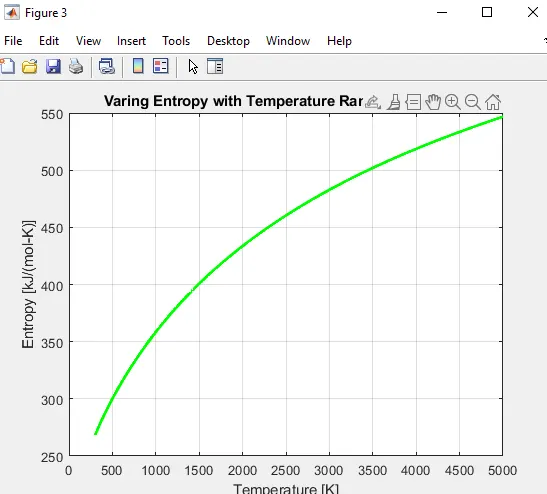
     %Plot 3, Entropy (s) vs Temperature Range (Temp)

     figure(3)
     plot(Temp,s,'LineWidth',2,'Color','g');
     xlabel('Temperature [K]');
     ylabel('Entropy [kJ/(mol-K)]');
     title(sprintf('Varing Entropy with Temperature Range of %s',Species_SP));
     grid on
     saveas(figure(3),'Entropy.jpg');


     M = Molecular_weight(Species_SP)
     f2 = fopen('molecular mass','w')
     fprintf('%s n %s n','species','Molecular mass','M')
     fclose(f2)


end
CODE EXPLANATION:
- clear all = clear all the variables on the workspace
- close all = close all the plots and fig
- clc = clear the command window
- making a directory using 'mkdir' with the location address
- Reading text file 'Thermo.dat' file and open it with 'fopen' and read it with 'r' command.
- for reading a line in a text file using 'fgetl'
- To obtain the temperature range from thermo.dat file using 'strsplit' to split the local temp into a particular string cell.
- Using 'str2num' to convert a string into numbers.
- Divide the temp into a string and convert it to a number so that temp can be used separately to solve the NASA thermodynamic data.
- Using 'for' & 'end' loops to skip the next three comments line in the text file.
- Reading all the 53 species to plot specific heat (Cp), enthalpy(H) and entropy (s), with temp values,and to find the molecular weight.
- Use for loop to read all 53 species.
- Use 'strfind' to find the string.
- Using 'linspace' specified the temp range from low to high.
- Extracting higher and lower temp coefficients by reading line by line from the species.
- Calling specific heat,enthaphy and entropy function codes.
- Calculating Molecular weight.
SYNTEX USED DURING CODE:
- fopen :
- r :
- fgetl :
- strsplit :
- str2num:
- strfind :
- linspace :
- fprintf :
- pwd :
- mkdir :
- cd :
ATTACHMENTS:
Screenshot of the window where all the folders are saved :
 \
\
RESULTS:
PLOTS:
1. SPECIFIC HEAT VS TEMPERATURE:
2.ENTHAPHY VS TEMPEATURE:
3.ENTROPY VS TEMPERATURE:
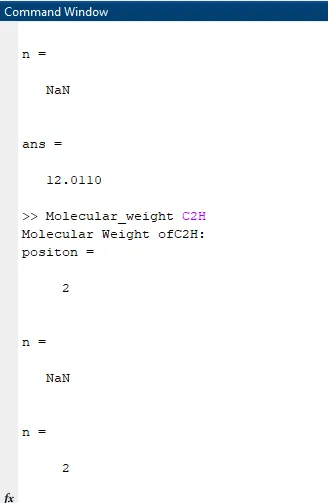
SCREENSHOTS OF THE COMMAND WINDOW WHICH CONTAINS THE MOLECULAR WEIGHT OF ALL SPECIES:
SOME EXAMPLES OF COMMAND WINDOWS (CROPPED):
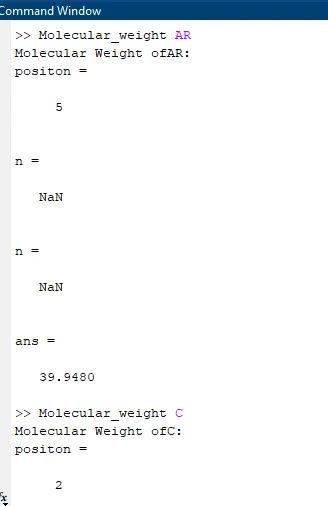 :
: 
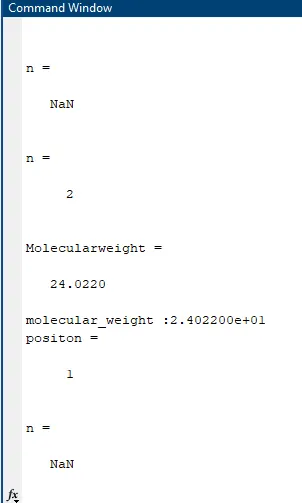
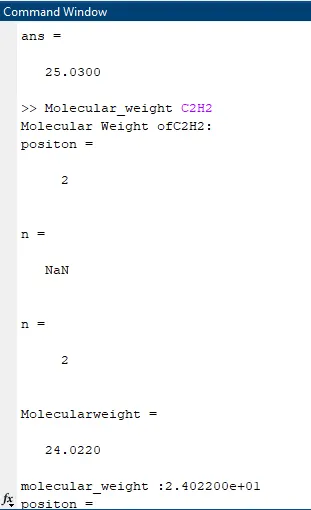
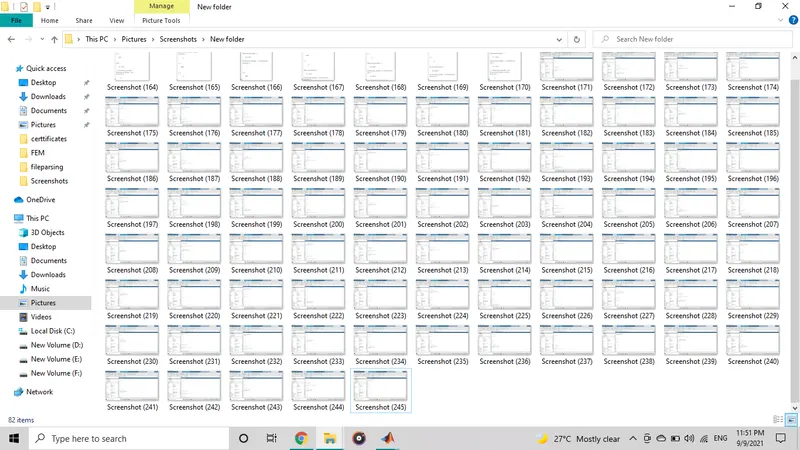
SCREENSHOT OF THE FOLDER CONTAINING ALL THE COMMAND WINDOW'S SCREENSHOT:
ERROR:
- In writing the formulae, more brackets were used due to which output was not accurate.
- Making in a directory file.
- Instead of using local temp, I used global temp.