BENCHMARKING
Product Benchmarking, also referred to as “best practice benchmarking” is an evaluation process of a manufacturer that is measured against the process of its competitors or peers within a given industry. The goal is to create and implement improvement plans and best practices to increase performance in the production lifecycle, and/or other manufacturing and business processes and practices. By discovering the best achievable performance, process gaps can be eliminated.
While product benchmarking in the automotive industry traditionally involves other manufacturers, its primary purpose is to positively impact internal processes. Consequently, benchmarking can be based on internal measurement where cooperative manufacturing process benchmarks of other manufactures is a secondary measure. This goes to the heart to understanding the purpose and use of benchmarking. Often benchmarking is focused on the manufacturing process itself to:
- Improve quality
- Decrease manufacturing times
- Reduce Scrap and rework
- Increase production
BECHMARKING PROCESS
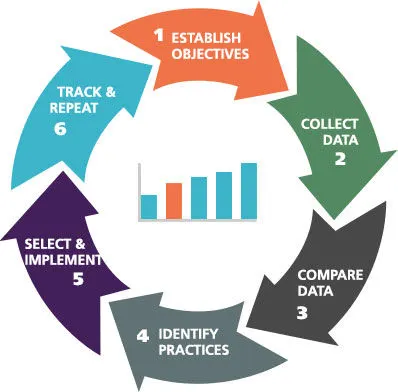
1. Establish Objectives. This key first step is to clarify what you wish to accomplish. What topics are of interest and what metrics can be evaluated? You also want to identify the type and extent of benchmarking you should do based upon your objectives.
2. Collect & Normalize Your Data. Each participant assembles the data that they wish to benchmark (some basic items are required and other sections are optional). Typically, there is a need to “normalize” some of it to be consistent with the agreed data definitions. The data can be assembled in an Excel template or entered in a series of online screens, organized by topic. There is a close relationship between facility benchmarking and facility metrics, measures, and KPIs.
3. Compare with a Target/Peer Group. Facility Issues analyzes the survey data submitted and publishes comparison reports with the results. We distribute these reports to members online and present summary results at best practice/association meetings. Each participant can see where they stand on all areas for which they submitted data.
4. Identify Apparent “Best Practices.” The real value in the benchmarking process is understanding how other organizations are doing similar jobs for less cost, or better performance, or both. Facility Issues’ metrics to identify the organizations / sites with the best apparent performance, and then discussion is required to confirm it is not the result of “under-performance.” The Best Practices meetings provide a forum for discussion about the practices used and lessons learned in implementing them.
5. Select Changes To Implement. Based on what you have learned about practices that have benefited others, you can select those that meet your objectives, provide significant improvement opportunity, and fit your organization culture for implementation at your own organization.
6. Tracking the Benchmark Progress. After implementing changes in your operations, it will be important to monitor costs and occupant satisfaction. This will tell you whether these changes are successful or require adjustment. The easiest way to measure progress is to re-benchmark; each cycle lets you build on the prior one and it may take a couple years to measure the benefits of some changes in practice.
BENCHMARKING CARS
|
|
|
|
|
|
|
|
 |
 |
 |
 |
|
|
|
|
|
|
|
|
|
|
|
|
|
|
 |
 |
 |
 |
|
|
|
|
|
|
|
|
|
|
|
|
|
|
1197 |
998 |
1199 |
1198 |
|
|
|
|
|
|
|
|
5 |
5 |
5 |
6 |
|
|
|
|
|
|
|
|
|
|
|
|
|
|
| 3655 mm L X 1620 mm W X 1675 mm H |
|
| 3995 mm L X 1680 mm W X 1520 mm H |
|
| 3827 mm L X 1742 mm W X 1615 mm H |
|
| 3700 mm L X 1735 mm W X 1655 mm H |
|
|
|
|
|
|
|
|
|
| Anti-Lock Braking System |
| Central Locking |
| Power Door Locks |
| Child Safety Locks |
| Anti-Theft Alarm |
| 2 Airbags |
| Driver Airbag |
| Passenger Airbag |
| Day & Night Rear View Mirror |
| Passenger Side Rear View Mirror |
| Rear Seat Belts |
| Seat Belt Warning |
| Door Ajar Warning |
| Adjustable Seats |
| Crash Sensor |
| Engine Check Warning |
| EBD |
| Speed Alert |
| Speed Sensing Auto Door Lock |
| Pretensioners & Force Limiter Seatbelts |
| Hill Assist |
|
| Anti-Lock Braking System |
| Central Locking |
| Power Door Locks |
| Child Safety Locks |
| 2 Airbags |
| Driver Airbag |
| Passenger Airbag |
| Day & Night Rear View Mirror |
| Passenger Side Rear View Mirror |
| Seat Belt Warning |
| Door Ajar Warning |
| Adjustable Seats |
| Engine Immobilizer |
| Crash Sensor |
| Engine Check Warning |
| EBD |
| Advance Safety Features |
| Rear Camera |
| Speed Alert |
| Speed Sensing Auto Door Lock |
| ISOFIX Child Seat Mounts |
| Pretensioners & Force Limiter Seatbelts |
| Impact Sensing Auto Door Unlock |
|
| Anti-Lock Braking System |
| Central Locking |
| Power Door Locks |
| Child Safety Locks |
| 2 Airbags |
| Driver Airbag |
| Passenger Airbag |
| Day & Night Rear View Mirror |
| Passenger Side Rear View Mirror |
| Rear Seat Belts |
| Traction Control |
| Adjustable Seats |
| Crash Sensor |
| Engine Check Warning |
| Automatic Headlamps |
| EBD |
| Advance Safety Features |
| Follow Me Home Headlamps |
| Rear Camera |
| ISOFIX Child Seat Mounts |
|
| Anti-Lock Braking System |
| Central Locking |
| Power Door Locks |
| Child Safety Locks |
| Anti-Theft Alarm |
| 2 Airbags |
| Driver Airbag |
| Passenger Airbag |
| Day & Night Rear View Mirror |
| Passenger Side Rear View Mirror |
| Rear Seat Belts |
| Seat Belt Warning |
| Door Ajar Warning |
| Adjustable Seats |
| Engine Immobilizer |
| Crash Sensor |
| Engine Check Warning |
| EBD |
| Advance Safety Features |
| Follow Me Home Headlamps |
| Speed Sensing Auto Door Lock |
| ISOFIX Child Seat Mounts |
|
CONCLUSION
As per my analysis i would to like to suggest tata punch car on Mr. D.S. Pughazhyendhii family because of it is 5 star safety ratting and also city millege is also good mulitple colours colours are avilable
cost wise its yours butget .