Benchmarking
Benchmarking:
Benchmarking involves a structured comparison between similar products, services or processes on some dimensions of performance. For example it can be used to compare the availability and delivery of features in a product and in this form often provides the basis of consumer tests and reviews.
In other words we can say that, "Benchmarking is a process of comparing your own product, services, processes, and operations to other competitors presented in the market or to the best industry in your market.
Fig. : Benchmarking
Understanding Benchmarking:
By using the process of benchmarking, we can improve our process to build the final product or to deliver the service which can leads to a reduce in the production cost, and increase the amount of profit or in other words we can increase the effectiveness of our company. So, when we improve our process to manufacture the product then the customer satisfaction will increase in a greater amount.
As we studied already benchmarking is not an immediate solution to a problem.
So, to perform the process of benchmarking we go through many benchmark stages like costs, key performance indicators, processes and strategy.In order to make your product and company more efficient, we go through every stage.
1. Cost - Includes the utility bills(electricity charges, transportations charges), wages, R&D(Research and development) costs, etc.
2. Key Performance Indicators - Includes indicators like sales per employee, profit per product, etc.
3. Processes - Includes stock management, quality control, and customer service, etc.
4. Strategy - Must learn the strategy from other organsations which are performing better than you.
Some steps to perform benchmarking:
1. Select the process of benchmark,
2. Determine who you want to benchmark against,
3. Document your current process,
4. Collect and analyse data,
5. Create a plan,
6. Implement changes.
Types Of Benchmarking:-
1. Internal - It is defined as the comparision performed within the organisation and it can be between their departments or it can be between any groups or teams made in a company.
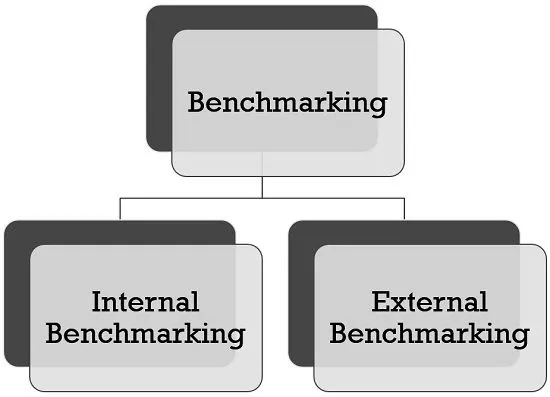
Fig. - Types Of Benchmarking
2. External - It is defined as the comparision performed between two organisations or company to be the best in their market.
Advantages Of Benchmarking -
1. It improves the efficiency of the company with a higher amount.
2. It helps the company to design and analyse the strategy.
3. Benchmarking maintains a contionuous improvement in the company.
4. With the help of benchmarking we can monitor our performance w.r.t. the company performing better than us.(our competitor)