Section Modulus calculation and optimization
AIM - Brief explanation about Section Modulus. Calculate the section modulus of the sketch of your designed hood and also after offsetting the curve by 2mm.
Important commands used – Section Inertia (Menu>Analysis>Section Inertia)
Theory – Section Modulus tells about the strength of a section under bending OR It can be defined as the ratio of moment of inertia of a section about it’s centroidal axis and to the distance of extreme layer from neutral axis. And it is denoted by “S”.
Mathematically,
S = I/y
Where, S = Section Modulus
I = Moment of Inertia about the axis,
y = Distance of the axis
Unit Of Section Modulus(S):-
As we know that it’s ratio of MOI(Moment of Inertia) and distance so the unit will be: S = MOI/y
= mm4/mm
= mm3
Hence, the unit of section modulus will be “mm3”.
Significance of Section Modulus:
- Section modulus is the important factor for design of beam and flexural member,
- Higher the value of section modulus, higher will be the resistance of member to bending,
- It is required to calculate stresses in beams,
- It is used to calculate strength of the steel structure,
- More the section modulus, it can withstand more load and it is also considered to be more tougher,
- Cross section Shape.
Moment Of Inertia about the axis or Area Moment Of Inertia:
The area moment of inertia is a property of a two-dimensional plane shape which characterizes its deflection under loading. The larger the moment of inertia less will be the bend.
Neutral Axis - The neutral axis is an axis in the cross section of a beam (a member resisting bending) or shaft along which there are no longitudinal stresses or strains.
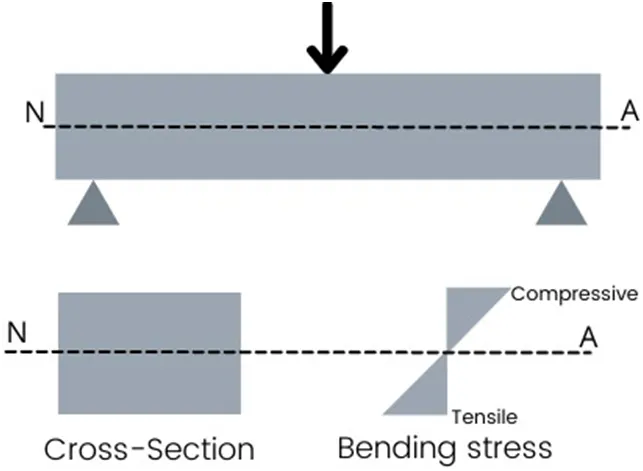
Fig – Neutral Axis
Calculations : Calculate Section Modulus in following conditions :
Condition 1: Before optimization of the curve
The Hood which was already created is imported in the software. And then, a sketch is created of the clipped section of hood.Then we have to ensure that the curve obtained by the sketch must be a closed curve otherwise section inertia analysis can’t be performed.
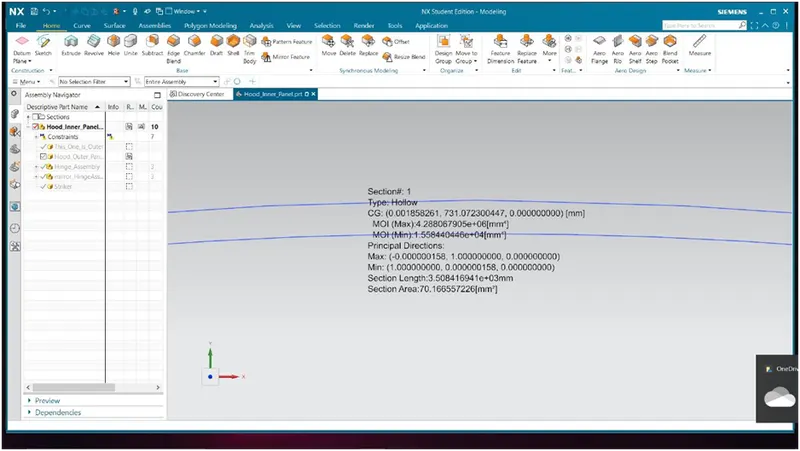
Fig – Without offsetting
From fig –
MOI(max) = 4.288067905e+06[mm4]
MOI(min) = 1.558440446e+04[mm4]
Using Section Modulus Equation,
Z = I/y
Here, I = MOI(min) = 1.558440446e+04 mm4
y = Total Distance/2,
Total distance = 483.3140 mm
so, y = 241.657 mm
Therefore,
Z = 1.558440446*104 (mm4)/241.657 mm
Z = 64.6639004149 mm3
Condition 2: After optimization of the curve
The hood which is imported and sketched is offsetted by 2mm downwards. And then we will perform section modulus of the existing curve. It must be ensured that the sketched curve must be a closed curve.
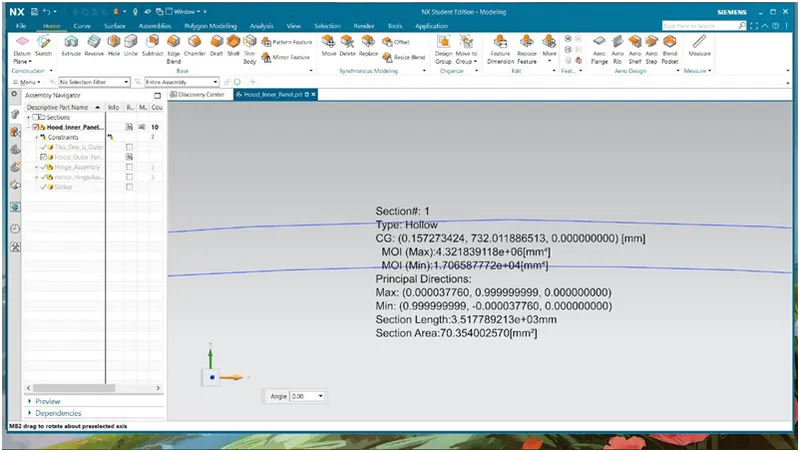
Fig – After 2 mm Offset
From the above Figure,
MOI(max) = 4.321839118e+06[mm4]
MOI(min) = 1.706587772e+04[mm4]
Using the formulae of section modulus,
Z = I/Y
Here, I = MOI(min) = 1.706587772e+04 mm4
y = Total distance/2
= 483.3140 mm/2
= 241.657 mm
Therefore,
Z = 1.706587772*104 mm4/241.657 mm
= 70.6202498582 mm3
Conclusion:
As from both of the cases, we can observe that the section modulus of hood is greater in case-2 as compared to case-1.
Hence, we found out that increasing the cross-section area would give a better section modulus and helps in increasing the strength of the hood.