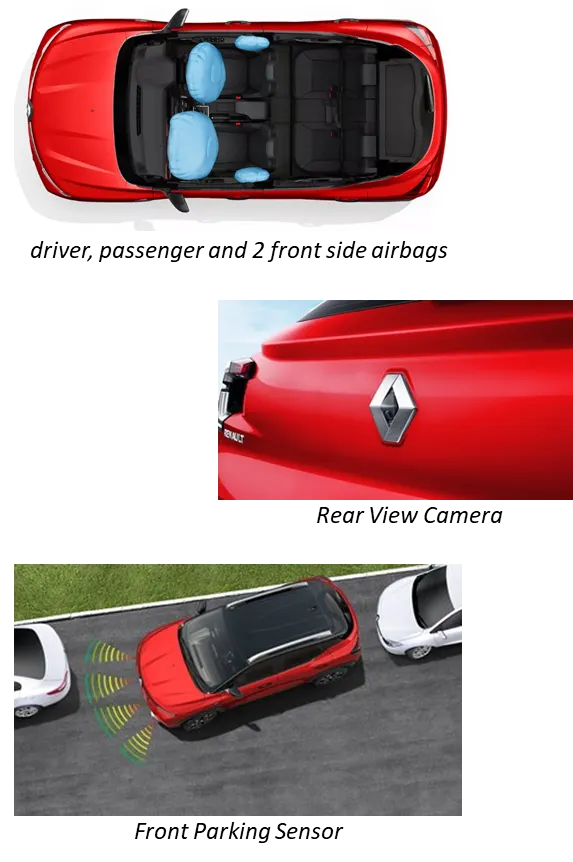
Benchmarking
What is Benchmarking?
Benchmarking is a process of measuring products, services, or practices against the manufacturer’s toughest competitors or those companies recognized as the industry leaders. Thus, it is a search for the industry’s best products or practices that can lead to superior performance.
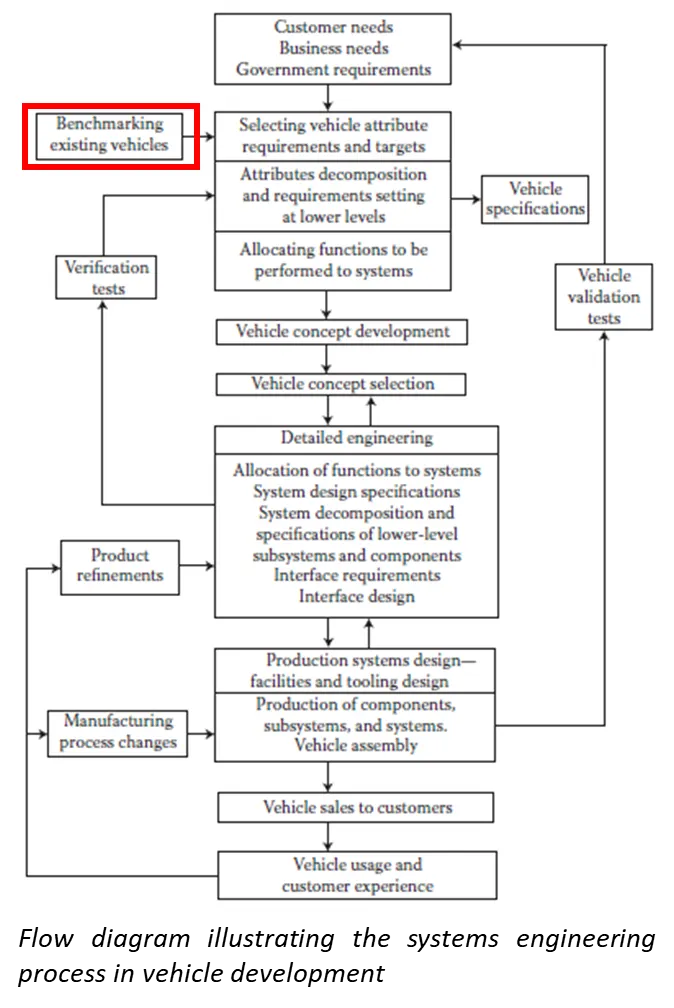
The benchmarking exercise typically starts with identifying the toughest competitors (e.g., very successful and recognized brands as the industry leaders) and their products (models) that serve similar customer needs to the manufacturer’s proposed product. The selected competitor products are used for comparison with the target product. The target product is the product considered by the manufacturer to be its future product (or an existing model of the future product).
A multifunctional team within the product development community is usually selected to perform the product benchmarking activities. The team gathers all important competitive products and information on the products and compares the competitors’ products with their target product through a set of evaluations (e.g., measurements of product characteristics, tearing down [disassembling] the products into their lower-level entities for close observation, evaluations by experts [e.g., performance, capabilities, unique features], materials and manufacturing processes used by the competitors, tests and measurements, and estimates of costs to produce the benchmarked products). The information gathered from the comparative evaluations is usually very detailed. However, the depth of evaluations included in benchmarking can vary between problem applications and companies.
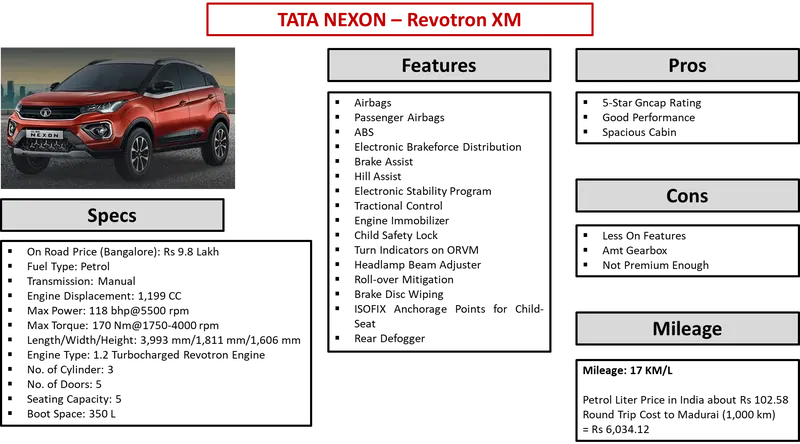
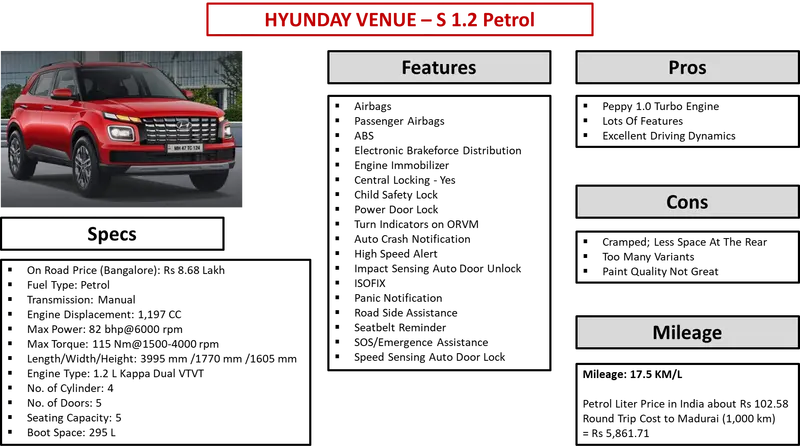
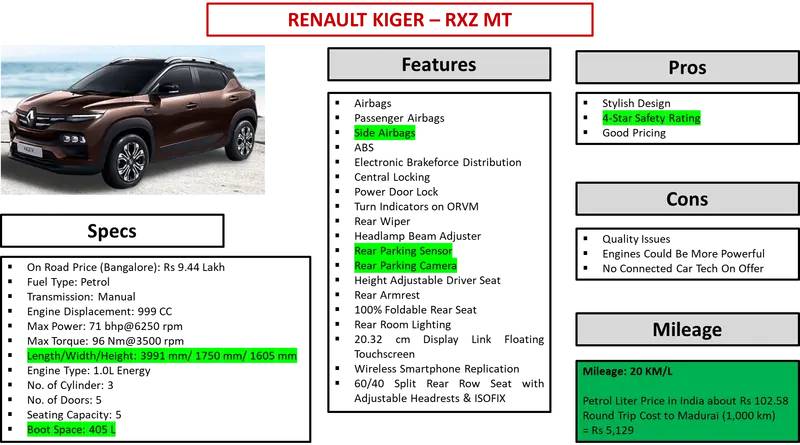
The gathered information is generally summarized in a tabular format with product characteristics listed as rows and different benchmarked products represented in columns.
The information is used to determine the “gaps” between characteristics of the competitors’ products and the manufacturer’s target product. An action plan can be developed to close the gaps by determining how the target product can be improved by implementing many of the good ideas used in the competitors’ designs and avoiding the problems uncovered in the poor designs. Thus, benchmarking can reveal one or more best competitors’ products that can be used as reference products during the subsequent product development phases. In addition, some innovative changes can be made to further improve the best design found during the benchmarking exercises.
Benchmarking is an important technique for quality improvements, and it is recognized in the National Institute of Technology and Standards (NIST) Baldrige Quality Award criteria (NIST, 2016) and International Organization for Standardization (ISO) 9000 requirements (ISO, 2016).
Benchmarking is probably the most commonly used and popular tool to understand design and construction issues within various automotive systems. During the early phases of design of any system and its subsystems, benchmarking is generally used to study and compare similar systems used in many existing vehicles, including those produced by leading competitors. Benchmarking provides a quicker understanding into the strengths and weaknesses of different designs and helps identify good design features that should be included and refined, and poor features and mistakes to avoid (e.g., especially when used in conjunction with the Pugh diagram.
Reference:
- Bhise, Vivek D. ‘Automotive Product Development - A Systems Engineering Implementation’. Taylor & Francis CRC Press. 2017.
-------------------------------------------------------------------------------------------------------------------------------------------------------------------
Benchmarking Exercise
Mr. D. S. Pughazhyendhii is a married man who lives in Bangalore which is highly crowded city. His family comprises of 5 members including his wife, 5-year boy, father and his mother. He once in a month visits his native place. Madurai which is almost 500 kms away from Bangalore. Also, he will be using his car commute to his office. His budget falls between 8 lakh to 10 lakh on road. Please suggest him with options so that he will buy a good car for his family.
NOTE: PUGHAZHYENDHII is fond of BIG CARS.
Instructions:
1.Benchmark will present the available cars in the market for this case. Compare at least 4 vehicles.
2.Provide a proper conclusion for the report, suggesting a single suitable vehicle among the comparison made with images.
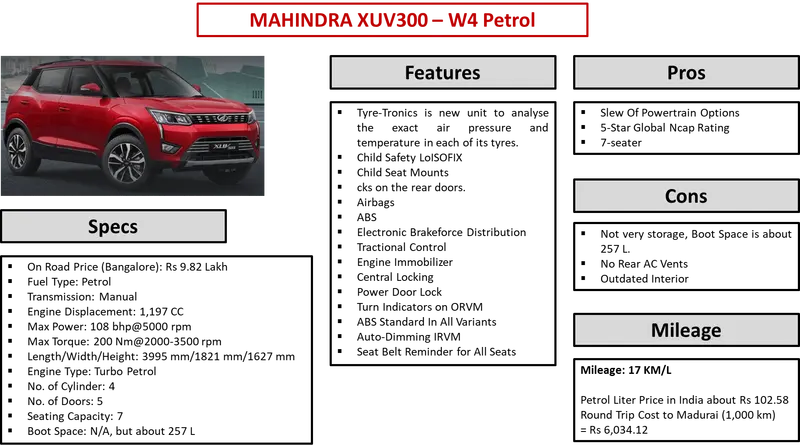
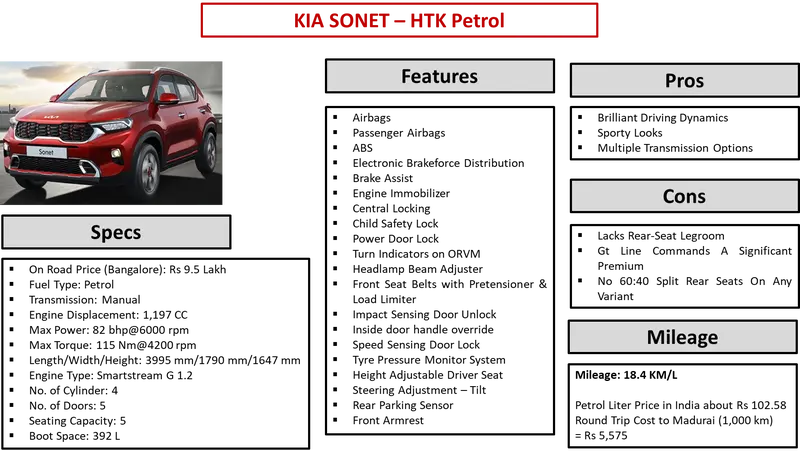

CONCLUSIONS:
I recommend Mr. PUGHAZHYENDHII to purchase RENAULT KIGER – RXZ MT because of the following reasons:
1.As he will be using the car manly for commuting between his office and home and once a month to visit Madurai, the mileage is very important, and RENAULT KIGER – RXZ MT shows the best performance of 20 km/L.
2.Taking advantage of this mileage, he can save about Rs 900 each time he visits Madurai, comparing with the performance of the other analyzed cars (Madurai Round Trip = Rs 5,129 vs Rs 6,034.12 for the most expensive MAHINDRA XUV300).
3.Considering Mr. PUGHAZHYENDHII is very fond of big cars, the dimensions of this SUV makes a very comfortable option for long family trips and one of the most spacious alternatives (Length: 3,991 mm, Width: 1,750 mm, Heigth: 1,605 mm). Additionally, it counts with the largest Boot Space (405 L).
4.RENAULT KIGER – RXZ MT is equipped with special safety features like Side Airbags which ensure full protection for the whole family. Even this model is classified with the 4-Star Safety Rating. It includes parking sensor and camera among other interesting safety features.