Assignment 7
Objective:-
To perform a side crash analysis by using the hypercrash. The following changes needs to be made prior to running the simulation.
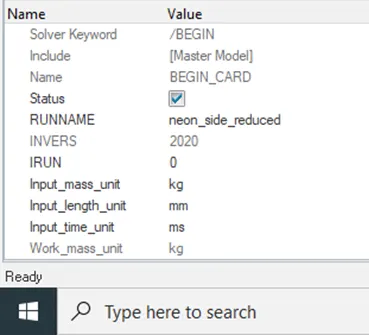
- Check the unit system.
- Create appropriate interface with friction value as 0.2 and recommended parameters.
- Correct rigid bodies if any issues.
- Create a rigid wall with friction as 0.1.
- Compare the model weight with reference model and use added masses to reach the target weight to 700 kg while getting CG about the required range.
- Initial velocity to me implemented as 35 mph.
- Timestep : 0.5 to 1.0 microseconds.
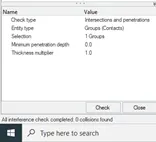
- Make sure of no penetrations and intersections.
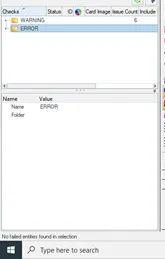
- Use model checker to ensure good quality.
Procedure followed:
Import the model
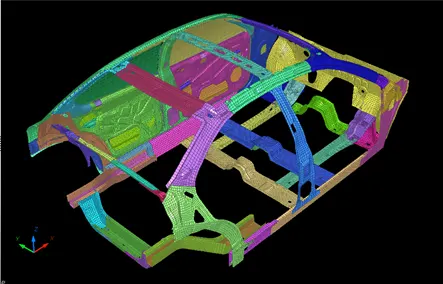
As we are using hyper-crash student edition, so this restricts the maximum nodes to 10000, and hence the further processes will be done in hyper-mesh, in which the maximum nodes is constrained to 100k.
Checking for the unit system.
Deleting all the rest interfaces and creating Interface type 7 as required with the parameters as follows
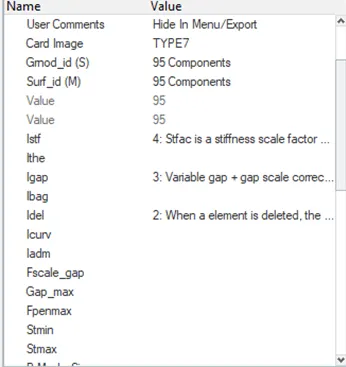
Parameters
Istf = 4, Igap = 3 ,Gapmin = .5, Idel = 2, Inacti = 6, Iform = 1
Also select master and slave nodes as the overall car components.
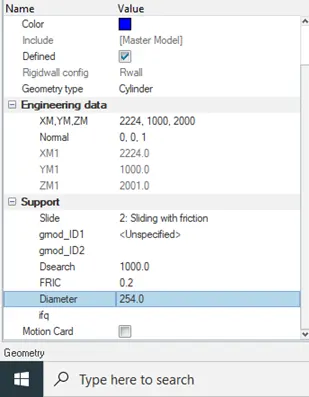
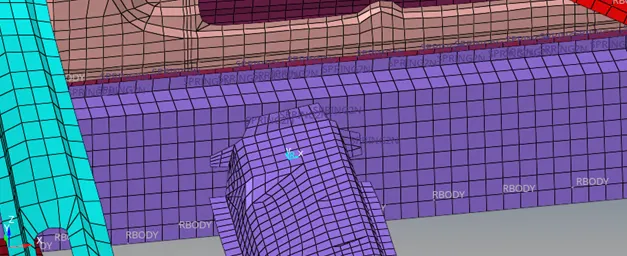
Now creating the rigid body i.e. pole in which the car will crash sideways.
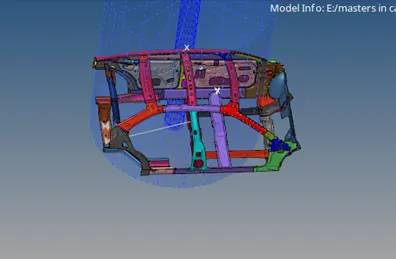
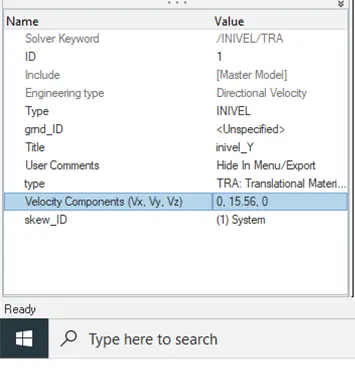
Creating initial velocity of 35 MPH which makes it 15.56 mm/ms. For the direction of the imposed velocity it is taken as Vx=0, Vy=15.56 & Vz=0 with a skew matrix to define the direction of motion.
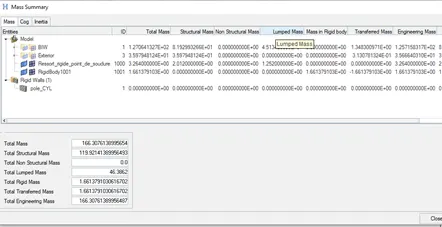
Post the inivel we have to check for mass and COG of the vehicle. The COG with mass 166.30761 lies at
X=2420.608
Y= 248.4562
Z= 588.9372
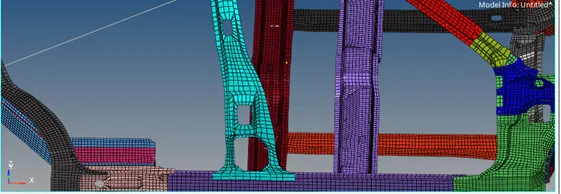
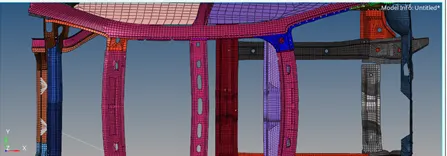
The target mass for the model is to be 700 kg but with our model it is near to 166, so adding mass to the model at various areas with keeping in mind about COG that must be near to the cross member of the floor.
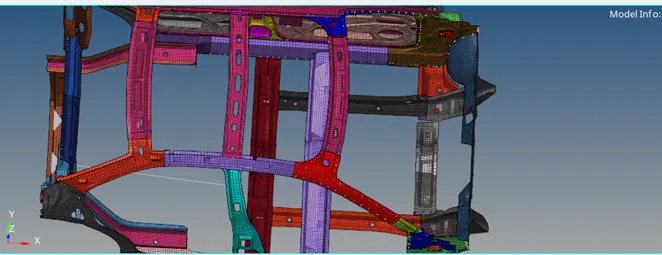
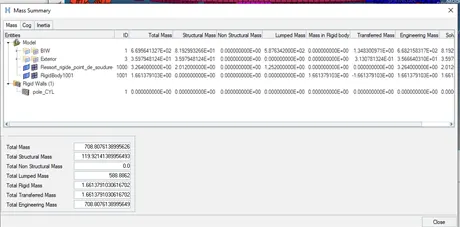
Mass is settled at near to 708 kg’s with COG at
X= 2369.1697
Y= 0.3931
Z= 336.5290
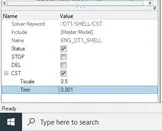
Now assigning time step control to the model with minimum time step= 0.1 ms and t-scale factor = 0.5.
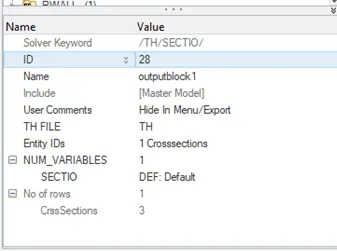
Creating sections at B-Pillar and floor cross members to know the sectional forces their.
Skew for the sectional forces
Post skew assigning sections to that skew for the force results.
The parameters for the sections are assigned as follows:
Delta t = 0.1, Alpha = 1.67, Iframe = 12
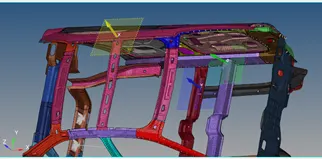
Created section at both the floor cross members and the B-Pillar.
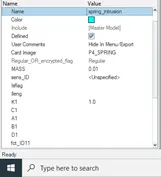
Now Creating spring elements for intrusion at B-Pillar, Hinge Pillar and Fuel tank region.
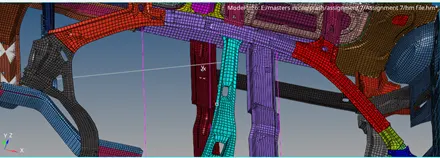
Property assigned to the spring
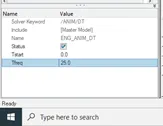
The frequency for writing the file is changed from 5 to 25 frames per second.
i.e. Tstart = 0
& Tfreq = 25 for 25 frames per second.
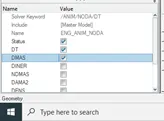
The output request for Anim/Noda/dt for time step animatio request
Also anim/noda/dmas is given for mass variation due to mass scaling during the mass addition is given.
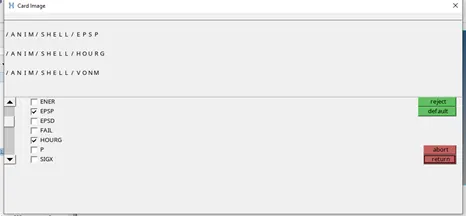
Now giving output request for vonmises stress, plastic strain & hourglass energy.
Solver – Create – Engine Keyword – anim – anim/shell – VONM,HOURGLASS,EPSP.
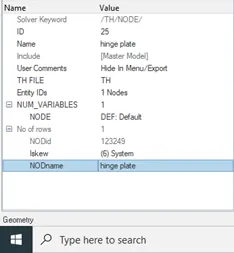
For output request of spring intrusion for hinge pillar, B-Pillar and fuel tank region, creating TH/nodes i.e. output blocks with assigning a node and a skew to the block.
.
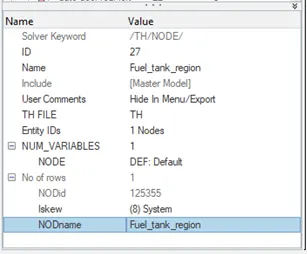
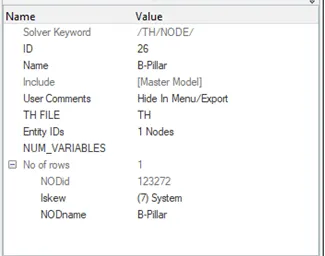
For output request for peak velocity creating a skew at the inner panel of the front left door and then creating an output block with name peak velocity. Now to that output block assigning a node and also the skew created is assigned to this output block for capturing the Peak velocity at that point.
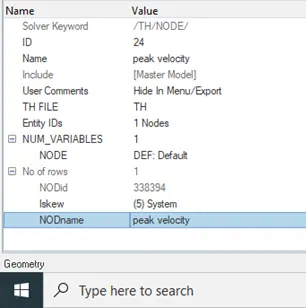
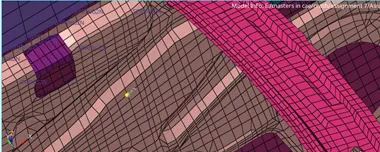
Also output request for Sectional force for B-pillar, Front cross member(floor) & Rear Cross member(Floor) is to be given.
Checking the intersections and penetration, and 0 intersections found.
Now its time for model checker, after completing the overall required process we have to check the model for any errors, as if any error is found in the model then it will not export to radioss for further simulation run and graph plotting.
Simulation run and diagnosis:
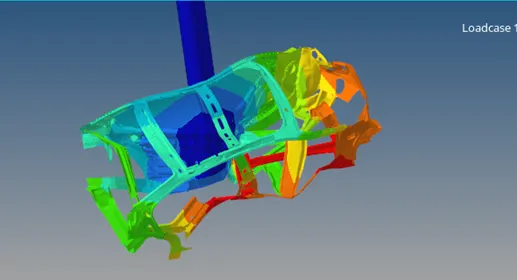
The simulation is run in hyperview and the file is below:
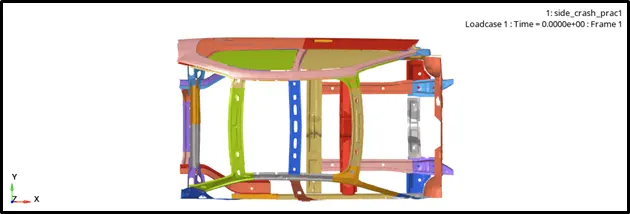
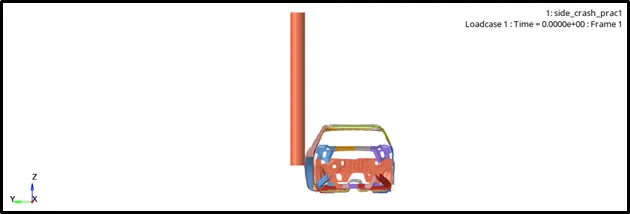
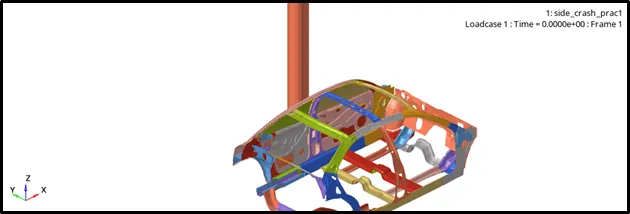
From the above run it is found that:
Mass error = 01276E-01
Energy error = -0.2%
Total number of cycles = 80001
Both the mass and energy error are within the limits, hence we can proceed towards plotting the graph.


Simulation results :
Von mises plot:
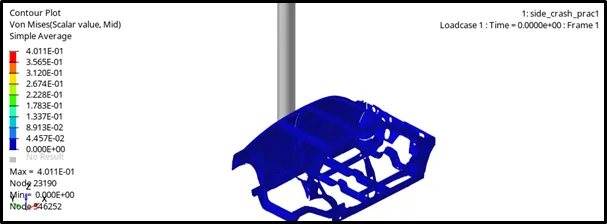
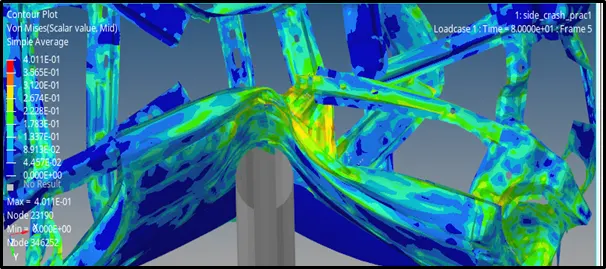
Maximum von mises energy plot is counted at 4.011E-01 KN/mm2. Also it can be seen that the maximum von mises is recorded at extreme left portion of the rear cross member area.
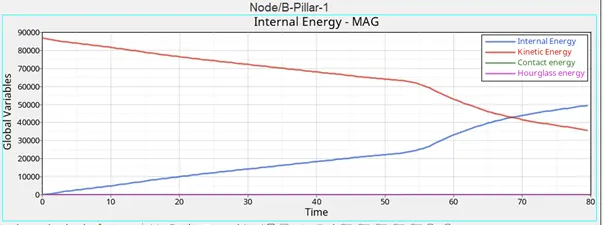
Energy plots:
- Internal energy
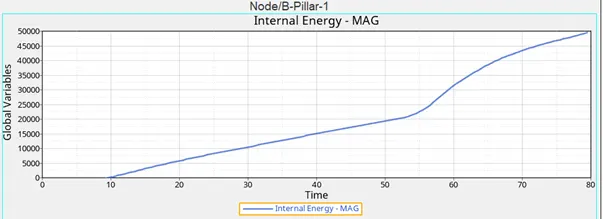
Maximum internal energy is at 50000 at the end of simulation i.e. at 80 ms.
- Kinetic energy
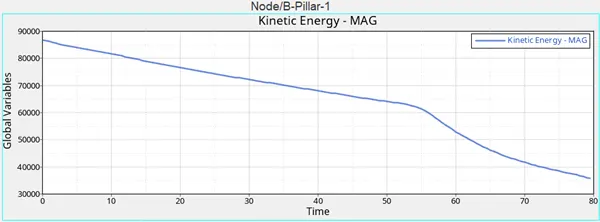
The kinetic energy at the start is accounted at 86000 and till the end of the simulation at 80 sec it is not 0.
- Contact energy
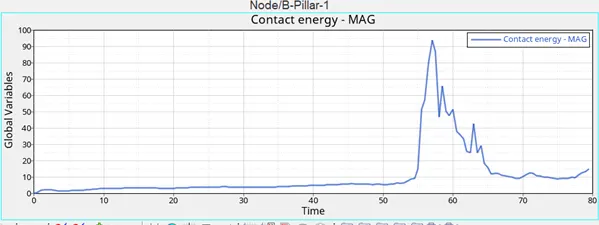
Contact energy maximizes after 55 ms and the value is 94.
Hourglass energy
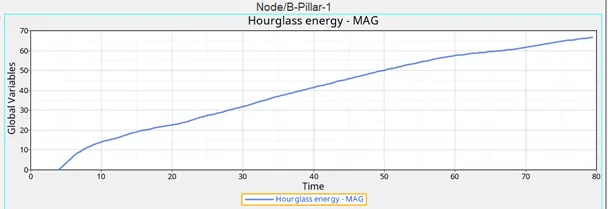
- All 4 in one plot
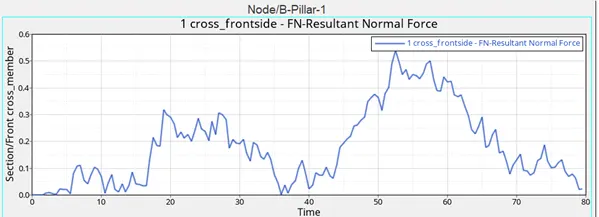
Sectional forces at different areas:
- Front cross member(Resultant normal force)
Total resultant force
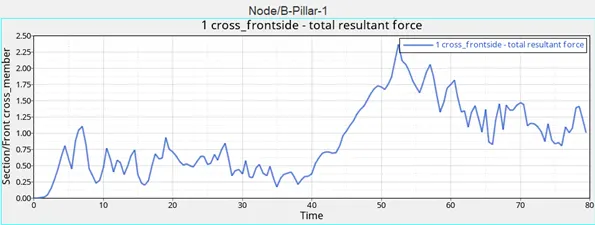
The maximum resultant force at front cross member is accounted to be 2.25 KN/mm2 at 53 ms. Also it can be seen that in the end the value of total resultant force has decreased.
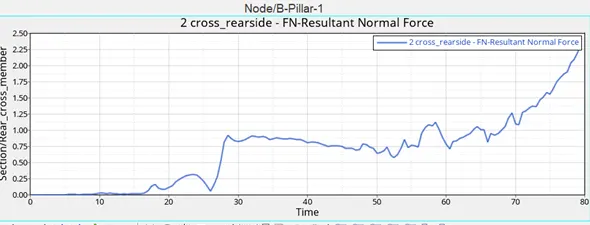
- Rear cross member
Resultant normal force
Total resultant force
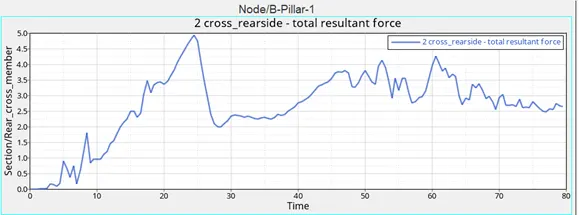
Maximum value of force is captured at 25 ms and the value goes to 5.0 KN/mm2. Thereafter the value of total resultant force gradually decreases.
Peak velocity at the front left door node:
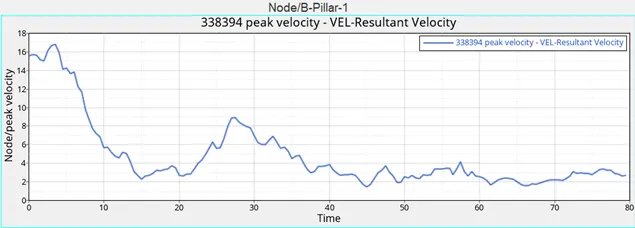
The peak velocity is captured in the front left side door inner panel by placing a node their, and the value of it is obtained as 17 mm/ms at 4 ms, thereafter the velocity decreases gradually.
Intrusions:
- Fuel tank region
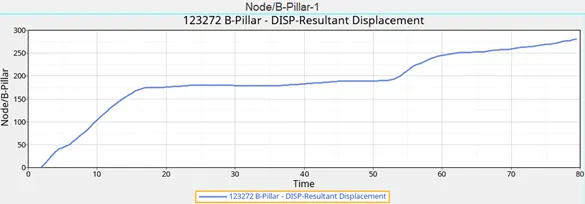
- B- Pillar
- Hinge plate
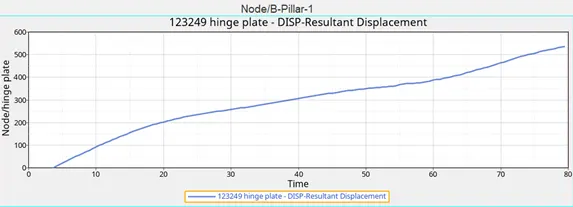
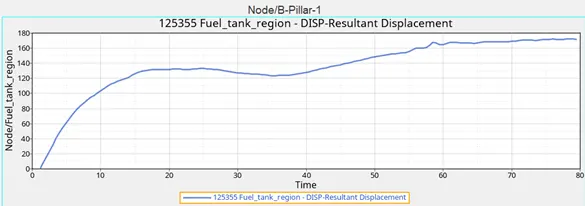
The intrusion is captured at fuel tank region by plotting a node and a skew. The value of resultant displacement maximizes to 175 mm. Also the value of resultant displacement at B-Pillar and Hinge plate is obtained as 275 & 520 mm respectively.
Conclusion:-
The side crash was performed using hypercrash successfully. From all the above plots it is concluded that:
- Mass and energy error are within the limits and hence can be sustained.
- Maximum von mises plot is at the left portion of the rear floor cross member and is counted at 4.011E-01 KN/mm2
- The intrusion is captured for all the three regions at B-Pillar, Hinge plate & Fuel tank region and the value for it is obtained as 275, 175 &520 respectively.
- The peak velocity at the front left door is obtained as 17mm/ms at 4 ms.