Assignment 4-RADIOSS Material Laws Challenge
Objective :
Perform the simulation on the cases given in the question.
Compare their results such as total no of cycles, energy error, mass error and simulation time. Determine which case would represent the on field scenario based on all the results.
Comparison of 7 cases :
| CASE 1 | CASE 2 | CASE 3 | CASE 4 | CASE 5 | CASE 6 | CASE 7 | |
| No. of cycles | 49380 | 49217 | 49380 | 49304 | 47969 | 53144 | 41113 |
| Energy Error (%) | 0.8 | 4.1 | 0.8 | 1.1 | 1.3 | -1.8 | -7.1 |
| Mass Error (%) | 0.0 | 0.000 | 0.000 | 0.000 | 0.000 | 0.000 | 0.000 |
| Simulation Time (s) | 70.06 | 78.11 | 71.48 | 77.89 | 81.64 | 86.21 | 69.22 |
Case_1
- In case 1 we ran the models as it is they were imported from the file given in question.
- The elements are being deleted but in a random way.
Case_2
In case 2 enable max failure plastic strain and fail_johnson failure card.
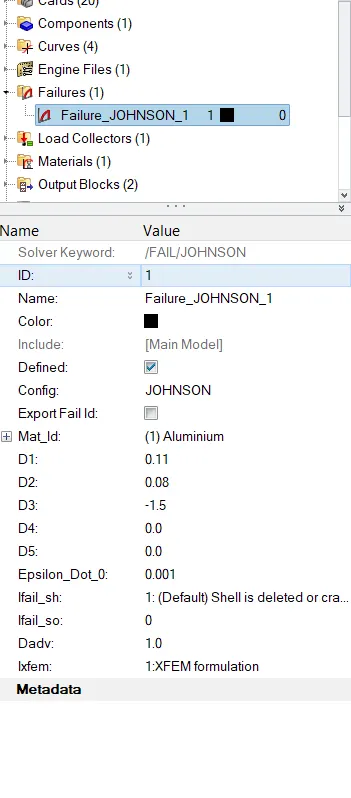
- Failure_Johnson card enabled.
- The elements are first cracked and after deleted.
Case_3
- Now remove fail_plastic card and perform simulation.
- Elements are deleted in this case as well.
- Elements are randomly deleted.
Case_4
- Now import the file from case_3 and remove max failure plastic strain and fail_johnson failure cards and perform simulation.
- Element are deleted but in a pattern.
- Element deletion was delayed in this case.
Case_5
- Import case_4 rad file and change material card to Law01. While keeping the same values of rho, E and nu.
- In this case Law01 is used, hence no material failure is observed.
Case_6
Now import case_1 rad file and change material card to Law36.
Case_7
Import Law27 rad file and change material card properties to Law27 and perform simulation.
| Case_1 | Case_2 | Case_3 | Case_4 | Case_5 | Case_6 | Case_7 | |
| Strain (max) | 0.1474 | 0.1474 | 0.1474 | 0.582 | 0.201 | 0.112 | 0.215 |
|
Displacement (max.) (mm/ms) |
15.86 | 11.27 | 15.86 | 5.62 | 5 | 48.35 | 8.11 |
|
Internal Energy (kg-mm^2/ms^2) |
27322 | 27322 | 27322 | 38724 | 864253 | 38642 | 23274 |
| Element failure | Deleted | Deleted after cracking | Deleted | Deleted | Neither Deleted nor cracked | Deleted | Deleted |
From the above chart we can conclude that -
-
From the above chart we can conclude that -
- The maximum strain observed in case_4. This may be due to we removed max. plastic strain from this case. In first three cases strain is less than max plastic strain provided.
- Maximum displacement is produced in case_6. In case_6 we used law36. Least displacement produced is in case_5 in which Law1 is used. This law exhibits only elastic properties.
- Obviously maximum internal energy was in case_5 and least in case_7 which is for brittle card.
- There are two types of element failures, one is element deletion and another one is element is cracked before deletion. Elements are deleted in case_2 only due to active failure card. There was no failure in case_5 because of elastic material card.
- The reason for failure could be the max plastic strain criteria provided. When max. plastic strain in elements is exceeded above given value of strain the element will be either deleted or crack and then deleted as per the failure card setup.