Assignment 4-RADIOSS Material Laws Challenge
Aim:
To do material challenge in RADIOSS with different material card as it given as different cases.
Objective:
The material challenge demonstrates how material behave with respect to material card and change in values that are asked to change.
About the challenge:
It is asked to run the given Failure-Johnson.0000.rad file and save the results as case 1.
From the case 1 we change values of Ifail_sh = 1, Dadv = 1, Ixfem =1.
Ifail_sh – Shell failure flag = 1, shell is deleted or cracked for one integration point or layer.
Dadv – criterion for crack advancement = 1,
Ixfem = 1, In this we can choose that if there is any element that is failing the numbers decide the element to crack or delete. Value 1 allow failed element to crack.
We run the file in RADIOSS and save the results as case 2.
From case 2 we remove the Fail_Johnsonfail card and run the file and save the result as case 3.
From case 3 we remove Eps_p_max and run the file and save RADIOSS result as case 4.
From case 4 we change the material card to LAW1 and apply the same value for E, Rho-initial and nu. We run the RADIOSS file and save the result as case 5.
In case 6 we import the case 1 file and perform LAW36 as it is given in the question.
In case 7 we import the new file which is given as LAW27.0000.rad and perform simulation with LAW27 material card.
Case 1
Here the results are from the default given file FAILURE_JOHNSON_0000.rad file.
Import the file – Analysis – RADIOSS – Include connections – Number of Threads 4 (-nt 4).
In results we get engine start file, engine run file, H3D animation file, T01 energy plot files.
To view animation files we use the option Hyperview and for energy plot we use the option hypergraph.
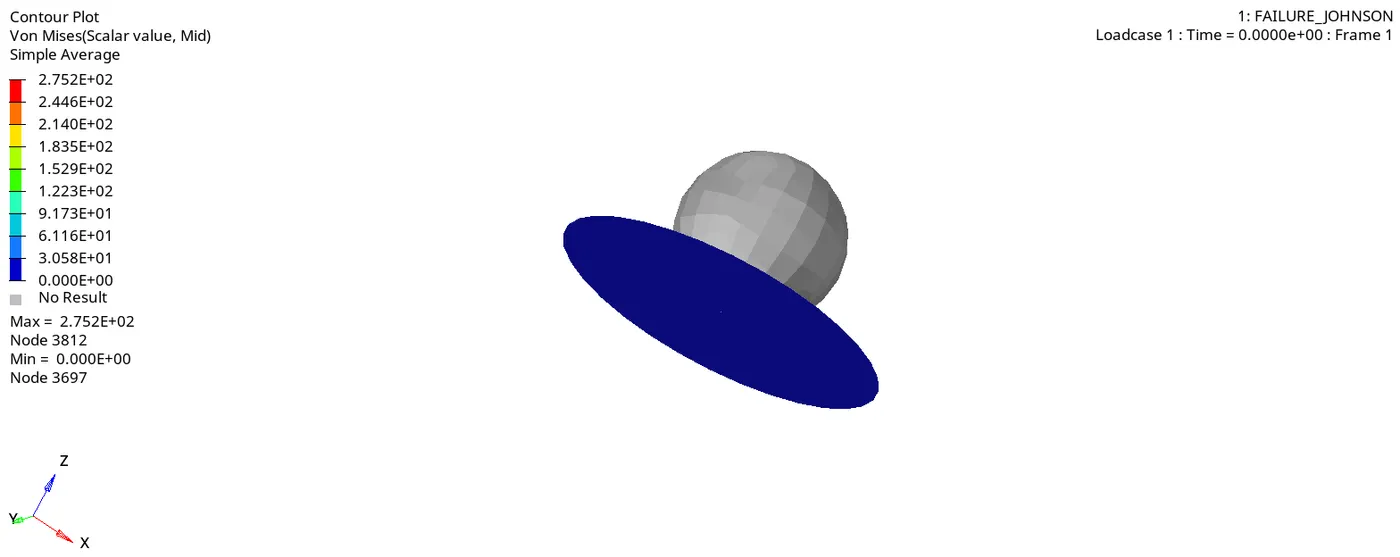
By selecting the contour option in the toolbar we change the result type to 'von mises' and averaging method to simple.
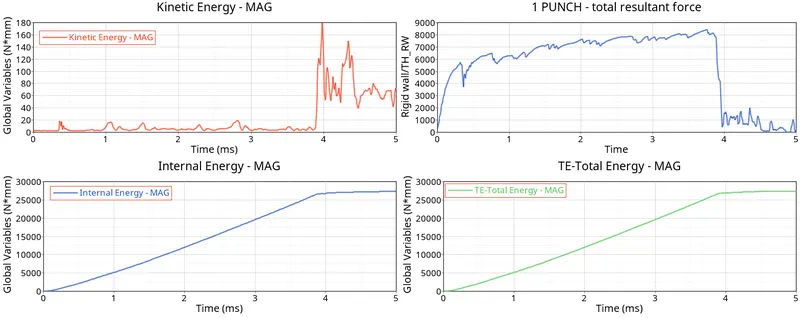
Cycle : 49379,
Time : 5.010,
Energy error : 0.8%,
Mass error : 0%. which is acceptable.
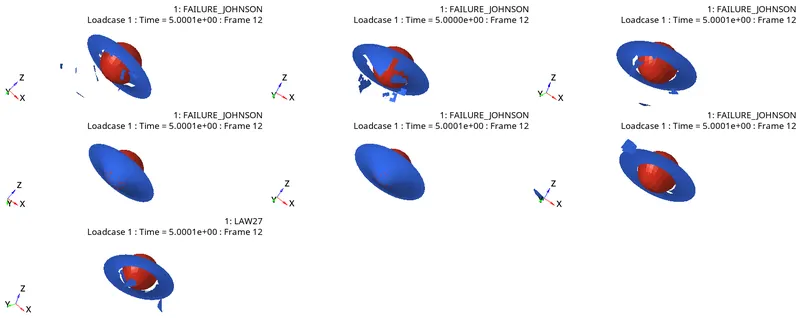
From the given file Ixfem value is assigned as 0. Due to this the elements gets deleted as soon as they cross the Eps_p_max threshold. The energy graph and force graph increases linearly until many elements are deleted. In rigid wall foce there is a huge defloction in curve due to large amount of deleted elements.
case 2
We take the above results as inputs for this case and we change few values which is asked to change and run the simulation.
And the required changes are Ifail_sh =1, Dadv = 1, Ixfem = 1.
we run the simulation after changing the given values and the results are given below.
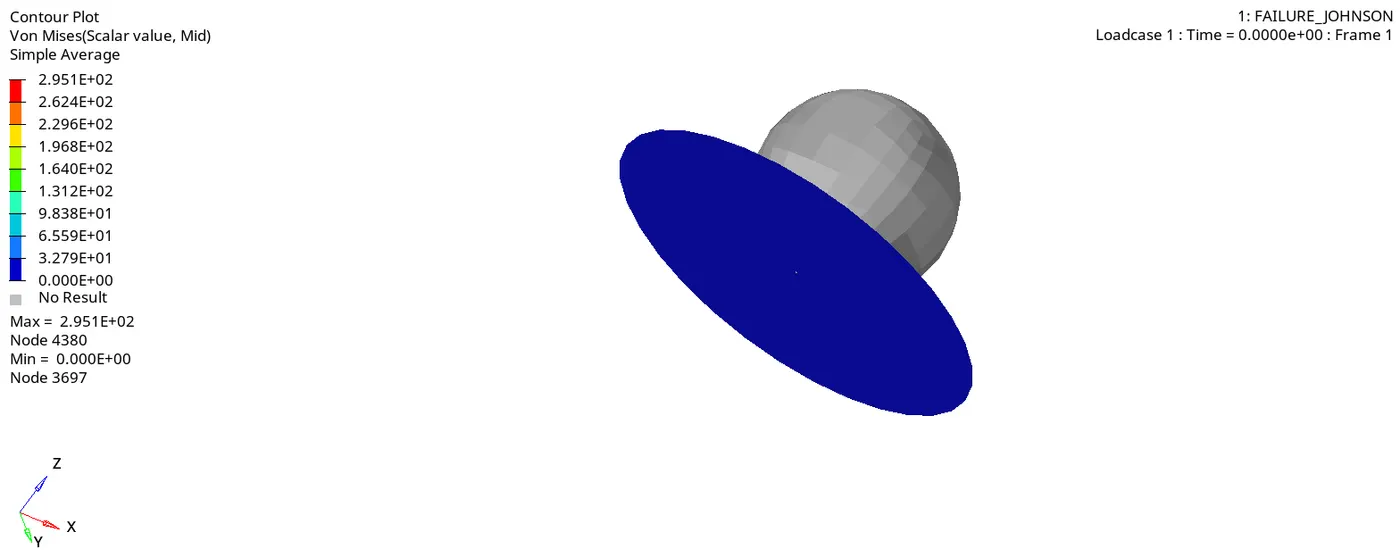
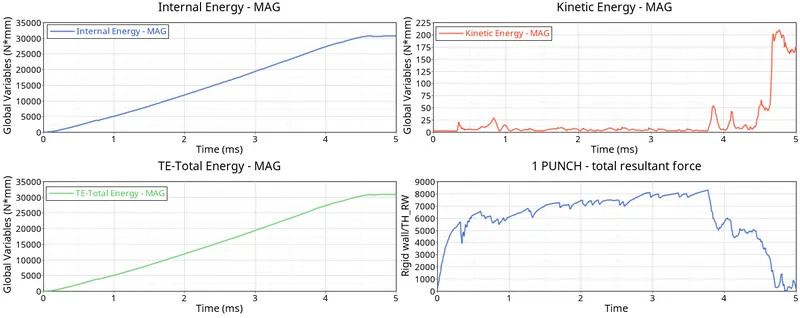
Cycle : 49216,
Time : 5.010,
Energy error : 4.1%,
Mass error : 0%. which is decent.
Ifail = 1 detemines shell element failure method. There are two ways of element failing one is elment deleted or cracking occurs accourding to material properties. Ixfem by this value we decide the failing element to crack or delete, Ixfem =1 will allow failed element to crack. Dadv can be activated when Ixfem =1. Dadv =1 gives critreria that how much element can brack into small pieces.
The rigid wall force start increasing from 0 and when it collided with the plate the energy gets transferred to elements, that's the reason the curve again reaches the point 0.
case 3
From case 2 result file we remove the fail_ johnson failure card we run the analysis and get the result files.
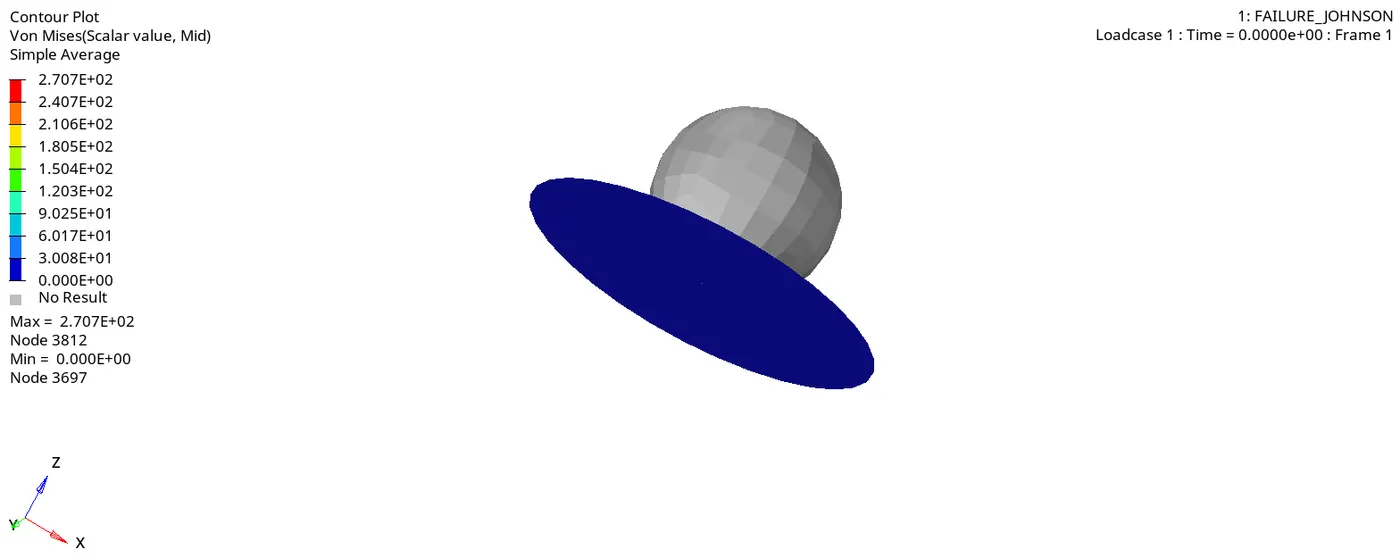
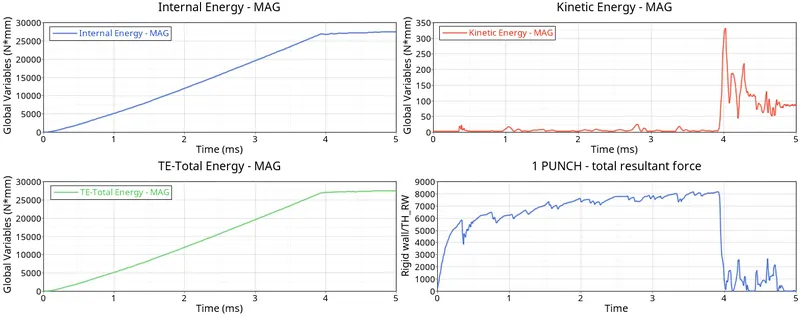
Cycle : 49407,
Time : 5.010,
Energy error : 0.8%,
Mass error : 0%. which is acceptable.
The only factor for element deleting is Eps_o_max. By default the given value is 0.151 so the element will get deleted if strain on any integration point reaches 15.1% of plastic strain. There is a linear increase in internal energy and total energy until bulk element deletion occurs. The rigid wall force is basically a measure of the opposing force generated by metal sheet.
case 4
We import the case 3 result and remove the Eps_p_max and run the file.
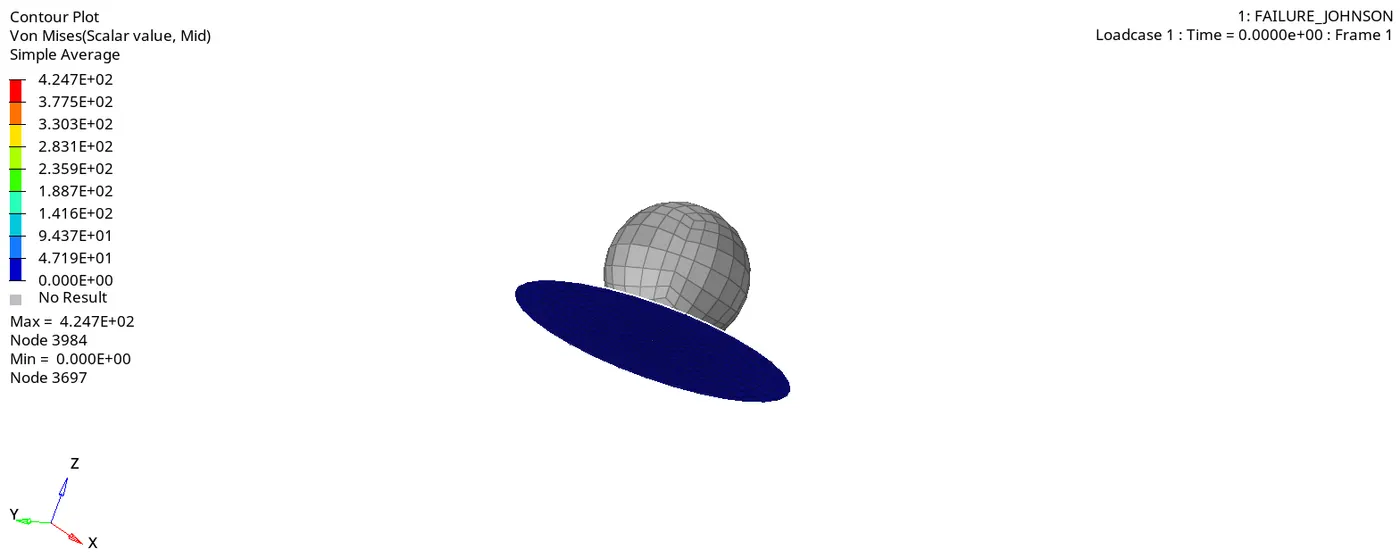
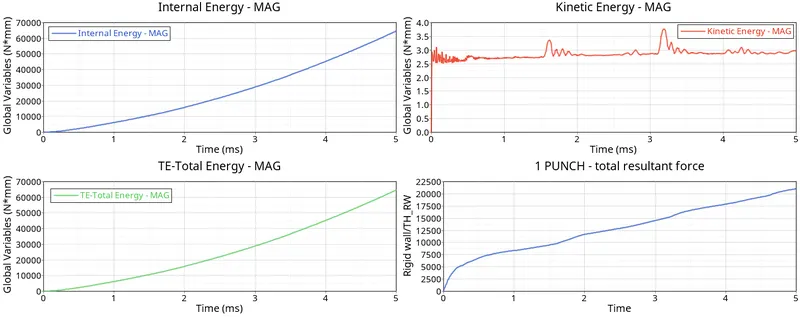
Cycle : 48736,
Time : 5.010,
Energy error : 3.0%,
Mass error : 0%. which is decent.
Due to the removal of Eps_p_max value the metal sheet withstand large amount of stress and control element deletion. The material behaves like a pseudo-elastic (also called elasic to plasic) material. Since it has very high Eps_p_max threshold and elements can't be deleted due to failure cards.
case 5
Fom the case 4 results we change the material card to LAW1 and we input the same values for rho_init, E and nu.
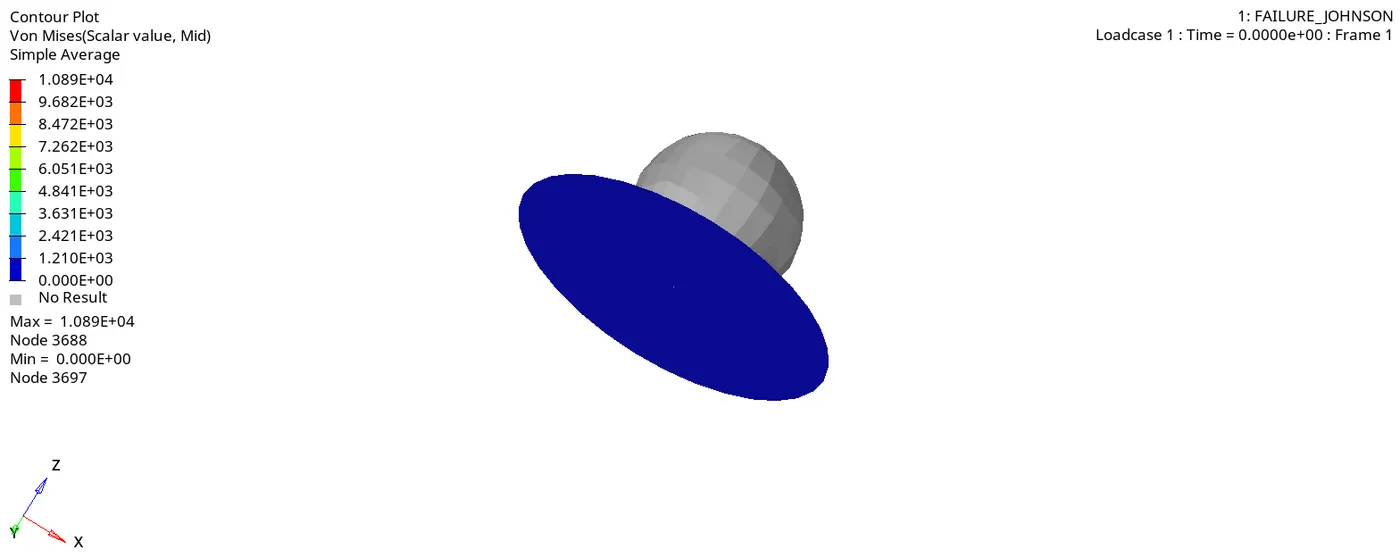
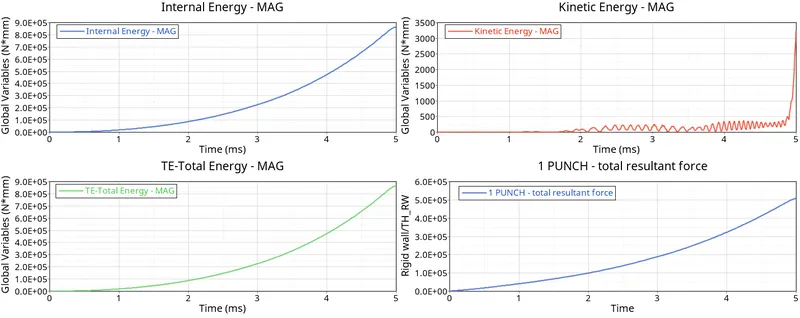
Cycle : 47968,
Time : 5.010,
Energy error : 1.3%,
Mass error : 0%. which is acceptable.
Law1 (M1_elastic) material defines basic properties of elastic material. The metal sheet absorbs full impact of sphere, it also absorbs an extreamly large amount of energy which explains peak in kinetic graph. The stress absorved is massive when compared to law2.
case 6
Here we import the case 1 and change the material card to LAW36 and run the analysis.
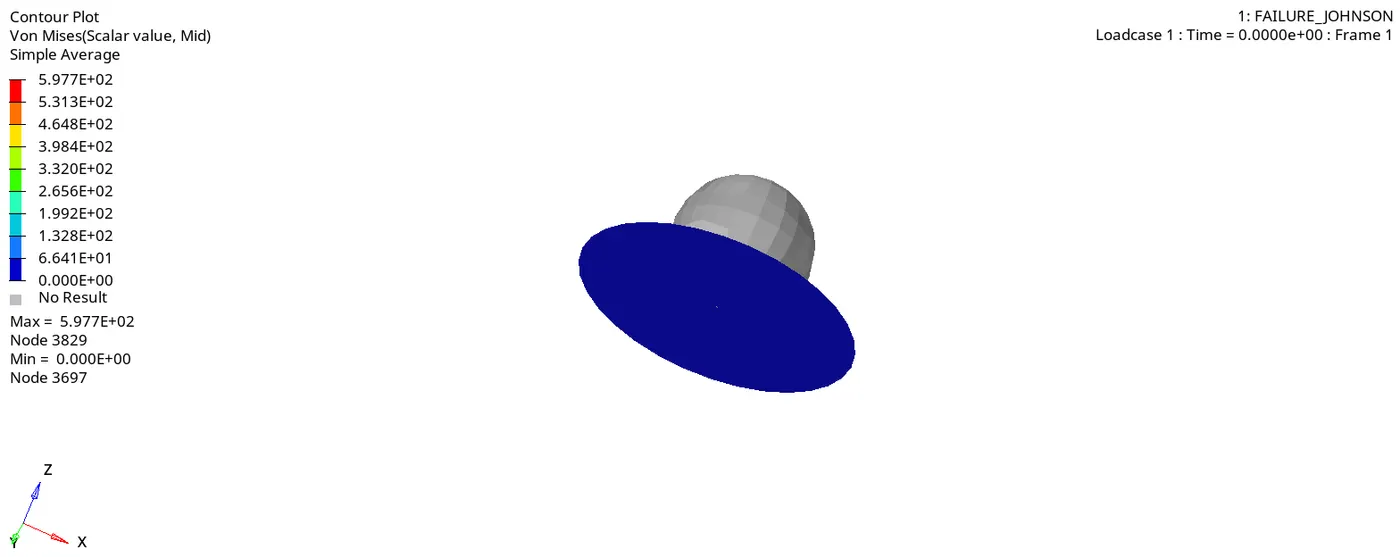
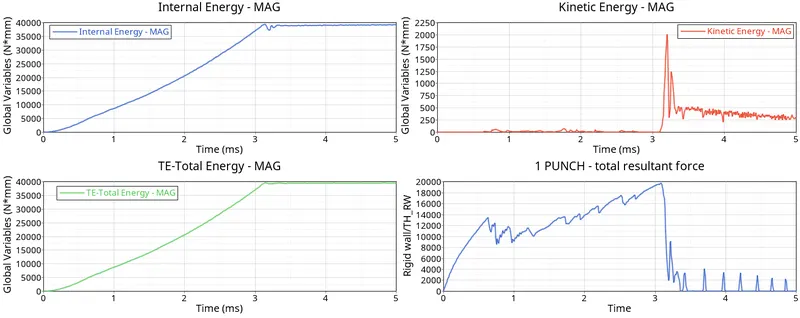
Cycle : 53149,
Time : 5.010,
Energy error : -1.7%,
Mass error : 0%.
LAW36 material helps in modelling isotropic rlasto-plastic material using user defined functions for the work hardening portion of stress strain curve for different strain rates.
Materials - Aluminium and change the card to M36_PLAS_TAB (Law 36). After that set the values for Rho_Initial, E & Nu as:
Rho_initial = 0.0027, E = 71000.00, nu = 0.33.
We can then add the curve using the N_funct attribute. We can change its value to 1 and by doing so, it lets us select the reference curve. We shall select the one we added by the value given in video content.
We can say that material exibits strong brittle behaviour. If it does't bend to the applied force there won't be cracking in element deletion.
case 7
In this case we import the given file Law27_0000.rad file and change material card to law27 with recommended shell properties.
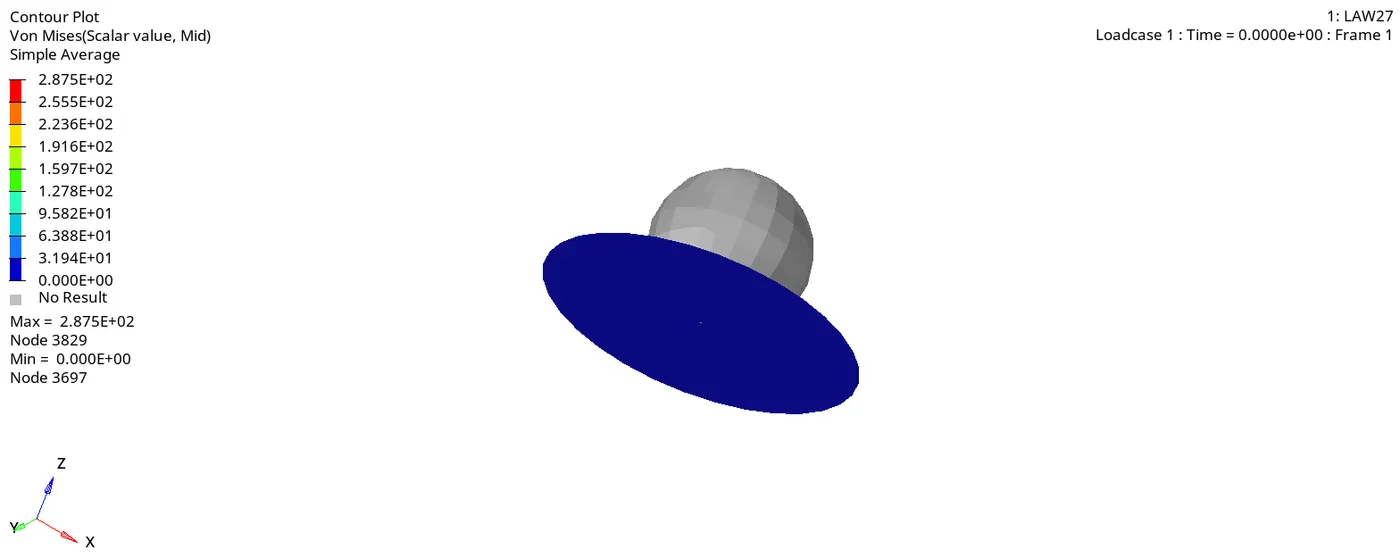
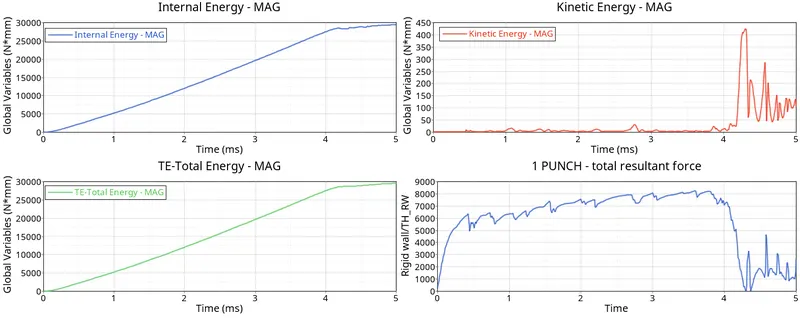
Cycle : 49506,
Time : 5.010,
Energy error : 0.8%,
Mass error : 0%.
The use of M27_PLAS_BRIT material is used for isentropic elastroplastic brittle failure. The sheet absorbs more force and restores more deformation before 4ms. The rigid wall force graph drops at same time. The curve spike denotes deleted elements.
Conclusion :
| Case | Group | Type | Total Runtime | Element behaviour |
| case 1 - /MAT/LAW2 (PLAS_JOHNS) | Elasto-plastic materials | Metal | 52.90 sec | Deleted |
| case 2 - /MAT/LAW2 (PLAS_JOHNS) | Elasto-plastic materials | Metal | 74.52 sec | Crack formation and Deletion |
| case 3 - /MAT/LAW2 (PLAS_JOHNS) | Elasto-plastic materials | Metal | 74.35 sec | Deleted |
| case 4 - /MAT/LAW2 (PLAS_JOHNS) | Elasto-plastic materials | Metal | 74.47 sec | No crack or Deleted elements |
| case 5 - /MAT/LAW1 (ELAST) | Other materials | Elastic | 72.86 sec | No crack or Deleted elements |
| case 6 - /MAT/LAW36 (PLAS_TAB) | Elasto-plastic materials | Metal | 59.45 sec | Deleted |
| case 7 - /MAT/LAW27 (PLAS_BRIT) | Elasto-plastic materials |
Brittle Metal and Glass |
53.73 sec | Deleted |