Assignment 4-RADIOSS Material Laws Challenge
Objective:
The aim of the challenge is to use different material laws available in Hyperworks and to see how they affect the results of the simulation.
Case setup & execution:
The challenge was executed in 7 different cases, each correspomding to different material law. The complete model for the analyses was given and only the material needed to be changed. The 7 cases are described below:
Case 1:
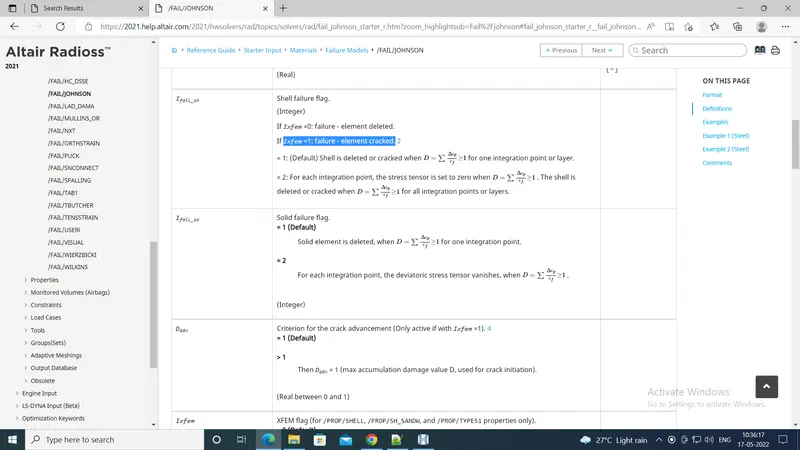
This case involved running the model as it was given, without any change. The model used the Law_2 Johnson Cook material law. While the Johnson Cook failure model was also used, the values of Ixfem and Dadv were zero. This ensured that, whenever the strain exceeded failure strain, the elements get deleted. This is mentioned in the Hyperworks Help Home as shown below:
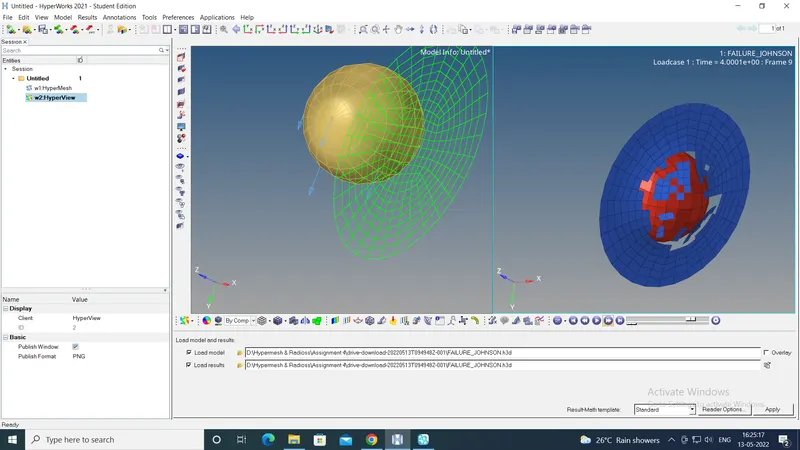
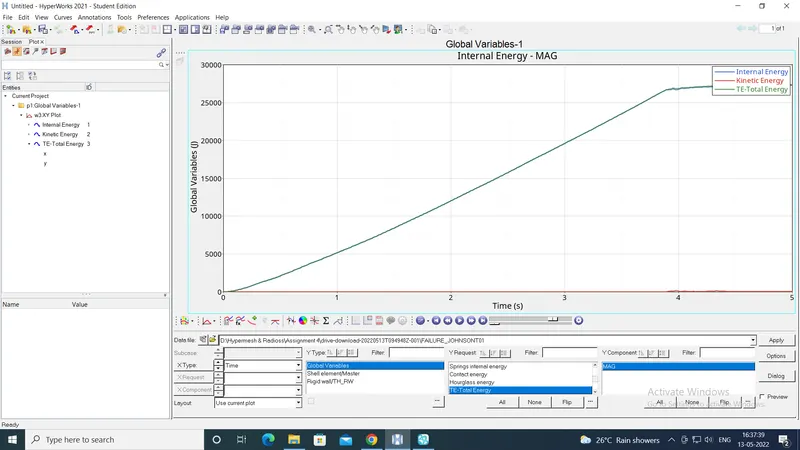
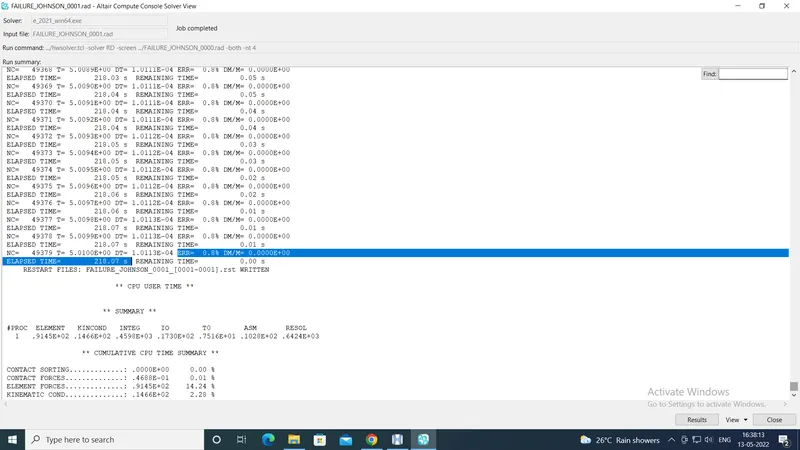
The images of the animation, energy plots and the energy error are also shown below:
Case 2:
In this case, the failure model is modified by providing values of Ixfem=1 and Dadv=1. Also the Ifail_sh is changed to 1.
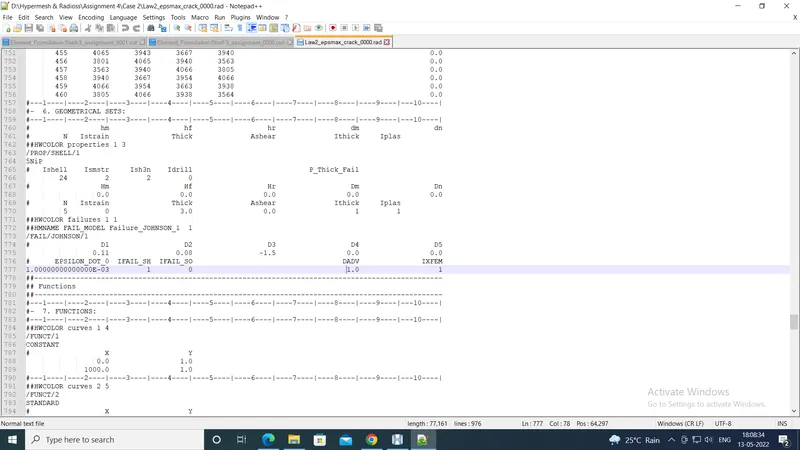
The results are shown below:
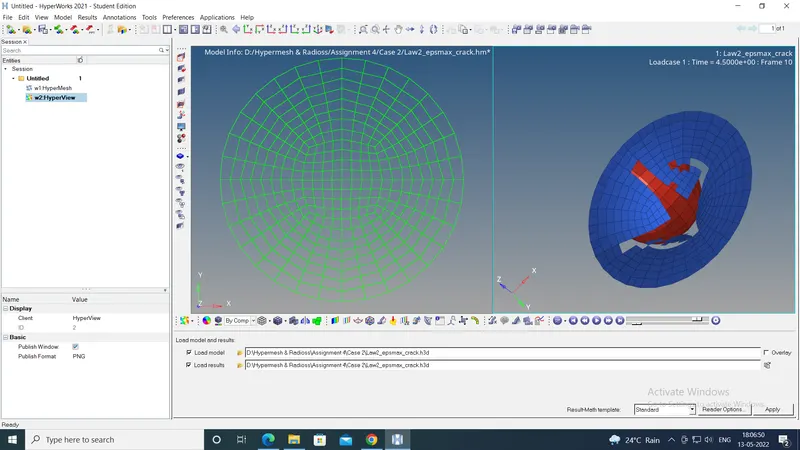
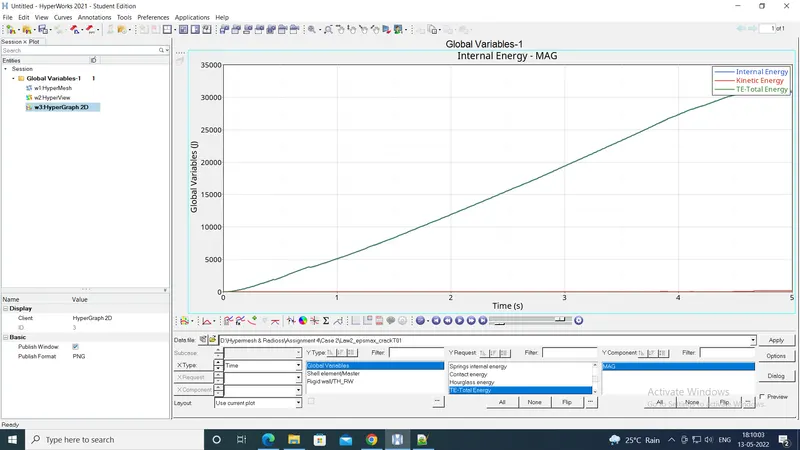
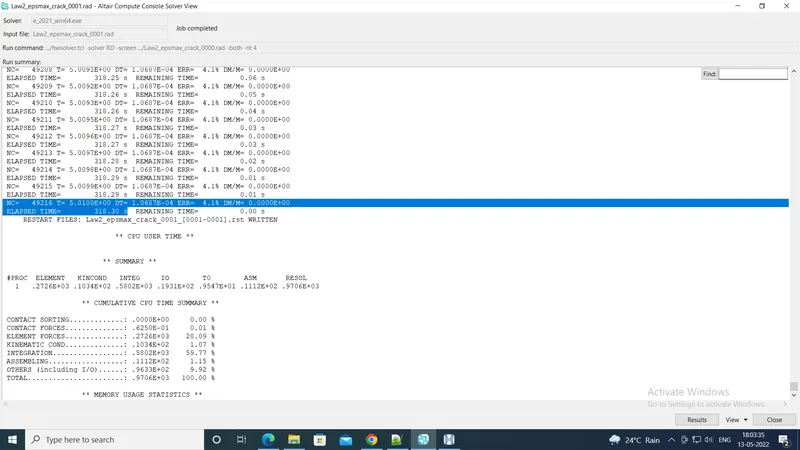
Case 3:
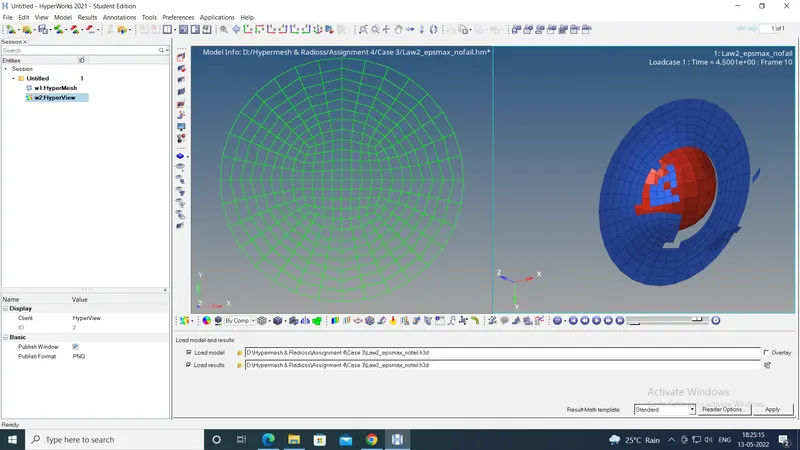
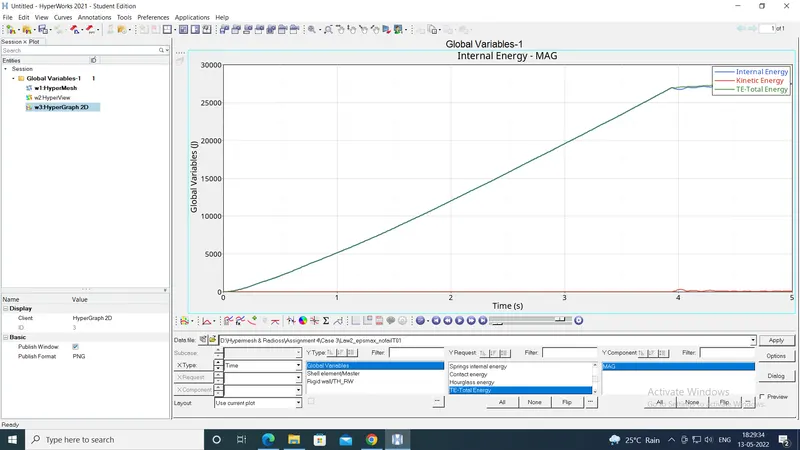
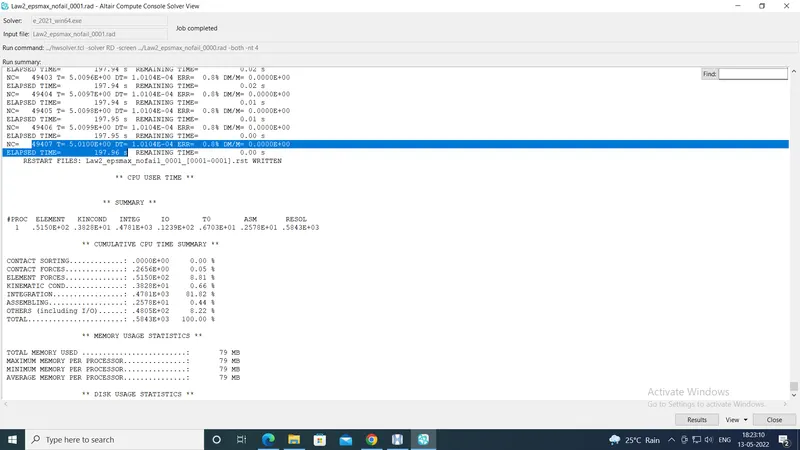
This case involved removing the fail_Johnson failure card but keeping the failure plastic strain (EPS_p_max) card and running the simulation. The images are shown below:
Case 4
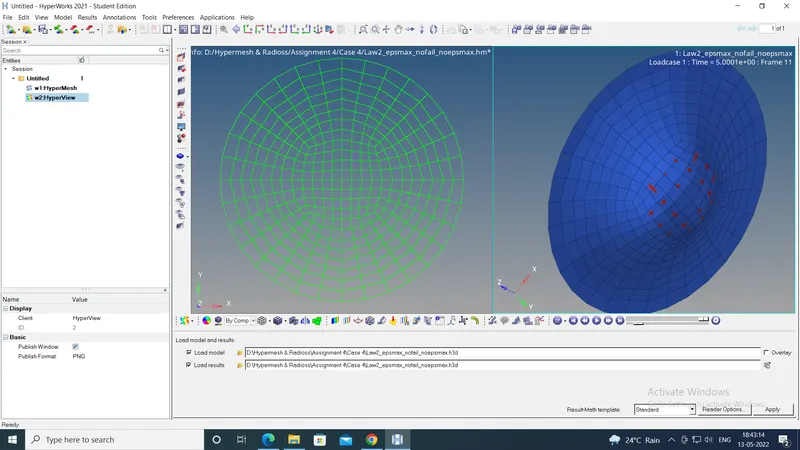
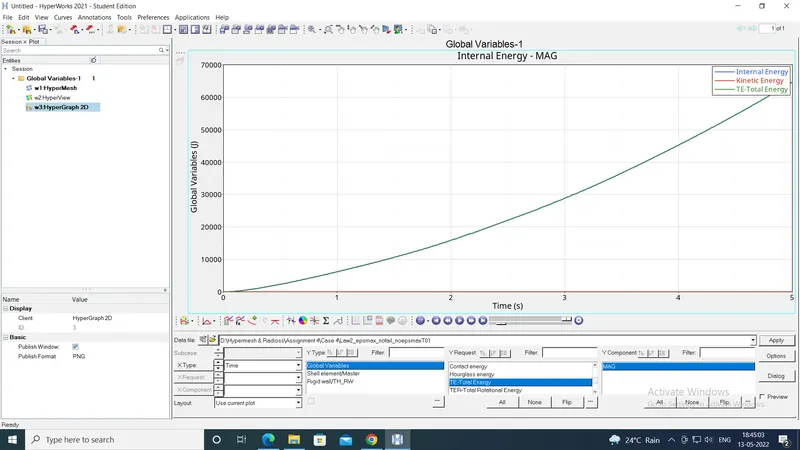
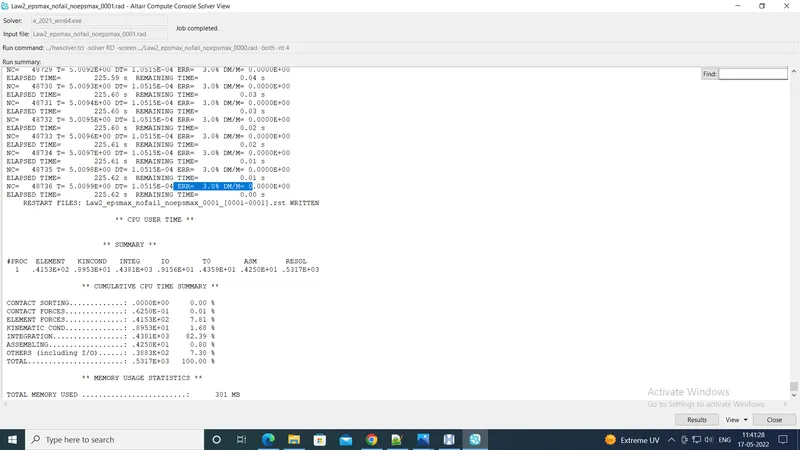
In this case, the simulation was performed by removing both the failure plastic strain (EPS_p_max) and the fail_Jhonson failure card. The images are shown below:
Case 5:
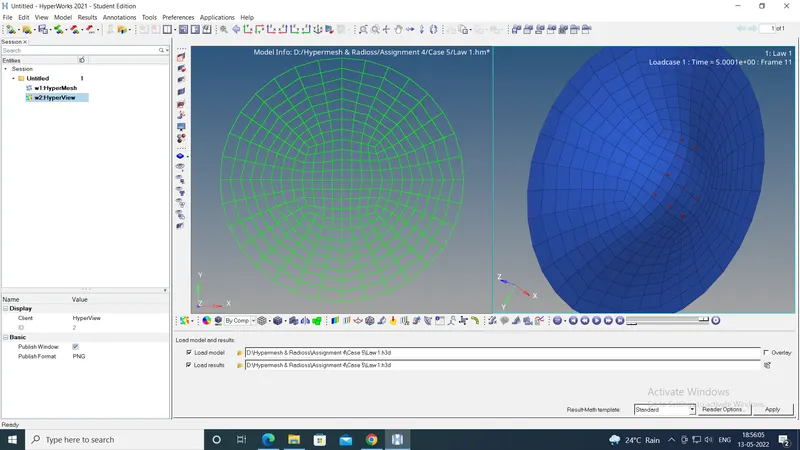
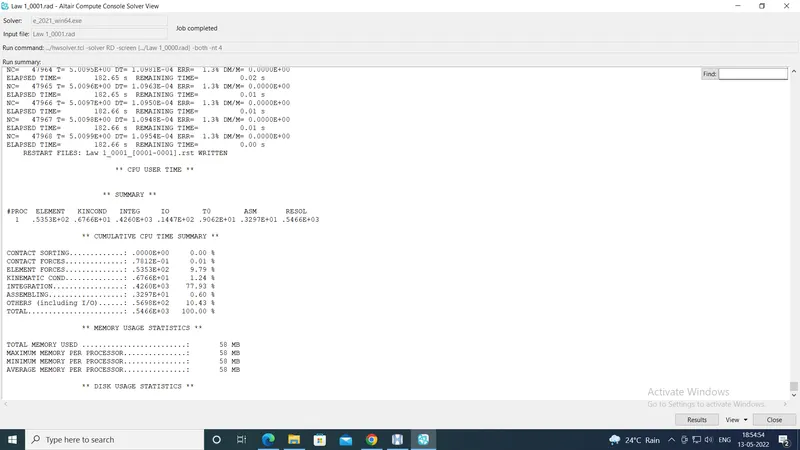
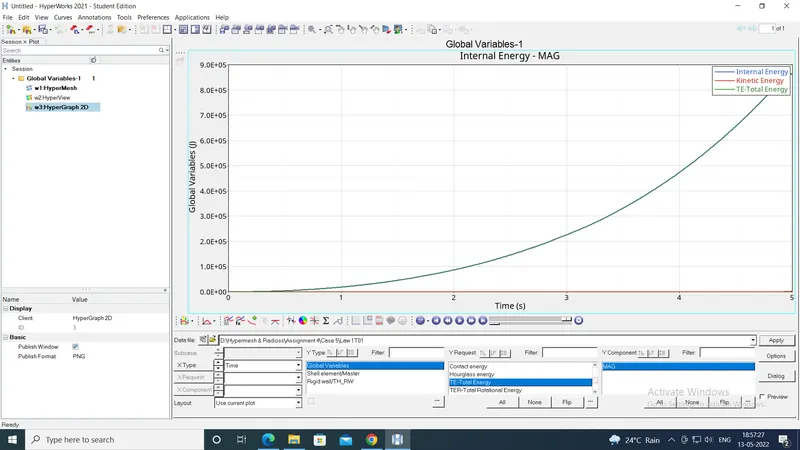
In this case, the simulation was run by changing the material card to Law 1 Elastic material and keeping the same value for rho, E, and nu values. The images are shown below:
Case 6:
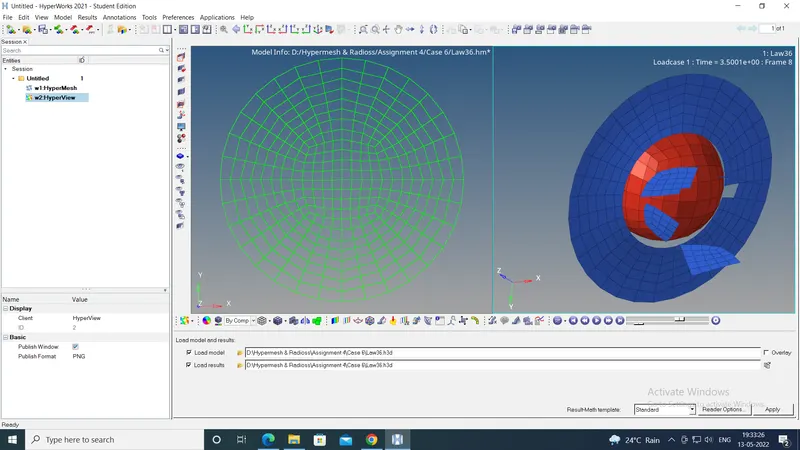
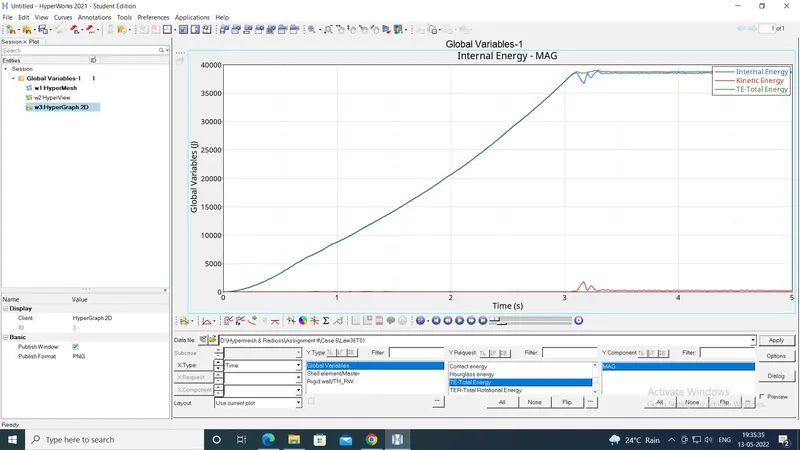
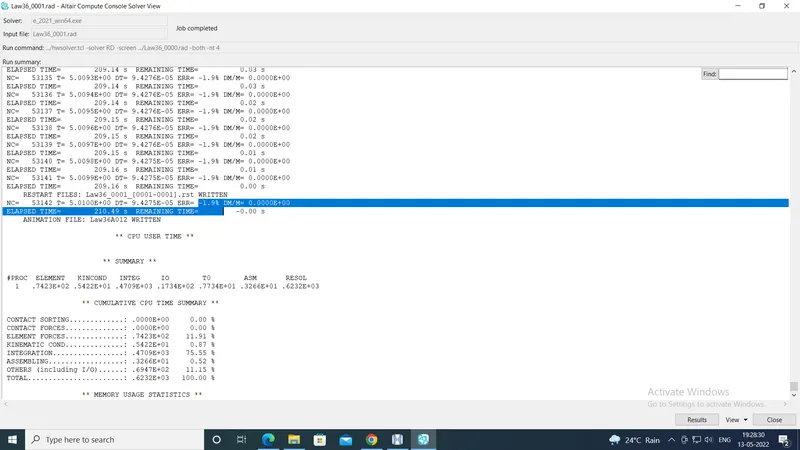
This case involved performing the simulation with the law 36 material card. The stress-strain curve of the material was defined usingthe values given in the titled "Materials 7". The images are shown below:
Case 7:
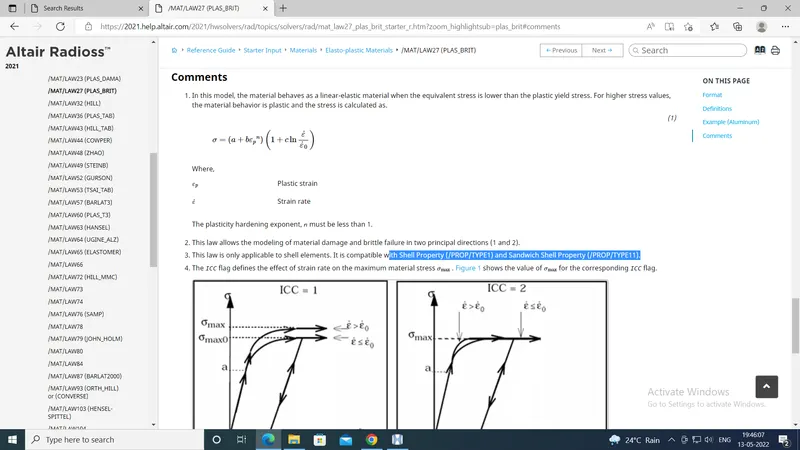
In this case the given Law27_0000.rad file was to be used with the law 27 material card using the recommended shell properties. From the Help home, it was clear that the Shell property 1 was to be used as shown below:
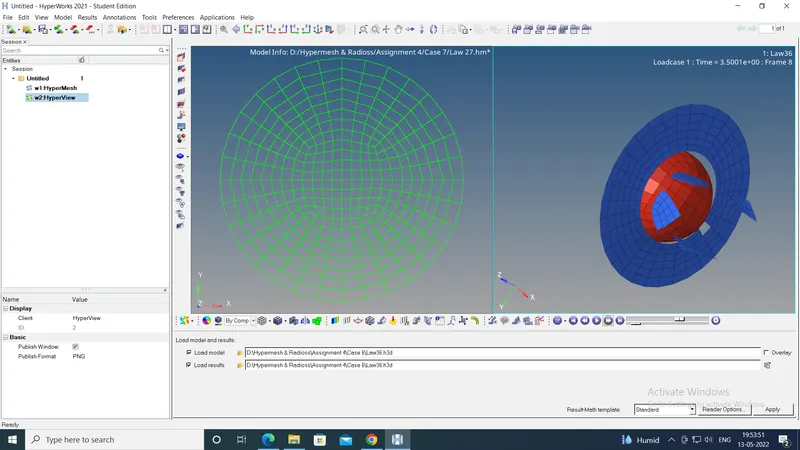
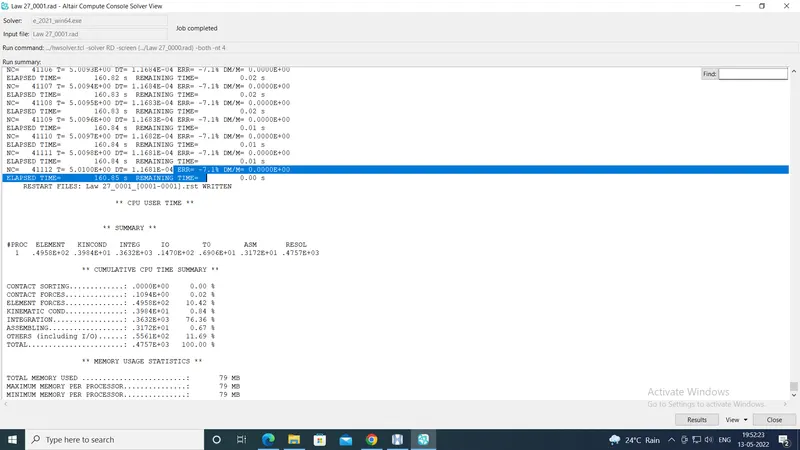
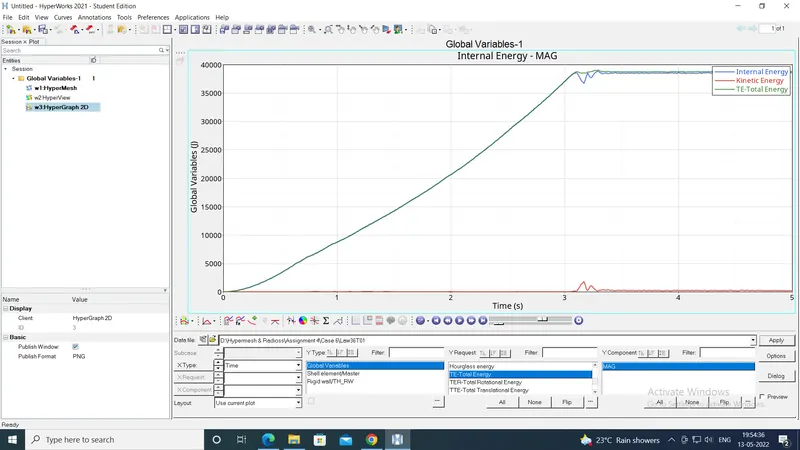
The images for the results are shown below:
Results explanation:
The results of all the 7 cases are compared in the following table:
|
Case |
Material model used |
Failure model used |
Total no. of cycles |
Energy error |
Maximum energy magnitude |
Mass error |
Simulation time |
|
Case 1 |
Johnson cook |
Johnson cook (no crack initiation) |
49379 |
0.8% |
27,000 |
0 |
218.07 sec |
|
Case 2 |
Johnson cook |
Johnson cook (with crack initiation) |
49216 |
4.1% |
31,000 |
0 |
318.30 sec |
|
Case 3 |
Johnson cook |
No failure card (but keeping eps_max) |
49407 |
0.8% |
27,000 |
0 |
197.96 sec |
|
Case 4 |
Johnson cook |
No failure card and no eps_max given |
48736 |
3.0% |
64,000 |
0 |
200.18 sec |
|
Case 5 |
Law1_Elastic |
No failure card; no eps_max |
47969 |
1.3% |
850,000 |
0 |
183.96 sec |
|
Case 6 |
Law36_Elasto-plastic |
Johnson cook failure model (no crack initiation) |
53143 |
-1.9% |
38,000 |
0 |
210.50 sec |
|
Case 7 |
Law27_Brittle |
no failure model given |
41113 |
-7.1 |
38,000 |
0 |
162.16 sec |
It can be seen that the first 5 cases are giving a positive value of energy error. This indicates a permanent loss of energy from the system. Hence the results in these cases can not be considered accurate.
In case 1, there was no crack initiation and hence the elements were deleted. As the elements are deleted, the energy is lost from the system forever, which gives a positive energy error.
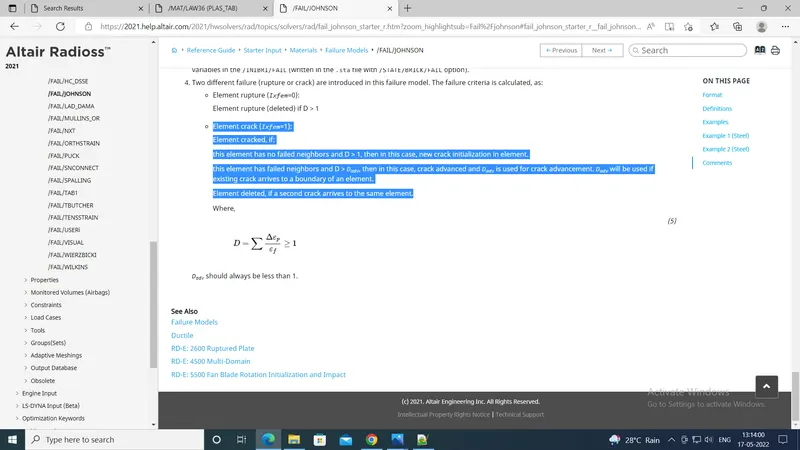
Also after about 3.8 ms, the energy in Case 1 remains constant, while it goes on increasing in Case 2. This means the elements in Case 2 can absorb more energy before they fail. This is because, in case 2, elements are cracked and they are deleted only if a second crack arrives at the same element. The crack advancement is governed by Dadv. The crack advances only if D>Dadv. This is evident from the image from Hyperworks Help, which is attached below.
All these parameters mean that the failure criteria for elements in Case 2 are a bit stricter. Hence thay absorb more energy before thay fail. Hence the maximum magnitude of energy in Case 2 is also higher than in Case 1 and hence the higher value of energy error too. The stricter criteria also increase the computational time, increasing the total simulation time.
In Case 3, no failure model is given and the elements fail when the strain value becomes greater than the maximum plastic strain at failure (eps_max). The simpler criteria mean that computational time is lower. Also the energy plot indicates that the energy remains constant after about 3.8 ms, indicating the failure of elements, which are deleted. This results in the positive energy error.
In case 4, no failure models is specified, nor the eps_max is given. Hence here the failure strain is assumed to be very very high. As a result, the elements do not fail in this case and continue to absorb the energy. Also since the failure strain is quite high, the magnitude of energy absorbed is also higher than earlier 3 cases. Also the graph shows continuous increase in the energy.
In case 5, the material law 1 for elastic material was used without providing the failure model or the eps_max value. Hence here the failure strain is assumed to be very very high. As a result, the elements do not fail in this case and continue to absorb the energy. Also since the failure strain is quite high, the magnitude of energy absorbed is also highest among all the cases. Also the graph shows continuous increase in the energy.
In case 6, the material law 36 for elasto-plastic material is used and the stress-strain curve beyond the elastic limit is defined by using the given values in the video. Here also the Johson cook failure model is used, but without crack initiation. As a result, the elements are deleted when failure criterion is reached. Hence after 3 ms the energy remains constant. Also the failure is eralier compared to first 3 cases, as the plastic region is defined by a different curve in this case. Also the energy error is negative, which is acceptable.
In case 7, material law 27 for brittle material is used. Although the energy plot is similar to case 6, the energy error is higher in case 7. Here also the elements are getting deleted, as the enegy remains constant after 3 ms.
Conclusion:
Thus from the above discussion, it is clear, that the material law 36 for elasto-plastic material is a better fit to the on-field scenario. The challenge also provided the opportunity to learn different material and failure models and their significance. The starter files for different cases have been attached as a zip file.