Assignment 4
Objective:
To change the component property and there after run the simulation and compare their parameter for various cases.
Procedure followed:
Import the Johnson failure file. [FAILURE_JOHNSON_0000.RAD]
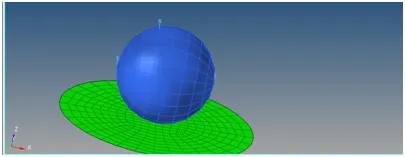
We have to run the simulation with law 2 , failure Johnson, law 27 and law 36. So as per the cases required proceeding forward.
CASE 1:
Check for material properties for law 2 of the model imported.
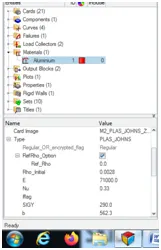
If the properties are well and good export the radioss file.
Post exporting the radioss file run the simulation and check for Energy error, mass error, total number of cycles and simulation time.
The mass error is varying in between - 0 to 0
Energy error is found to be varying in between - 1.1% & - 0.3%
Total number of cycles =49480
Simulation time = 5 ms
Running the simulation and it is found that the elements are getting cracked when applied law 2 i.e. PLAS_JOHNS/Johnson cook material.
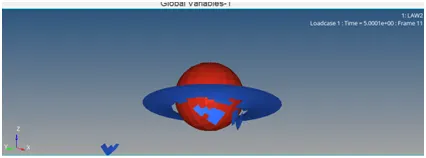
The internal energy, contact energy and hourglass energy plot are below.
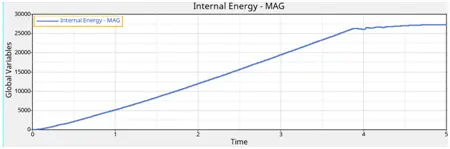 internal energy = 0~27500
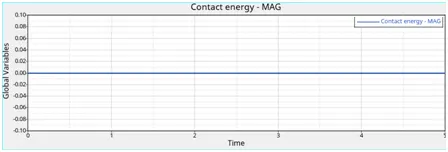 contact energy = 0
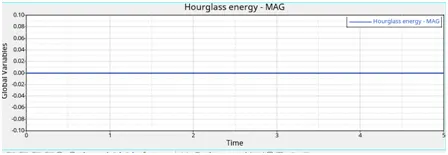 hourglass energy = 0
CASE 2
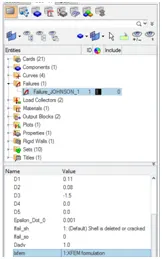
Import the law 2 file which will be input file foe case 2 , and change the failure Johnson parameters as
Ifail_sh = 1, dadv = 1, Ixfem = 1, and after changing the parameters run the simulation.
The mass error is varying in between = 0 to 0
Energy error is found to be varying in between = -0.6% to 5.9%
Total number of cycles = 49397
Simulation time = 5 ms
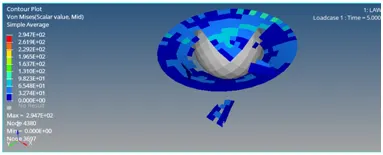
While running the simulation it is noted that the elements are getting cracked when applied material is law 2 with some property changes.
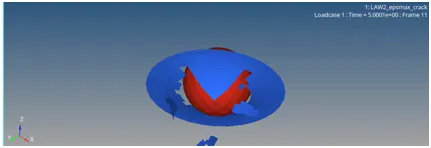
The internal energy, contact energy and hourglass energy plot are below.
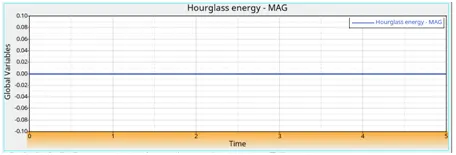 hourglass energy = 0
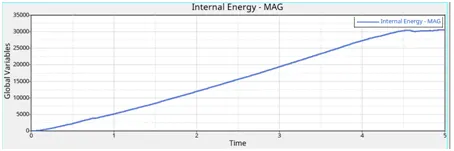 internal energy = 0~ 30000
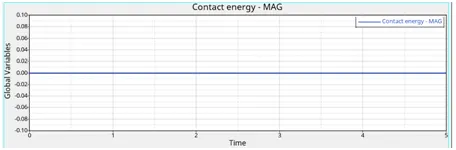 contact energy = 0
Case 3:
Now delete FAIL JOHNSON CARD and run the model as law2_eps max_nofail. Export the radios as law2 epsmax nofail.
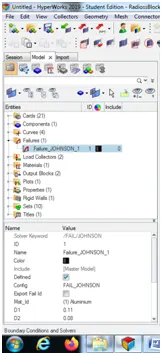
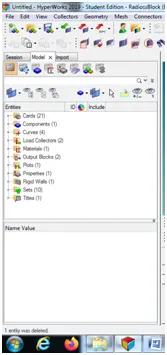
The mass error is varying in between - 0 to 0
Energy error is found to be varying in between - 0.6% & - 1.2%
Total number of cycles = 49405
Simulation time = 5 ms
Run the simulation and record the mass and energy error.
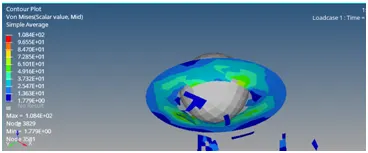
Elements are getting cracked and also the max von mises stress produced in the material varies from 1.779E+0 to 1.084E+2
The internal energy, contact energy and hourglass energy plot are below.
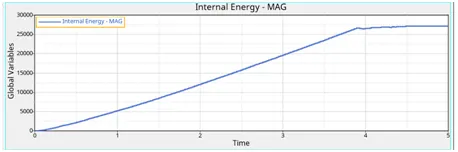 Internal energy = 0~27500
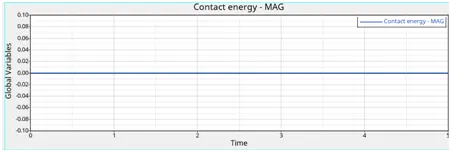 contact energy = 0
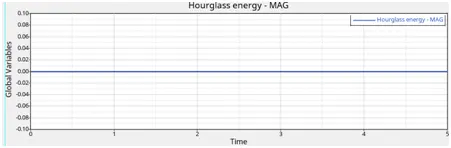 hourglass energy = 0
Case 4:
Delete the eps p max parameter i.e. mark that parameter as 0. Save the radios file and run the simulation. Record the errors and compare.
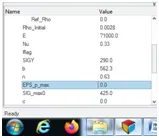
The mass error is varying in between - 0 to 0
Energy error is found to be varying in between - 0.6% & - 3.0%
Total number of cycles = 48737
Simulation time = 5 ms
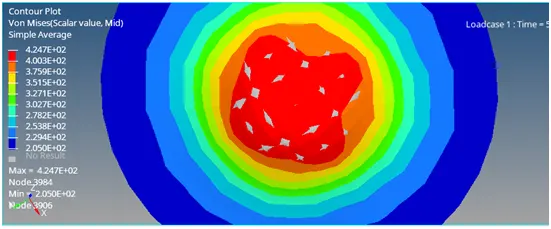
Running the simulation and it is found that Von Mises stress has the minimum value- 2.050e+2 & the maximum value- 4.247e+2 and also the elements are not cracking in this case.
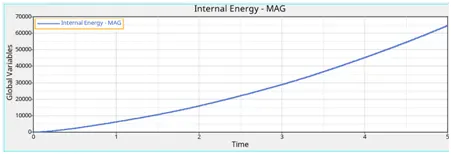 Internal energy = 0~65000
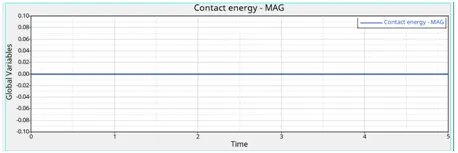 contact energy = 0
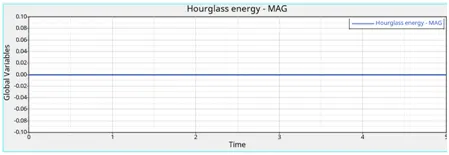 hourglass energy = 0
Case 5: LAW 1
Now change the material to law 1 material, with same density, youngs modulus and nu value and save the radios file.
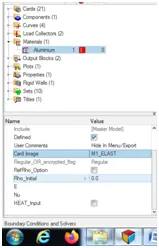
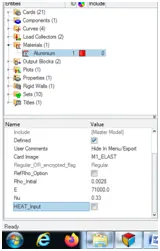
Run the simulation and note down the von mises stress,
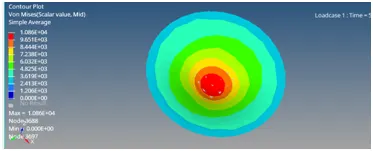
The von mises stress lies between 1.086e+4 and 0 also the elements are well organized and not getting cracked.
The mass error is varying in between - 0 to 0
Energy error is found to be varying in between - 0.6% & - 4.0%
Total number of cycles = 47969
Simulation time = 55 ms
The internal energy, contact energy and hourglass energy plot are below.
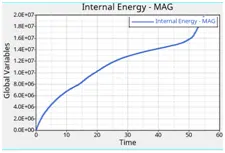 internal energy = 0~1.8E+07
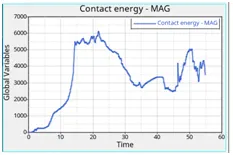 contact energy = 0
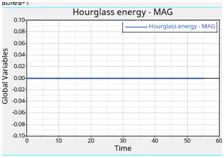 hourglass energy = 0
Case 6: LAW 27 PLAS_BRIT
Now import the law 27 file which is provided with the base assignment file and check for properties, if any property parameter need to change, according to the recommended property.
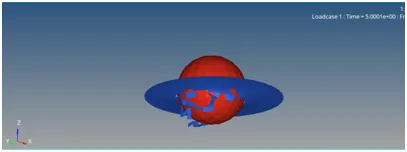
The mass error is varying in between - 0 to 0
Energy error is found to be varying in between = -4.4% & 0.8%
Total number of cycles = 41855
Simulation time = 5 ms
The internal energy, contact energy and hourglass energy plot are below.
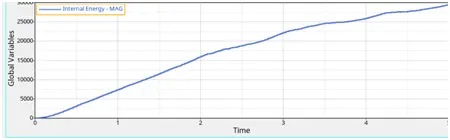
internal energy = 0~3000
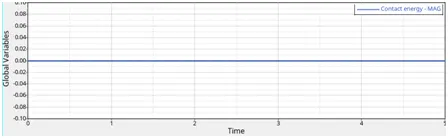
contact enrgy = 0
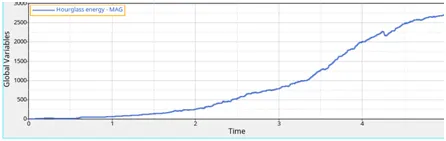
hourglass energy = 0~2450
Case 7 LAW 36_PLAS-TAB
Import the failue johnsoon file, create curve and name it plas_tab. Now assign the X & Y values for the curve as per the values provided in the question or with reference to the values provided in the learning videos.
X Y
0 300
4.84405E-4 360.13
.0011878 390.56
.0032105 442.82
0.00478134 465.98
Setting the fscale=1 and eps dot=1
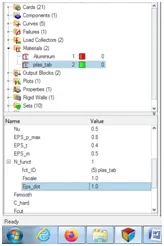
now the function is ready to go and export to radios file.
Export the radios file and name it as law 36.
And also run the simulation and compare the results with the other laws.
The mass error is varying in between - 0 to 0
Energy error is found to be varying in between = -9.4% & -0.2%
Total number of cycles = 39932
Simulation time = 5 ms
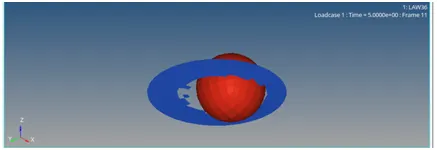
Elements are cracking while applying law 36 i.e. PLAS-TAB material.
The internal energy, contact energy and hourglass energy plot are below.
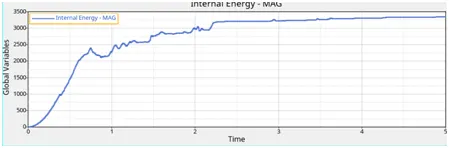
internal energy 0~3400
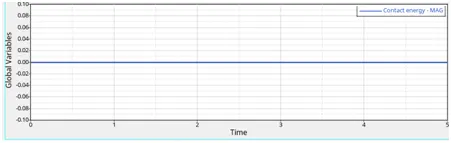
contact energy = 0
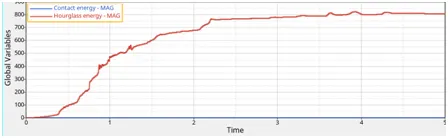
Hourglass energy - 0 to 750
Conclusion:-
On seeing all the above parameters it is better to chose LAW 1 i.e. M1 ELAST as the best material for the component.