Assignment 3-2D Element Formulation Challenge
Objective: To run the simulation of a given model and plot the rigid wall forces with designated shell properties.
Procedure:
- Change the animation steps to 60 in 0001.rad
- Change the run time to 55 ms. In 0001.rad
Case 1:
- Import the solver deck 0000.rad
- Without making any changes, run the simulation using Analysis > radioss
- Check the 0000.out file to check the energy and mass error. If the energy error is less than +5% then proceed to the next step
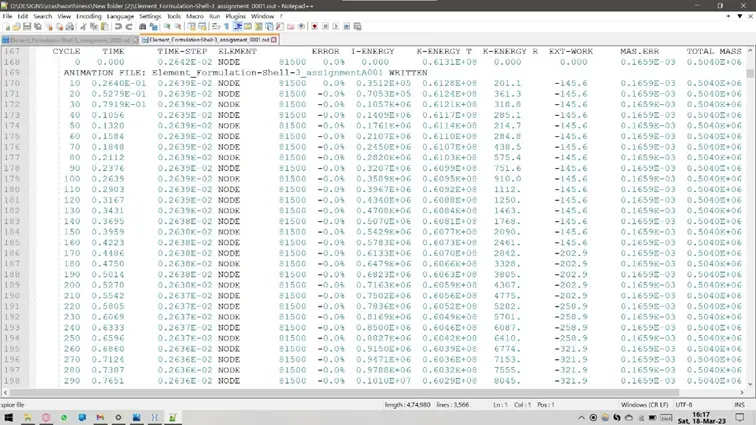
- Switch to hyperview window and import the .h3d file and apply.
- Load the results using the Contour section
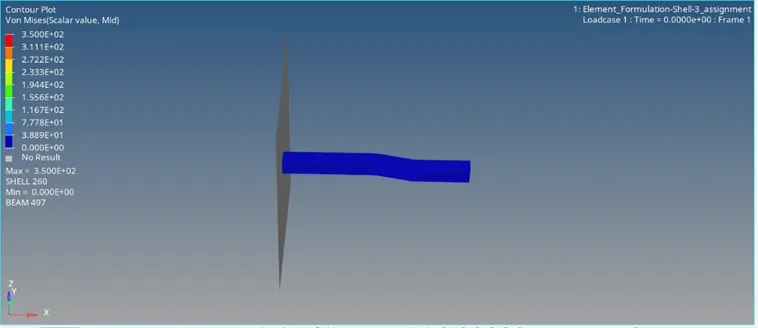
- Divide the window into two.
- Switch to Hypergraph 2D in the second window.
- Load the T01 file.
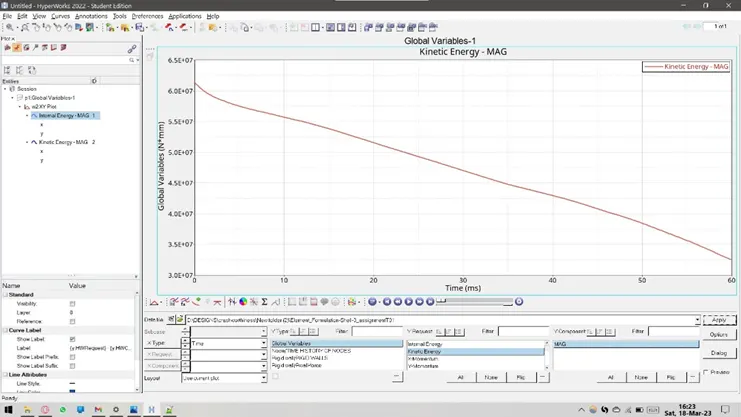
- Select the global variables of rigid wall forces and hit apply
- Select the unit.
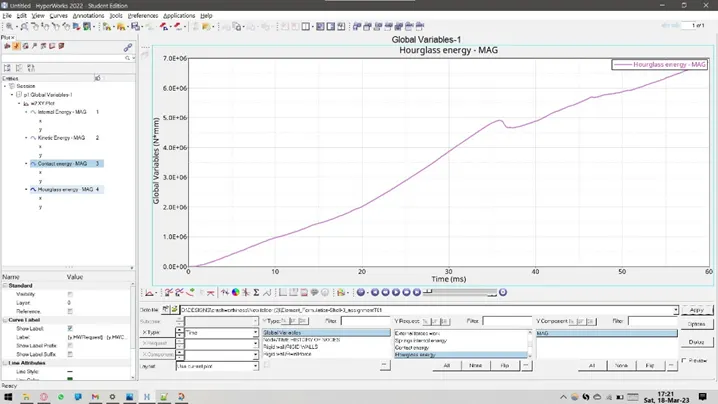
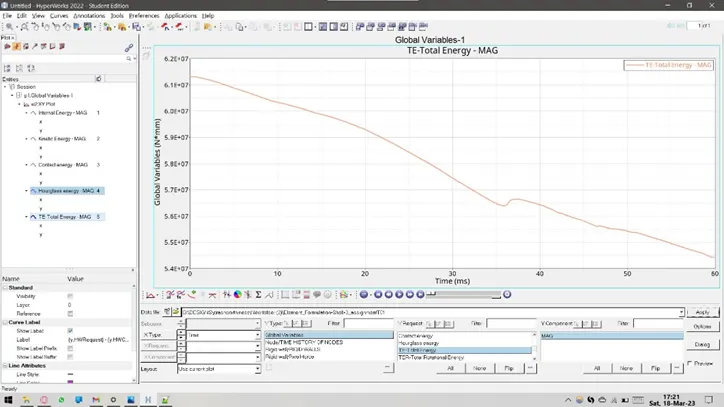
- The graph should be plotted.
- Observe the graphs.
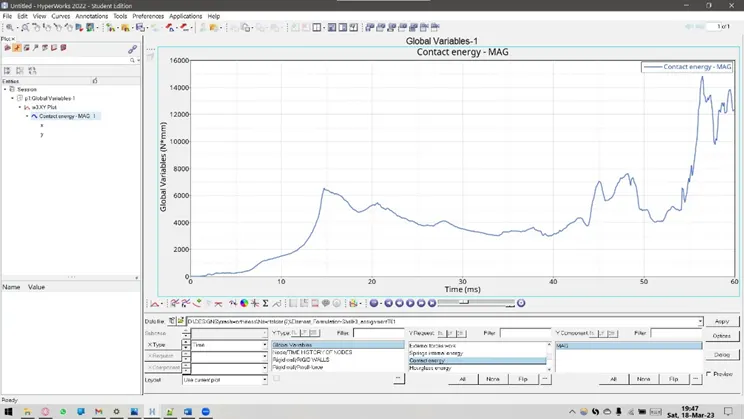
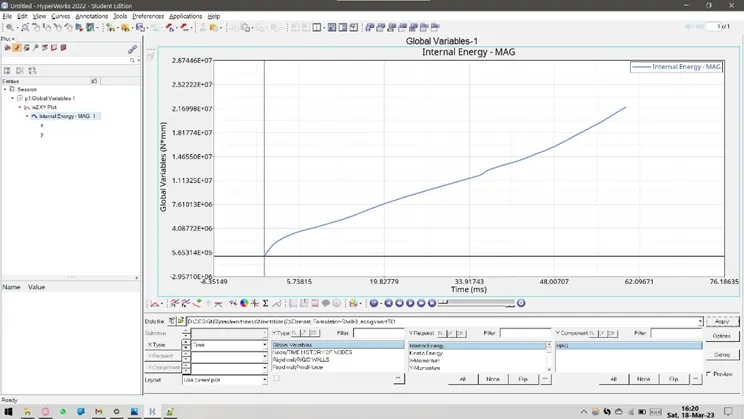
Case 2:
- In the same session, switch to Hypermesh window.
- In the Solver browser, navigate to PROP > SHELL.
- Make these changes:
- Ishell =24 QEPH
- Ismstr = 2 Full geometric nonlinearities (default) with possible small strain formulation activation in RADIOSS engine.
- Ish3n = 2 Standard 3 nodes shell
- N = 5
- Ithick = 1
- Iplas = 1
- Run the simulation using Analysis > RADIOSS
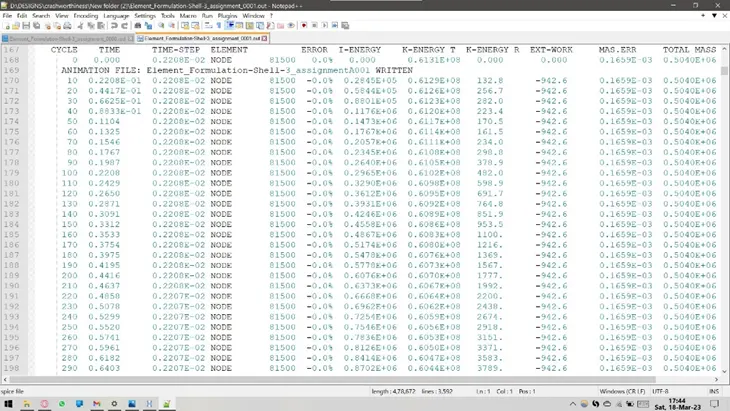
- Check the 0000.out file for energy and mass errors
- In a new window switch to Hyperview
- Load the .h3d file and apply.
- Check the results in the Contour tab
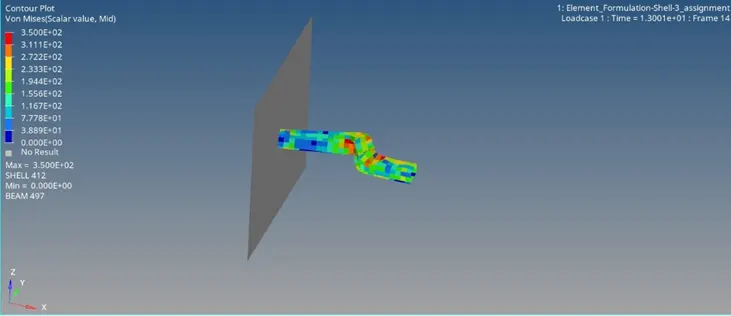
- Divide the window into two.
- Switch to Hypergraph 2D in the second window.
- Load the T01 file.
- Select the global variables of rigid wall forces and hit apply
- Select the unit.
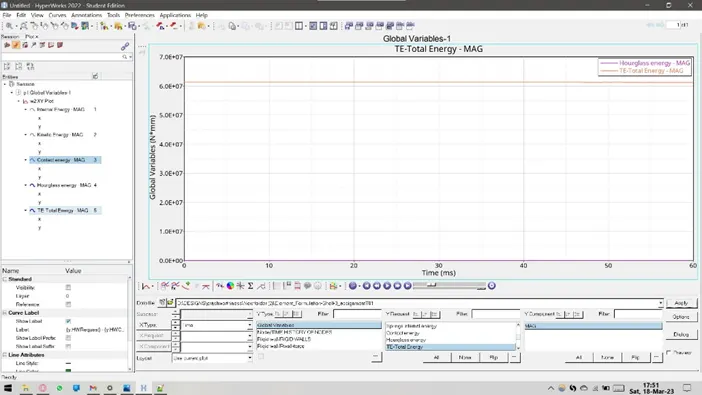
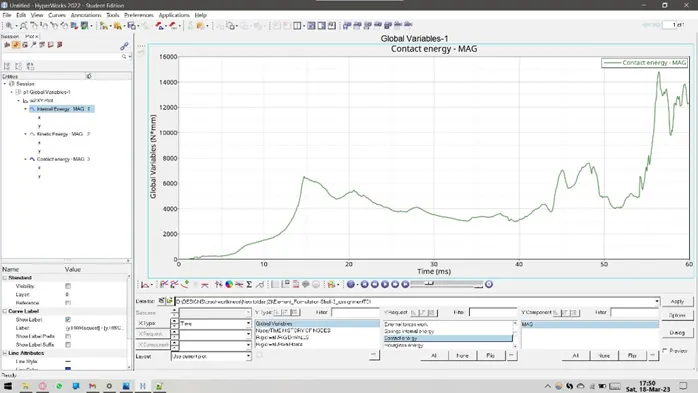
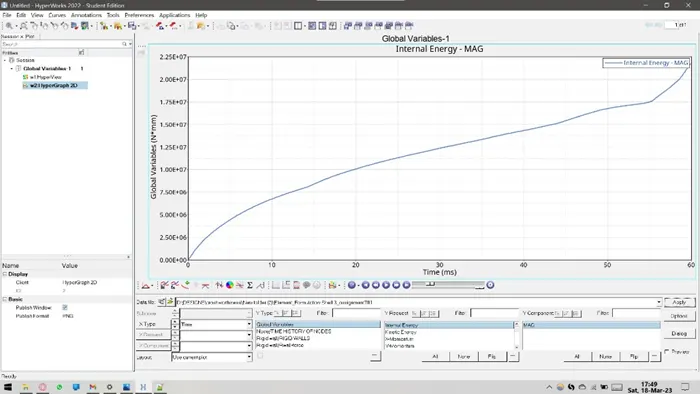
The graph should be plotted.
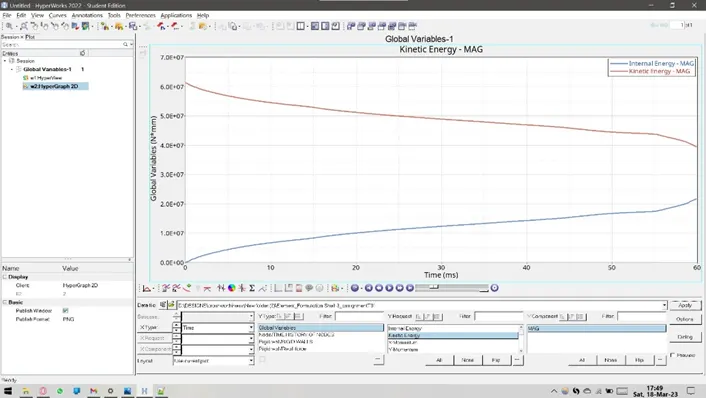
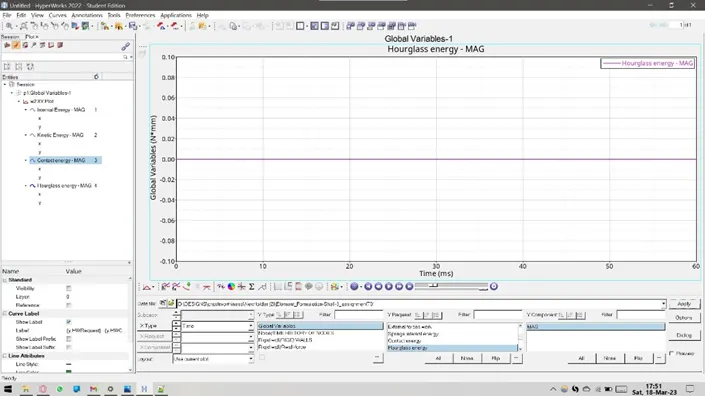
Conclusion:
After changing the properties of shell elements the hourglass and total energy smoothened out. This due to the QEPH element used in the simulation. QEPH elements use the stiffness method to prevent hourglass. In this method the hourglass treatment is done in the material level. It also spends less energy and is preferred for lower rate problems
When shells are under-integrated then non-physical zero energy deformation nodes are formed that produce no stress. This is called hourglass modes. The methods to deal with it are Perturbation (Q4 elements) and Physical Stabilization (QEPH elements).