Assignment 3-2D Element Formulation Challenge
Aim :
To import and run the Radioss file for the given changes and to compare the result using Hypermesh.
Objective :
Here we compare between two different methods they are,
Perturbation method,
Physical stabilization.
Procedure :
To import the 0000.rad file and start the simulation.
We follow the process which is given in the question.
As per the given values in the question we change the values and run the simulation.
First step it is asked to change the run time as 55ms.
Change the ANIM/DT to a value between 25 – 60, we choose 40.
In time frequency we change the value as 1.375.
55/40 = 1.375.
We run the simulation and save the .out file as case 1.
|
CASE 1 |
CASE 2 |
|
Ishell = 1 |
Ishell = 24 |
|
Ismstr = 2 |
Ismstr = 2 |
|
Ish3n = 2 |
Ish3n = 2 |
|
N = 0 |
N = 5 |
|
Ithick = 1 |
Ithick = 1 |
|
Iplas = 1 |
Iplas = 1 |
We change the values for case 2 and run the file in Radioss and save the results for case 2.
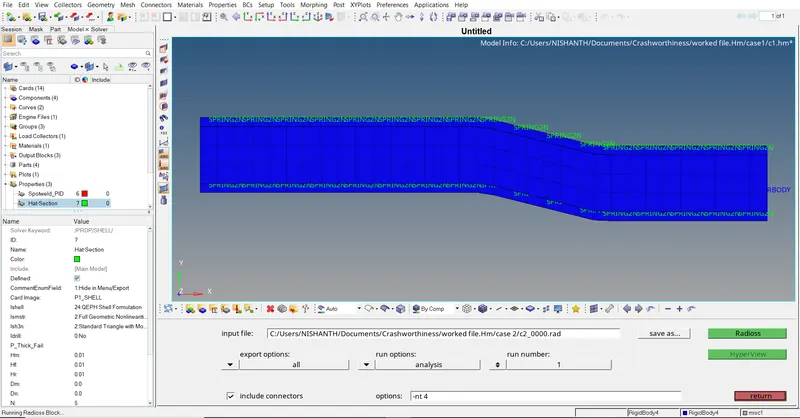
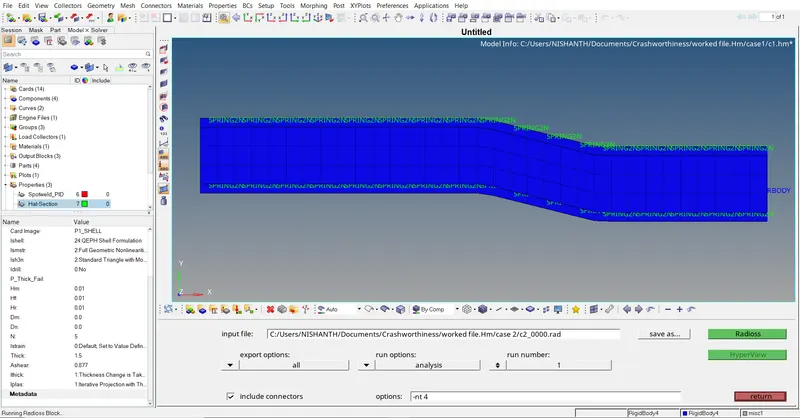
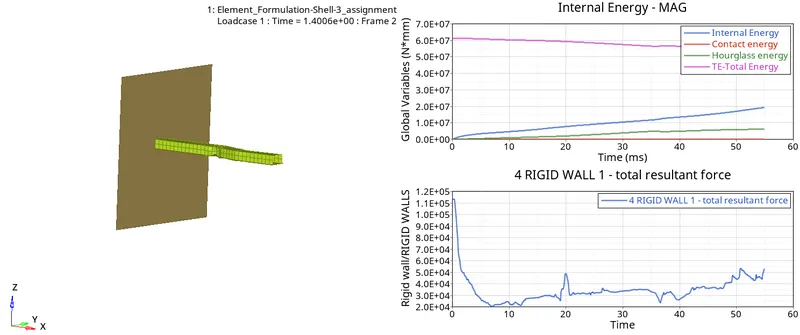
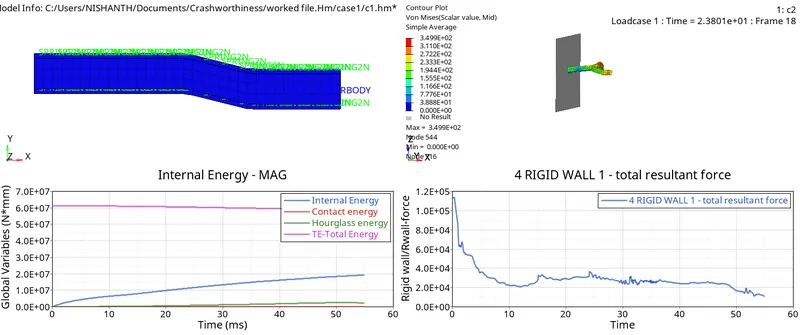
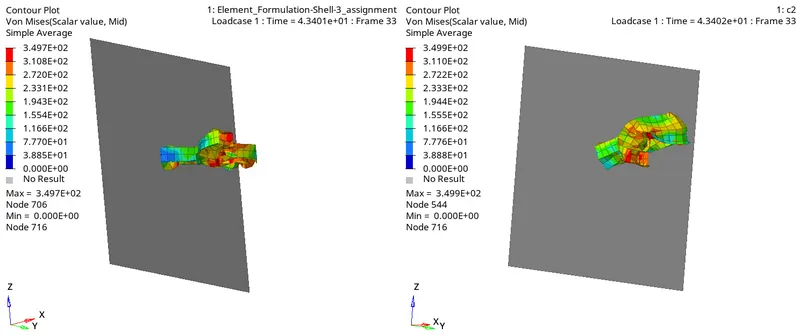
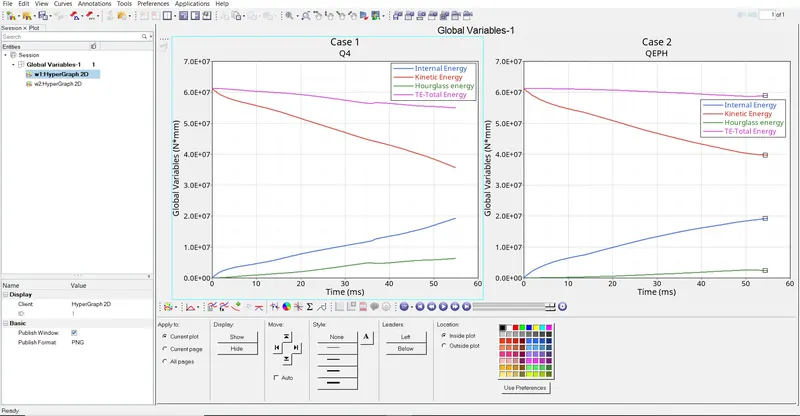
We plot the results in hypergraph and compare the result for both cases.
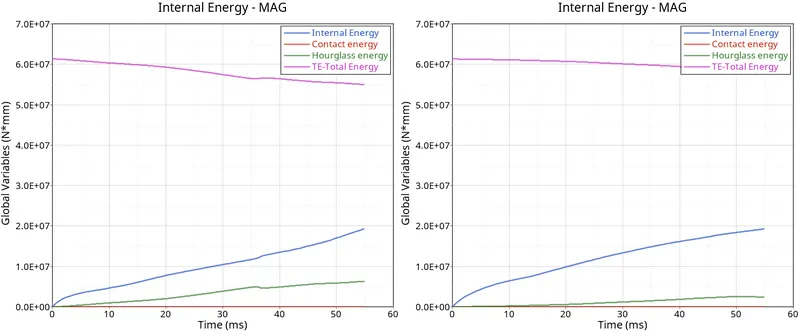
Time vs Internal energy, Hourglass energy, Contact energy, Total energy.
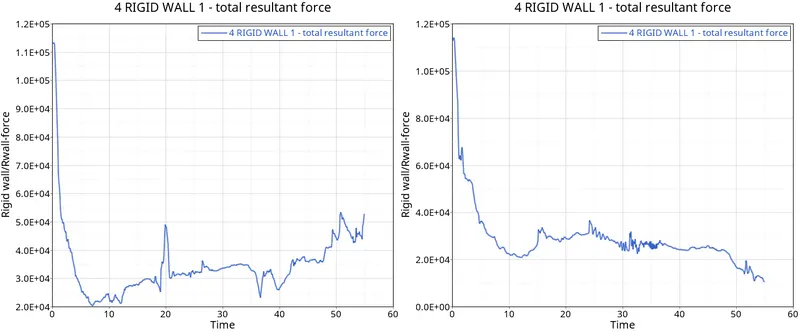
Time vs Rigid wall force.
Result comparison:
Internal energy (u): U = Q - W.
Q = heat exchanged, W = Work done.
In our case we does't consider any thermal properties so we take the only the work done in the system. We choose work done which says that when the force applied on a system the system experice a displacement.
Contact energy : It is nothing but the interface energy. It is calculated as contact force * node displacement.
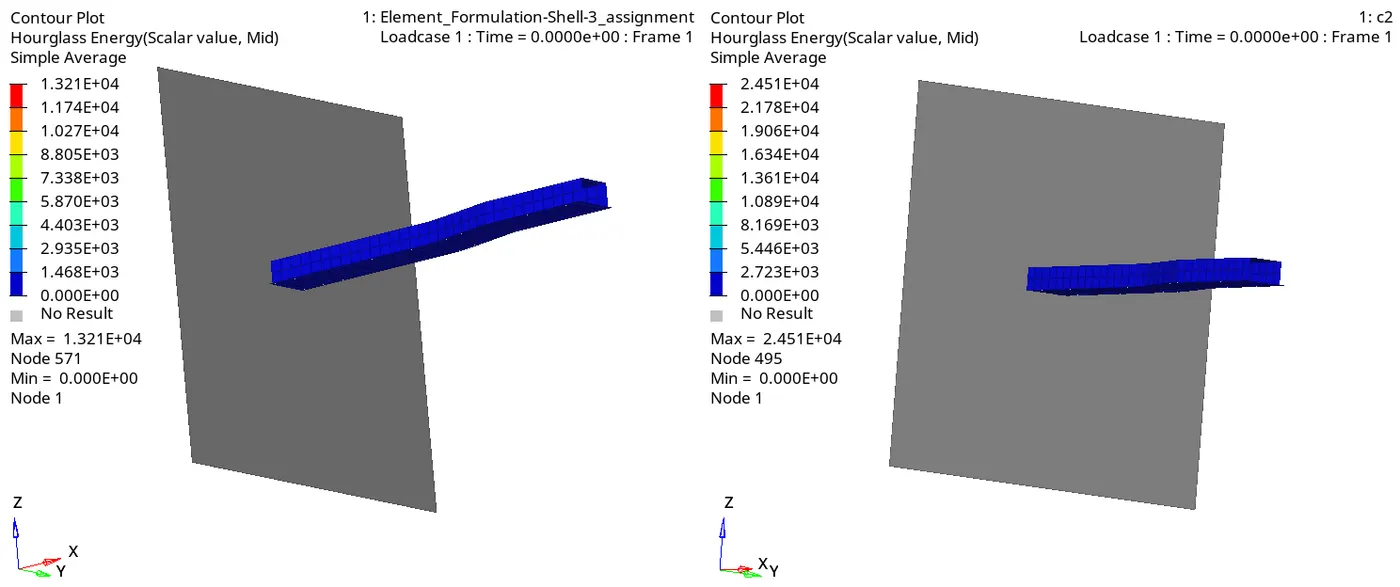
Hourglass Energy: It is the work done by the forces to counterattack the hourglass nodes. When the element in the model deforms but the strain energy is not computed for deformation it results in hourglass deformation.
Total energy : It is the sum of kinetic energy and potential energy. The total energy is directly propotional to kinetic energy.
Total Resultant force : The deformation for the given force towards the rigid wall. The resultance force decreases with respect to time with a gradual slope in the curve for case 2 which is acceptable. Whereas in case 1 there we can see more higher spike in mid of the slope. where the time and force reduction is not gradual.
Conclusion:
The value chages with comparision is done with hypergraph and we conclude with important difference between two cases.
| Case 1 | Case 2 |
|
Max energy error: 10.3% |
Max energy error: 3.8% |
|
Max internal energy: 0.1932E+08 |
Max internal energy: 0.1930E+08 |
|
Max kinetic energy: 0.3563E+08 |
Max kinetic energy: 0.3967E+08 |
|
Hourglass energy: From the plot we see that the kinetic energy deceases the internal energy and hourglass energy increases. since here under_integrated element is used for simulation, there is an hourglass assosiated with it. |
Hourglass energy: Ishell = 24, which is an improved under_integrated element with physical hourglass stablization. |