Assignment 3-2D Element Formulation Challenge
MAIN OBJECTIVE; We have to compare the results with a base simulation and improved shell element properties.
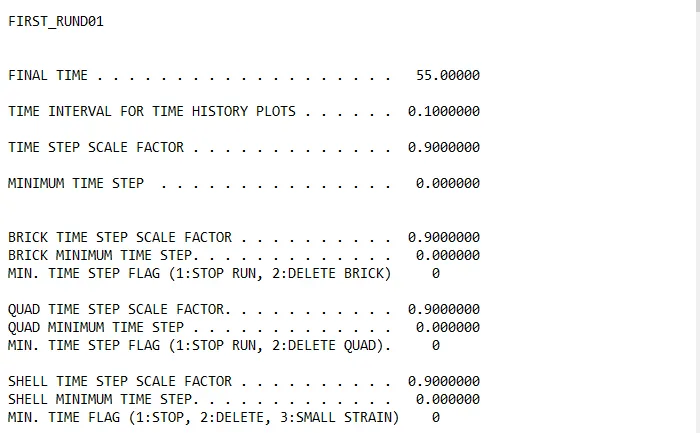
1.Using the crash beam file from the previous assignment, change the run time to 55 ms.
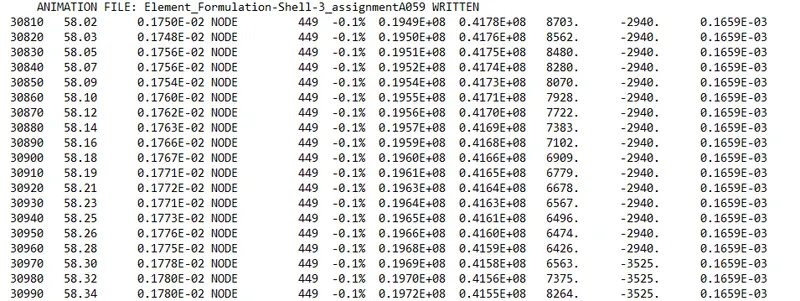
Here we import the previous assignment starter file and where we change the run time to 55 m/s and go to analysis >radioss>save the file and run the file and we see the results in an engine rad file which we can see in the below image.
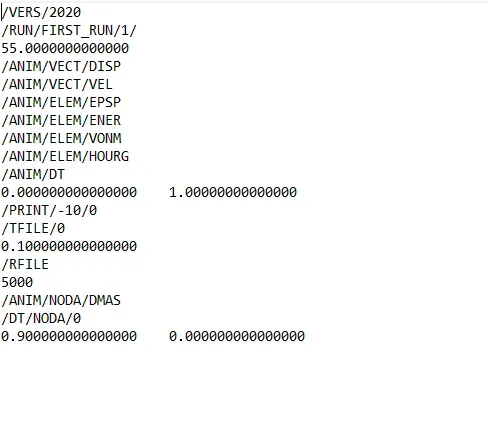
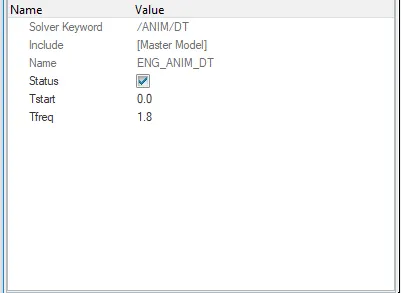
2. Change the number of animation steps during simulation to a minimum of 25 and a maximum of 60.
Here we have to take an average value of these animation steps and we take the 30 as the average value and set the frequency in the Anim DT card.
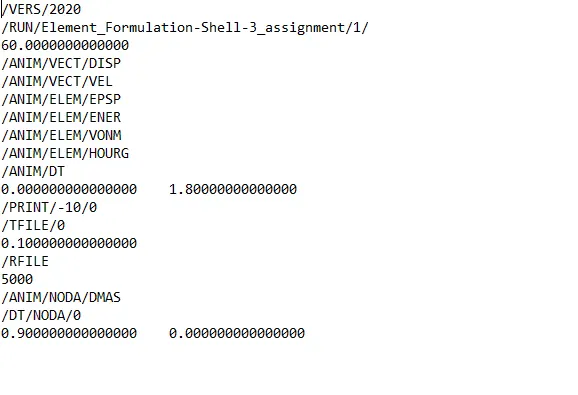
CASE1
3. Run the base simulation without any modification to element properties.
- Go to file>import option>solver deck>choose the radio..file>import it.
- Now we have to run the file as without mentioning properties to the files.


4. At the end of the simulation, do the energy error and mass error checks and determine whether the results would be acceptable.
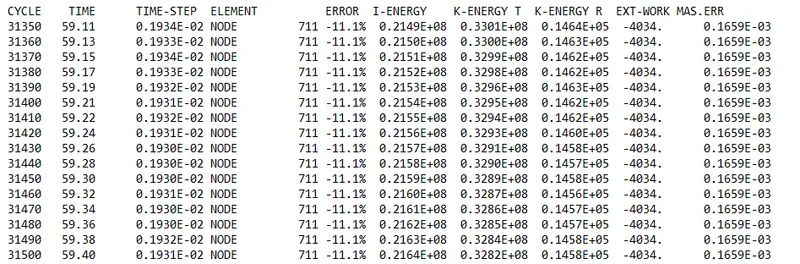
The energy error must be negative and ideally, the error should go up to -15% and below +5% and our simulation gets an -11% energy error and mass as 0.1659, here we go to plot the rigid wall forces and all other energy simulations.
5. If acceptable, Plot rigid wall forces, internal energy, hourglass energy, contact energy, the total energy of the simulations.
Hypergraph 2D;
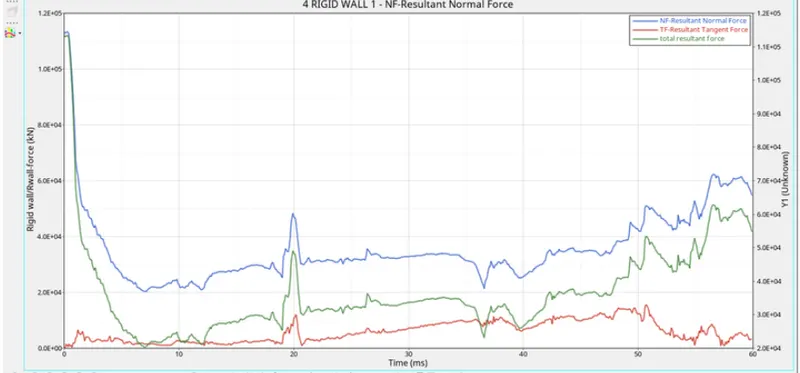
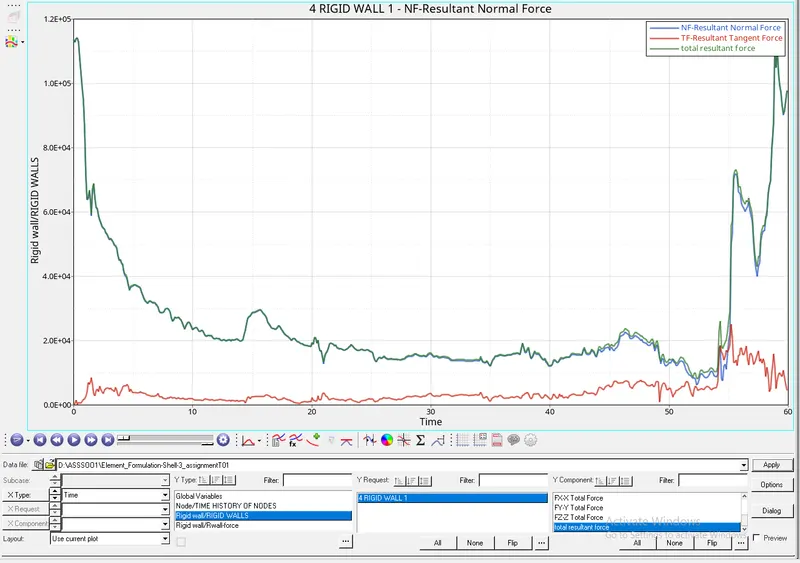
Here we go plot these rigid wall forces to the kinetic, internal energy, contact, hourglass, and total energy.
for these plots, we have imported the T01 files to the hypergraph 2d folder.
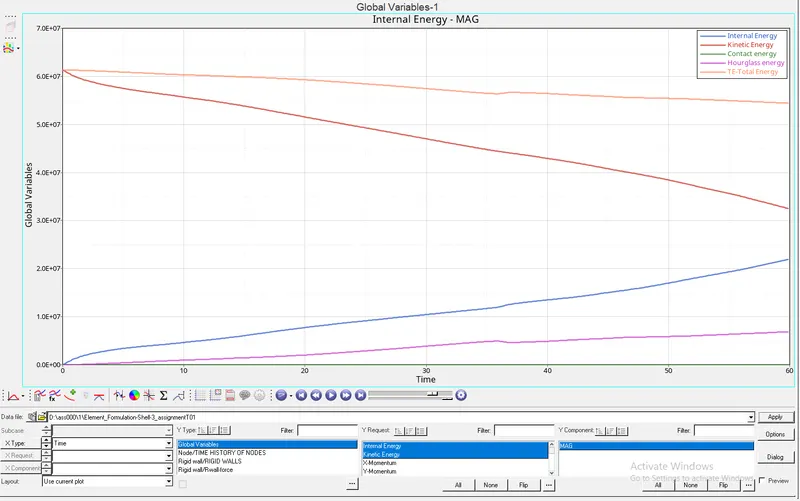
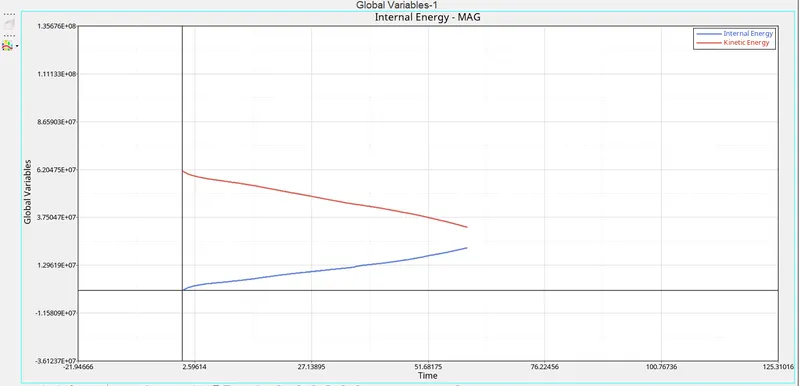
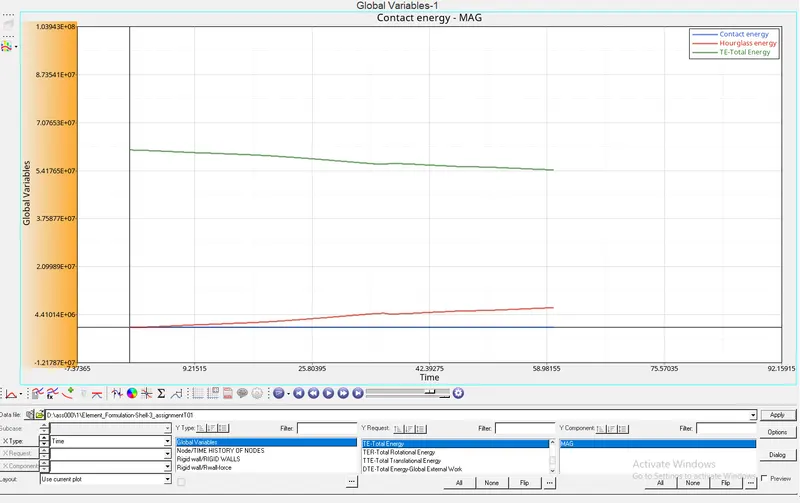
In these, we see that normal force was increasing from the starting point and it will become slowly because the internal force was opposing to resist to that external force which was acting upon them.
Hyper view;

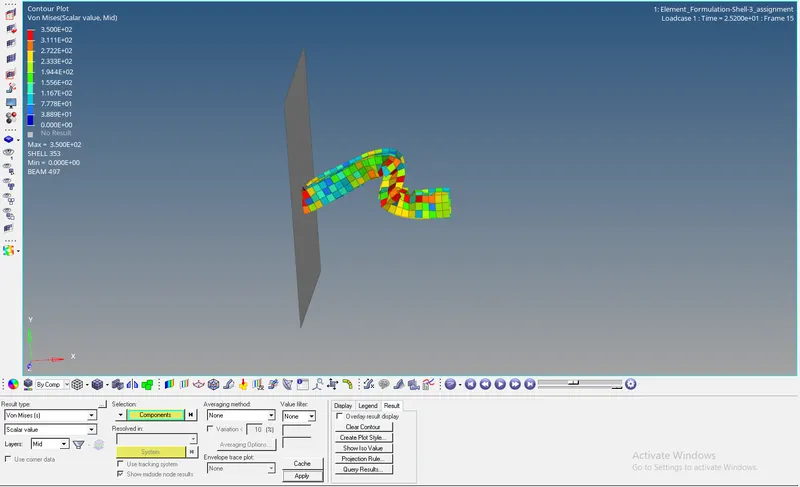
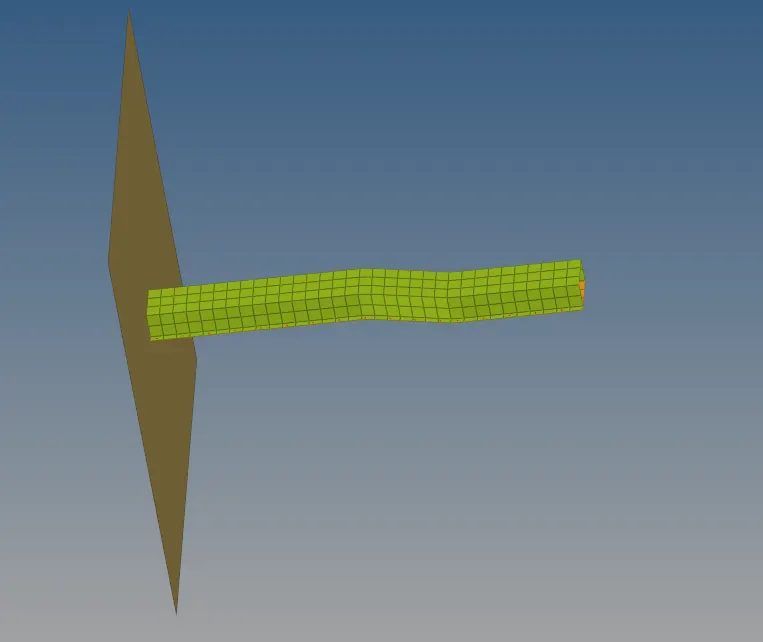
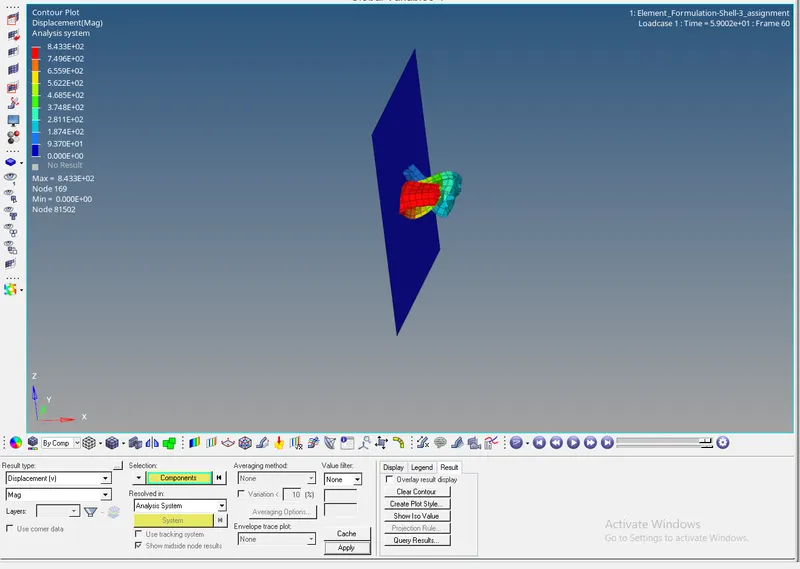
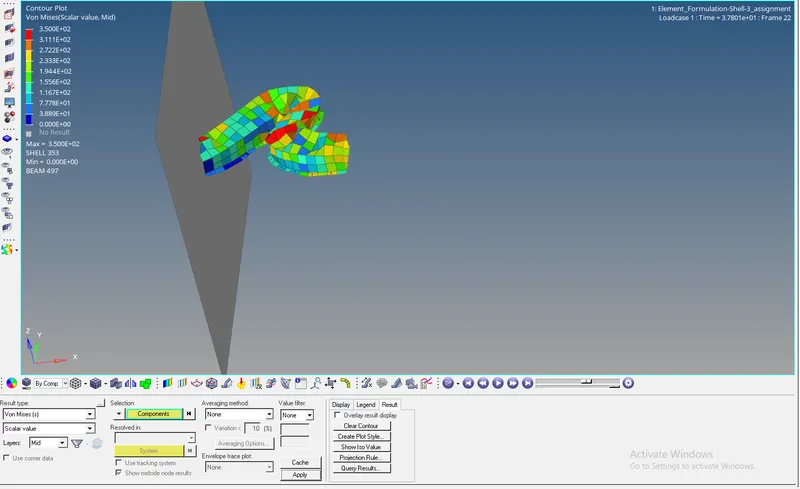
After importing the h3d files in hyper view we contour the rail component for displacement, hourglass, and von Moises
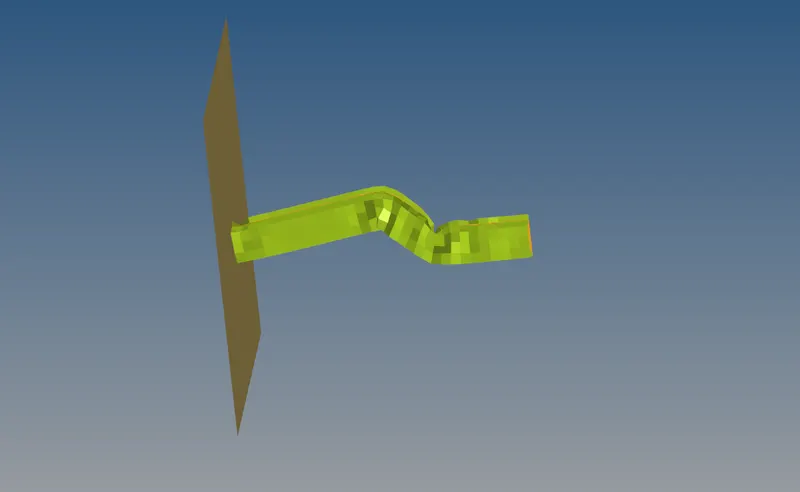
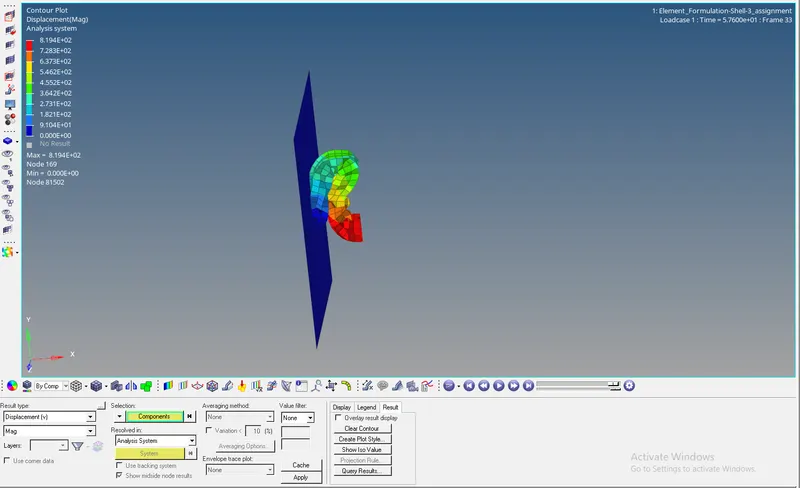
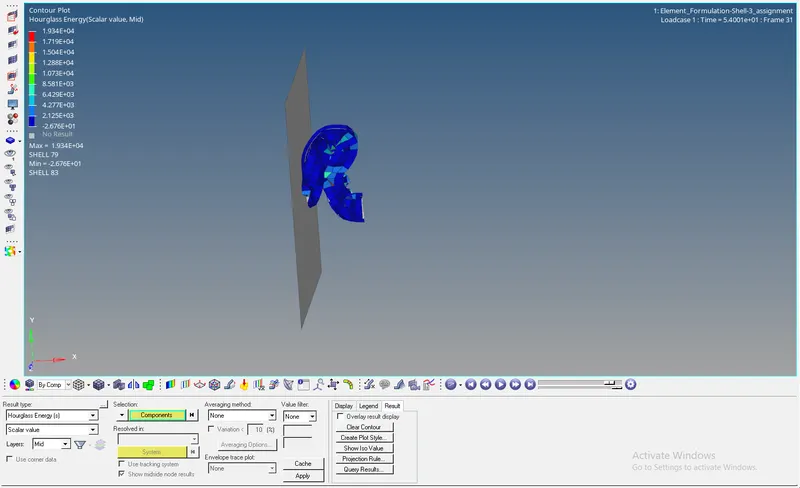
Von Mises stress is a value used to determine if a given material will yield or fracture. The von Mises yield criterion states that if the von Mises stress of a material under load is equal or greater than the yield limit of the same material under simple tension then the material will yield or not.
CASE2
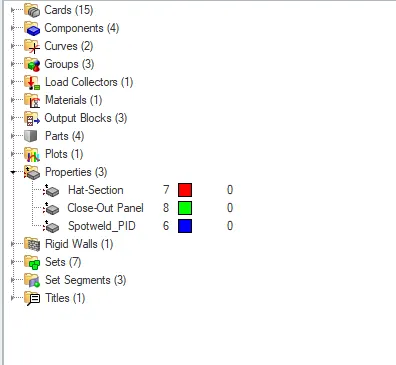
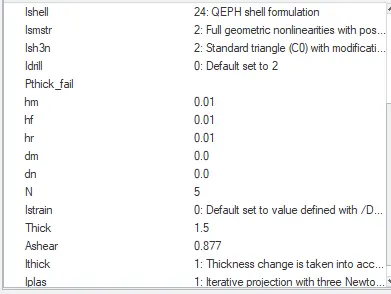
6. Change all the shell elements properties to recommended properties, save this as separate, rad files, and run the simulation.
Recommended properties:
| Parameters | Comment | |
|
Ishell =24 |
QEPH 4 node shells are the best combination of cost and accuracy. | |
|
Ismstr=2 |
Full geometric nonlinearities (default)with possible small strain formulation activation in RADIOSS Engine. | |
|
Ish3n=2 |
Standard 3 noded shell (C0)with modification for large rotation(default) |
|
| N=5 | The number of integration points set to 5 for accuracy bending. | |
|
Ithick=1 |
Thickness change is taken into account for accuracy. |
|
|
Iplas=1 |
Iterative plasticity for good accuracy. |


At the end of the simulation, do the energy error and mass error checks and determine whether the results would be acceptable.
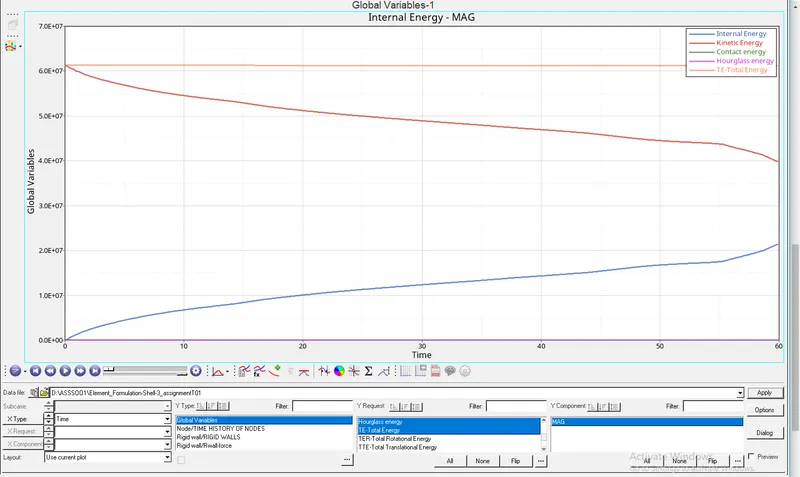
Hyper graph2D;
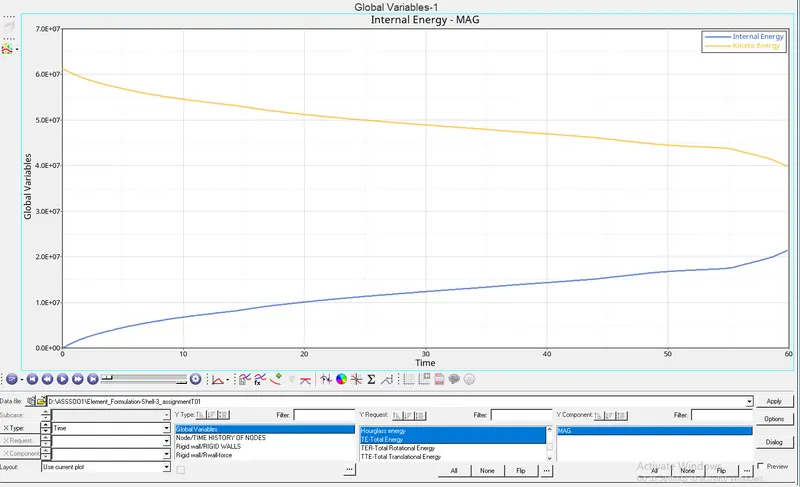
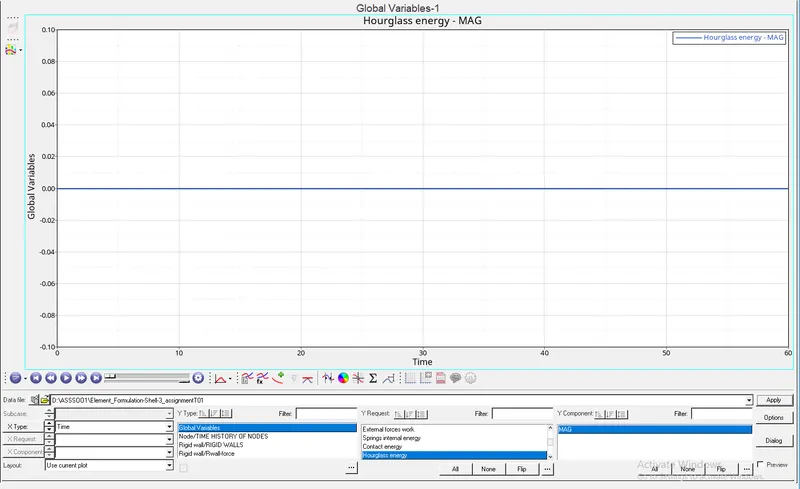
hyper view;

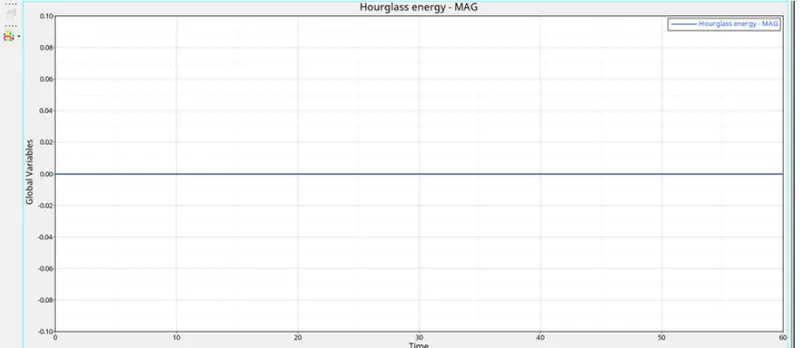
By comparing to case 1 we have reduced the hourglass energy completely adding and Ishell element properties to the rail component.
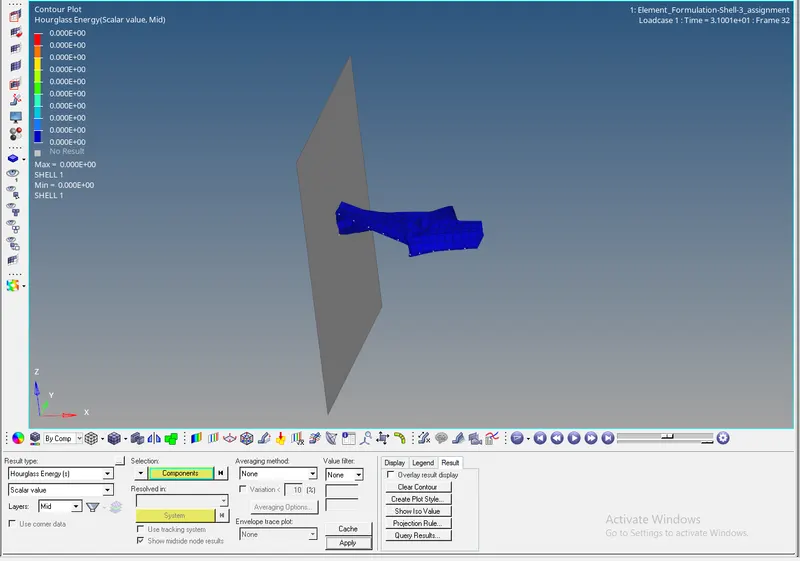
HOURGLASS FORMATION;
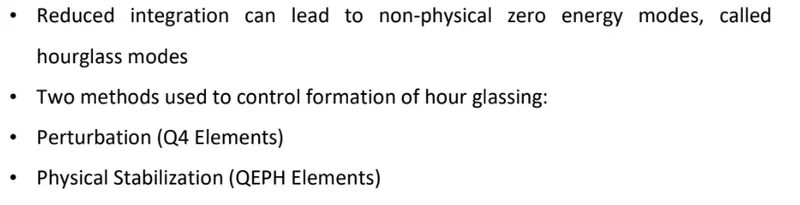

Perturbation Method;
it is a vicious method when the hourglass is forming there is damping force is applied due to this damping the hourglass is stabilized in order to control the speed of the hourglass entering the body.
The hourglass deformation is detected with the relative motion(velocity)of the nodes.
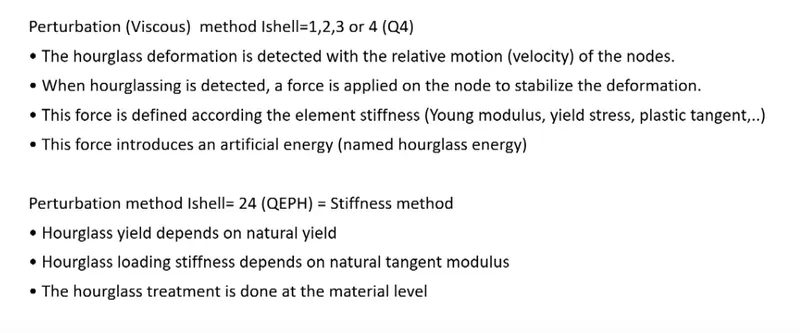
physical stabilization;
The hourglass treatment is done at the material level directly and makes them avoid the hourglass formation at starting level only.
hourglass yield depends on natural yield.
stiffness method is used to control the hourglass formulation.
CONCLUSION;
Here we having two plots case1 and case2 in which we run the simulation without any modification and next one we use recommended shell properties to the components.
case1; In which we run the based simulation without any modification components.
- Kinetic Energy - The kinetic energy is high at the starting regarding the energy of mass in motion(velocity) with respect to the time and it's gradually decreasing due to the elements collide each other and stops the possibility of the element moving further.
- Internal energy; The internal energy starts at low because there is no strain formation and it will increases slowly as displacement will increases.
- Hour Glass Energy - since the properties are not assigned to the rail component, the graph shows the clear result that hourglass energy is not stabilized and causes improper deflection of the elements.
- Contact Energy - There is no contact or friction between the surfaces, so the contact energy is not exceeded in this simulation and it can be seen that the contact energy curve is at zero for the entire simulation.
- Total Energy - Total energy is a combination of the sum of all different types of energies of a body, it will include kinetic energy and potential energy of a system. The total energy is high at the start and reducing gradually due to the reduction of kinetic energy also there is no external load acting upon it.
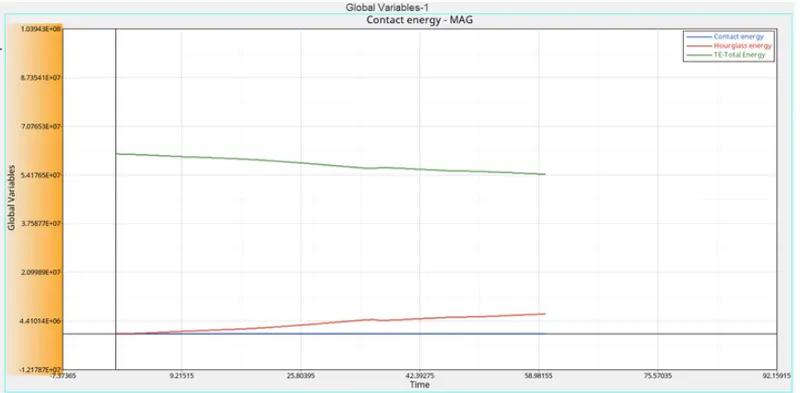
case2;
we use recommended improved shell element properties to the components.
I shell =24 Qeph is an improved under integrated 4 noded element With one point integration formulation.
- physical hourglass stabilization and make the results accurate by avoiding the hourglass formulation.
- The best compromise between cost and time.
Ismstr = 2, full geometric nonlinearities. It is applicable for the material that undergoes small strain deformation and also for a large strain with large displacements and strains. we recommended for mostly large strain deformations of nonlinearities.
Ish3n, This is for the three noded elements. since the component has meshed with four noded, there is no hourglass deformation.
N=5 is the number of integration points set through the thickness which we recommended up to 5 integration points for the accuracy of the simulations.
Ithick =1, The thickness changes are taken into the account. determine if the thickness is constant under load or if the element thins
Iplas =1, Iterative plasticity for good accuracy, choose the method for calculating post-yield strains.
In this case2 we add the improved shell element properties to the rail component and by these, we can clear the hourglass formation decreased to constantly.