AIR STANDARD CYCLE
AIM- To write a programm in matlab to create the pv-diagram of otto cycle and calculate the efficiency
THEORY -
Otto cycle :- a four-stroke cycle for internal-combustion engines of the type used in automobiles wherein the first stroke consists of the suction into the cylinder of the explosive charge (as gas and air), the second stroke consists of the compression, ignition, and explosion of the charge, the third stroke consists of the expansion of the gases, and the fourth stroke consists of the expulsion of the products of combustion from the cylinder .
DIAGRAMS -
FIG-1( PRESSURE-VOLUME DIAGRAM) FIG-2(TEMPERATURE -ENTEROPY DIAGRAM)
PROCESSES-
- Process 0–1 a mass of air is drawn into piston/cylinder arrangement at constant pressure.
- Process 1–2 is an adiabatic (isentropic) compression of the charge as the piston moves from bottom dead centre(BDC) to top dead center (TDC).
- Process 2–3 is a constant-volume heat transfer to the working gas from an external source while the piston is at top dead center. This process is intended to represent the ignition of the fuel-air mixture and the subsequent rapid burning.
- Process 3–4 is an adiabatic (isentropic) expansion (power stroke).
- Process 4–1 completes the cycle by a constant-volume process in which heat is rejected from the air while the piston is at bottom dead center.
- Process 1–0 the mass of air is released to the atmosphere in a constant pressure process.
FORMULA USED -
SWEPT VOLUME - vs = pi/4*bore^2*stroke
Clearence volume- vc = vs /(cr-1)
where vs = swept volume .
cr = compression ratio .
Total volume = vt = vs+vc
Adiabatic process = PV^gamma = C
where P = pressure of the system .
V= volume of the system .
gamma = ratio of specific heat of fluid .
change of the volume inside the chamber = v/vc=1+0.5(cr-1)[(R+1-cos(theta) - (R^2-sin^2(theta)^0.5)]
where v = volume inside the cyclinder .
R = ratio of length rod to crank pin radius (a); (a) = stroke length(l)/2
vc = clearence volume .
cr = compression ratio .
Thermal efficiency of otto cycle = 1 - (cr^(1- gamma))
cr = compression ratio .
gamma = ratio of specific heat of fluid .
CODE-
MAIN PROGRAM :
clear all
close all
clc

% inputs
gamma = 1.2
t3 = 2400
p1 = 101325
t1 = 560

% engine geometric parameter

bore = 0.1;
stroke= 0.1;
con_rod = 0.15;
cr = 12;

% calculation of clearence and swept volume

v_swept = (pi/4)*bore^2*stroke;
v_clearence = v_swept/(cr - 1)

v1 = v_swept + v_clearence;
v2 = v_clearence;

% state variable at point 2
% p2*v2^gamma = p1*v1^gamma
% p2 = p1*(v1/v2)^gamma
p2 = p1*(cr)^gamma

%p1*v1/t1= p2*v2/t2
t2 = (p2*v2*t1)/(p1*v1)
constant_c = p1*v1^gamma;

v_compression = engine_kinematics(bore,stroke,con_rod,cr,180,0);
p_compression = constant_c./v_compression.^gamma;
% of state variable at point 3
v3 = v2
% p3*v3/t3=p2*v2/t2
p3 = p2*t3/t2

constant_c = p3*v3^gamma;

v_expansion = engine_kinematics(bore,stroke,con_rod,cr,0,180);
p_expansion = constant_c./v_expansion.^gamma;

% of state varibale at point 4

v4 = v1
% p3*v3^gamma = p4*v4^gamma
p4 = p3*(v3/v4)^gamma
%p3*v3/t3 = p4*v4/t4
t4=p4*v4*t3/p3*v3

% thermal efficiency
t_e = 1 - (cr^(1- gamma))


figure(1)
hold on

plot(v1,p1,'*','color','r');
plot(v_compression,p_compression)
plot(v2,p2,'*','color','r');
plot([v2 v3],[p2,p3],'linewidth',1)
plot(v3,p3,'*','color','r');
plot(v_expansion,p_expansion)
plot(v4,p4,'*','color','r');
plot([v4 v1],[p4 p1],'linewidth',1)


xlabel('volume');
ylabel('pressure');
hold off
FOR FUNCTION PROGRAM :
function [v] = engine_kinematics(bore,stroke,conc_rod,start_crank,end_crank)


a = stroke/2
R = conc_rod/a


v_s = pi/4*bore^2*stroke;
v_c = v_s /(cr -1);

theta = linspace(start_crank,end_crank,100);
 term1 = 0.5*(cr-1);
 term2 = R+1- cosd(theta);
 term3 = (R^2-sind(theta).^2).^0.5;
 v = (1+term1*(term2-term3)).*v_c
end
RESULT =
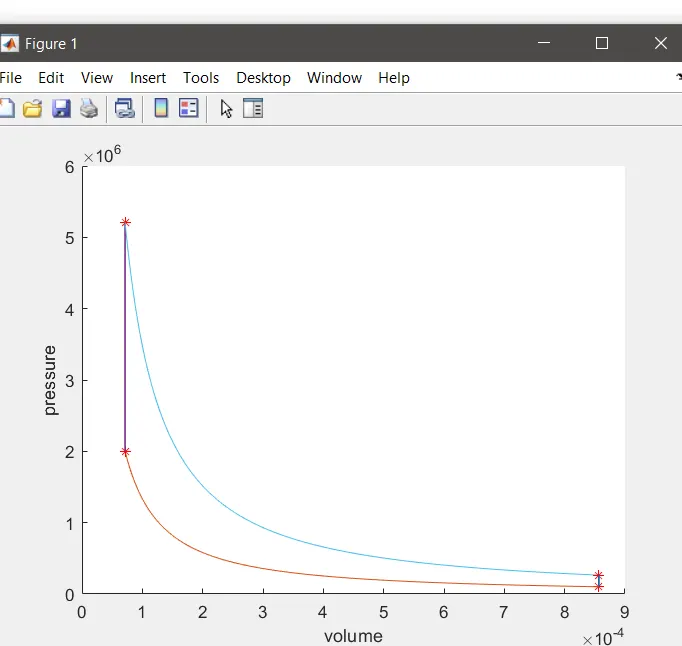
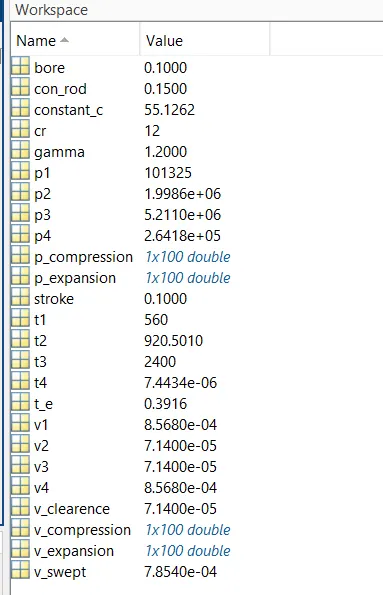
CONCLUSION - The PV - diagram of all the four process has been plotted.
The thermal efficiency of a otto cycle is = 0.3916 or 39.19%
it can be noticed that thermal efficiency is depend upon the compression ratio of the engines and type of fluid used so the engine with higher compression ratio wil have high thermal efficiency.