Study and Simulation of Ahmed Body (ANSYS FLUENT)
AIM:
To understand the importance and application of the ahmed body.
OBJECTIVE:
- Describe Ahmed's body and its importance.
- Explain the reason for the negative pressure in the wake region.
- Explain the significance of the point of separation.
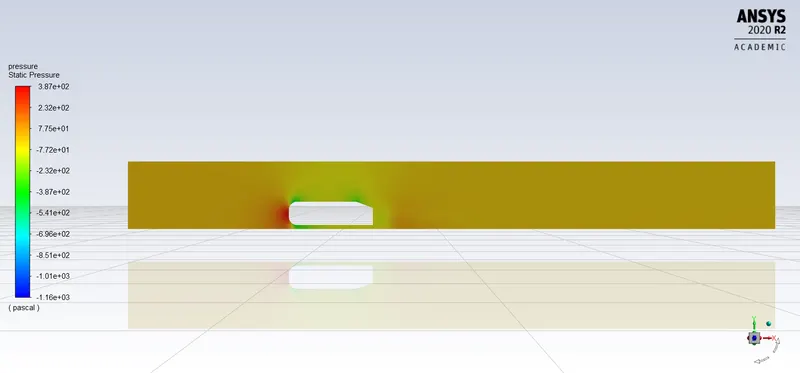
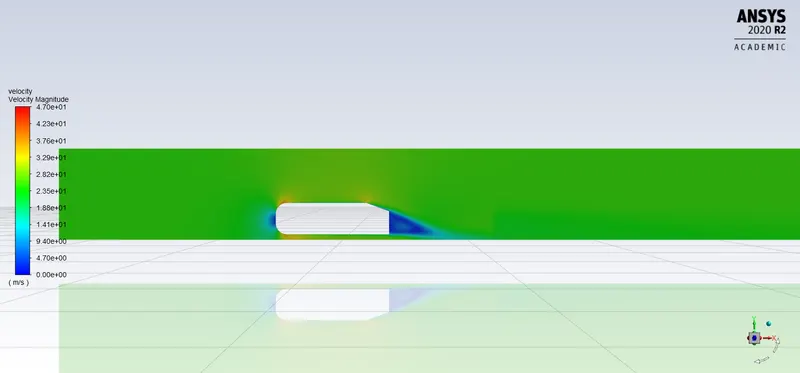
- Velocity and pressure contours.
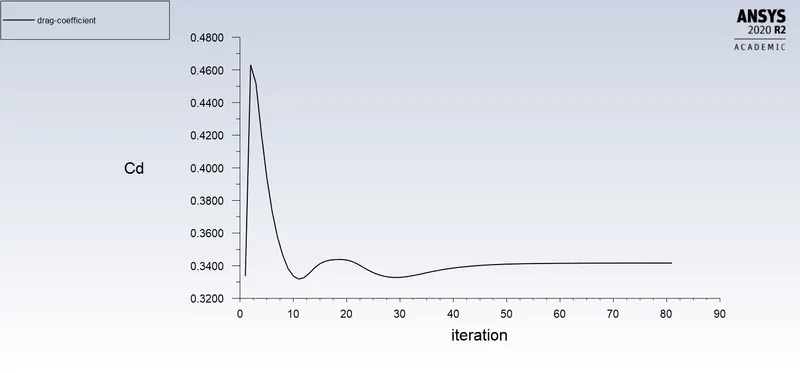
- The drag coefficient plot for a refined case. ( For velocity of 25m/sec, the drag coefficient should be around 0.33).
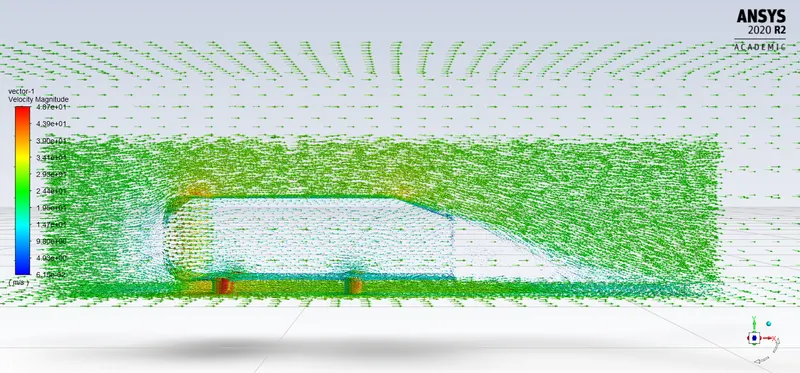
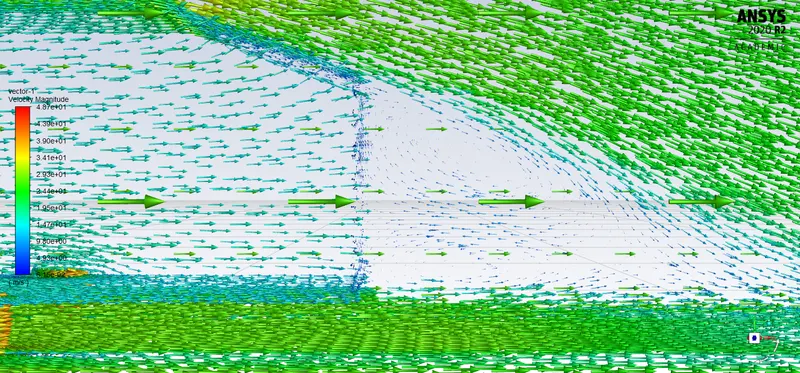
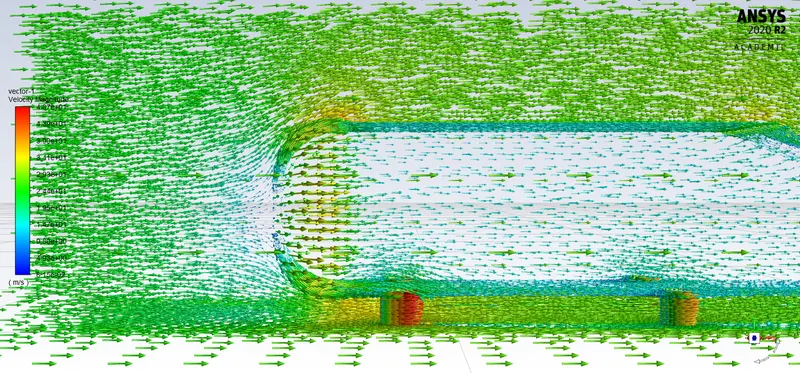
- The vector plot clearly showing the wake region.
- Perform the grid independency test and provide the values of drag and lift with each case.
THEORY:
Ahmed body:
The Ahmed body is a generic car body (a simplified vehicle model). The airflow around the Ahmed body captures the essential flow features around an automobile and was first defined and characterized in the experimental work of Ahmed . Although it has a very simple shape, Ahmed body allows us to capture characteristic features that are relevant to bodies in the automobile industry.
This model is also used to describe the turbulent flow field around a car-like geometry. Once the numerical model in validated, it is used to design new models of the car.
Negative pressure in wake region:
When the air moving over the vehicle is separated at the rear end, it leaves a large low pressure turbulent region behind the vehicle known as the wake. This wake contributes to the formation of pressure drag, which is eventually reduces the vehicle performance. It is characterised by large vortex formation behind the rear of the vehicle.
Point Of Seperation:
The position at which the boundary layer leaves the surface of a solid body. It may occur with the laminar flow (laminar separation) or when the boundary layer is turbulent (turbulent separation). Separation is sometimes followed by reattachment of the flow. The point of seperation has a huge impact on the nature of the wake generated by the vehicle. the nature of the wake created by the vehicle affects various characteristics of the vehicle such as downforce creation, drag, handling characteristics etc. if the flow seperation occurs earlier then the wake created is more and thus the drag on the vehicle is more, conversly if the point of seperation is farther from the reference point the wake created is lesser and thus so is the drag. This is why racecars have extremely long rear ends(ie to delay flow seperation from the body of the vehicle)Thus it is extremely important to understand the nature of the flow past the point of flow seperation.
Drag:
In fluid dynamics, drag (sometimes called air resistance, a type of friction, or fluid resistance, another type of friction or fluid friction) is a force acting opposite to the relative motion of any object moving with respect to a surrounding fluid. This can exist between two fluid layers (or surfaces) or a fluid and a solid surface. Unlike other resistive forces, such as dry friction, which are nearly independent of velocity, drag forces depend on velocity. Drag force is proportional to the velocity for a laminar flow and the squared velocity for a turbulent flow. Even though the ultimate cause of a drag is viscous friction, the turbulent drag is independent of viscosity.
STEPS:
- launch space claim; open the Ahmed body(a.b) model; convert the units to metres
- create an 'enclosure' around the a.b; uncheck symmetry; enter the dimensions.
- create a 2nd 'enclosure' (region of refinement) inside the first, this is to get better simulation results without wasting the computational power
- 'supress physics' of the a.b to prevent a.b from affecting external mesh.
- Open the meshing interface, after updating the mesh in workbench;name all necessary faces(use f8 to hide unnecessary faces)
- use 'cut plane' to check the mesh quality
- to improve the mesh quality:
- Add inflation layer around a.b -> use total thickness option for best inflation region
- In 'space claim' run interference check, click the tick symbol to solve problems(overlap); set share topology to share
- Right click (r.c) on mesh -> insert method -> set method to multizone.
- set element sizer; in sizing set max size to element size
- r.c on mesh -> insert sizing -> set inside element size smaller than outer mesh size.
- r.c on mesh -> insert sizing for the legs of a.b -> select a.b legs -> make mesh size smaller - open fluent after updating the mesh; perform mesh check
- physics -> general -> pressure based;absolute;steady state -> set turbulence model to k-omega sst
- update the reference values;
- set up boundary condition for all walls
- solution -> hybrid initialisation -> enter number of iterations
- post processing -. create cut plane -> define velocity and pressure contours;
- set up the lift and drag coefficient graphs
- create animation.
- hit calculate
- open cfd post -> check desired values/ plots.
Grid Independence test
| type | lift coefficient | drag coefficient |
| case 1 (30 mm) | 0.262 | 0.34 |
| case 2 (50 mm) | 0.247 | 0.37 |
| analytical | 0.33 |
RESULTS:
CONCLUSIONS:
- From the above plots we can clearly see the wake region of the Ahmed body.
- We can observe the region of flow seperation
- having two enclosure reagion not only saves computational time but helps create more detail in regions of interest
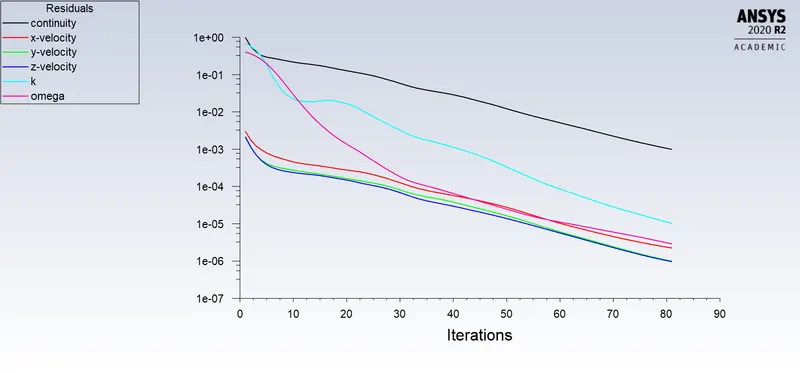
- From the residuals plot we can see that the solution has converged at 80 iterations
- The coefficient of drag is 0.34
- The coefficient of lift is 0.262
- the wake region is a region of low velocity vortices.
- we can see from the pressure contour, the green regions are regions where the velocity is changing. we can also see that the pressure is highest in the frontal arear of the Ahmed body
- from the velocity contours we can see that the point of flow seperation. We can also see that the wake region is characterised by low velocity and very few velocity vectors
- As the grid size increases the accuracy of the solution also decreases.We are unable to run simulations for a finer mesh as we are ristricted by the lisence.