Ahmed Body Challenge
Aim: To perform external aerodynamic simulation over an Ahmed body and calculate drag and lift coefficient for a free stream velocity of 25 m/s. Also perform mesh independence test
Introduction:
Ahmed Body-
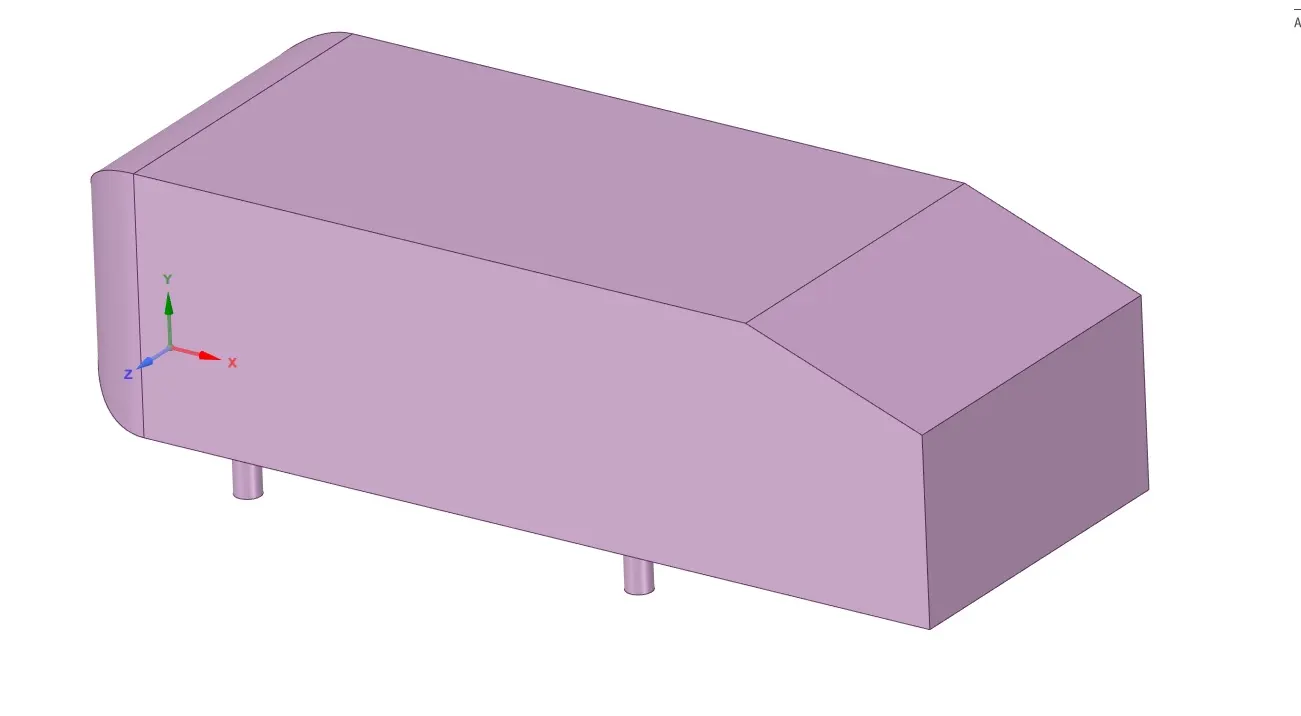
The Ahmed body was at first put forward by Ahmed et al. (1984). is a general car model which is used by the automotive industries (Morel (1978), Good and Garry (2004), Guilmineau and Chometon (2009), Heft et al. (2012) and Huminic and Huminic (2012)), to examine the wake forces and dynamics which is experienced in a variety of configurations. The Ahmed body is designed to have a smooth-edged front end with a flat roof and a flat bottom section and an angled back slant which basically acts as the rear window of a car and ending with a vertical base. The back-slant angle which is commonly designated as ϕ is very critical to the flow patterns which are fashioned at the near wake region and subsequently has an impact on the aerodynamic forces which act on the body. Car companies makes numerous attempts to develop modified designs to effectively reduce the aerodynamic drag force which occurs at the rear end without putting any constraints in the stability, comfort and safety of the passengers.
The chief purpose of automotive aerodynamics is the reduction of drag, lessening noise emission, increasing fuel economy and eliminating unnecessary lift forces and other origins of aerodynamic unsteadiness which arises at high speeds. The conventional Ahmed reference model has been considered as the standard model in this research work for carrying out numerical simulations for researching on the aerodynamic parameters. The Ahmed body has alike featured like a general car and is broadly utilized for authentication of new codes in the automobile industry. This simple geometric model has a length of 1.044-meter, height of 0.288 meter and a width of 0.389 meter. It consists of cylindrical legs of 0.5-meter radius attached to the bottommost part of the body.
Procedure
- The geometry was imported in Spaceclaim,as the geometry being symmetric about XY plain it was split by using split body command to reduce mesh cell count(thus reducing computational time). An enclosure was created around the body which will act as a virtual wind tunnel
- An additional small enclosure was created close to the body so as to study the wake region and body forces more accurately
- For refined case the mesh element size selected was 0.05m
- Multizone mesh was created in the outer enclosure.Multizone mesh creates hexa dominant mesh.
- Body sizing was created for the inner enclosure with mesh size of 0.03m
- The bottom of the enclosure was set for wall as boundary condtion with no-slip.The remaining walls where set for symmetry plane
Results:
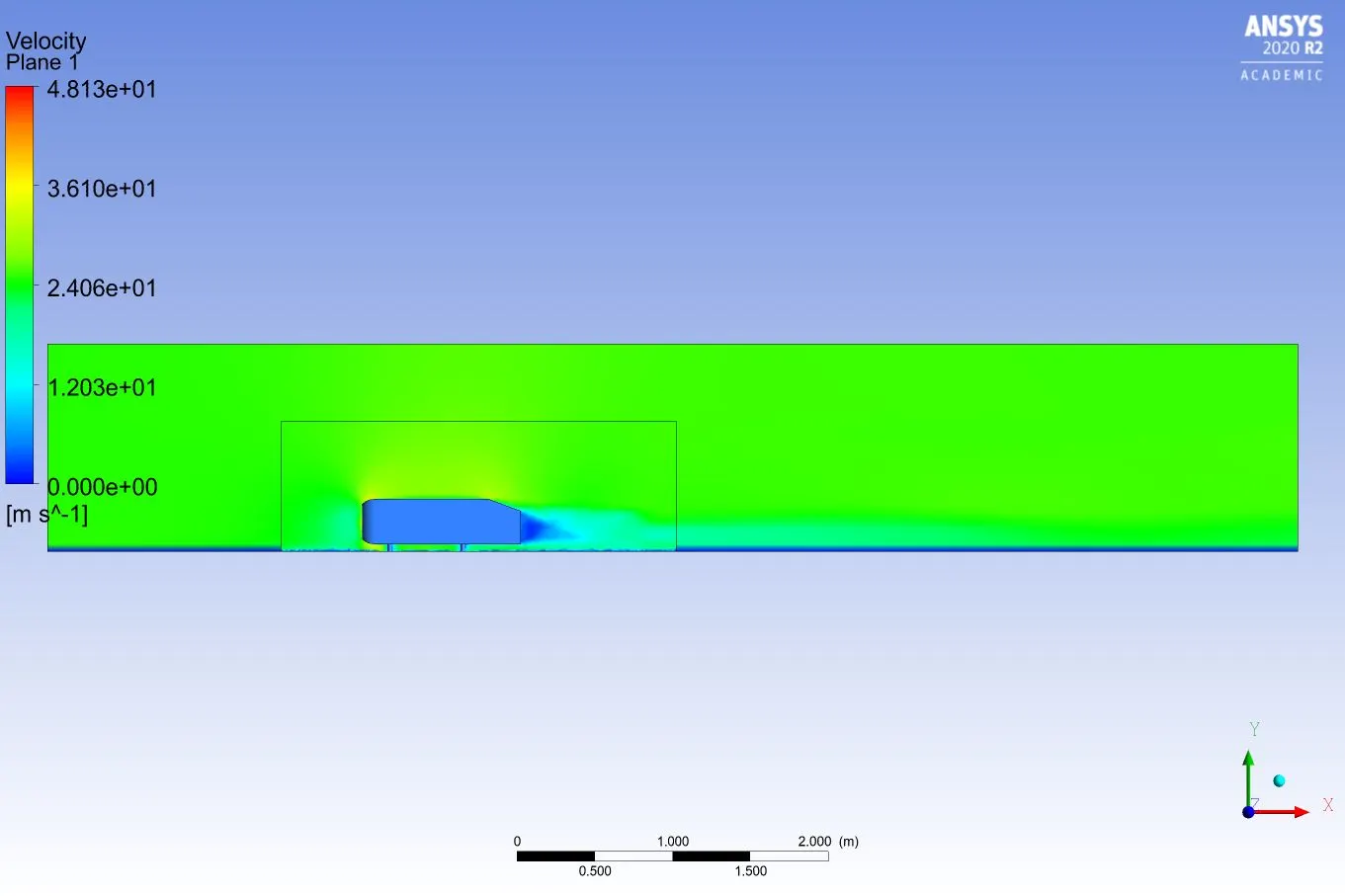
Velocity Contour
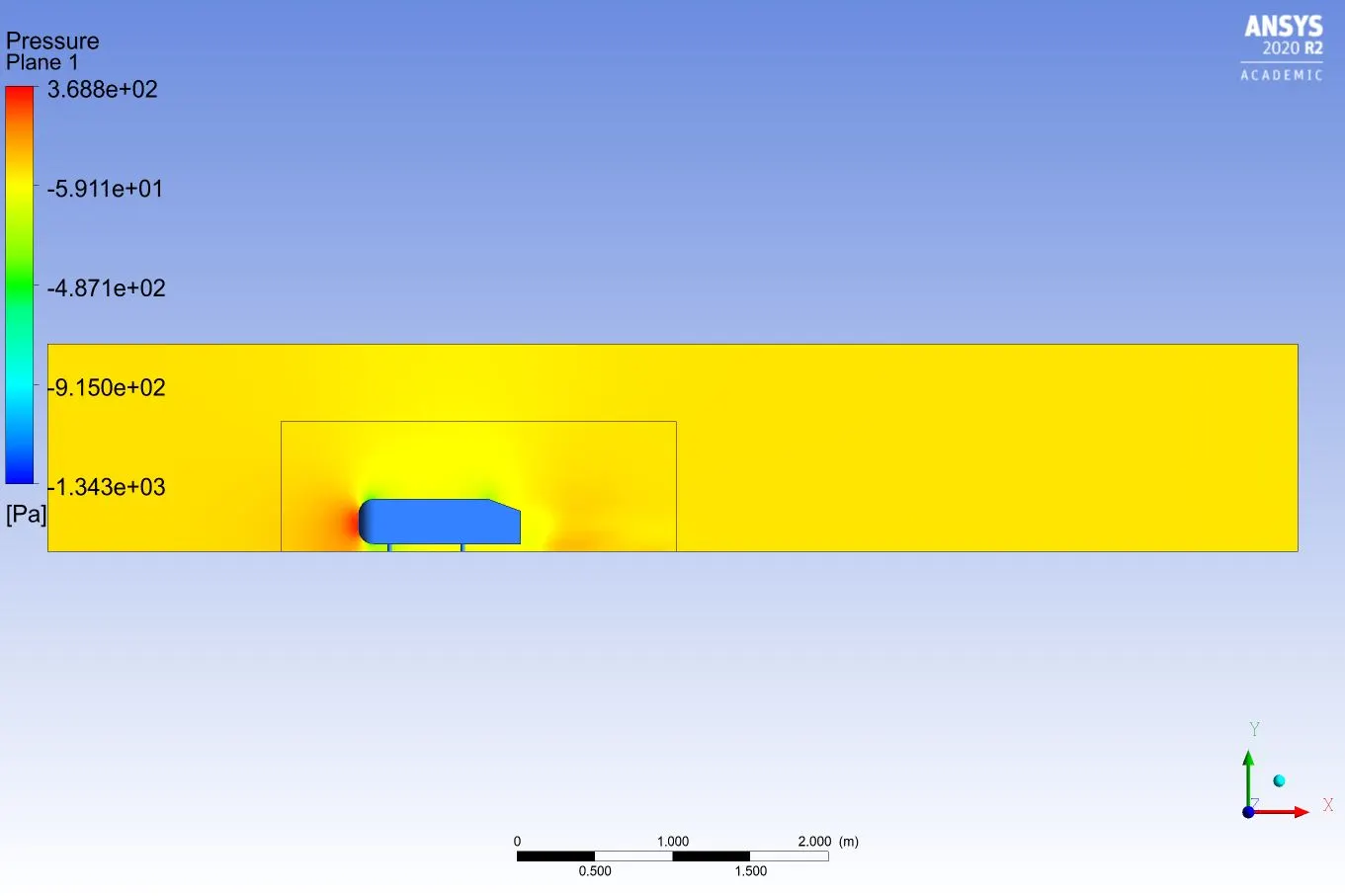
Pressure Contour
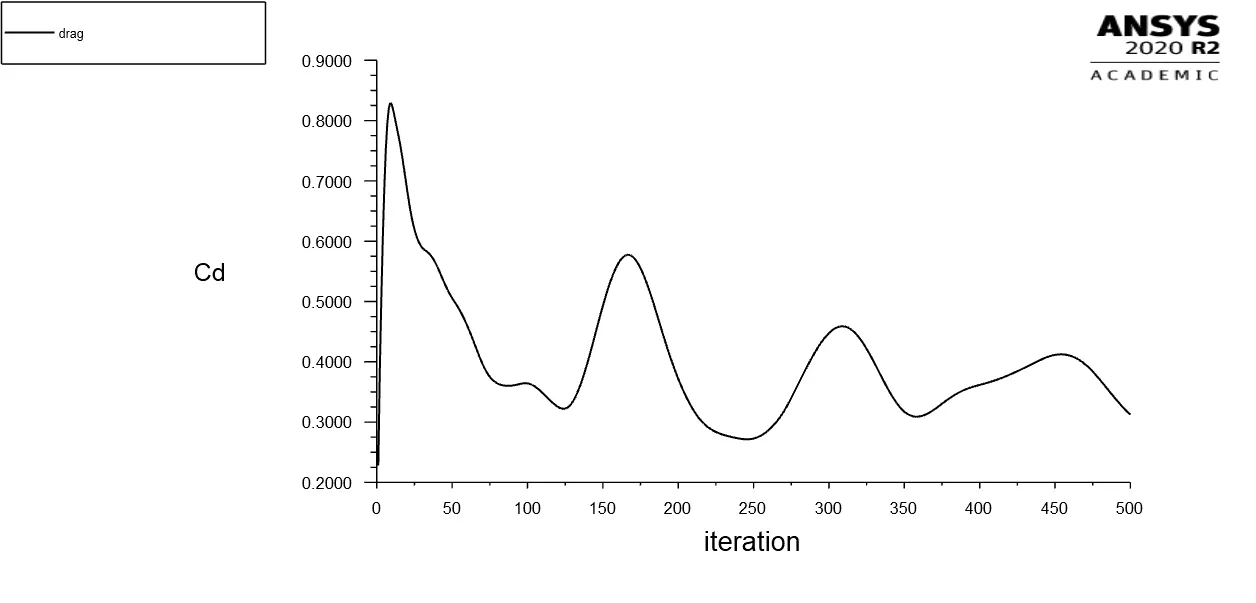
Drag coefficient plot for refined case(Cd=0.312641960
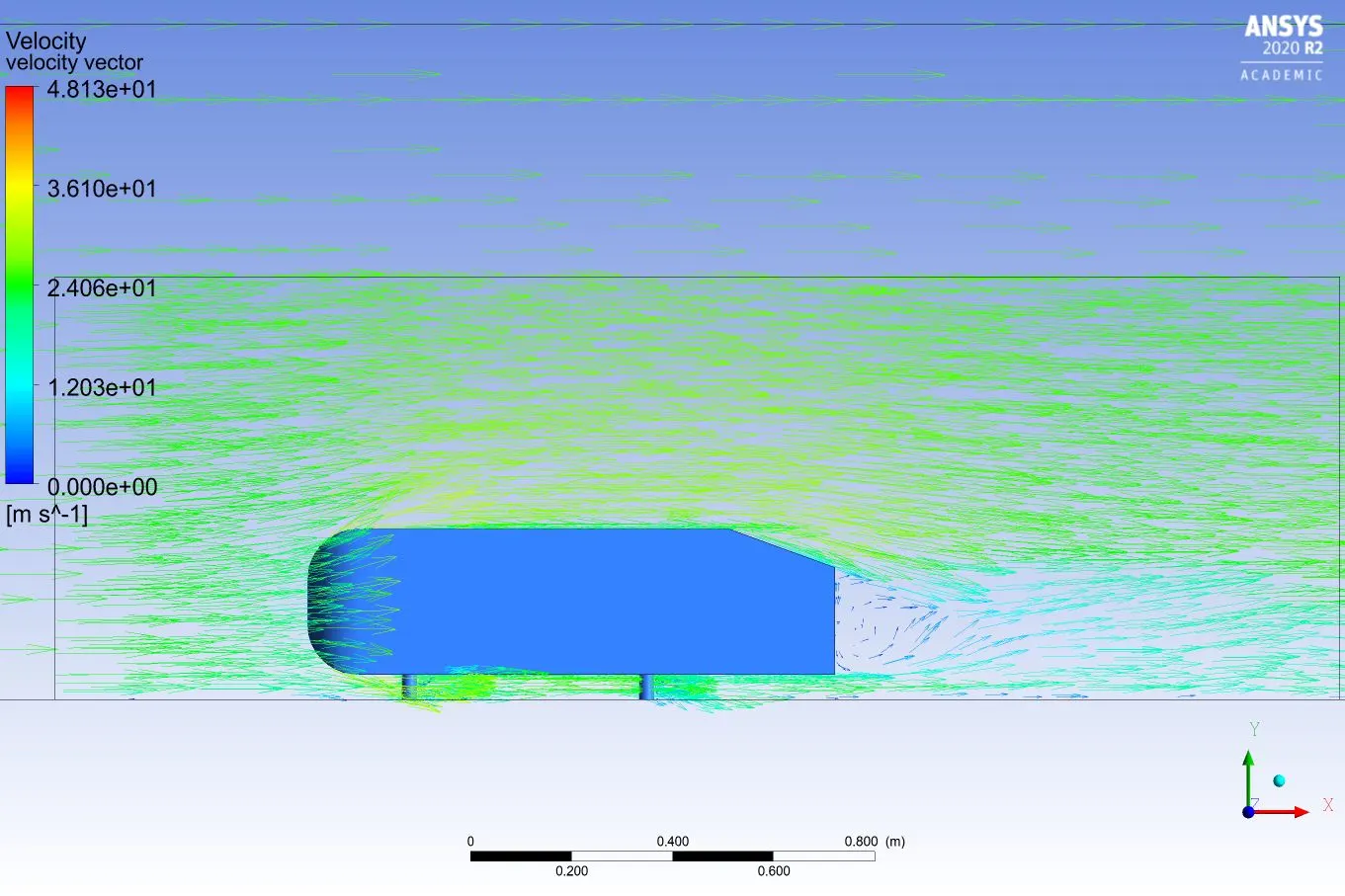
Velocity Vector
Mesh Independence Test
| Mesh Type | Element Size(m) | Number of elements | Drag coefficient | Lift coefficient |
| Coarse | 0.1 | 97250 | 0.40177727 | 0.28967212 |
| Medium | 0.08 | 104358 | 0.38982709 | 0.27006449 |
| Fine | 0.05 | 364800 | 0.31264196 | 0.35813188 |