Adams Assignments – Problem 5 – Compliance
Part 1: Baseline analysis
1. Brake steer
Brake steer is found out by running a static load analysis for braking force. It is then plotted for wheel travel base left vs toe angle to fing out the magnitude.
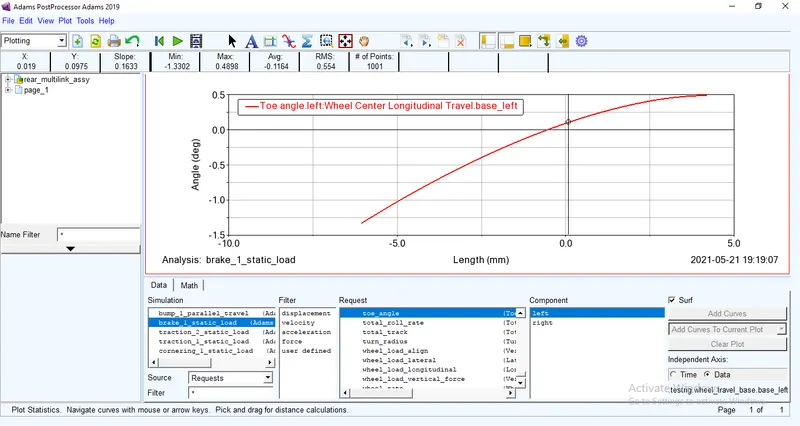
Brake steer = 0.1633 degree/mm = 163.3 degree/m
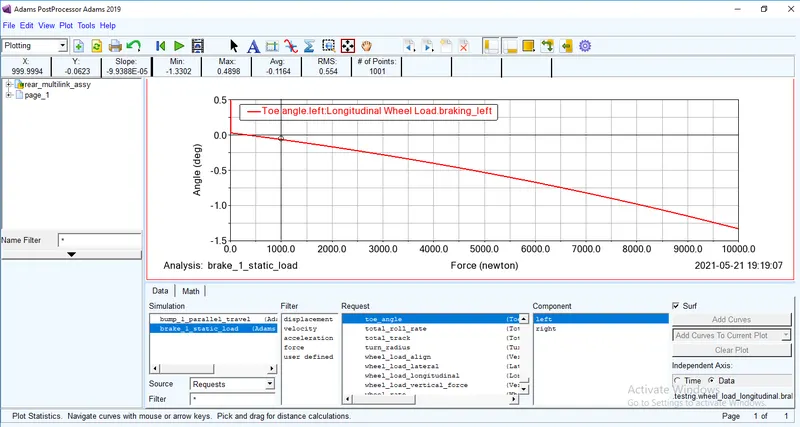
From the graph it is seen that as the braking force increases the toe angle becomes negative (toe out).
The wheel will toe out during braking.
2. Traction steer
Traction steer is found out by running a static load analysis. It is then plotted for wheel travel base left vs toe angle to fing out the magnitude.
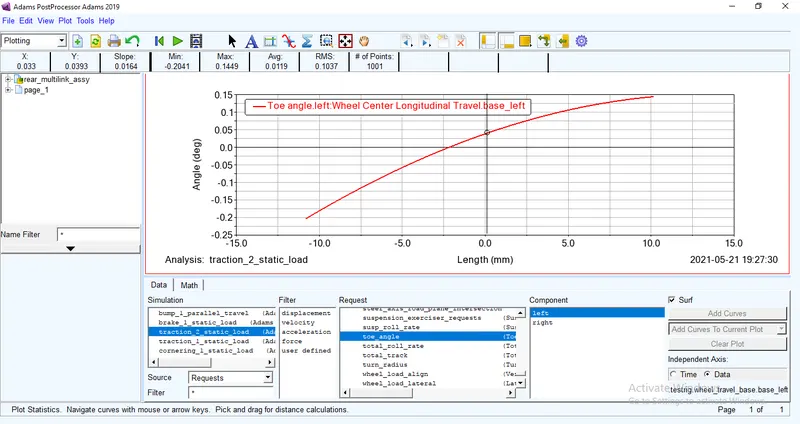
Traction steer = 0.0164 degree/mm = 16.4 degree/m
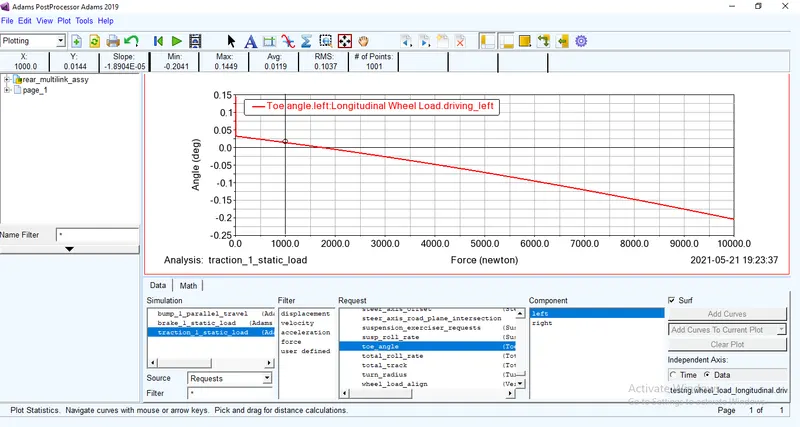
From the graph we can see that as the traction force increases the toe angle becomes negative (toe out).
Wheel will toe out during driving.
3. Longitudinal wheel centre recession
This is found out by plotting wheel load longitudinal (driving/braking) vs wheel travel base for the static analysis of traction or braking force carried out earlier.
a. Longitudinal wheel centre recession under traction
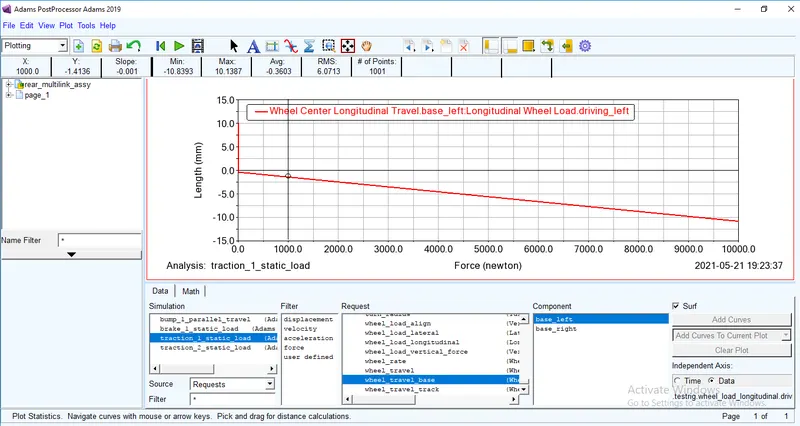
Longitudinal wheel centre recession under traction = 1 mm/kN
b. Longitudinal wheel centre recession under braking
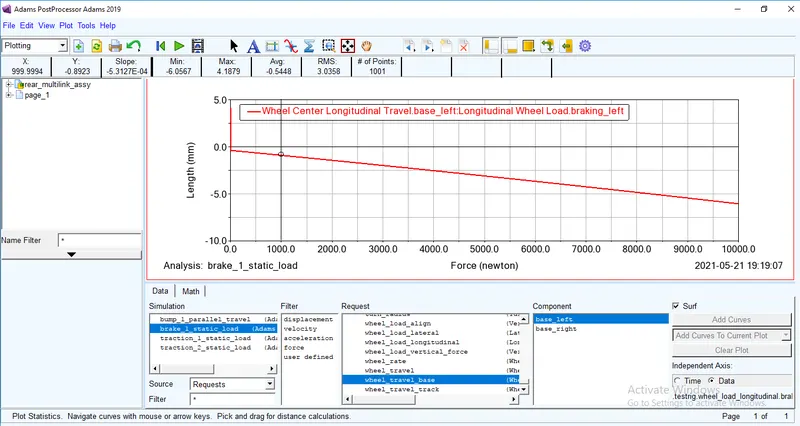
Longitudinal wheel centre recession under braking = 0.53 mm/kN
The Longitudinal wheel centre under trackion and braking is different because the traction force is applied at the wheel centre whereas the braking force is applied at the tire contact patch.
4. Lateral force compliance steer
Lateral force compliance steer is found out by running a static load analysis for cornering force and then plotting wheel load lateral left vs steer angle.
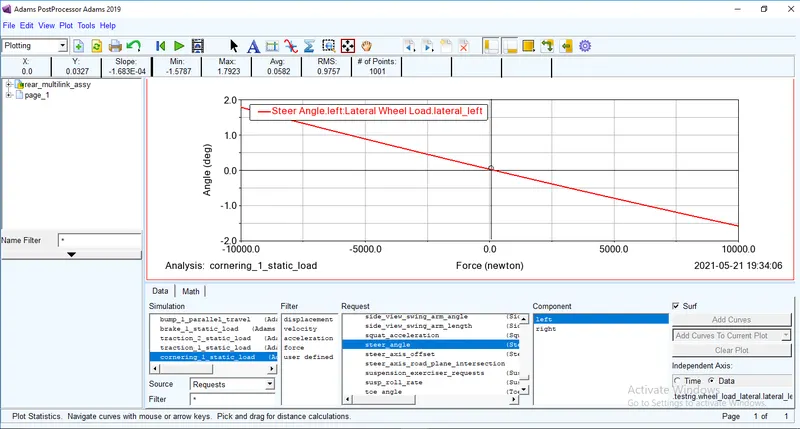
Lateral force compliance steer = -0.168 degree/kN
From the graph we can see that as the lateral force increases the wheel will toe out. Toe out in rear wheel will result in oversteer.
5. Lateral force compliance camber
Lateral force compliance camber is found out by running a static load analysis for cornering force and then plotting wheel load lateral left vs camber angle.
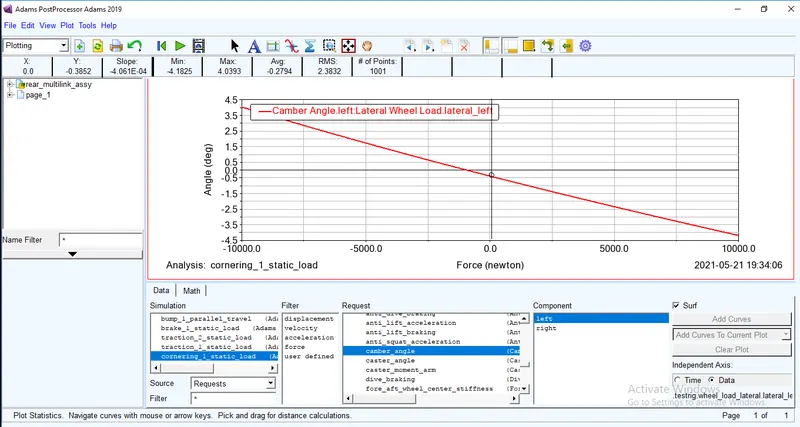
Lateral force compliance camber = -0.406 degree/kN
From the graph we can see that as the lateral force increases the wheel develops a negative camber. Negative camber in the rear wheel results in understeer.
6. Bump steer
Bump steer can be found out by parallel wheel travel suspension analysis and then plotting wheel tarvel vertical vs toe angle.
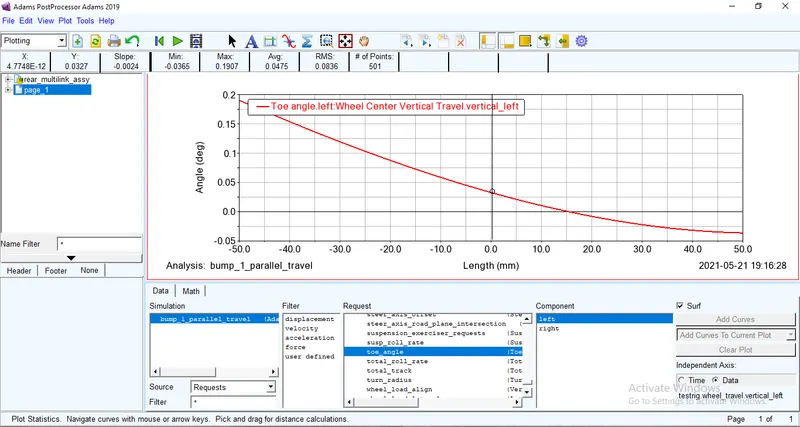
Bump steer = -2.4 degree/m
From the graph we can see that the wheel will toe out during jounce. Toe out in jounce at rear wheel will produce oversteer effect.
Part 2 : Tuning
To achieve a bump steer of 2.6 degree/m
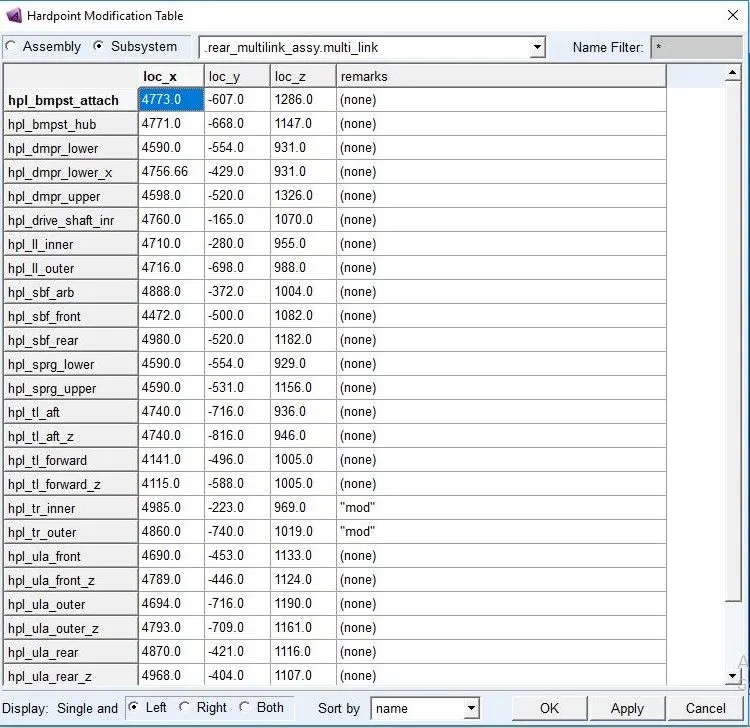
The modifications of the outer and inner tie rod Hardpoints has influence on the bump steer. For achieving the target bump steer I have modified both the inner and outer tie rod Harpoints in both X and Y axis (vehicle axis).
Hardpoints before modification
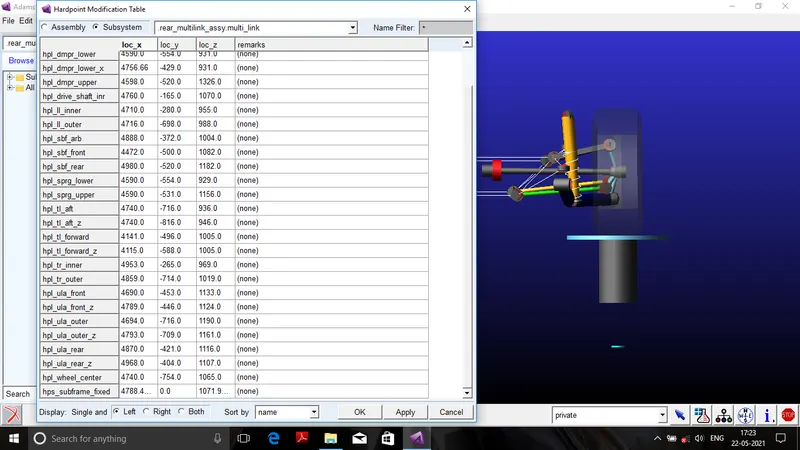
Hardpoints after modification
Bump steer achieved plot
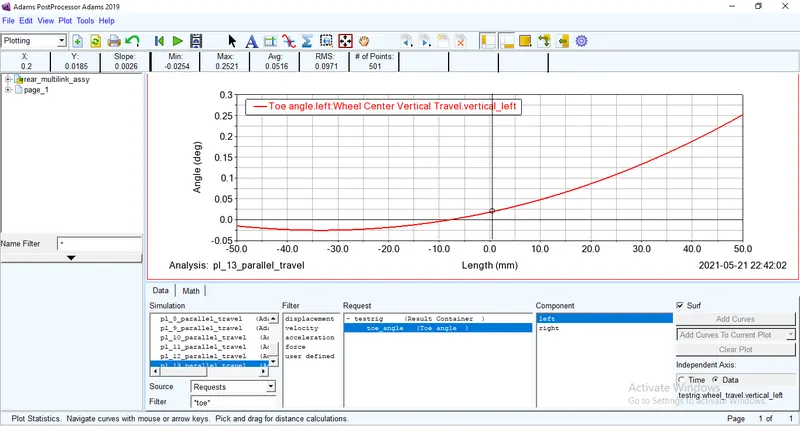
Achieved bump steer = 2.6 degree/m
To achieve Traction wheel center recession stiffness of 500 N/mm
To achieve the required wheel center recession stiffness, we need to modify the bushing shown below(make it softer).
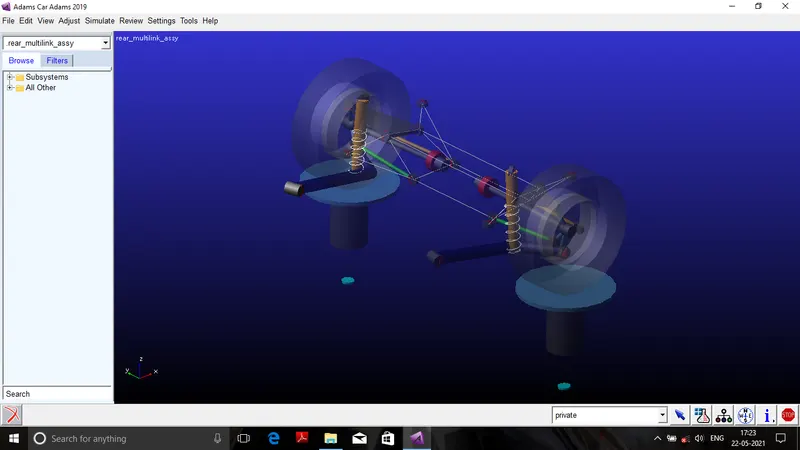
The current traction wheel center recession stiffness = 1kN/mm.
Initial bushing stiffness
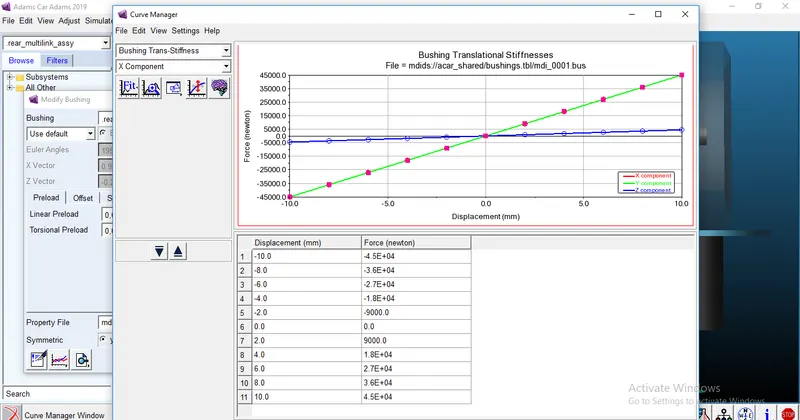
The default bushing stiffness in X direction = 4500 N/mm.
Modified bushing stiffness
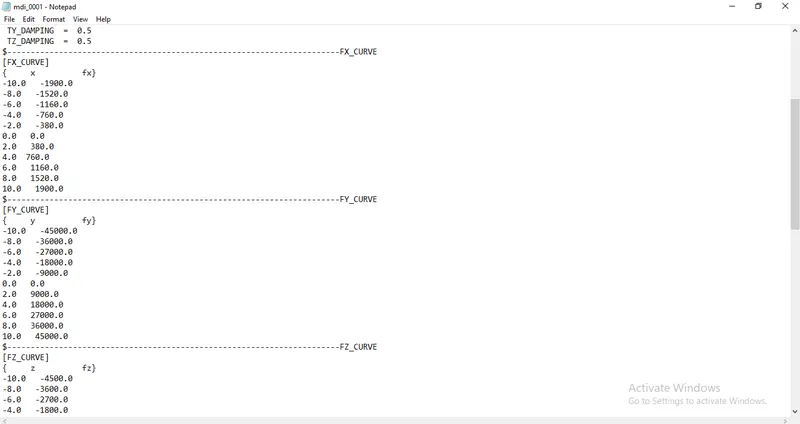
The Fx curve of the bushing is modified to a stiffness of 190 N/mm.
Achieved traction wheel centre recession stiffness plot
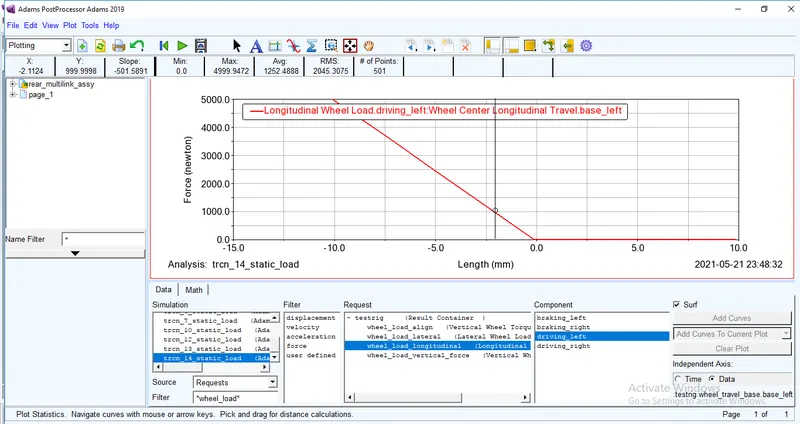
Achieved stiffness = 501.5891 N/mm
To achieve a camber compliance of 0.45 degree/kN
To achieve the camber compliance, we need to modify the UCA ball joint bushing(making softer).
Modified bushing plot
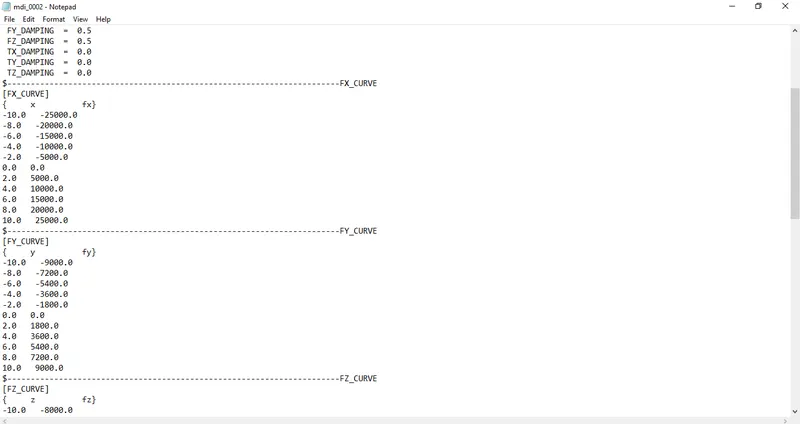
Achieved camber compliance
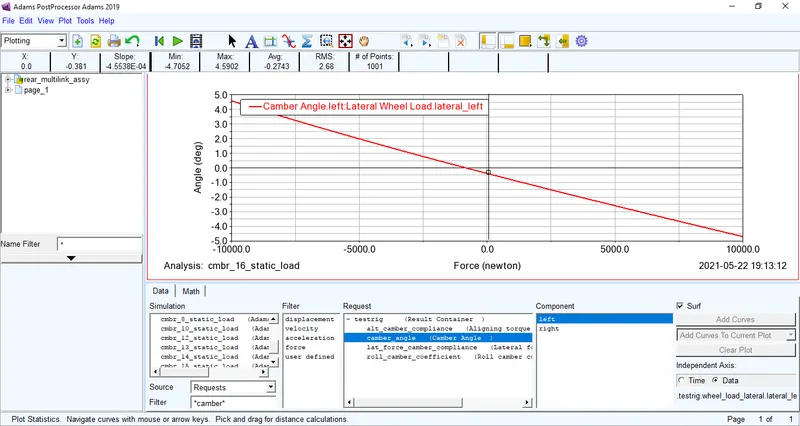
Achieved camber compliance = 0.45 degree/kN