 Free · 4 lessons · no payment
Geometric Dimensioning and Tolerancing: 4 free lessons
Four free lessons from Skill-Lync's Geometric Dimensioning and Tolerancing course. They explain what GD&T solves compared with plus-minus tolerancing, how to read a feature control frame under ASME Y14.5, the modifier symbols (MMC, LMC, RFS, projected zone, datum targets), and a live tolerance stack-up worked with worst case, RSS and MRSS.
Last updated 16 Nov 2026 · 4 free lessons (1 h 34 min) · full course: 65 lessons (13 h 6 min), paid · ₹40,000
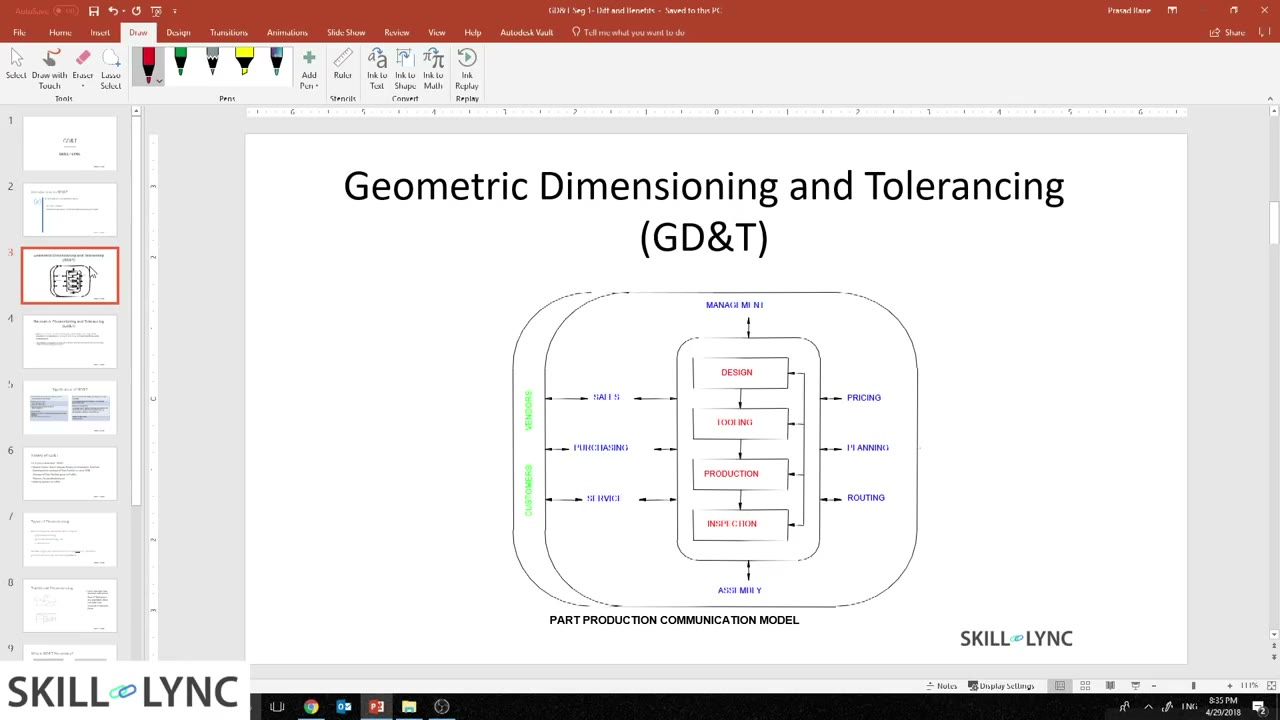 Free lesson 1 · 12 minGD&T Benefits and Traditional Dimensioning Limits
What will you learn in the free Geometric Dimensioning and Tolerancing lessons?
- Where plus-minus dimensioning falls short and what GD&T adds
- Reading every box of a feature control frame
- MMC, LMC, RFS, projected tolerance zones and datum targets
- Tolerance stack-up by worst case, RSS and MRSS (RSS x 1.2)
Free lessons you can watch now
- Lesson 1 · 12 minGD&T Benefits and Traditional Dimensioning LimitsThe instructor introduces GD&T as a way to dimension and tolerance a part for function and assembly, using the four phases of part development as context. It covers dimensional variation and gap analysis, then compares plus-minus tolerancing with GD&T using a flatness example on a table top.
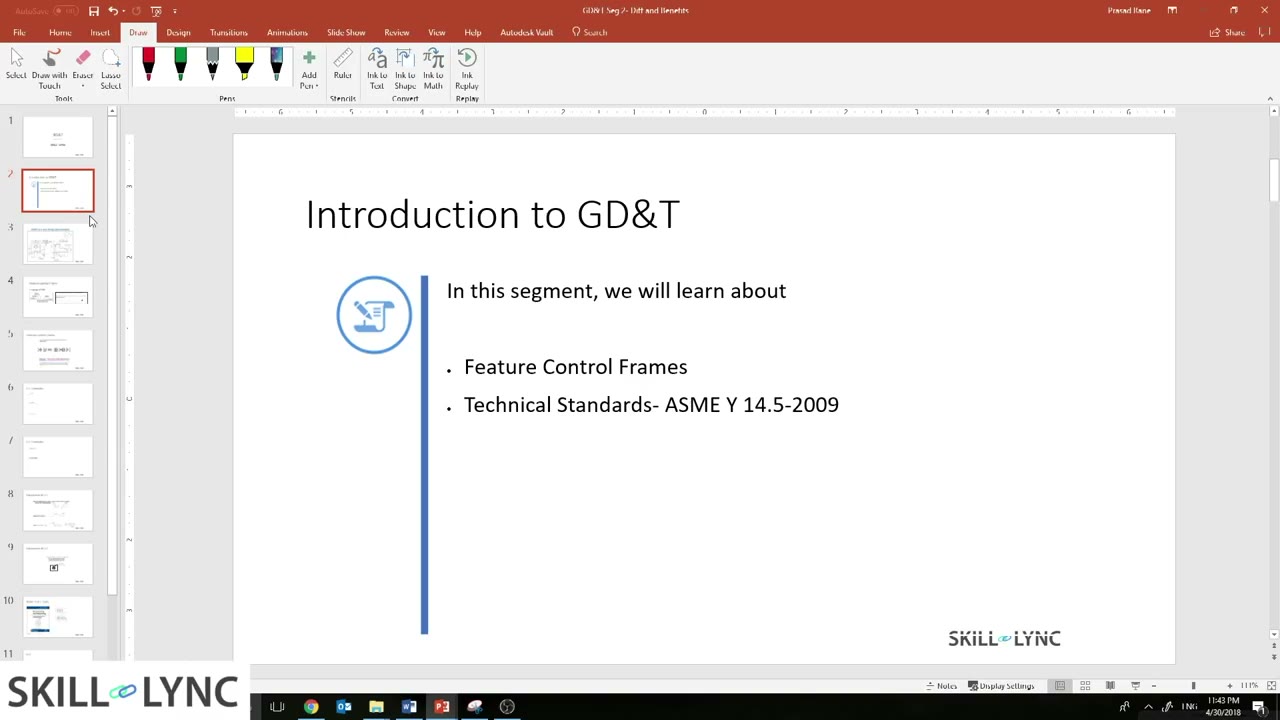 Lesson 2 · 24 minReading Feature Control Frames and the ASME Y14.5 StandardThe instructor explains that a feature control frame is the language of GD&T and walks through each box, from geometric characteristic and diameter symbol to tolerance value, material modifier and datums. A flatness example is read aloud, followed by the history of the standard from Military Standard to ASME Y14.5 2009.
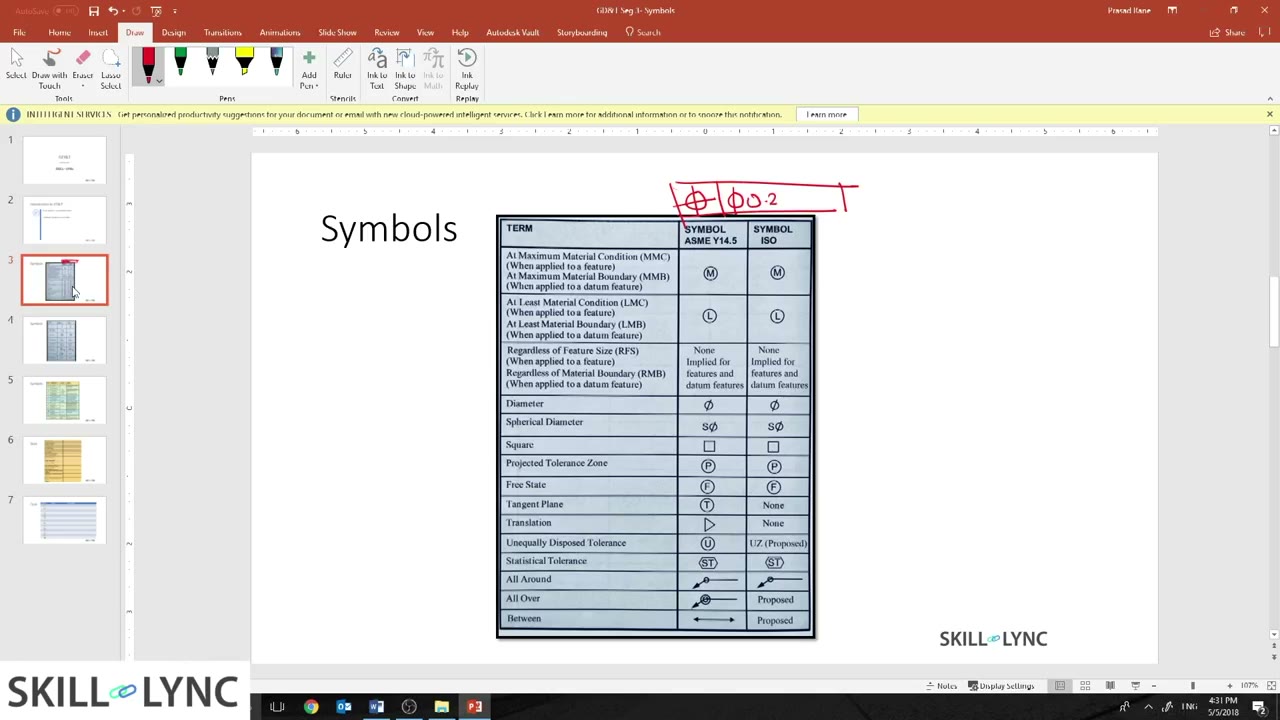 Lesson 3 · 37 minGD&T Modifier Symbols: MMC, LMC, RFS, Projected and Datum TargetsThe instructor defines the symbols used in feature control frames, starting with maximum material condition for holes and pins with worked diameter examples. It then covers LMC, RFS, projected tolerance zone, free state, datum symbols and datum targets, and ends with a symmetry callout and a symbol quiz.
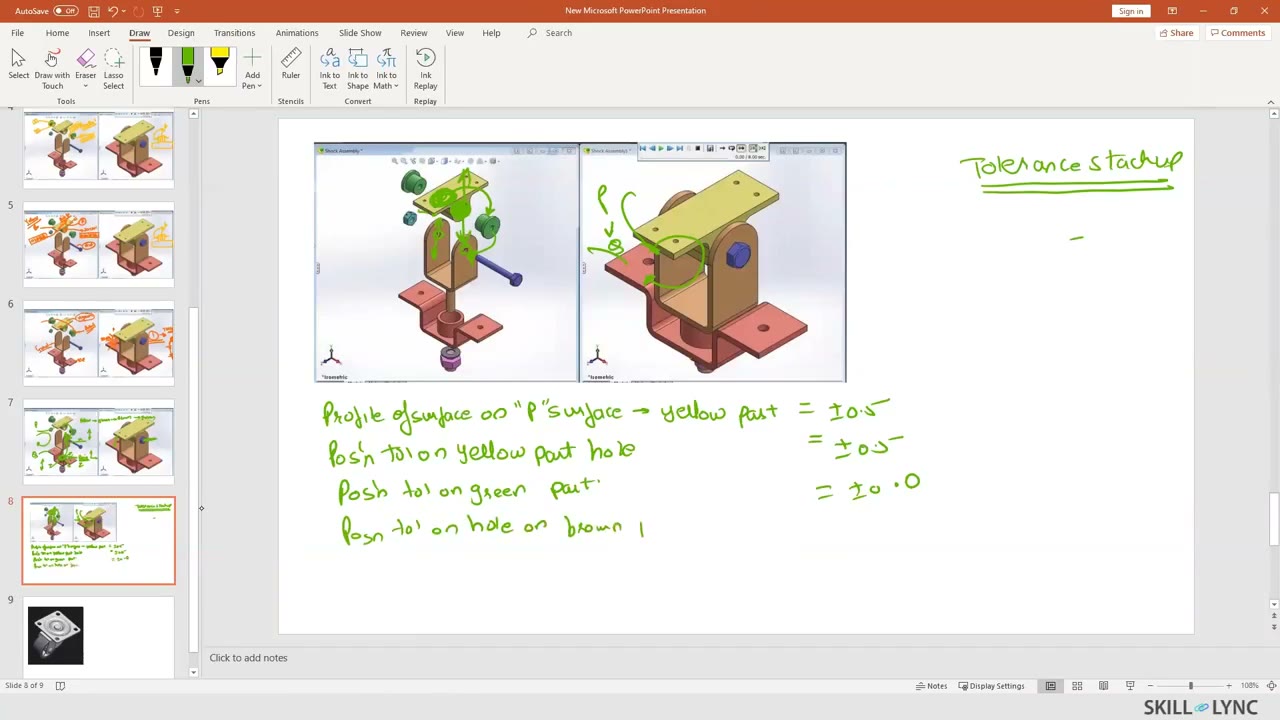 Lesson 20 · 21 minTolerance Stack-Up Analysis with RSS, MRSS and Worst CaseThis live session works through a tolerance stack-up for a gap between two surfaces, building the tolerance chain part by part. It computes RSS, MRSS using a 1.2 factor, and worst case, and explains why datums, form and orientation tolerances do not contribute while position and profile do.
Which lessons of Geometric Dimensioning and Tolerancing are free?
The first 4 lessons are free on Grow by Skill-Lync: 1 h 34 min of video from Skill-Lync's Geometric Dimensioning and Tolerancing course that you can watch here at no cost: leave your name and phone number once and they play (as of 16 Nov 2026). The full course is paid (₹40,000); its other 61 lessons are listed in the outline below so you can see what each one covers.
How long is the Geometric Dimensioning and Tolerancing course?
The full course has 65 lessons and 13 h 6 min of recorded video, plus the projects and assignments that come with enrolment. The free lessons alone take about 1 h 34 min, so you can finish them in an evening and decide whether to continue.
What comes after the free lessons?
Lesson 4 onwards is in the paid Geometric Dimensioning and Tolerancing course on Skill-Lync, with mentor support and a certificate. For a career in CAD & design, the Post Graduate Program in CAD goes further with industry projects and placement support.