 Free · 3 lessons · no payment
Design for Manufacturability (DFM): 3 free lessons
Three free lessons from Skill-Lync's Design for Manufacturability (DFM) course. They cover where DFMA came from, why it is used and what it saves, and how concurrent engineering replaces the sequential design process. Examples include early assembly automation, cost data from an espresso machine study, and a multimeter redesigned with fewer parts.
Last updated 16 Nov 2026 · 3 free lessons (55 min) · full course: 30 lessons (11 h 8 min), paid · ₹40,000
 Free lesson 1 · 21 minOrigins of DFMA: History and the Goals It Supports
What will you learn in the free Design for Manufacturability (DFM) lessons?
- Definitions of design for manufacture and assembly
- Historical milestones behind DFMA, from conveyors to robots
- Cost and time benefits of applying DFMA early
- Concurrent engineering versus over-the-wall design
Free lessons you can watch now
- Lesson 1 · 21 minOrigins of DFMA: History and the Goals It SupportsThe instructor defines design for manufacture, design for assembly and DFMA, then walks through a timeline from Oliver Evans' conveyors in 1793 to Whitney's interchangeable musket parts, Henry Ford's assembly line and early industrial robots. It closes on the three aims of DFMA: manufacturability, interchangeability and automation.
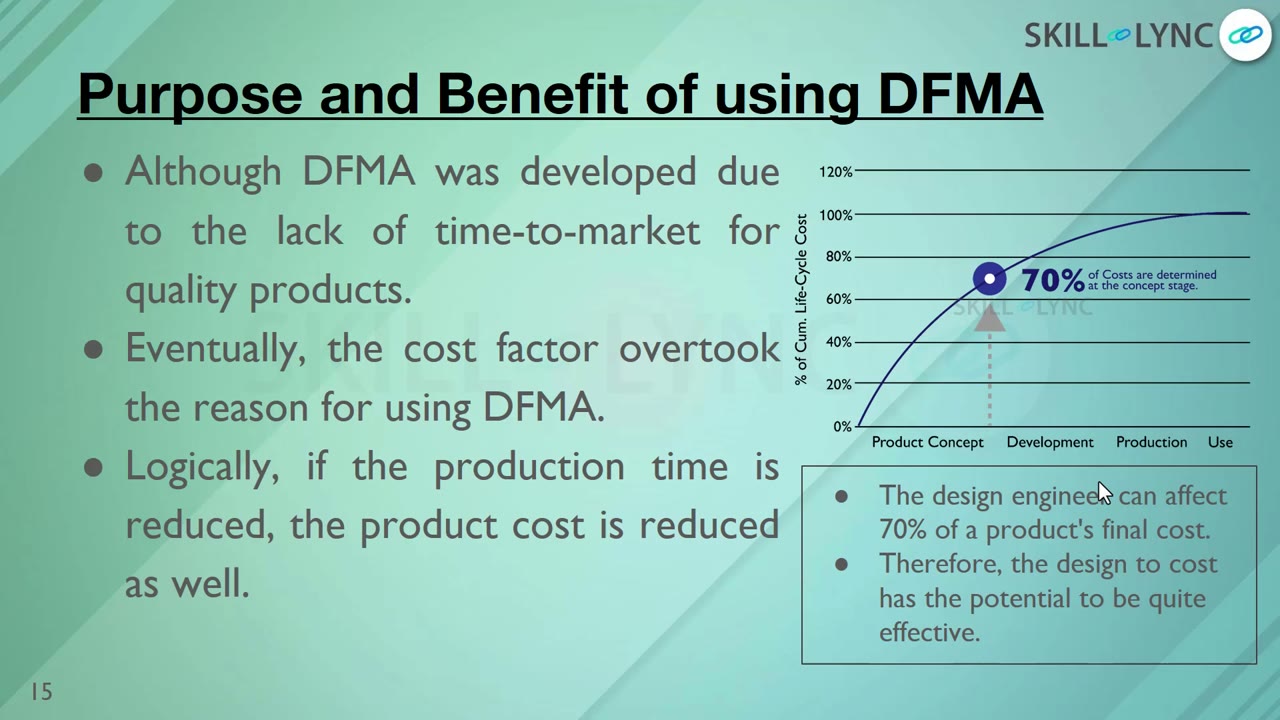 Lesson 2 · 17 minBenefits and Cost Impact of DFMA on Product DesignThe lesson explains why design decisions fix most product cost and lists five benefits of DFMA, including shorter time to market and fewer parts. It reads cost charts, such as material at 50 percent of product cost and a study of 18 espresso machines, and compares DFMA with lean manufacturing and DFAB.
 Lesson 3 · 17 minConcurrent Engineering Versus the Over-the-Wall Design ProcessThe instructor describes the conventional sequential design process, where marketing, design and production pass work between departments, and its drawbacks of time loss and personality conflict. The lesson then covers concurrent engineering, the specialists in the team, a multimeter redesigned with 76 components instead of 131, and the rule of 10 for fixing faults.
Which lessons of Design for Manufacturability (DFM) are free?
The first 3 lessons are free on Grow by Skill-Lync: 55 min of video from Skill-Lync's Design for Manufacturability (DFM) course that you can watch here at no cost: leave your name and phone number once and they play (as of 16 Nov 2026). The full course is paid (₹40,000); its other 27 lessons are listed in the outline below so you can see what each one covers.
How long is the Design for Manufacturability (DFM) course?
The full course has 30 lessons and 11 h 8 min of recorded video, plus the projects and assignments that come with enrolment. The free lessons alone take about 55 min, so you can finish them in an evening and decide whether to continue.
What comes after the free lessons?
Lesson 4 onwards is in the paid Design for Manufacturability (DFM) course on Skill-Lync, with mentor support and a certificate. For a career in CAD & design, the Post Graduate Program in CAD goes further with industry projects and placement support.