Computer vision courses online
Every Skill-Lync course on computer vision, cameras, deep learning for images and medical image processing, with fees, hours, projects and which ones overlap.
- 9
- courses
- ₹40,000
- per short course
- 6 to 12
- weeks per course
- 0
- vision job titles in our placement records
As of 19 Nov 2026 · Fees are the list price on each course page, inclusive of all charges
Skill-Lync teaches computer vision and image processing in 9 online courses: seven 6 to 12-week courses on classical vision, self-driving perception, camera systems, deep learning and medical imaging, and two data science programs that include the deep learning course. Here they all are with fees, duration and projects, which ones overlap, and which fits the job you want.
Every Skill-Lync course that teaches Computer Vision
| Course | Level | Duration | Projects | Fee |
|---|---|---|---|---|
| Basics of Computer Vision using Python | Short course | 12 weeks | 2 | ₹40,000 |
| Advanced Medical Image Processing | Short course | 6 weeks | 1 | ₹40,000 |
| Introduction to Medical Image Processing | Short course | 6 weeks | 1 | ₹40,000 |
| Introduction to Camera Systems | Short course | 8 weeks | 2 | ₹40,000 |
| Advanced Deep Learning using Python | Short course | 12 weeks | 2 | ₹40,000 |
| Advanced Medical Image Processing in Clinical Applications | Short course | 12 weeks | 3 | ₹40,000 |
| Applying CV for Autonomous Vehicles using Python | Short course | 12 weeks | 2 | ₹40,000 |
| Post Graduate Program in Data Analytics and Data Science | PG program | 24 weeks | 18 | ₹2,75,000 · EMI from ₹14,375/mo |
| Post Graduate Program in Data Science and Machine Learning | PG program | 24 weeks | 12 | ₹2,75,000 · EMI from ₹14,375/mo |
Projects is the number of industry projects listed on the course page. Programs also include the courses' smaller assignments. EMI figures are the lowest monthly plan shown on the course page.
How much does a computer vision course cost in India?
As of 18 Nov 2026, other providers' computer vision courses range from free lessons (NPTEL) to ₹14,900 (Skillfloor) among those priced in rupees; the cheapest paid one is E&ICT Academy, IIT Kanpur at ₹423 + GST. Skill-Lync's options in this table cost ₹40,000, inclusive of all charges, with graded projects and doubt support.
| Provider and course | Fee | Duration | Format |
|---|---|---|---|
| NPTEL (IIT Kharagpur) Computer Vision (Prof. Jayanta Mukhopadhyay) | Free to enrol and learn | 12 weeks (the last run's exam was on 24 October 2026; the next run date is not on this page) | Recorded video lectures with weekly assignments |
| NPTEL (IIT Hyderabad) Deep Learning for Computer Vision (Prof. Vineeth N Balasubramanian) | Free to enrol and learn | 12 weeks (the last run's exam was on 18 October 2026; the next run date is not on this page) | Recorded video lectures with theory and programming assignments |
| Coursera (IBM) Introduction to Computer Vision and Image Processing | Free to enrol | 2 weeks at 10 hours a week (6 modules) | Recorded, self-paced, with labs and a final transfer-learning project (traffic sign classification) |
| Coursera (DeepLearning.AI) Convolutional Neural Networks (course 4 of the Deep Learning Specialization, Andrew Ng) | Free to enrol | 4 weeks at 10 hours a week (4 modules) | Recorded, self-paced, graded programming assignments |
| E&ICT Academy, IIT Kanpur (EICTA consortium) Deep Learning with Generative AI for Computer Vision | Rs. 423.73 plus GST, the only price shown, tagged 'Faculty' | 30 hours, self-paced | Recorded, self-paced |
| Skillfloor Certified Computer Vision Specialist | ₹14,900 | 6 weeks of live training, then a 6-week internship | Live online classes plus a client-project internship |
| Skill-Lync Basics of Computer Vision using Python | ₹40,000 incl. all charges | 12 weeks | Online: recorded lessons, live doubt sessions, graded projects |
| Skill-Lync Applying CV for Autonomous Vehicles using Python | ₹40,000 incl. all charges | 12 weeks | Online: recorded lessons, live doubt sessions, graded projects |
| Skill-Lync Introduction to Camera Systems | ₹40,000 incl. all charges | 8 weeks | Online: recorded lessons, live doubt sessions, graded projects |
| OpenCV University (opencv.org) Mastering OpenCV with Python | USD 162 on offer | 21 modules, self-paced with lifetime access (no hours given) | Recorded video lessons with code, graded quizzes, assignments and projects |
| Udacity Computer Vision Nanodegree | USD 249 a month, USD 212 a month on a 4-month bundle, or USD 999 one-time | 37 hours | Recorded, self-paced, projects with expert feedback |
Read from each provider's own course page on 18 Nov 2026, sorted by fee: free first, then rupee fees, then fees in US dollars, then pages that show no fee. Some providers include GST and many don't say. Free courses usually charge for the certificate. For certificates, placement support and how to choose, see the full comparison: Best computer vision course in India (2026).
Which one should you pick?
- You are new to computer vision and want the foundations. Basics of Computer Vision using Python (12 weeks, ₹40,000, 21 h) builds classical vision week by week, from colour and filters to calibration and epipolar geometry, and only reaches CNNs and YOLO in the last week. Its two projects use public road video: tracking pedestrians and vehicles, and segmenting a driving scene.
- You want perception for self-driving cars or ADAS. Applying CV for Autonomous Vehicles using Python (12 weeks, ₹40,000, 21 h) moves faster and further into deep learning: MobileNet classification, Deep SORT tracking, segmentation, TensorFlow object detection and an introduction to 3D detection. Pick it over the Basics course if you can already code in Python; most of its classical weeks repeat the Basics course.
- You want to work on the camera itself. Introduction to Camera Systems (8 weeks, ₹40,000, 28 h, the most video of the seven) is for camera and calibration engineers: sensors and colour filters, fisheye models, distortion, calibration, stereo, structure from motion, and camera interfaces such as GMSL, LVDS and I2C. It pairs with either vision course; it does not teach deep learning.
- You want deep learning first, vision second. Advanced Deep Learning using Python (12 weeks, ₹40,000, 22 h) teaches neural networks from back-propagation up. CNNs take two of its twelve weeks; the rest is regularisation, optimisers, RNNs, LSTMs and basic NLP. Take it before or after a vision course, not instead of one.
- You want medical image analysis. Advanced Medical Image Processing in Clinical Applications (12 weeks, ₹40,000, 21 h, 3 projects) contains the modules of both 6-week medical courses: Introduction to Medical Image Processing (13 h) and Advanced Medical Image Processing (9 h). Buy the 12-week course, or only the half you need, not all three.
- You want a program with placement support. There is no computer vision program. The PG Program in Data Science and Machine Learning (24 weeks, ₹2,75,000, EMI from ₹14,375 a month) and the PG Program in Data Analytics and Data Science (24 weeks, ₹2,75,000) both include Advanced Deep Learning. Choose them for a data science career; for vision you would still add one of the vision courses.
What is Computer Vision?
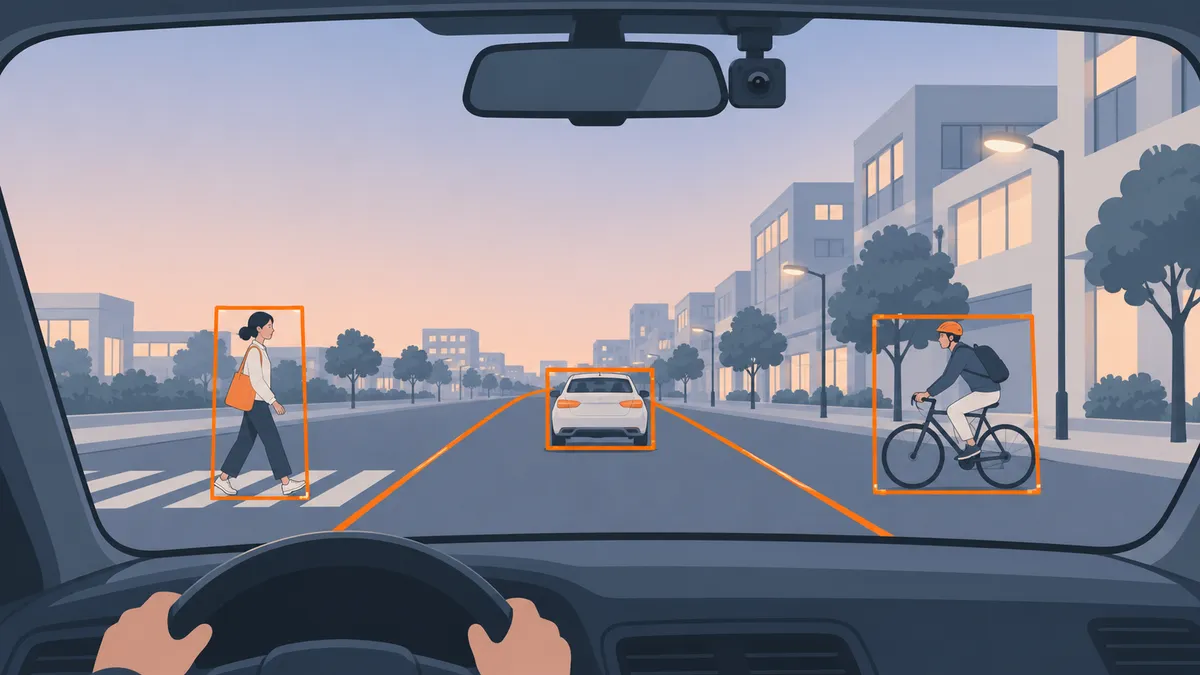
Computer vision is getting a computer to measure and recognise things in images and video: where the lane is, how far away the car ahead is, whether a weld has a crack, which pixels of an MRI scan are a tumour. Classical computer vision does it with geometry and hand-built filters (edges, corners, optical flow, calibration). Modern computer vision mostly trains convolutional neural networks (CNNs) on labelled images. Working engineers need both: the network finds the object, the geometry tells you where it is in metres.
Every pipeline runs the same steps. A camera forms the image (lens, sensor, colour filter); pre-processing cleans it (denoising, colour conversion, undistortion); features or a network find structure (edges, keypoints, boxes, masks); geometry turns pixels into the 3D world (calibration, stereo, structure from motion); tracking ties frames together. The courses below each cover a different part of that chain.
Here is the geometry a stereo camera lives by. Two rectified cameras 12 cm apart (the baseline B) with a focal length of 700 pixels see the same point shifted by a disparity d, and the depth is Z = f × B ÷ d = 84 ÷ d metres (an assumed rig, typical of small stereo cameras). A car whose image shifts by 21 px is 4 m away. Get the match wrong by one pixel and you read 3.82 or 4.2 m: about 0.19 m of error.
The same car at 20 m shifts by only 4.2 px, and the same one-pixel mistake now reads 16.2 or 26.25 m. Depth error grows with the square of distance (ΔZ ≈ Z² ÷ fB per pixel: 0.19 m at 4 m, 4.8 m at 20 m). That one formula is why cars add radar or lidar for range, why stereo rigs for long range use wider baselines, and why camera calibration matters so much.
Detection is scored with overlap. A network predicts a box from (50, 50) to (150, 150) pixels; the labelled box runs from (70, 60) to (170, 160). They overlap on an 80 × 90 = 7,200 px² patch, their union is 12,800 px², so intersection over union (IoU) = 0.5625. PASCAL VOC counts that as a correct detection (IoU ≥ 0.5); COCO also asks how it scores at 0.75, where it fails, and averages precision over ten thresholds from 0.50 to 0.95, of which this box passes two. "Our model gets 90%" means little until you know which threshold.
What a Computer Vision course covers
- Image processing. Colour spaces, convolution and filtering (mean, median, Gaussian, bilateral, non-local means), noise models, histograms and Otsu thresholding, morphology (erosion, dilation, opening, closing), frequency-domain filtering.
- Features, motion and tracking. Sobel, Laplacian of Gaussian and Canny edges, Hough lines and circles, Harris, FAST, SIFT, SURF and ORB features, HOG descriptors, image stitching, optical flow (Lucas-Kanade, Horn-Schunck, Farnebäck), KLT, mean-shift, MOSSE and Deep SORT trackers.
- Cameras and 3D geometry. CCD and CMOS sensors, RGGB and RCCB colour filters, pinhole and fisheye models, lens distortion, intrinsic and extrinsic calibration, homography, epipolar geometry, the fundamental and essential matrices, stereo matching, disparity and depth maps, structure from motion and bundle adjustment.
- Deep learning for vision. CNN building blocks (convolution, padding, stride, pooling), transfer learning, LeNet, AlexNet and MobileNet classifiers, YOLO and the TensorFlow Object Detection API, segmentation networks, 3D object detection from stereo and monocular images.
- Medical imaging. DICOM and NIfTI files with SimpleITK and NiBabel, 3D Slicer, texture features (GLCM, Gabor), graph-cut and active-contour segmentation, image registration, CNN classification, U-Net and nnU-Net segmentation, self-supervised learning and FDA rules for medical image analysis.
The courses in detail
Basics of Computer Vision using Python
Classical computer vision in Python and OpenCV, week by week: colour spaces, filtering, edge detection, Otsu thresholding and background subtraction, morphology, shape features and PCA, optical flow, Harris, SIFT and KLT tracking, camera calibration and epipolar geometry, then LeNet, AlexNet and YOLO.
Projects include: Real time traffic tracking using matching algorithms; Real time video segmentation using machine learning and feature extraction.
Tools: Python, OpenCV, TensorFlow, Keras TensorFlow 2
Advanced Medical Image Processing
Segmentation (thresholding, graph cuts, active contours), image registration, CNNs for classification, U-Net and nnU-Net for segmentation, transfer and self-supervised learning, and FDA rules for medical image analysis. One project on retinal images.
Projects include: Full Scale Medical Image Analysis.
Tools: Python, SimpleITK, NiBabel, Slicer3D, ITKSnap, FIJI, TensorFlow, PyTorch, Keras
Introduction to Medical Image Processing
Medical images in Python: DICOM and NIfTI with SimpleITK and NiBabel, 3D Slicer, intensity and frequency-domain filtering, histogram methods and Otsu, morphology, denoising (Gaussian, bilateral, non-local means) and texture features (GLCM, Gabor).
Projects include: Internal investigation of the medical images to recognize the features present.
Tools: Python, C++
Introduction to Camera Systems
The camera side of vision: CCD and CMOS sensors, RGGB and RCCB filters, pinhole and fisheye models, lens distortion, calibration, projective geometry, stereo and depth maps, HOG and SIFT features, structure from motion, and camera interfaces (GMSL, LVDS, I2C).
Projects include: Immersion of practical knowledge of camera system concepts on datasets in detail; Implementation of basic SLAM algorithm.
Advanced Deep Learning using Python
Neural networks from the maths up in Python and TensorFlow: activations, back-propagation, regularisation, ensembles and optimisers, then CNNs (two weeks: convolution, padding, pooling, transfer learning), RNNs and LSTMs, and basic NLP with word2vec.
Projects include: Logistic Regression and Gradient Descent; ANN, CNN and RNN.
Tools: Python
Advanced Medical Image Processing in Clinical Applications
The two medical imaging courses in one: DICOM and NIfTI, filtering, denoising and texture, then segmentation, registration, CNN classification and U-Net segmentation, with three projects (retinal registration, fMRI mapping).
Projects include: Internal Investigation of the Medical Images; Image Registration, Classification & Segmentation using AI Techniques; Magnetic Resonance Images (MRI) Detection and Registration.
Tools: Python
Applying CV for Autonomous Vehicles using Python
Vision for self-driving cars in Python: filters, Canny and Hough lines, projective and stereo geometry, camera calibration, MobileNet classification, SIFT and ORB features, optical flow, Deep SORT and KLT tracking, segmentation, TensorFlow object detection and an introduction to 3D detection.
Projects include: Implementation of an image classification model using MobileNet architecture; 2D Object Detection with tensorFlow.
Tools: MATLAB, Python, TensorFlow, OpenCV, Keras TensorFlow 2
Post Graduate Program in Data Analytics and Data Science
24-week PG program in data analytics and data science: Python, SQL, Tableau and Excel, 18 projects on real datasets, mentor reviews and placement support.
Projects include: English Dictionary App; Library Book Management System; C2C E-Commerce User’s Behaviour Analysis; Analyzing the choice of career for the Alumni of Engineering College..
Tools: Python, MySQL, Anaconda, Tableau, SQLite, MS Excel, Power BI, Jupyter Notebook
Post Graduate Program in Data Science and Machine Learning
Machine learning & data science Certification Course.
Projects include: English Dictionary App; Library Book Management System; Analysis of Medical Insurance Data; Analysis of Fermented Drink Data.
Tools: Python, MySQL, Anaconda, SQLite, Jupyter Notebook
Jobs after a Computer Vision course
Typical job titles: computer vision engineer, perception engineer (cameras for ADAS and robots), camera calibration or camera validation engineer, machine vision engineer (inspection on factory lines), medical imaging or image analysis engineer, and the broader machine learning engineer. Perception roles sit with carmakers, Tier 1 suppliers and engineering services companies; machine vision with automation integrators; medical imaging with device makers and health-tech start-ups.
From Skill-Lync's own placement records (as of 19 Nov 2026, 3,905 placements): none has computer vision, image processing or perception in its job title. The nearest are 15 placements with data science or machine learning titles, 13 with a salary: median 4.5 LPA, range 1.8 to 10 LPA, all from 2022 to 2024. 14 of the 15 came from the PG Program in Data Analytics and Data Science.
That program has 178 placement records in all (median 3.6 LPA, n = 160 with a salary), mostly analyst roles. These are learners who told us they were placed, so treat them as a starting point, not as today's market rate, and not as evidence about vision jobs. Salary data by field: salaries.
Free Computer Vision tutorials
Start here before you pay for anything. These are written by Skill-Lync learners and engineers:
- How To Become A Computer Vision Engineer?
- Navigating the Future of Autonomous Vehicles with Computer Vision
- Camera in Autonomous Vehicle and Active Safety Systems
- Importance of Object Detection in Autonomous Vehicles and ADAS
- Importance of Datasets in Object Detection, Identification, and Classification
- Evaluating and Benchmarking Computer Vision Models and Algorithms in Python
- Deep Learning with Python: A Comprehensive Guide for Beginners
- The Math Behind Medical Imaging: CT, MRI and Ultrasound Explained
Before you pay
We have no placement record for a vision job. If a computer vision role is your goal, the course is the start: plan for your own projects on public datasets (a lane detector, a tracker, a segmentation model) and a portfolio you can show. Ask the counsellor for recent placements in the exact role before you pay.
Do not buy overlapping courses. Basics of Computer Vision and CV for Autonomous Vehicles share filtering, edges, features, optical flow, tracking, segmentation and stereo. Camera Systems overlaps both on calibration and stereo. The 12-week clinical medical course contains both 6-week medical courses.
Deep learning is a small part of most of these courses. The Basics course reaches CNNs and YOLO in week 12; Advanced Deep Learning gives CNNs two weeks. Current detectors and transformers move fast; expect to read papers and library docs after the course.
You need a GPU for real training. The classical weeks run on any laptop. Training detection or segmentation networks needs a GPU: a free cloud notebook works for the course projects, a larger dataset will not fit in its limits.
Programs are not vision programs. Both PG data programs cost ₹2,75,000; vision in them is the two CNN weeks of one course. Pay for a program only if you want a data science or analytics career.
Computer Vision course FAQs
What is the fee for a computer vision course at Skill-Lync?
As of 19 Nov 2026: each of the seven computer vision, deep learning and medical imaging courses is ₹40,000. The PG Program in Data Science and Machine Learning and the PG Program in Data Analytics and Data Science are ₹2,75,000 each (EMI from ₹14,375 a month). Fees are inclusive of all charges.
Which software is used for computer vision?
Python with OpenCV for classical vision (OpenCV is free and Apache 2.0 licensed), TensorFlow and Keras or PyTorch for deep learning, and for medical images SimpleITK, NiBabel and 3D Slicer. The Skill-Lync courses use Python, OpenCV and TensorFlow; Camera Systems also covers C++-style camera interfaces.
Do I need to know Python before a computer vision course?
You need basic Python (lists, loops, functions, NumPy arrays) and some linear algebra (matrices, eigenvectors). Basics of Computer Vision starts gently on the vision side but not on Python; if you have never coded, take a Python course first.
What is the difference between computer vision and image processing?
Image processing transforms an image into another image: denoising, sharpening, thresholding. Computer vision extracts meaning or measurements from images: which object, where, how far, how it moves. Vision uses image processing as its first step.
How long does it take to learn computer vision?
Each Skill-Lync course runs 6 to 12 weeks with 9 to 28 hours of video and 1 to 3 projects. Being job-ready usually means one vision course, comfort with a deep learning framework, and two or three projects of your own on public datasets.
Is computer vision a good career for engineers in India?
There is work in automotive perception and camera validation, factory machine vision, and medical imaging. It expects strong programming and maths. Skill-Lync's placement records include no vision job titles; the nearest, data science and ML roles, had a median reported salary of 4.5 LPA (13 records, 2022 to 2024).