What Is Corporate Training? Types, Benefits and How to Measure ROI
Corporate training explained for engineering companies: the seven types with examples, how to design a programme, how to measure it with the Kirkpatrick and Phillips levels, and a worked ROI calculation for a 40-person graduate engineer bootcamp.

Corporate training is learning that an employer plans, pays for and runs for its own staff, so they can do their current job better or move into a new one. It covers everything from a new-hire onboarding bootcamp and mandatory safety training to a six-week course that moves powertrain engineers from engines to electric drives. It matters because skills now go stale faster than people change jobs: employers expect 39% of workers' core skills to change between 2025 and 2030.
Key takeaways
- Skills are moving. Employers in the World Economic Forum's Future of Jobs Report 2025 (8 Jan 2025, over 1,000 companies) expect 39% of core skills to change by 2030. In a workforce of 100 people, 59 would need training. 63% of employers call skill gaps the main barrier to transforming their business, and 85% plan to prioritise upskilling.
- What companies spend. ATD's 2025 State of the Industry report (539 organisations, 2024 data) puts average direct learning spend at $1,254 per employee and 13.7 formal learning hours per employee. That works out to about $165 per learning hour.
- Why engineering firms train new hires. The India Skills Report 2026 rates 63% of mechanical and 75% of electronics and communication graduates as employable on its test. Even employable graduates need role-specific onboarding before they ship work.
- How to judge a programme. Measure it at five levels: reaction, learning, behaviour on the job, business results (the four Kirkpatrick levels), then ROI (Phillips). In our worked example below, a 40-person graduate-engineer bootcamp returns 49.6%. Credit it with a smaller share of the improvement, or a slower ramp, and it loses money.
This guide is for HR and L&D teams, engineering managers who have been asked to "sort out training", and engineers who want to know what their company's programme is supposed to do for them. It explains the types of corporate training with engineering examples and how to design a programme. It then works through the return on one bootcamp, with every number recomputed by a script.
What is corporate training?
Corporate training (also called workplace learning, or employee training and development) is any structured learning an organisation provides for its employees, usually free to them and during working hours. Its aim is a change in what people can do at work, not a certificate for its own sake. Three features set it apart from a course you sign up for yourself:
- The employer chooses the outcome. The starting point is a business need: a new product line, a compliance rule, a gap in a team's skills.
- It is tied to a role. Content uses the company's own tools, standards and processes. An automotive supplier's design onboarding teaches its own drawing standard and PLM workflow, not just CAD in general.
- It is supposed to be measured. Did people learn it, use it, and did something improve? We cover how to check this below.
Corporate training vs development: what is the difference?
Training closes a gap in the job someone has today: a new simulation tool, a revised safety standard, the company's design-review checklist. Development prepares people for a role they don't have yet: a first-time manager programme, or moving a mechanical engineer into battery systems. Most companies run both under one "training and development" (T&D) or "learning and development" (L&D) budget.
Why is corporate training important in 2026?
Corporate training matters because skills change faster than companies can hire for them. Employers expect 39% of core skills to change by 2030, and they name skill gaps as the top barrier to transforming their business. Training existing staff is usually quicker and cheaper than finding and onboarding new hires with skills that are scarce for everyone.
The WEF report puts numbers on the scale. If the world's workforce were 100 people, 59 would need training by 2030. Employers expect 29 of them could be upskilled in their current roles and 19 redeployed elsewhere in the same organisation. The other 11 are unlikely to get the training they need. The report also suggests why skill change has slowed slightly, from 44% in 2023 to 39%: more workers (50%, up from 41%) had already completed some training or upskilling.
For engineering companies, the pressure is concrete:
- Technology transitions. Teams built around engines, mechanical systems or standalone electronics now work on electric drivetrains, software-defined vehicles and connected devices. Hiring a whole new team for each transition is rarely possible.
- Graduate onboarding. According to the India Skills Report 2026, overall graduate employability is 56.35%. Mechanical engineering stands at 63%, and computer science at 80%. Passing a general employability test is not the same as knowing a company's tools, standards and quality system. Graduate engineer trainee (GET) programmes exist to close that gap.
- Retention. Engineers who see a path to new skills inside the company have one less reason to leave to learn them elsewhere.
What are the main types of corporate training?
The main types of corporate training are onboarding, technical (hard-skills) training, reskilling for a technology transition, compliance and safety, quality and process training, leadership and management development, and professional or soft skills. Most companies run several at once. The table gives an engineering example of each, so you can see how they differ in practice.
| Type | What it is for | Engineering example |
|---|---|---|
| Onboarding / induction | Make new hires productive in the company's way of working | A 4-8 week GET bootcamp: drawing standards, PLM, a guided first project |
| Technical (hard-skills) training | Close a specific tool or method gap in a current role | FEA with a new solver, AUTOSAR basics for embedded engineers |
| Reskilling / functional transition | Move a team into a new technology area | Powertrain engineers moving from engines to EV motors and battery packs |
| Compliance and safety | Meet legal, customer or certification requirements | Functional safety (ISO 26262) awareness, high-voltage safety for EV technicians |
| Quality and process | Make work repeatable and auditable | APQP, PFMEA, GD&T for design and inspection teams |
| Leadership and management | Prepare people to lead teams and projects | A first-time-manager programme for newly promoted team leads |
| Professional (soft) skills | Communication, customer and teamwork skills | Writing a clear design-review note, presenting test results to a customer |
ATD's 2025 report found the three most common content areas were new-employee orientation, mandatory and compliance training, and managerial and supervisory training.
How is corporate training delivered?
Corporate training is delivered through instructor-led classrooms, live virtual classes, self-paced digital libraries, hands-on labs and on-the-job projects, or a blend of these. The classroom is still the most common method. The right mix depends on what has to change: knowledge can be self-paced, but skills need practice with feedback.
- Instructor-led classroom. Still the most common method in ATD's 2025 report: the median class had 20 learners. It is best when people need to practise with feedback, for example on a lab bench or a shared simulation model.
- Live virtual classroom. The median virtual class in the same report had 25 learners. It suits teams spread across sites and topics that work well on screen, such as software and simulation.
- Self-paced digital library. Recorded courses with assessments. Cheap per learner and good for refreshers and breadth. On its own it rarely changes how people work.
- Labs and on-the-job projects. Learners solve a real or realistic company problem under review. This is the format most likely to change behaviour, and the hardest to run at scale.
- Blended. For example, self-paced theory before a classroom week, then a project reviewed by the learner's manager. Most good engineering programmes look like this.
What are the benefits of corporate training?
Corporate training helps employers by shortening the time new hires take to become productive and by moving teams into new technologies without replacing them. It also cuts errors and rework, and gives people a reason to stay. Employees gain skills that keep them employable, a clearer path to promotion, and confidence with tools their job now requires.
The benefits most often claimed, and how you would check each one:
| Benefit | How to check it is real |
|---|---|
| Faster ramp-up of new hires | Months until a GET's work is released without major rework, trained batch vs earlier batch |
| Fewer errors and less rework | Drawing or code review findings per release, scrap and warranty claims linked to a process |
| Capacity in a new technology | Number of engineers signed off to work on the new product line |
| Retention | 12-month attrition of trained vs untrained cohorts |
| Better managers | Team engagement scores and attrition under newly trained managers |
The right-hand column is the important one. ATD's 2025 report found the most common ways organisations measure their learning function are employee satisfaction, productivity improvement and the ability to retain key employees. Satisfaction is the easiest of these to collect and the weakest evidence.
How do you design a corporate training programme?
Design a corporate training programme backwards from a business problem. Name the result that should change, the on-the-job behaviour that drives it, and the skill gap behind that behaviour. Only then choose content, format and duration. Decide how you will measure the change before the first session.
- Start with the business need. Write it as a measurable problem: "GETs take nine months to release drawings without rework" or "we have three engineers who can work on the BMS and need twelve".
- Analyse the gap. Assess a sample of the target group: a short practical test, a review of their recent work, and a conversation with their managers. Training people on what they already know is the most common waste.
- Set outcomes at each level. What will they be able to do at the end (learning)? What will managers see them doing at 30, 60 and 90 days (behaviour)? Which number should move (results)?
- Choose the format. Use practice for skills, self-paced study for knowledge, and a project for transfer. Keep cohorts small enough for feedback.
- Involve managers. A manager who knows what was taught, and checks for it at work, is often what decides whether training is used on the job. Give managers the 30/60/90-day checklist.
- Measure, then adjust. Compare against a baseline (an earlier batch, or a team that hasn't been trained yet), and change the next run.
How do you measure the effectiveness of corporate training?
The standard approach is the Kirkpatrick model's four levels: reaction, learning, behaviour on the job and business results. Many organisations add the Phillips ROI Methodology's fifth level, return on investment. Each level is harder to measure than the one before, and more convincing.
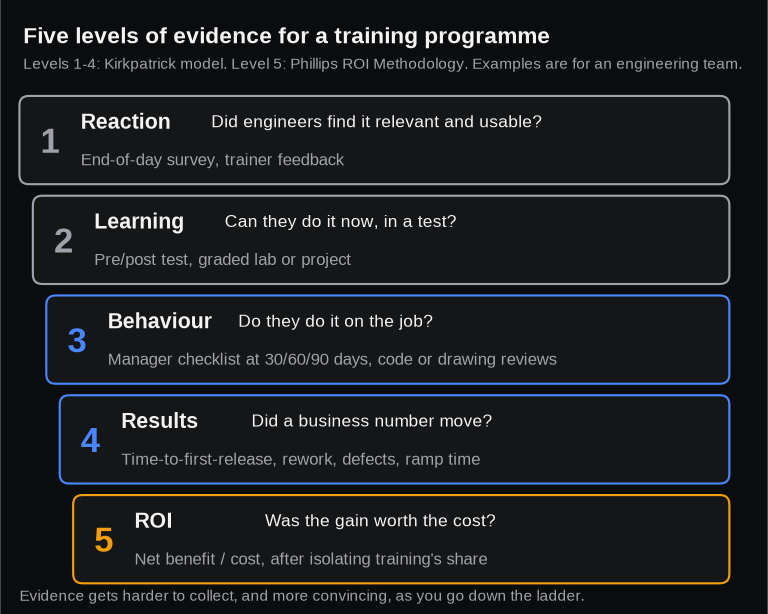
Donald Kirkpatrick created the four-level model in the 1950s. Kirkpatrick Partners now defines level 4 (results) as the degree to which the targeted organisational outcomes occur as a result of the training. The ROI Institute's Phillips methodology uses five levels: reaction and planned action, learning, application and implementation, business impact, and ROI. It adds two steps that matter in practice: isolate the improvement caused by the programme from everything else that changed, and convert that improvement to money. Its two summary ratios are:
Not everything needs a rupee value. The ROI Institute itself says some level-4 measures are better reported as intangible benefits. Engagement and team morale are examples. Kirkpatrick Partners also warns against claiming training as the sole cause of a result. The worked example below shows why that warning matters.
Worked example: what is the ROI of a GET onboarding bootcamp?
A mid-sized engineering company hires 40 graduate engineer trainees a year. Today they join teams directly and learn on the job. The proposal: a 4-week on-ground bootcamp in their first month, covering company standards, tools and a guided project. Is it worth it? All inputs below are assumptions chosen for illustration, not Skill-Lync prices or any company's data. Put in your own.
| Input | Assumed value |
|---|---|
| Cohort | 40 GETs |
| Fully loaded cost per GET (salary, seat, laptop, benefits) | ₹60,000 per month |
| Ramp without bootcamp | 10% of full output in month 1, rising evenly to 100% by month 9 |
| Ramp with bootcamp | 0% in month 1 (in training), 35% in month 2, rising evenly to 100% by month 6 |
| Share of the faster ramp credited to the bootcamp | 70% (the rest to mentoring, better hiring, an easier year) |
| Bootcamp fee | ₹35,000 per GET |
| Internal SME and manager time | ₹2,00,000 for the batch |
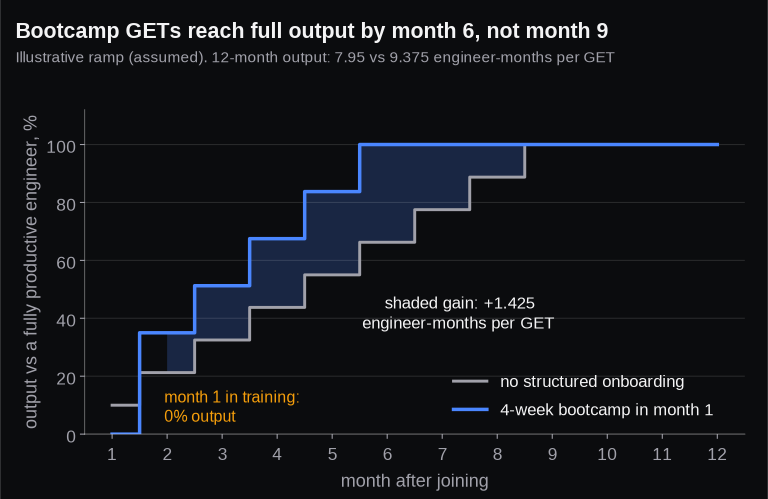
Step 1: output gained. Adding the monthly percentages over 12 months gives 7.95 productive engineer-months per GET without the bootcamp and 9.375 with it. The gain is 1.425 engineer-months per person.
Step 2: convert to money and isolate. Value a month of full output at what you pay for it: ₹60,000. This is a deliberately low valuation, because an engineer's work is worth more to the company than their cost. Credit the bootcamp with 70% of the gain:
Step 3: costs. Fees: ₹35,000 × 40 = ₹14,00,000. Add ₹2,00,000 of internal time, for a total of ₹16,00,000. Trainees' salaries in month 1 are not added again: the ramp curve already counts that month as zero output.
Step 4: ROI.
In ₹ lakh (₹23.94 lakh of benefits, ₹16 lakh of costs):
Cumulative extra output covers the cost in month 6, so the payback period is about half a year.
What does the sensitivity check tell you?
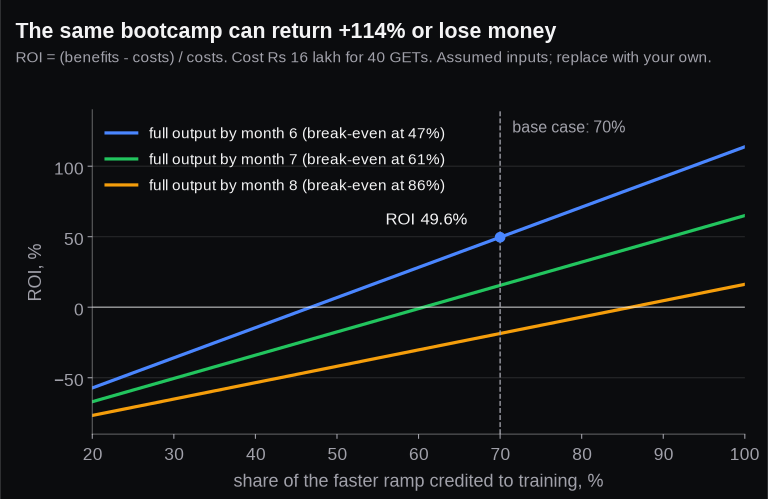
The sensitivity check shows the ROI rests on two assumptions you should test before quoting it. With full output by month 6, the bootcamp breaks even only if at least 47% of the faster ramp is genuinely due to training. If trained GETs only reach full output by month 8, it needs 86% of the credit, and at the 70% base case it loses 18.6%. Before you show anyone an ROI figure, measure the ramp of one trained batch against an earlier batch (level 4). The ramp is the input the whole answer depends on.
Why do corporate training programmes fail?
Most corporate training that fails was aimed at the wrong problem, or what was learned never reached the job. The usual causes are no business target, measuring only whether people enjoyed the sessions, managers who never ask for the new skill, one-off events without practice, and claiming credit for every improvement. In detail:
- No business problem behind it. "Everyone should learn AI" is a topic, not a need. Without a target number, nobody can say whether the training worked.
- Measuring only level 1. A 4.6/5 feedback score says the sessions were pleasant. It says nothing about whether drawings got better.
- Managers left out. Engineers go back to a team where nobody asks them to use the new method, so they don't.
- One-off events. A single three-day workshop with no practice afterwards is mostly forgotten. Projects, reviews and short refreshers spread over weeks hold better.
- Claiming every improvement. If a new tool, a new manager and the bootcamp all arrived in the same quarter, credit the bootcamp with only part of the gain. As the sensitivity chart shows, the answer can change sign.
How does Skill-Lync run corporate training for engineering teams?
Skill-Lync's enterprise team runs custom, hands-on programmes for engineering R&D, manufacturing, quality and after-sales teams in automotive, consumer electronics, manufacturing, MedTech and semiconductors. According to Skill-Lync's corporate training page (as of 23 Nov 2026), it has upskilled 75,000+ engineers and delivered 9,000 training days with 1,000+ empanelled industry experts. It works in four engagement models:
| Model and duration | Best for | Example programmes |
|---|---|---|
| GET bootcamp (on-ground), 1-8 weeks at 8 hours a day | Fresher hiring and GET onboarding | EV engineering; embedded and hardware; manufacturing and quality |
| Lateral training, 1-4 weeks | Upskilling experienced engineers in a role | EV technology, embedded systems, ADAS, AUTOSAR, cybersecurity |
| Functional transition, 2-12 weeks | Moving a team or organisation into a new technology | ICE to EV, SDV engineering, GenAI for automotive, hardware to firmware |
| Digital library, ongoing access | Self-paced learning at scale | 300+ engineering courses: EV systems, embedded firmware, CAD/CAE, data analytics |
If you are planning a GET batch or a team transition, see Skill-Lync's corporate training programmes, or talk to a Skill-Lync counsellor about scoping one. Individual engineers upskilling on their own can start with a programme such as the EV design and development master's or the PG certification in embedded systems. Our guide on upskilling as a mechanical engineer while working covers that side.
Frequently asked questions
What is corporate training in simple words?
Corporate training is learning a company organises and pays for so employees can do their work better or take on new work. Examples include onboarding for new hires, training on a new software tool, safety and compliance sessions, and leadership programmes for new managers. It is chosen to fix a business need, and it should be measured against that need.
What are some examples of corporate training?
Common examples are new-hire onboarding, technical tool training (CAD, simulation, programming), compliance and safety training, and quality-process training such as PFMEA or GD&T. Others are leadership programmes for new managers and communication skills courses. In engineering companies, graduate engineer trainee bootcamps and team transitions from engine to EV work are two of the biggest programmes.
How long should a corporate training programme be?
Match the length to the change you need, not to a calendar. Short refreshers can be a few hours. Role upskilling for experienced engineers typically runs one to four weeks. Graduate onboarding bootcamps run one to eight weeks. Moving a whole team into a new technology can take two to twelve weeks, spread across phases with projects in between.
How do you calculate the ROI of corporate training?
ROI is net benefits divided by costs, times 100. First, measure the business improvement against a baseline. Second, isolate the share caused by training. Third, convert it to money. Then subtract the full programme cost, including fees and internal time. In our worked example, a ₹16 lakh GET bootcamp returning ₹23.94 lakh of benefits gives 49.6%.
Is corporate training only for large companies?
No. In ATD's 2025 report, organisations with fewer than 100 employees spent the most per head on learning: $1,965 per employee in 2024. Medium organisations spent $1,195, and those with 2,500 or more employees spent $445. Small firms often buy external programmes or digital libraries instead of building a training department.
What is the difference between corporate training and online courses?
An online course is a format; corporate training is a purpose. A company can use online courses in its training, but corporate training is defined by the employer choosing the outcome, tying it to a role, and measuring results at work. An individual taking a course for their own career is doing self-directed upskilling, which is valuable but different.
Sources and further reading
- World Economic Forum, Future of Jobs Report 2025 press release, 8 Jan 2025, and report digest: 39% skill change, 59 of 100 workers, 63% and 85%.
- ATD, 2025 State of the Industry: Talent Development Benchmarks and Trends (2024 data, 539 organisations): spend and hours per employee, class sizes, content areas, metrics.
- Wheebox, India Skills Report 2026: overall and domain-wise employability.
- Kirkpatrick Partners, The Kirkpatrick Model: definitions of the four levels.
- ROI Institute, ROI Methodology: five levels, isolation, conversion to money, BCR and ROI formulas.
- Skill-Lync, Corporate training for engineering teams: engagement models and programme figures, accessed 23 Nov 2026.