Hyundai Verna Earns 5 Stars in Bharat NCAP: 28.22/32 Adult, 44/49 Child
Bharat NCAP has rated the new Hyundai Verna 5 stars for adults and children. Here are the official scores, the body regions where the sedan lost frontal-test points, how it compares with the Dzire, the Amaze and this month's SUVs, and what it means for crash engineers.

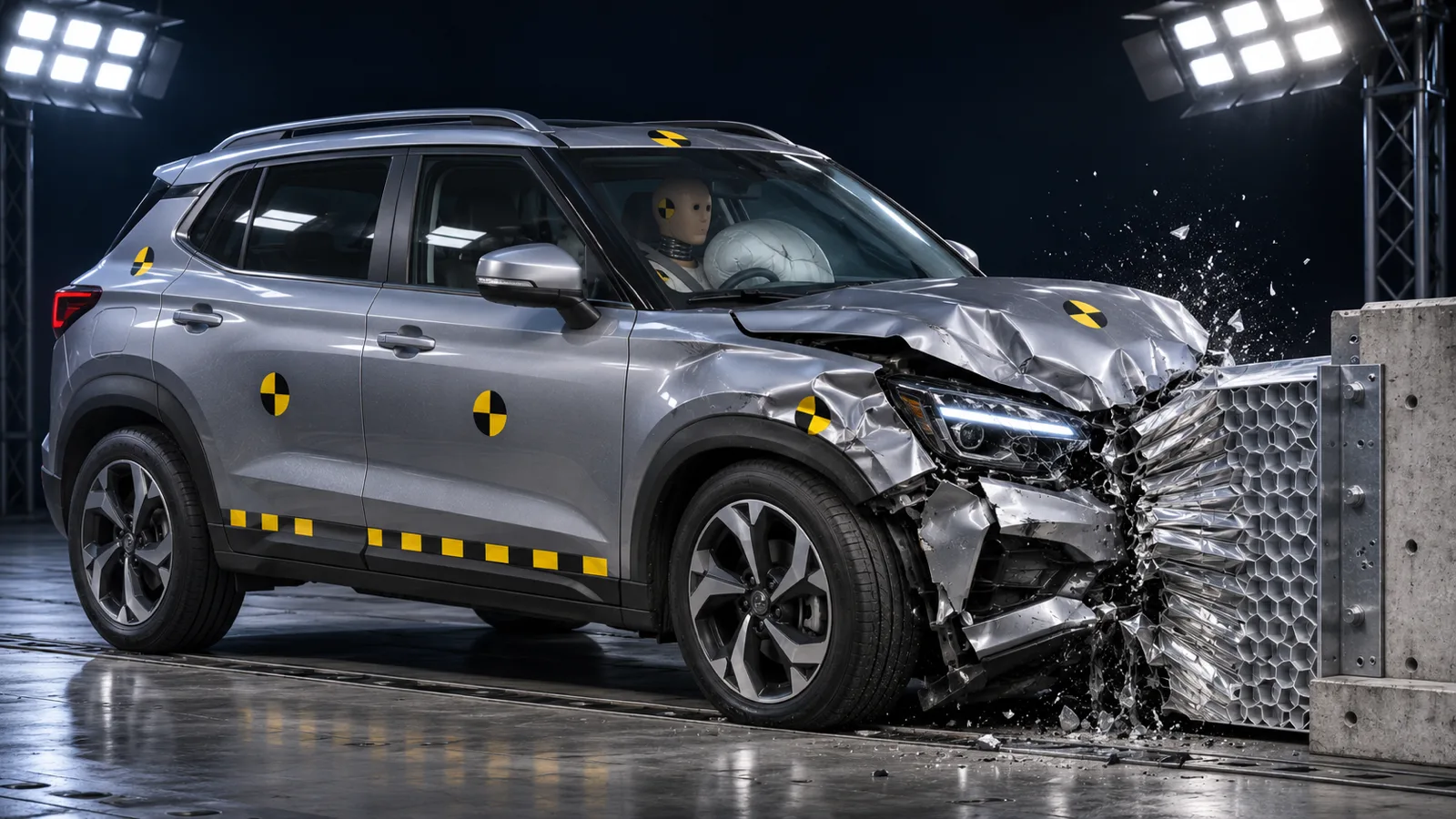
The new Hyundai Verna has a 5-star Bharat NCAP rating for both adult and child occupant protection, with official scores of 28.22 out of 32 (adult) and 44 out of 49 (child). Bharat NCAP lists the rating from November 2026, and Hyundai Motor India announced it from Gurugram on 20 November 2026. The sedan lost most of its points in the frontal crash, at the occupants' knees and thighs.
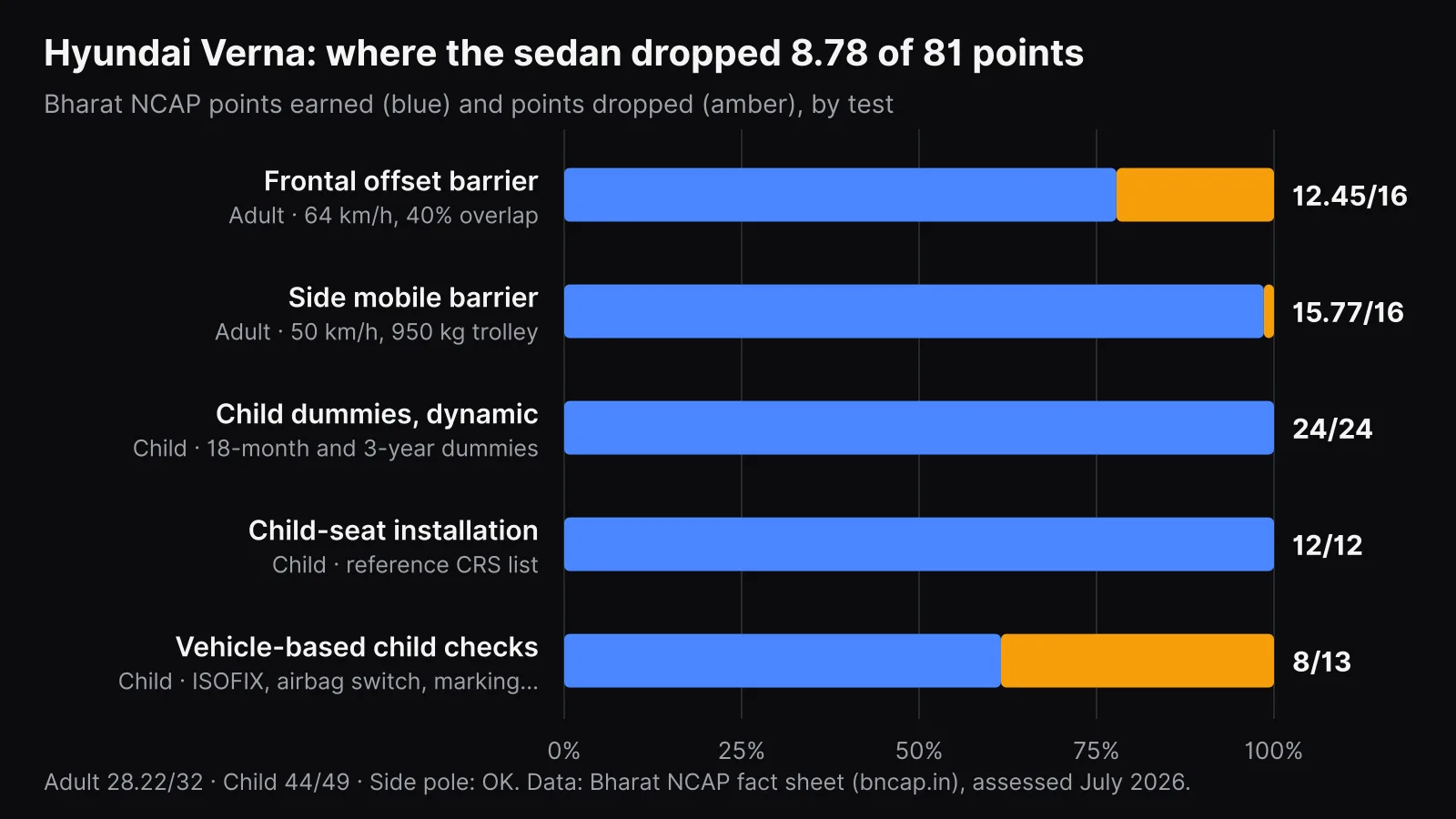
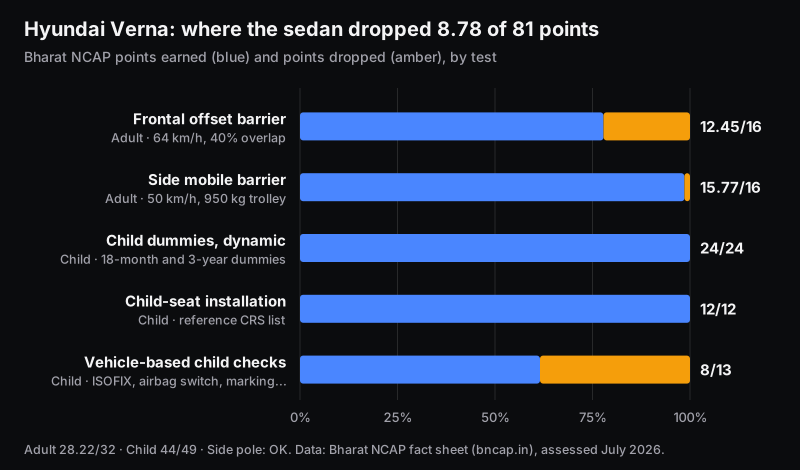
- Adult score 28.22/32: 12.45/16 in the 64 km/h frontal offset test, 15.77/16 in the 50 km/h side barrier test, and a pass in the side pole test (Bharat NCAP fact sheet).
- Child score 44/49: 24/24 in the dynamic dummy tests, 12/12 for child-seat installation, and 8/13 on the vehicle-based checks.
- Test cars: the 1.5 Turbo GDi DCT HX 8 and 1.5 MPi iVT HX 8, crash-test weight 1,521 kg, assessed in July 2026.
- Coverage: the annexure covers all listed trims from HX 2 to HX 10, with both engines and the MT, iVT and DCT gearboxes.
What did Bharat NCAP give the Hyundai Verna?
The Verna got 5 stars in both categories: 28.22/32 for adults and 44/49 for children. That clears the 27-point adult and 41-point child lines for 5 stars. Of the 81 points on offer, it dropped 8.78: 3.55 in the frontal test, 0.23 in the side test and 5 in the vehicle-based child checks.
The fact sheet grades each dummy body region from good to poor. The lowest grade on the car is marginal, for both front occupants' knees, thighs and pelvis in the frontal crash.
| Body region | Driver, frontal | Passenger, frontal | Driver, side barrier | Driver, pole |
|---|---|---|---|---|
| Head and neck | Good | Good | Good | Good |
| Chest | Adequate | Good | Adequate | Good |
| Abdomen (side dummy) | n/a | n/a | Good | Good |
| Knees, thighs, pelvis | Marginal | Marginal | Good (pelvis) | Good (pelvis) |
| Lower legs | Adequate | One good, one adequate | n/a | n/a |
| Feet | Adequate | Not graded | n/a | n/a |
The equipment table lists front, side chest and curtain airbags, pretensioners and load limiters as standard, and no knee airbags. ISOFIX is on the rear outboard seats only, there is no integrated child seat, and the passenger airbag cut-off is manual, which is where the 5 vehicle-check points went.
How does the Verna compare with other sedans and this month's SUVs?
The Verna is one of only three sedans on the Bharat NCAP list. It has the best child score of the three, but the lowest frontal score. Among cars rated in 2026, its side score is the lowest and its frontal score is second-lowest, after the VinFast VF6 (11.13).
| Car | Frontal /16 | Side /16 | Adult /32 | Child /49 | Test weight |
|---|---|---|---|---|---|
| Hyundai Verna (Jul 2026) | 12.45 | 15.77 | 28.22 | 44.00 | 1,521 kg |
| Maruti Dzire (Feb 2025) | 14.17 | 15.29 | 29.46 | 41.57 | 1,185 kg |
| Honda Amaze 3rd Gen (Oct 2025) | 14.33 | 14.00 | 28.33 | 40.81 | 1,241 kg |
| Tata Sierra EV, SUV (Jun 2026) | 14.62 | 16.00 | 30.62 | 45.00 | 2,412 kg |
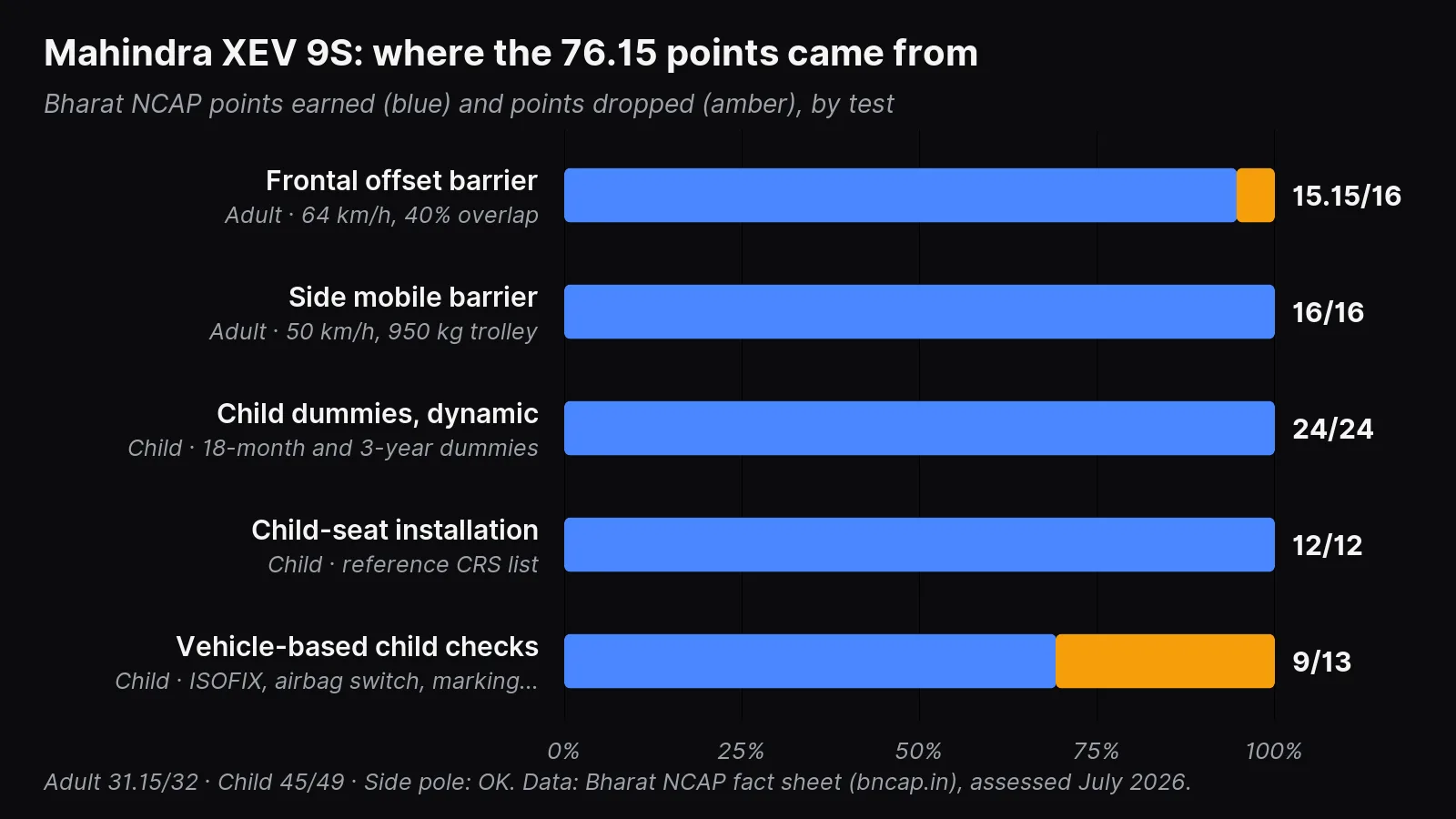
| Mahindra XEV 9S, SUV (Jul 2026) | 15.15 | 16.00 | 31.15 | 45.00 | 2,529 kg |
Months are when each car was assessed. Hyundai calls the Verna the first 5-star sedan longer than 4,000 mm (data up to 19 November 2026); Bharat NCAP does not define segments, so that is Hyundai's claim. Every 2026 result is in our Bharat NCAP ratings tracker, and the XEV 9S result came out in the same batch.
Why does this matter for engineers?
Mass does not explain the frontal score. By our calculation, at 64 km/h (17.78 m/s) the Verna brings this much kinetic energy into the barrier:
That is 40% less than the 400 kJ the XEV 9S brings, yet the SUV scored 2.7 frontal points more. The lighter Dzire (about 187 kJ) and Amaze (about 196 kJ) also beat it. Points come from dummy readings, and the weak region here is the knee-thigh-pelvis load path, which runs through the knee bolster, lower instrument panel and steering column. The fact sheet gives no cause, but tuning that path is typically restraint and interior work as much as structure work.
The side test is the reverse case. A 950 kg trolley hits the parked car, and a lighter car gets pushed harder. In an idealised plastic collision (our estimate) the Verna picks up about 19.2 km/h, against 13.7 km/h for the XEV 9S. Even so, it lost only 0.23 side points, with an adequate chest reading.
In India this work employs crash CAE engineers (LS-DYNA, Radioss, HyperMesh), restraint-system and interior-trim engineers, and homologation engineers who know AIS-197, the standard Bharat NCAP runs on.
What happens next?
The rating applies only to the variants in the fact sheet's annexure. For comparison, the earlier Verna got 5 stars for adults and children from Global NCAP on 3 October 2023, with its structure rated unstable. That test used Global NCAP's 2022 protocol, so its scores do not carry over. Students can read the 4-page official Verna fact sheet to see how a crash report is laid out.
Frequently asked questions
What is the Hyundai Verna Bharat NCAP rating?
5 stars for adult occupant protection (28.22/32) and 5 stars for child occupant protection (44/49). The car was assessed in July 2026, and the rating applies from November 2026.
Where did the Verna lose points?
It dropped 3.55 points in the frontal offset test, where both front occupants had marginal knee, thigh and pelvis readings. It also lost 0.23 points in the side barrier test and 5 of 13 vehicle-based child points.
Is the Verna safer than the Dzire or Amaze?
On Bharat NCAP numbers the Verna has the best child score of the three sedans, but the Dzire has a higher adult score (29.46). The three were tested in different years, so treat small gaps with care.
Learn the engineering behind crash ratings
Skill-Lync's crashworthiness analysis course with HyperMesh and Radioss teaches the frontal and side crash simulation behind results like this one. The automotive safety standards course covers AIS-197 and related regulations. If you are unsure which suits you, talk to a Skill-Lync counsellor.
Sources and further reading
- Bharat NCAP, Hyundai Verna rating page and fact sheet (read 21 Nov 2026)
- Hyundai Motor India, Verna Bharat NCAP press release (20 Nov 2026)
- Bharat NCAP, rating pages for the Maruti Dzire, Honda Amaze 3rd Gen, Tata Sierra EV and Mahindra XEV 9S, and the full ratings list (read 21 Nov 2026)
- Global NCAP, Hyundai Verna result (3 Oct 2023)