Top Materials Science Universities in the US for an MS: 2027 Guide
The top US materials science departments by the 2026 US News and QS rankings, which of them actually admit master's students, eight MS and MEng programs checked for Fall 2027, whole-degree tuition at 2026-27 rates in rupees, STEM OPT, US pay and the IIT M.Tech alternative.
The top US universities for materials science and engineering in the 2026 rankings are MIT, Northwestern, UC Berkeley, the University of Illinois Urbana-Champaign, UC Santa Barbara and Georgia Tech (US News, April 2026), with Stanford, Harvard and Berkeley also in QS's world top ten. For an Indian student applying for a master's in Fall 2027, though, the shortlist looks different. Two of those six departments rarely or never admit students for a master's on its own, and the programs that do differ by more than ₹50 lakh in tuition.
In short
- US News's 2026 graduate ranking for materials engineering (published 7 April 2026) puts MIT first, Northwestern second, Berkeley and Illinois tied at third, UC Santa Barbara sixth and Georgia Tech seventh.
- UC Santa Barbara does not admit students for a terminal MS. At MIT, a master's (SM) on its own is possible but uncommon. Berkeley trains master's students through a nine-month MEng.
- Whole-degree tuition at a full load runs from $33,080 (Georgia Tech, about ₹31.2 lakh) to $88,250 (Penn, about ₹83.1 lakh) at 2026-27 published rates. We checked each rate on 21 Nov 2026.
- One academic year all-in at Carnegie Mellon comes to $97,384 (₹91.7 lakh) on CMU's own 2026-27 budget, at the FBIL reference rate of ₹94.20 per dollar (week ended 13 Nov 2026).
- Materials Engineering (CIP 14.1801) and Materials Science (40.1001) are both on the DHS STEM list, so a qualifying degree allows 12 months of OPT plus a 24-month STEM extension.
This guide is for Indian mechanical, metallurgical and production graduates weighing a US master's in materials for Fall 2027. It is chapter 10 of Skill-Lync's series on master's degrees for mechanical engineers. If you are still choosing a field, read chapter 3 on specialisations first. The earlier version of this page listed eleven universities and their research labs. This rewrite keeps that idea but checks every program against the university's own pages. It adds the facts that decide an application: who admits master's students, how long the degree takes, what it costs and what it leads to. Every cost below was computed with a short script kept with this article.
Which US universities are best for materials science and engineering?
By the 2026 rankings, MIT leads both major lists for materials. Northwestern, UC Berkeley, Illinois, UC Santa Barbara and Georgia Tech fill out US News's top seven. Stanford, Harvard and Berkeley join MIT in QS's world top ten. Rankings measure reputation and research, not how good a master's program is, so treat them as a starting filter.
| University | US News 2026, materials engineering | QS 2026, materials science (world) | Hosts an NSF MRSEC? |
|---|---|---|---|
| MIT | 1 | 1 | Yes |
| Northwestern | 2 | 15 | Yes |
| UC Berkeley | 3 (tie) | 7 | No |
| Illinois Urbana-Champaign | 3 (tie) | =33 | Yes |
| UC Santa Barbara | 6 | =22 | Yes |
| Georgia Tech | 7 | 12 | No |
| Penn State | 11 | =24 | Yes |
| Texas A&M | 14 | outside top 30 | No |
| Stanford | not confirmed (see note) | =3 | No |
| Harvard | not confirmed | 6 | Yes |
Read the table with three cautions. First, US News ranks engineering specialties only by peer assessment: department heads rate each other. Second, we took each US News rank from the university's own announcement, because the US News list itself could not be read. Berkeley and Illinois each report a third place and UC Santa Barbara reports sixth, which leaves room for a three-way tie at third. Stanford appears there in the US News listings, but we could not confirm it from a page we read, so we leave its exact rank out. Third, the QS column comes from QS's 2026 subject table, released on 25 March 2026. MIT's first place is confirmed by MIT.
The last column is a research signal, not a ranking. NSF's Materials Research Science and Engineering Centers (MRSECs) are large, multi-year research centres funded by the US National Science Foundation. NSF's list, last updated 30 July 2026, shows 22 of them. They include MIT, Northwestern, Illinois, UC Santa Barbara, Penn State, Harvard, Michigan, Penn, Minnesota, UW-Madison and Princeton. In July 2026 NSF announced $108 million for six centre awards, $18 million each over six years. A centre means more research projects and seminars, and for thesis students, more chances of a lab position.
Which top materials departments actually admit master's students?
Most do, but not the two you might try first. UC Santa Barbara does "not admit students seeking a terminal M.S. degree". MIT's materials department offers an SM, but it is uncommon, needs a thesis and uses PhD admission criteria. Berkeley admits terminal MS students "only on rare occasions" and trains master's students through a nine-month MEng.
The eight programs below admit master's students directly and publish their requirements. We checked each one on 21 November 2026.
| Program | Size | Thesis? | GRE for Fall 2027 | Funding for master's |
|---|---|---|---|---|
| Stanford: MS, Materials Science and Engineering | 45 units; typically 5-6 quarters | Optional (12 research units) | Not accepted | "Generally self-funded"; a first-year assistantship is "quite rare" |
| Carnegie Mellon: MS, Materials Science and Engineering (coursework) | 2 full-time semesters | No; a separate research MS takes 3-4 semesters | Not stated on the department's pages | No statement for master's students |
| Cornell: MEng, Materials Science and Engineering | 30 credits; 2-3 semesters | No; two-semester project | Optional | Self-funded; limited merit aid and some half-time teaching posts |
| Georgia Tech: MS, Materials Science and Engineering | 30 credit hours | Thesis or non-thesis | Not required | "Typically not available" for MS students |
| Illinois Urbana-Champaign: MS, Materials Science and Engineering | 36 hours (32 with thesis); 1.5-2 years | Non-thesis by default | Optional (waived) | Non-thesis MS is self-supported |
| Northwestern: MS, Materials Science and Engineering | 12 courses (thesis: 10 + 3 quarters of research) | Course or thesis track | Not required; scores not reviewed | "No funding available" for master's students |
| UC Berkeley: MEng, Materials Science and Engineering | 25 units in 9 months | No; team capstone | Optional but "highly recommended" (department) | No department support; partial Fung Institute scholarships |
| University of Pennsylvania: MSE, Materials Science and Engineering | 10 course units | Thesis, independent study or coursework | Optional this cycle | Generally none for master's students |
The funding column is the one most applicants skip, and it matters most. Every one of these departments either says its master's is self-funded or says nothing at all. Assistantships that waive tuition go overwhelmingly to PhD students. If a scholarship decides whether you can go at all, apply for a PhD or a research MS and contact faculty before you apply. Berkeley's two GRE statements also disagree: the department's page recommends the test, while the Fung Institute's page says it is not required. When pages conflict, email the department and keep the reply.
Should you choose an MS or an MEng in materials?
Choose a thesis MS if you might want a PhD or a research-heavy R&D role. Choose an MEng or coursework MS for the shortest, most industry-focused route: Berkeley's MEng takes nine months and Cornell's two to three semesters. Stanford's MS typically takes five to six quarters, and Stanford says it is not designed to prepare students for its PhD.
The trade-off is time against depth. A thesis gives you a supervisor who can write a strong reference and a result you can talk about in interviews. A one-year MEng costs less in living expenses and gets you to OPT sooner, but you finish with a team project rather than your own research. Carnegie Mellon makes the choice explicit: its coursework MS fits in two semesters, while its research MS takes three to four semesters, with at least 72 units of master's project work and a written final report.
What does a materials engineer actually do? A worked example
A materials engineer chooses and develops the material that lets a part meet its targets for stiffness, strength, weight, cost and life. The classic first lesson in materials selection shows why the answer depends on how the part is loaded. Here is that lesson with real property data.
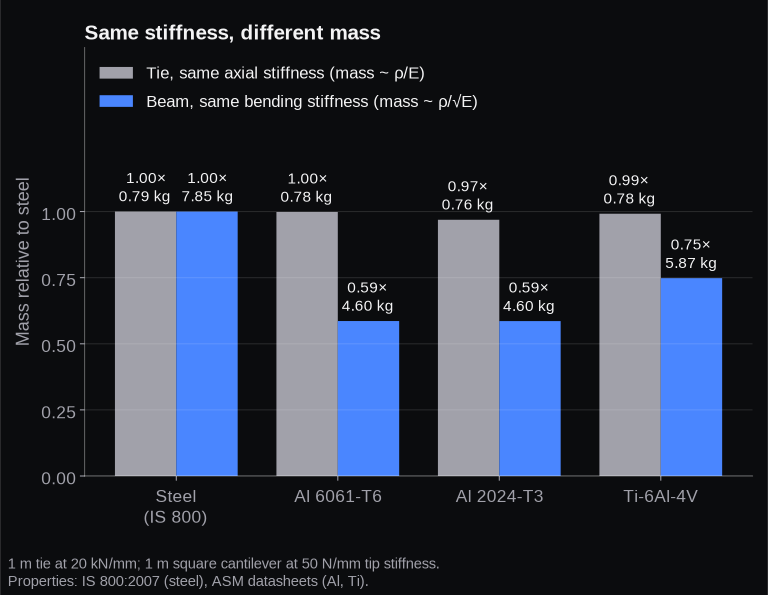
Take a 1 m part that must be stiff. As a tie (pulled along its length) it must stretch no more than 1 mm per 20 kN. As a cantilever beam with a square section it must deflect no more than 1 mm per 50 N at the tip. The section size is free, so the material decides the mass. For the tie, stiffness is . For the beam, the tip stiffness is with for a square of side . Solving each for the mass :
So for a tie the mass scales with , and for a beam with . The square root comes from geometry: a beam gets stiffer with the fourth power of its depth. A light material that needs a thicker section therefore pays a smaller penalty in bending than in tension. For steel ( GPa, kg/m³, from IS 800:2007), the beam needs
| Material | (MJ/kg) | Tie mass (20 kN/mm) | Beam side, mass (50 N/mm) | Beam mass vs steel |
|---|---|---|---|---|
| Structural steel | 25.5 | 0.785 kg | 31.6 mm, 7.85 kg | 1.00 |
| Aluminium 6061-T6 | 25.5 | 0.784 kg | 41.3 mm, 4.60 kg | 0.59 |
| Aluminium 2024-T3 | 26.3 | 0.761 kg | 40.7 mm, 4.60 kg | 0.59 |
| Ti-6Al-4V, annealed | 25.7 | 0.779 kg | 36.4 mm, 5.87 kg | 0.75 |
The result surprises most students. In tension, steel, aluminium and titanium weigh within about 3% of each other for the same stiffness, because their stiffness-to-density ratios are almost identical (about 25.5 MJ/kg). In bending, aluminium saves 41% of the mass. Titanium sits between the two, so you choose it for strength, temperature or corrosion, not stiffness per kilogram. A materials master's turns this kind of reasoning into a toolkit: property charts, processing routes, microstructure and failure. Our guide to materials used in manufacturing engineering covers the families of materials themselves.
How much does an MS in materials science in the US cost?
At 2026-27 published rates, tuition alone for the whole degree at a full load runs from about ₹31 lakh at Georgia Tech to about ₹83 lakh at Penn. Most programs fall between ₹57 lakh and ₹70 lakh. These figures are for an international student taking the fastest path each program allows. Living costs come on top.
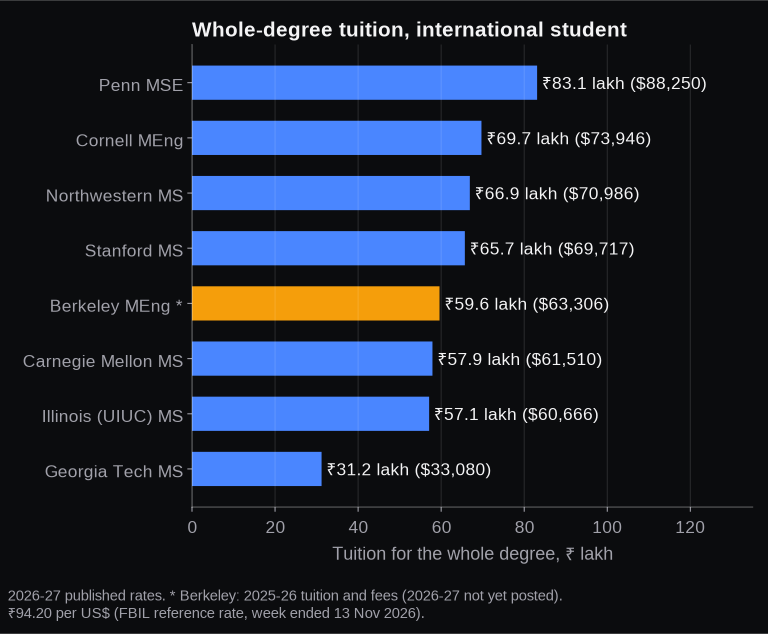
| Program | How tuition is charged | Fastest path | Tuition for the degree |
|---|---|---|---|
| Georgia Tech MS | Out-of-country: $16,540 a semester, flat for 12+ hours | 30 hours = 2 semesters of 15 | $33,080 (₹31.2 lakh) |
| Illinois MS (non-thesis) | Engineering, nonresident: $20,222 a semester for 12+ hours | 36 hours = 3 semesters of 12 | $60,666 (₹57.1 lakh) |
| Carnegie Mellon MS | Engineering master's: $30,755 a semester | 2 semesters | $61,510 (₹57.9 lakh) |
| Berkeley MEng | 2025-26 non-resident tuition and fees | 2 semesters | $63,306 (₹59.6 lakh) |
| Stanford MS | Graduate engineering: $23,239 a quarter, flat for 11-18 units | 45 units = 3 quarters of 15 | $69,717 (₹65.7 lakh) |
| Northwestern MS | $23,662 a quarter for 3-4 courses | 12 courses = 3 quarters of 4 | $70,986 (₹66.9 lakh) |
| Cornell MEng | Professional tier 1: $36,973 a semester | 2 semesters | $73,946 (₹69.7 lakh) |
| Penn MSE | $8,825 per course unit | 10 course units | $88,250 (₹83.1 lakh) |
Flat-rate bands reward a full load and punish a slow one. Stanford charges $23,239 a quarter for anything from 11 to 18 units. Taking 15 units a quarter finishes the 45 units in three quarters: 3 × $23,239 = $69,717. Taking 11 a quarter does not save money. Four quarters of 11 give only 44 units, one short, so you need a fifth: 5 × $23,239 = $116,195. That is $46,478 (about ₹43.8 lakh) more for the same degree. Since Stanford says its MS students typically take five to six quarters, plan your budget on the longer path unless you are sure of the faster one.
Three caveats. Georgia Tech's 30-hour total comes from its graduate catalogue, which was offline when we checked, so confirm it with the department. Carnegie Mellon's billing page notes that rates "may vary" by program. Fees add more: Georgia Tech charges $758 a semester in mandatory fees, $100 a semester as an international student fee, and separate health insurance. Penn adds $2,924 in fees for a full-time term.
What does one year in the US cost all-in?
For a one-year program at a private university, plan for roughly ₹90 lakh to ₹1 crore. On each university's 2026-27 cost-of-attendance budget, one academic year costs $97,384 at Carnegie Mellon (about ₹91.7 lakh) and $107,474 at Northwestern (about ₹1.01 crore). We left out federal loan fees, which do not apply to Indian students.
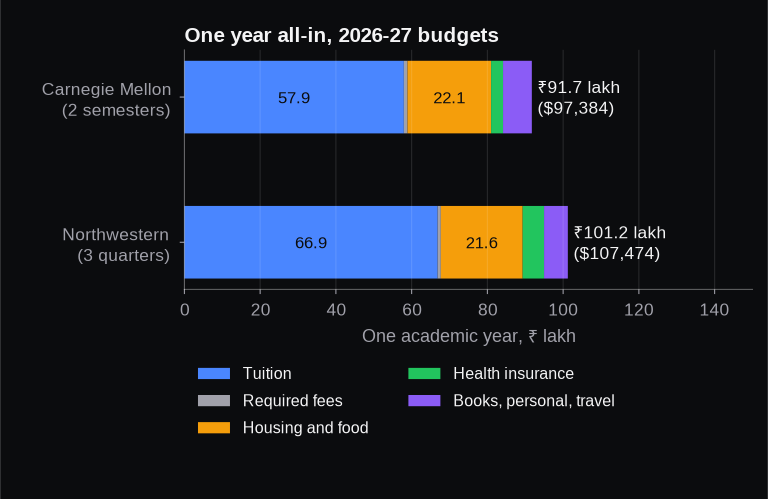
| 2026-27 budget line | Carnegie Mellon (2 semesters) | Northwestern (3 quarters) |
|---|---|---|
| Tuition | $61,510 | $70,986 |
| Required fees | $1,040 | $894 |
| Housing and food | $23,416 | $22,941 |
| Health insurance | $3,352 | $5,996 |
| Books, personal, travel | $8,066 | $6,657 |
| Total | $97,384 (₹91.7 lakh) | $107,474 (₹101.2 lakh) |
The exchange rate is a budget line too. The FBIL reference rate was ₹88.74 per dollar in the week ended 14 November 2025 and ₹94.20 a year later, so each dollar now costs 6.2% more. On the Carnegie Mellon budget, that alone adds ₹5.3 lakh (₹86.4 lakh then, ₹91.7 lakh now). If you plan to borrow, size the loan with a margin for the rupee.
Is a materials science master's a STEM degree for OPT?
Yes, in almost every case. The DHS STEM Designated Degree Program List (last updated 22 July 2024) includes Materials Engineering (CIP 14.1801), Materials Science (40.1001), Metallurgical Engineering (14.2001) and Polymer/Plastics Engineering (14.3201). A degree carrying one of these codes allows 12 months of post-completion OPT plus a 24-month STEM extension: up to 36 months of US work after graduation.
Two details matter. What counts is the CIP code on your I-20, not the program's name, and none of the department pages we read states its code, so ask admissions before you accept an offer. Cornell does confirm that its MEng graduates are eligible for STEM OPT. The OPT rules in 8 CFR 214.2(f) also cap unemployment at 90 days in the first 12 months and 150 days in total with the extension. A DHS rule published in July 2026 would have replaced open-ended "duration of status" with fixed admission periods. The University at Buffalo's international office reports that courts paused it in September and blocked it on 16 November 2026. Check your university's international office for the current position before you travel.
What do materials engineers earn in the US?
The US Bureau of Labor Statistics puts the median annual pay of materials engineers at $112,860 in May 2025. The lowest-paid 10% earned under $72,300 and the top 10% over $175,720. These are medians across all experience levels, not starting offers, and no degree guarantees them.
The occupation is small: about 23,800 jobs in 2025, with 8% growth projected for 2025-35 and about 1,300 openings a year. The largest employers are transportation equipment manufacturing (17% of jobs), scientific R&D (10%) and engineering services (9%). Government pays the highest median, $137,610. Because the field is small, many materials graduates work under other titles: process, quality, failure-analysis, battery, welding or simulation engineer. For the wider picture after a mechanical master's, see chapter 2 on job prospects.
Should you do an M.Tech in materials in India instead?
If cost is the deciding factor, an IIT M.Tech through GATE comes out ahead on money. GATE 2027, organised by IIT Madras, has a Metallurgical Engineering (MT) paper and a Materials Science section (XE2) within the Engineering Sciences paper. Exams run on 6, 7, 13, 14, 20 and 21 February 2027, and results are due on 19 March 2027.
The numbers make the point. IIT Madras's 2026-27 fee circular sets M.Tech fees at ₹40,402 a semester plus ₹21,000 in one-time fees, so a two-year M.Tech costs ₹1,82,608 (plus a refundable ₹5,000 deposit). GATE-qualified M.Tech students can receive ₹12,400 a month in financial assistance, generally for 22 months: ₹2,72,800. On those figures the degree pays for itself with about ₹90,000 to spare, while a US master's costs ₹60 lakh to ₹1 crore.
The trade-off is the job market you enter. Indian steel, aluminium and defence employers recruit metallurgy and materials graduates. For example, SAIL's November 2025 notice for 124 Management Trainee (Technical) posts reserved 20 for metallurgy and accepted Materials Science and Engineering degrees, at a starting basic pay of ₹50,000 a month. That cycle selected through SAIL's own test, not GATE scores. A US degree opens US R&D, semiconductor and aerospace roles that are scarcer in India, at a cost you need a plan to repay. Our GATE hub covers exam dates, cut-offs and PSU recruitment.
When should you apply for Fall 2027?
Apply between now and mid-February 2027, and sooner for research-track programs. The earliest deadlines are MIT's on 1 December and UC Santa Barbara's PhD deadline on 16 December 2026. Most master's deadlines fall between 12 January and 12 February 2027, as the list below shows in date order:
- MIT DMSE (SM and PhD): 1 December, 11:59 pm Eastern; GRE scores not accepted.
- UC Santa Barbara Materials (PhD only): 16 December 2026, 11:59 pm Pacific.
- Stanford MS: 12 January 2027; late applications are not accepted; application fee $125.
- Berkeley MEng: 14 January 2027; international application fee $155; TOEFL iBT at least 90.
- Carnegie Mellon MS: applications open 1 October and close 15 January; fee $75; spring entry is also possible.
- Cornell MEng: priority review 15 January, then rolling until 1 June; a video interview is required.
- Penn, Georgia Tech and Illinois: 1 February (Penn also has an early round on 1 November).
- Northwestern MS: 12 February.
Several department pages show a date without a year, so confirm each one on the application portal before you plan around it. English requirements vary too: Illinois asks for TOEFL 103 or IELTS 7.5 for full status, while Northwestern asks for TOEFL 80 or IELTS 7.0.
How can you build a materials profile from India before you apply?
Show that you can already use materials knowledge on a real problem. Admissions committees read hundreds of statements that say "I am passionate about materials". What stands out is evidence: a failure analysis from your internship, a project comparing materials with real property data like the example above, or a simulation that models material behaviour.
Skill-Lync's courses can supply that evidence. The PG Program in CAE covers FEA, where material models decide whether a crash or durability result is right. HyperMesh for FEA Plastic and Sheet Metal Applications deals with two material families industry designs with every day. The Biomaterials course suits applicants aiming at biomaterials research. Li-ion Battery System Design is a route into energy materials. If you are interested in additive manufacturing, compare this guide with chapter 9 on 3D printing universities. Not sure which project would strengthen your application most? Talk to a Skill-Lync counsellor.
Frequently asked questions
Which is the best university in the US for materials science?
MIT ranks first for materials in both the 2026 US News graduate ranking and the 2026 QS subject ranking. For a master's, though, MIT's SM is uncommon and requires a thesis. Northwestern (US News #2), Berkeley's MEng and Stanford's MS are the top-ranked programs that regularly admit master's students.
Can I get funding for an MS in materials science in the US?
Rarely. Stanford, Northwestern, Georgia Tech, Cornell, Illinois and Penn all say their master's students are mostly or fully self-funded, and assistantships go mainly to PhD students. The realistic routes to funding are a thesis MS with a supervisor who agrees to support you, a PhD application, or external scholarships from India.
Is the GRE required for a materials science master's in the US for Fall 2027?
Mostly not. Stanford and MIT do not accept GRE scores, Northwestern does not review them, and Georgia Tech does not require them. Cornell, Illinois and Penn list the GRE as optional. Berkeley's materials department recommends it for 2027 entry and says it will be required from August 2028.
Can a mechanical engineer do an MS in materials science?
Yes. US materials programs regularly admit mechanical, chemical, metallurgical and physics graduates, and mechanical graduates already know solid mechanics, which underpins much of the field. You may need to catch up on thermodynamics of materials and crystallography in your first term. A project using real material data strengthens the application.
How long is an MS in materials science in the US?
Between nine months and two years. Berkeley's MEng takes nine months, Carnegie Mellon's coursework MS two semesters and Cornell's MEng two to three semesters. Stanford's MS typically takes five to six quarters, and Illinois's MS 1.5 to 2 years. A thesis usually adds at least one term.
What is the difference between materials science and metallurgical engineering?
Metallurgical engineering focuses on metals: extraction, alloy design, heat treatment and processing. Materials science covers all materials, including metals, ceramics, polymers, composites, semiconductors and biomaterials, and links their structure to their properties. Both are on the US STEM list (CIP 14.2001 and 40.1001), and GATE 2027 tests them in its MT paper and XE2 section.
Sources and further reading
- MIT News, MIT graduate engineering and business programs ranked highly by U.S. News for 2026-27 (7 Apr 2026)
- Northwestern University, Data Book table T1.02: graduate program rankings (8 Oct 2026)
- UC Berkeley MSE, Berkeley MSE ranked #3 nationally in 2026 graduate rankings (Apr 2026)
- Grainger College of Engineering, Illinois, Facts and rankings (Apr 2026)
- UC Santa Barbara College of Engineering, 2026 U.S. News graduate rankings (7 Apr 2026)
- Georgia Tech MSE, MSE maintains ranking as 7th highest materials science graduate program
- Penn State MatSE, Rankings; Texas A&M Engineering, Graduate rankings 2026-27 (7 Apr 2026)
- MIT DMSE, QS 2026 subject ranking announcement (25 Mar 2026); QS 2026 materials science table as reproduced at xuanxiao.org
- US National Science Foundation, Materials Research Science and Engineering Centers (updated 30 Jul 2026) and NSF deploys $108M for materials science (30 Jul 2026)
- UC Santa Barbara Materials, PhD program application process; MIT DMSE, Master's degree and requirements and Applying
- Stanford, MS in Materials Science and Engineering, How to apply, FAQ and 2026-27 tuition rates
- Carnegie Mellon, MS in MSE (coursework), MS in Materials Science (research), How to apply and 2026-27 engineering tuition and cost of attendance
- Cornell, MEng requirements, MEng admission, MEng FAQ and Bursar tuition rates
- Georgia Tech, MSE graduate admissions, MS catalogue entry and Fall 2026 tuition and fees
- Illinois, MatSE MS admissions, MS degree requirements, FAQ and 2026-27 graduate tuition
- Northwestern, MS curriculum, MS admissions, Financial aid, TGS tuition and master's cost of attendance
- UC Berkeley, MSE Master of Engineering, Graduate admissions, Fung Institute How to apply and Tuition and financial aid
- University of Pennsylvania, MSE master's, How to apply, Funding and SEAS costs
- US Bureau of Labor Statistics, Occupational Outlook Handbook: Materials Engineers (modified 29 Oct 2026)
- US DHS / ICE, STEM Designated Degree Program List (22 Jul 2024); eCFR, 8 CFR 214.2; University at Buffalo ISS, Fixed admission rule update
- Reserve Bank of India, National Summary Data Page: FBIL reference rate (20 Nov 2026)
- GATE 2027, IIT Madras: Papers and syllabus, Important dates and Opportunities; IIT Madras, Fee structure 2026-27 (4 May 2026)
- SAIL, Recruitment of Management Trainees (Technical), advertisement HR/REC/C-97/MTT/2025 (12 Nov 2025)
- Bureau of Indian Standards, IS 800:2007 General Construction in Steel, clause 2.2.4.1 (public copy); ASM Aerospace Specification Metals datasheets: Al 6061-T6, Al 2024-T3, Ti-6Al-4V