Week 9: Project 1 - Surface preparation and Boundary Flagging (PFI)
Project 1 - Surface preparation and Boundary Flagging of a PFI Engine:
Objective:
Import the CAD model of the IC engine into Converge CFD and run a diagnosis. Look for errors and solve them, without compromising actual model. The main objective is to set up the case for no hydrodynamic simulation, solve it, and create animation in Paraview to see valve and piston movements.
Introduction:
Fuel injection is the introduction of fuel in the internal combustion engine most commonly automotive engines by the means of an injector. Port fuel injections long ago replaced carburetors in cars because of their efficiency and lower maintenance requirements. The fuel injector is installed in the intake manifold and they are cheap in production and do not have to withstand high pressure from the combustion chamber. The fuel injector injects the fuel into the combustion chamber through the intake valve owing to which the intake valve always remains and there is no carbon deposit in the intake valve. The major disadvantage with respect to the other injection system is that it lacks efficiency (better fuel economy) with respect to the other fuel delivery system.
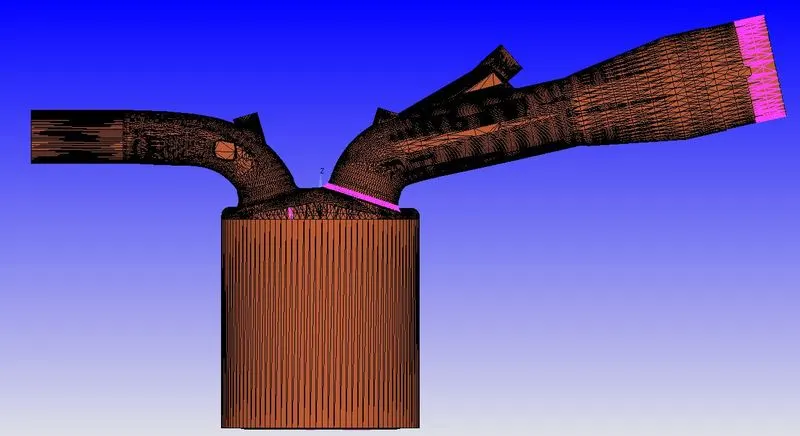
When importing our geometry and running the diagnosis in Converge CFD we are prone to get a lot of errors in the design geometry. First, we flag recognizable boundaries and hide certain parts of the geometry to start working on our problem triangles.
Initial geometry model:
Problem triangle/errors in the geometry:
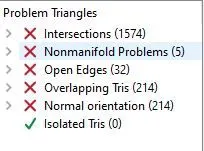
1. Intersections: As the name suggests the intersection of the plane of one triangle to another plane of triangles. Areas and angles less than specified values will be also considered as intersection errors. Intersection errors can be removed by translating or rotating the surfaces or increasing the angle or areas if any.
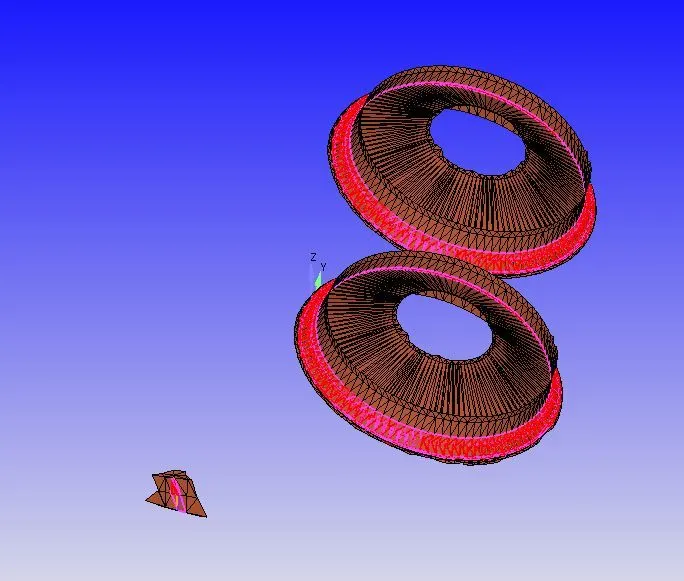
2. Non-manifold Problems: Non-manifold Problems arise when an edge is shared by more than two triangles or A vertex that connects two otherwise disconnected pieces of geometry. This is error will be removed automatically after assigning the boundaries or regions.
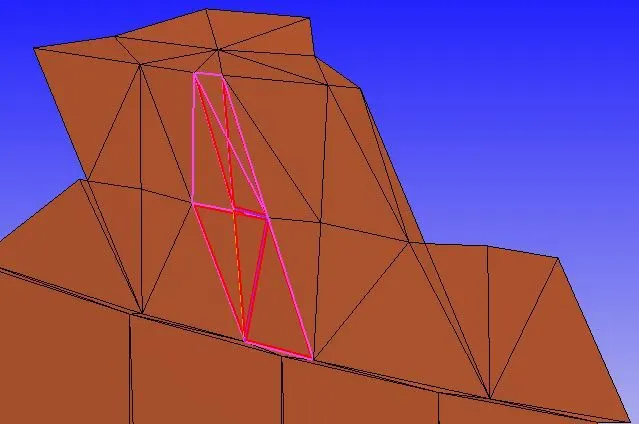
3. Open Edges: This problem arises when there is an open edge since converge works on the volume so it does not allow open edges. Make patch or stitch triangles to remove this error.
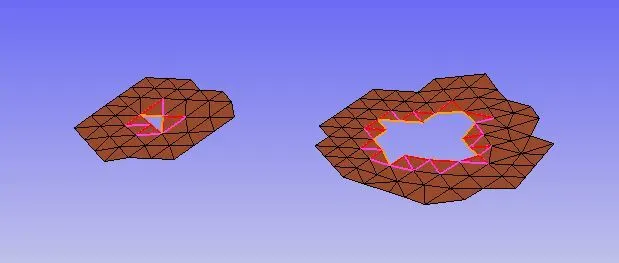
4. Overlapping triangles: Triangles that meet other triangles at an angle less than the specified value, in degrees. Delete the overlapping triangle and make a patch if necessary.
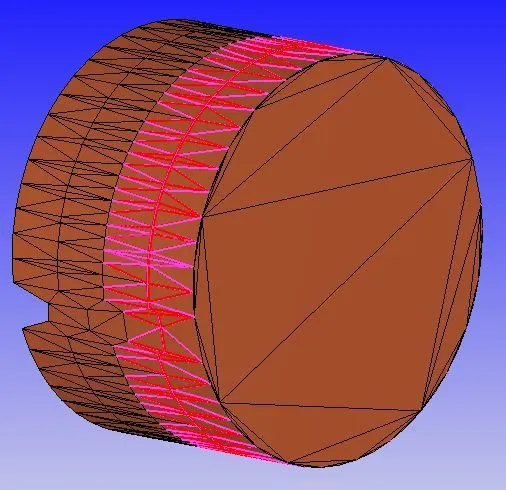
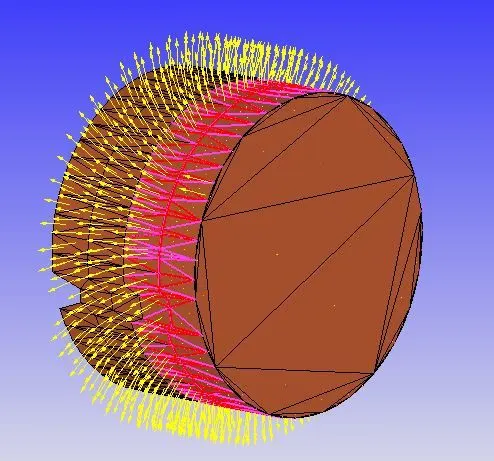
5. Normal orientation: This problem arises when a triangle has a different orientation of normal than its adjacent one. This error can be removed easily by translating the normal.
After boundary flagging and resolving the errors, the geometry model looks this way:
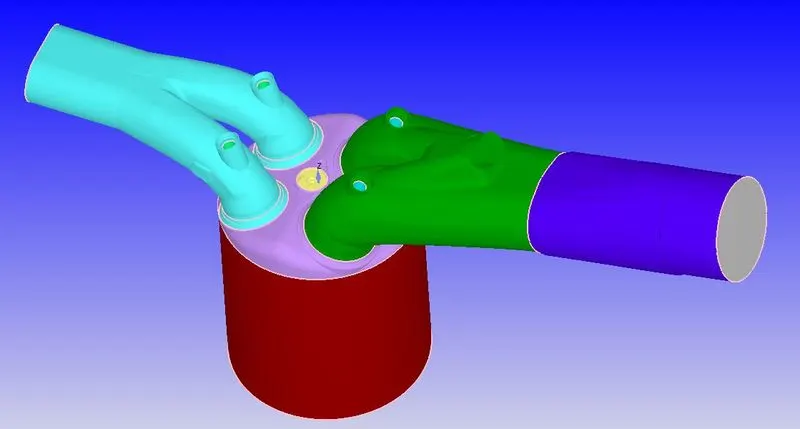
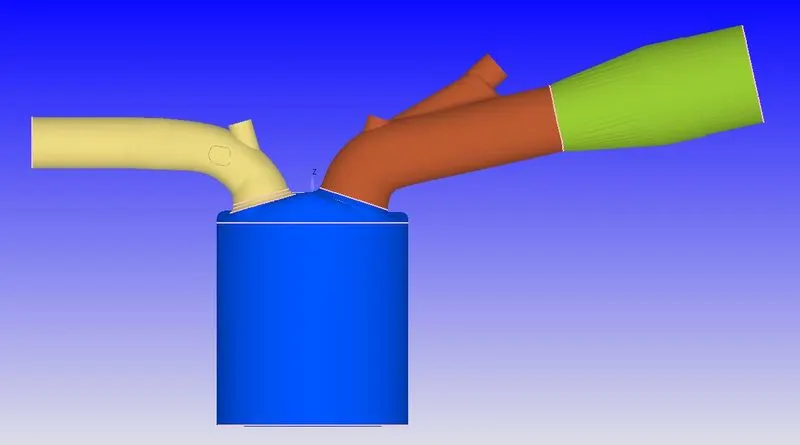
After this 4 regions are constructed namely Intake region-1(away from combustion chamber), Intake region-2(near combustion chamber), Exhaust region, and Cylinder region.
Geometry model grouped by regions:
No Hydro simulation:
With the input data from the challenge page, the NO hydro simulation is set up and run to study the No Hydro run of the IC engine.
Application Type:
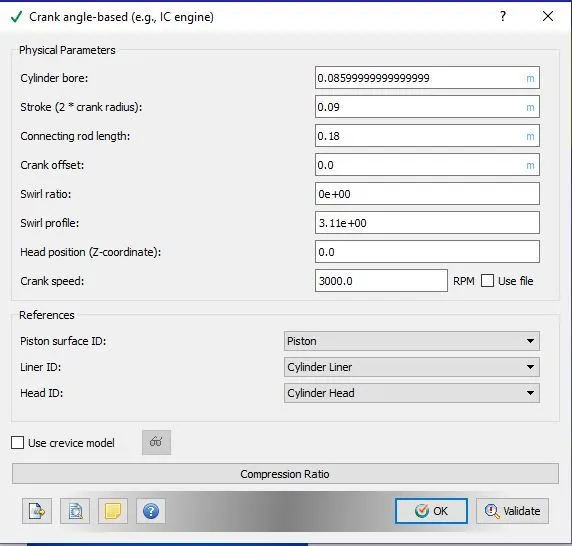
- Under "Gas simulation" the Equation of state is selected as "Redlich Kwong", the critical temperature is 133K and the critical pressure is 3770000Pa and the therm.dat file is loaded under Gas thermodynamic data.
- The Turbulent Prandtl number is 0.9 and the Turbulent Schmidt number is 0.78 under Global Transport parameters.
- The PFI engine involves the combustion process therefore the Reaction mechanism is selected and mech.dat is loaded.
- Under Run parameters, the parameters are kept at their default values except the Simulation mode is selected as No hydrodynamic solver (for testing setup only).
- Under Simulation time parameters start time is -480 deg, end time is 240 deg. The initial time step is 1e-07s and the minimum time step is 1e-08s. The maximum time step is 0.0001s and the rest values are kept as default. The Solver parameters are kept as default.
Boundary Conditions:
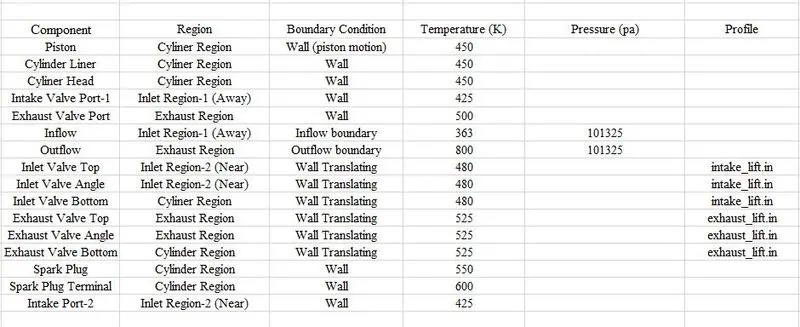
1. The inflow boundary has a mass fraction of 1 which contains the constituents of air i.e. Nitrogen (0.77) and Oxygen (0.23).
2. Combustion of our fuel is given by the equation: `C_8H_18 + 12.5*( 0_2 + 3.76*N_2 ) = 8CO_2 + 9H_2 O + (3.76*12.5) N_2`.
3. We assume that combustion is stoichiometric and the concentration of species in our outflow boundary when combustion products are released is given by the following table:

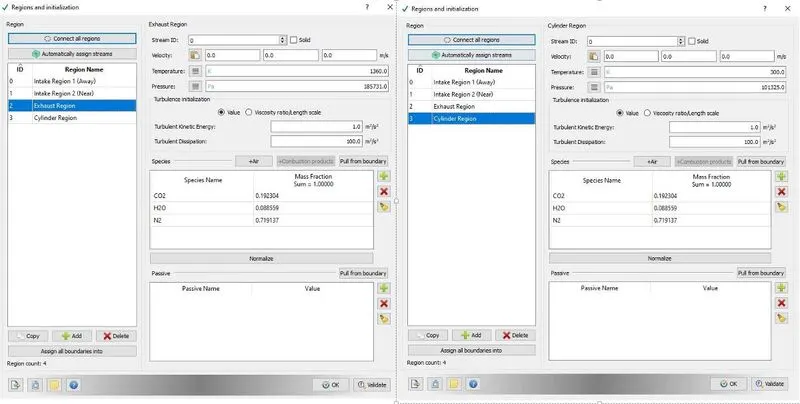
Regions and Initializations:
Intake Regions 1 and 2:
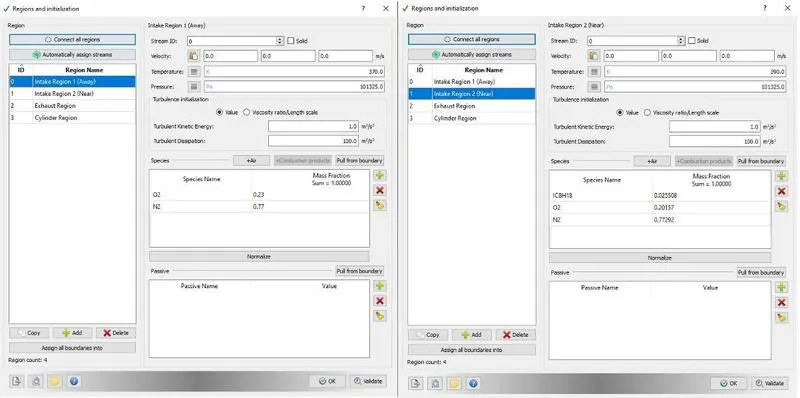
Exhaust and Cylinder Regions:
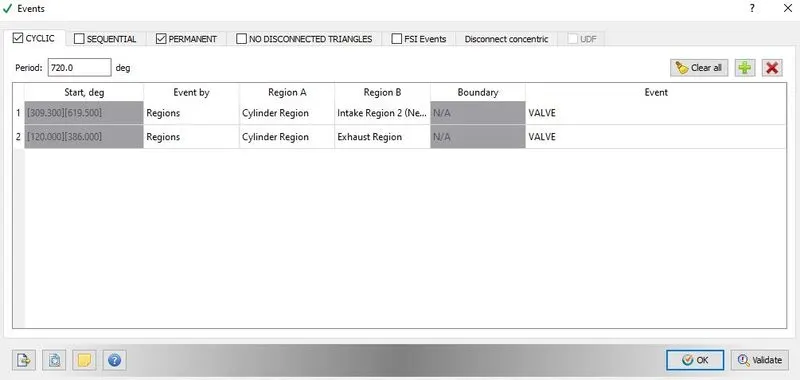
Events:
- Based on the valve timing for the intake and the exhaust profiles we must connect and disconnect from the combustion chamber using the cyclic option in the Events box.
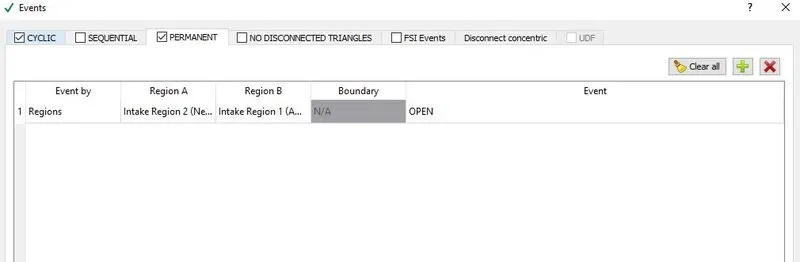
- We need to give a permanent event for Intake regions 1 and 2 and set event to Open.
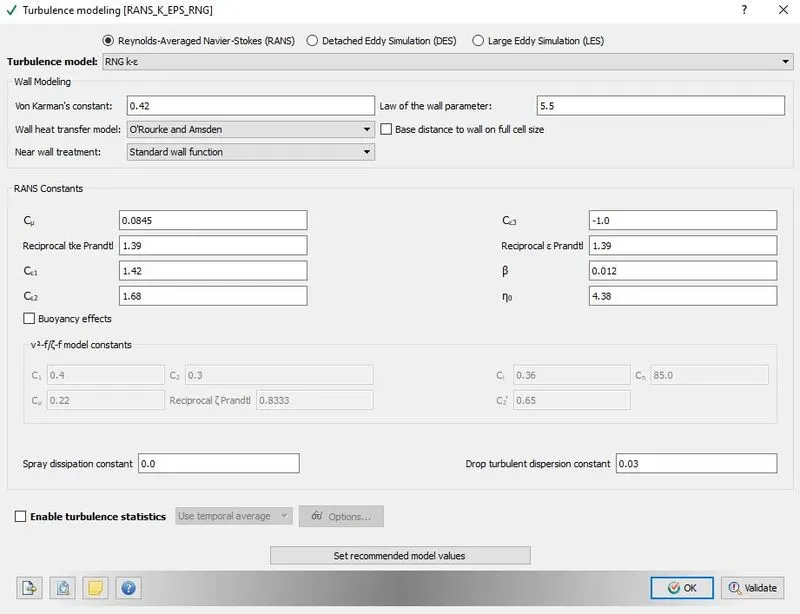
Turbulence Modeling:
A standard RNG k-e model is used as our turbulence model as a lot of experiments were conducted to determine constants suitable for our IC Engine case.
Base Grid:
Base grid size = 4mm.
After this, the input files are exported and simulation is done using Cygwin. Then the output files are post-processed in Converge CFD and results are viewed in ParaView.
Results:
No-Hydro Simulation:
Mesh Generation:
Conclusions:
The PFI surface preparation and the boundary flagging were done successfully using Converge-CFD. The errors like intersections, non-manifold problems, open edges, overlapping triangles, and normal orientation were eliminated successfully and set up for simulation. The no-hydro simulation setup was done successfully and the animation of the PFI Engine was uploaded successfully. Fixed embedding was not used in the simulation setup as such the software uses an academic license and the use of the fixed embedding exceeded the number of cells required for the license.