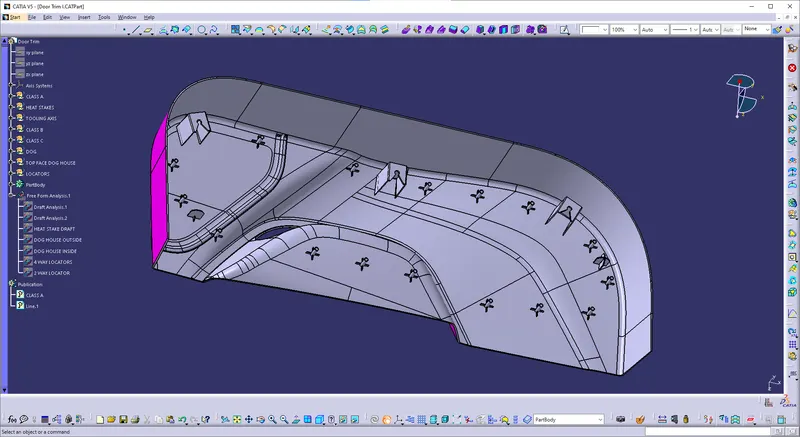
Week 9 - Project 1 - Door Trim Lower with Engineering Features
Door Trim Lower with Engineering Features
AIM:
- Create the Door Trim Lower Plastic component through the given Class-A surface. To begin with, the tooling axis for the given Class-A Surface should be created meeting the requirements of the draft angle and at the end perform the Draft analysis on the model.
- Create the Heat Stakes and the locators considering the design rules mentioned in the video for the door applique.
Objective:
- The main aim of this challenge is to create a solid body of 'Door Trim Lower' with the help of the closed surface method by using the 'Generative shape design' workbench in CATIA V5.
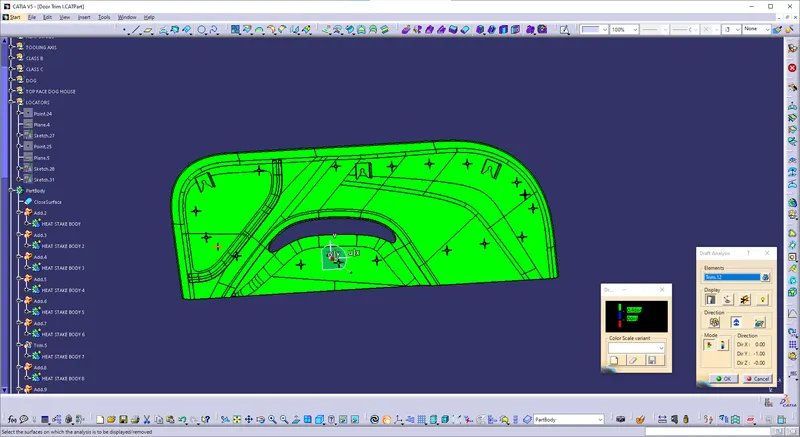
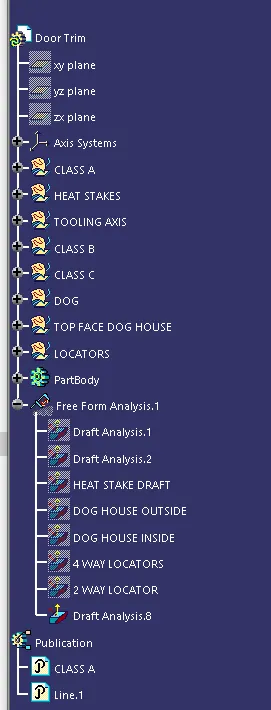
- Performing the 'Draft Analysis' on the solid part body of the Door trim.
CLASS-A SURFACE:
the class-A surface is used in the automotive design industry.it the describes the final production surface data for the aesthetic parts of the car.
CLASS-B SURFACE:
The Class B finish is a quality finish with only minimal imperfections.
CLASS-C SURFACE:
The interior surfaces not readily visible, surfaces that will be covered by another part when assembled, or surfaces which the Customer feels do not need to meet a high cosmetic finish.
DRAFTING ANALYSIS:
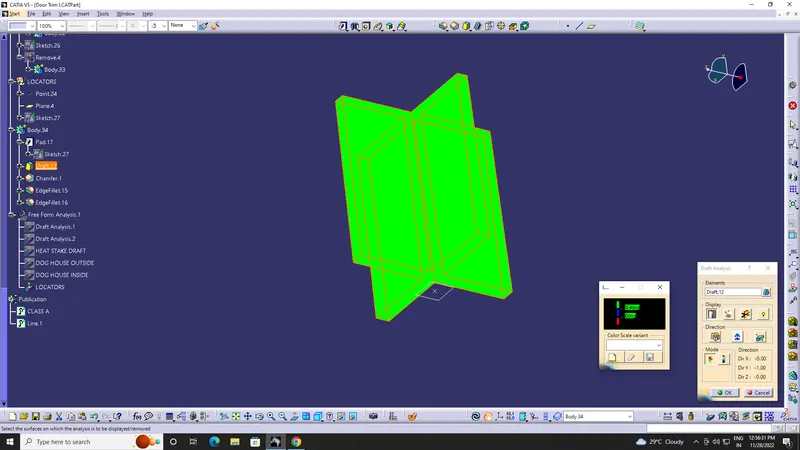
- Draft analysis is performed on the components where the ejection of materials happens after the material is made inside the tools.
- In the case of automotive sheet design manufacturing, the blank sheet after turning into automotive panels like Hood, Fender, Roof, Side Doors, Back Doors,bumpers need to be removed from Panel Dies.
- If a considerable amount of draft angle is not provided, the removal of components from the tool will be difficult.
- It’s the same in the case of mold(plastic component) after getting filled inside the core and cavity, it needs to get ejected easily with the help of ejectors.
Creating tooling axis:
- The ejection from the mold after manufacturing the interior trim must have the nominal 3-degree draft angle.
- hence the tooling directions created by considering the above factor and bisecting method is used.
- The base surface of the class-A was extracted to create a reference point on the surface using the point, create a line in the z-direction and an axis system was inserted to the point
- Tooling direction is the main consideration for plastic part and mould parts because it defines the movement of the mould part and the possibility of the plastic part coming out from the mould part (Core and Cavity).
MATERIAL USED IN DOOR TRIM:
ACRYLONITRILE BUTADIENE STYRENE(ABS) OR HIGH IMPACT RESIN:
High Rigidity:
- ABS has high rigidity and impact resistance. Even in low-temperature conditions or over long periods, ABS plastics will retain these characteristics.
- Its tensile strength is around 35-44 Mpa and because of its plastic yield at high strain rates, the impact failure of ABS is ductile rather than brittle.
- It is used in Instrument-Panel, Door-trims,Coin holder etc. As it has good impact resistance, it is used in creating bumpers as well.
Excellent Insulation:
- It has very good insulating properties, both acoustic and thermal.
Highly Weldable:
- It is a good weldable material as it is an amorphous material
- It is usually measured in terms of stiffness or modulus.
High Dimensional Stability:
- It remains mechanically strong over time.
Good Surface Characteristics:
- High Surface brightness and excellent surface finish. ABS is an ideal material whenever superlative surface quality, color fastness, and luster are required. ABS is a two-phase polymer blend.
- A continuous phase of ‘Styrene-Acrylonitrile’ co-polymer(SAN) gives the material rigidity. Hardness and heat resistance. The toughness of ABS is the result of microscopically fine polybutadiene rubber particles uniformly distributed in the SAN matrix.
- Hence, ABS is also used in Wheel-covers, IP substrate, etc
HIGH IMPACT RESIN:
- High Impact Polymer Resin is a Toyota Boshoku-developed resin material featuring the world’s top level of impact resistance.
- By controlling dispersion of PA11 (Polyamide) and PP (polypropylene) at the nanometer level, it forms a unique salami structure.
- Using High Impact Polymer Resin as an impact modifier, and performing high-expansion foam molding enables an approximately 20% weight reduction compared with conventional door trim materials, from 1.8kg/m2 to 1.5kg/m2.
CLASS A SURFACE:
- In automotive design application Class A surfaces are created on all visible exterior surfaces (ex; body panels, bumper, grill, lights etc.) and all visible surfaces of see-touch in interior (ex: Dashboard, seats, door pads etc.)
- class A surface should be given and we dont make any dimension changes.
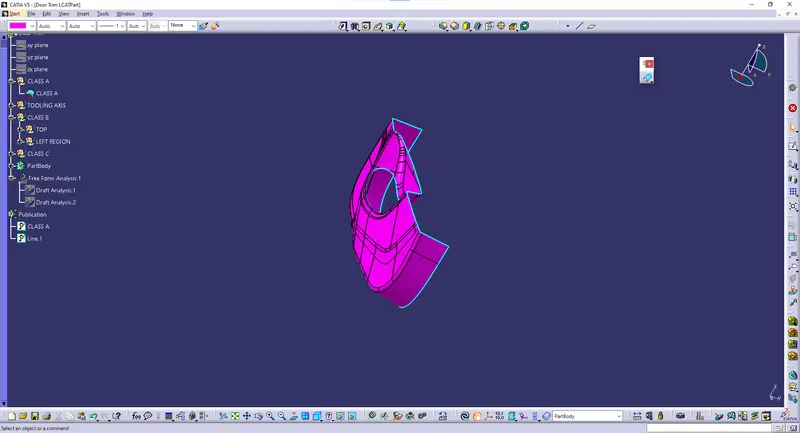
CLASS A DRAFT ANALYSIS:
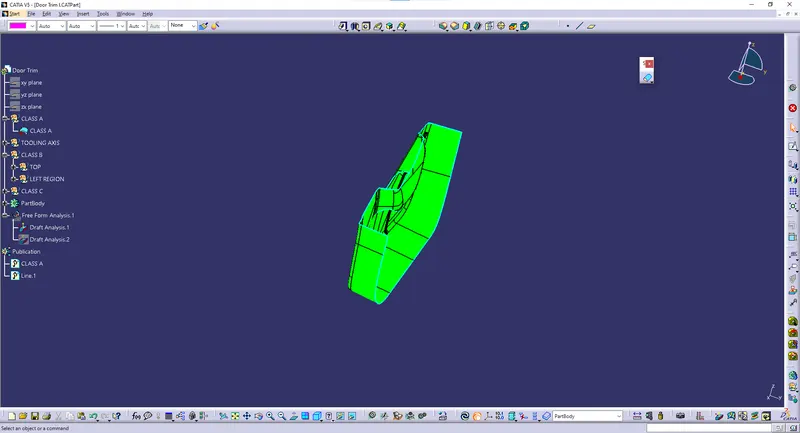
CLASS B SURFACE:
- Class B surface is to be creating the engineering features and offsetting the surface of class A. Firstly we will extract surfaces by using the extract command and from the class A surface. And if there are any patches we have to make it a smooth surface and finally get the complete boundary.
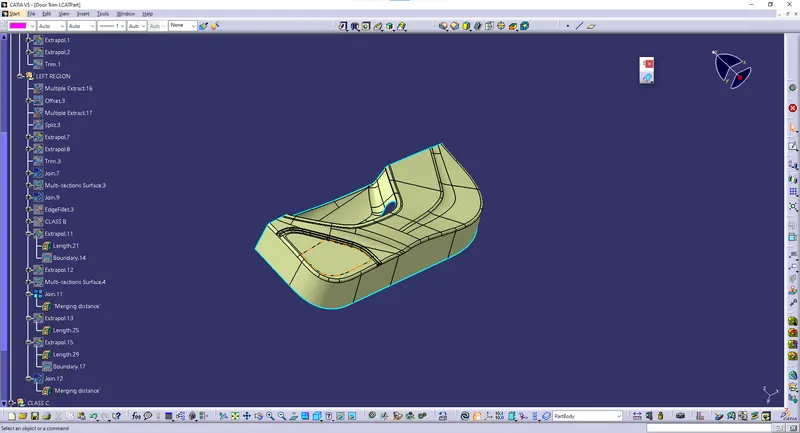
CLASS C SURFACE:
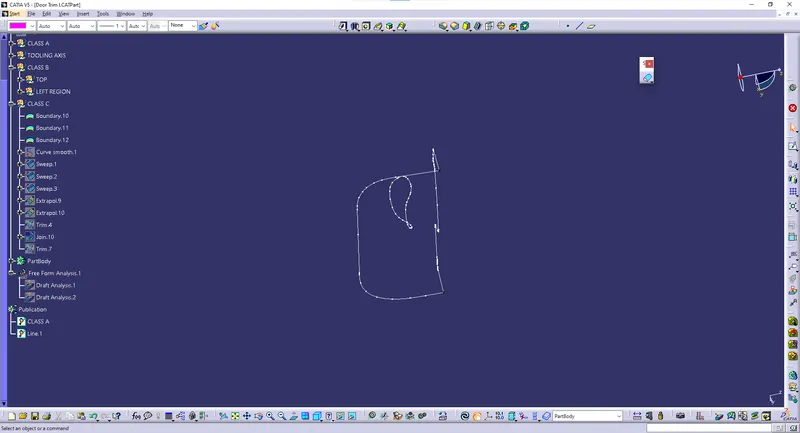
- Class C surface is connected the Class A and Class B, For the class C surface, we need to create the entire boundary of the component by using the boundary command.
- And also creating the best way for the tooling direction to manufacturing easily in an effective way.
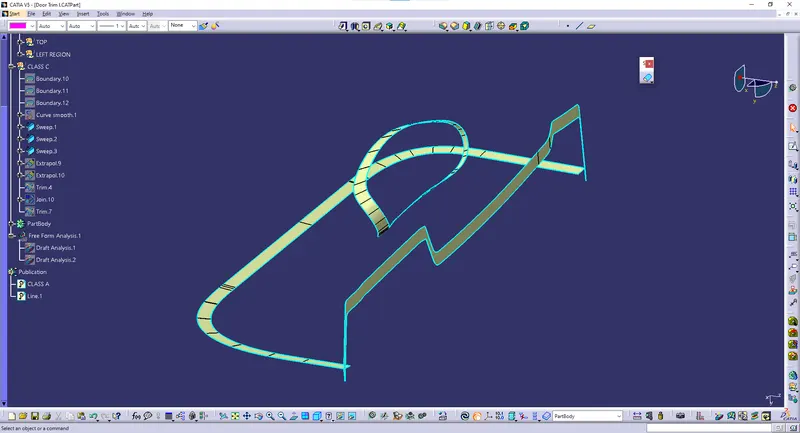
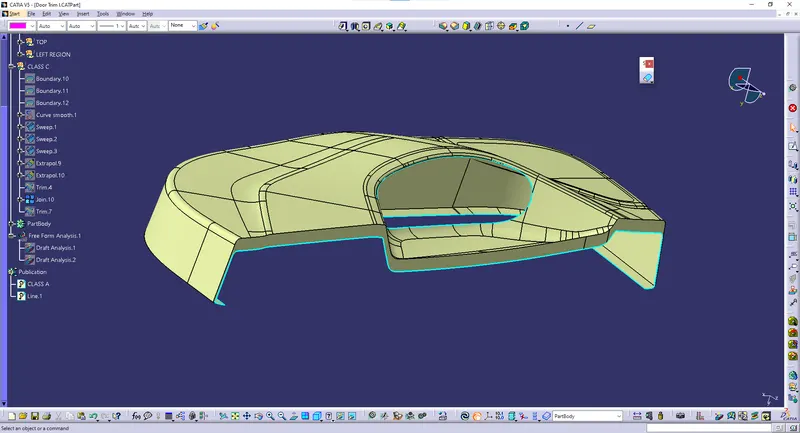
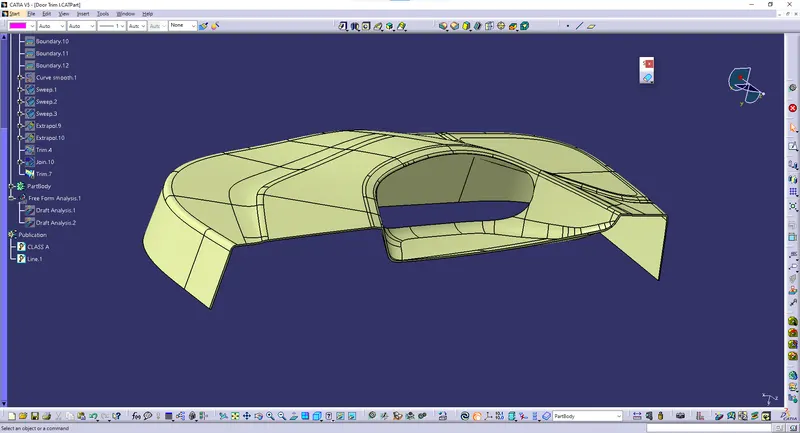
- By using the sweep command we can combine them and trim the surfaces so we can get the completed closed surface body and draft angle given as min 3 degrees.
- Before trimming the most important things join them all.
- After the body has to be closed by using the closed surface in part modeling.
CLASS C BOUNDARY SURFACE:
CLASS C SWEEP SURFACE:
CLASS C & A SURFACE:
CLASS A & B & C :
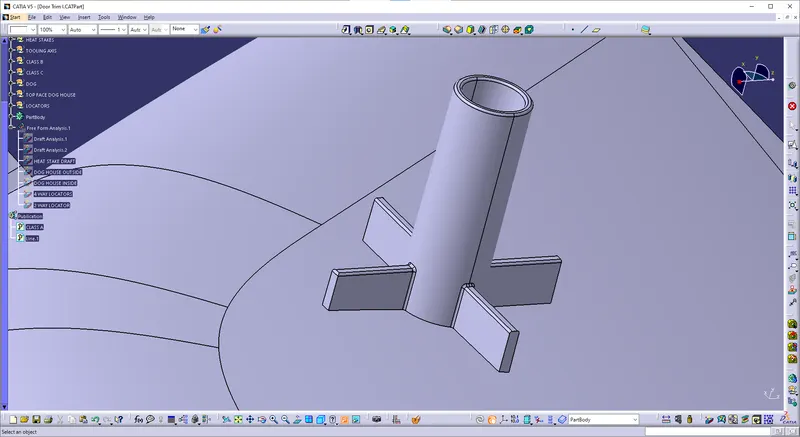
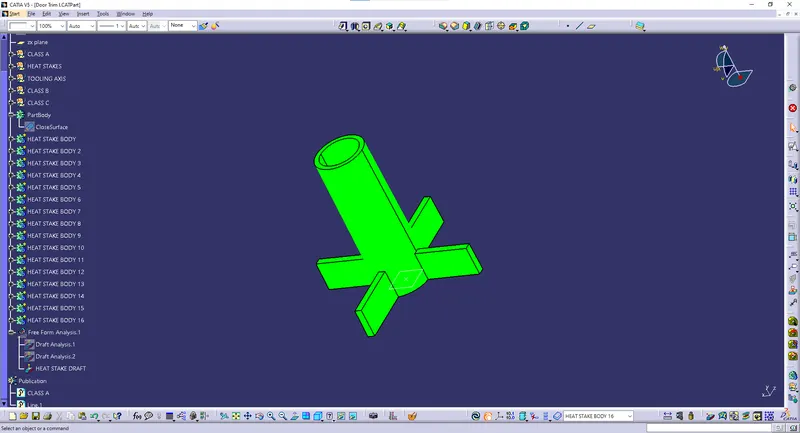
HEAT STAKES:
- Heat staking also known as thermoplastic staking is the process of joining two dissimilar materials together.
- In heat staking we use local heating and cooling to raise the temperature of plastic components and allow plastic reforming to be carried out. This reforming can be used in a wide variety of applications.
- Applications range from staking plastic bosses for assembly of car door panels to joining PCB’s to plastic housings.
- Benefits of this technique include; no vibration damage, no particulates, the ability to stake metalized coated applications and the capability to stake in difficult to access or restricted areas.
Advantages of Heat Staking:
- Consistent, Fast & Economical Alternative to Rivets & Screws.
- Joins different materials Eg: Plastic to plastic , plastic to non-plastic or join 2 non-plastics.
- Able to handle difficult to weld plastics.
- Simple mechanism and accurate control.
Industry Applications:
- Automotive : Reliable solution for interior parts, welding bumpers, tail light assemblies, dashboards & many more parts.
HEAT SKAKES DRAFT ANALYSIS:
DOG HOUSE:
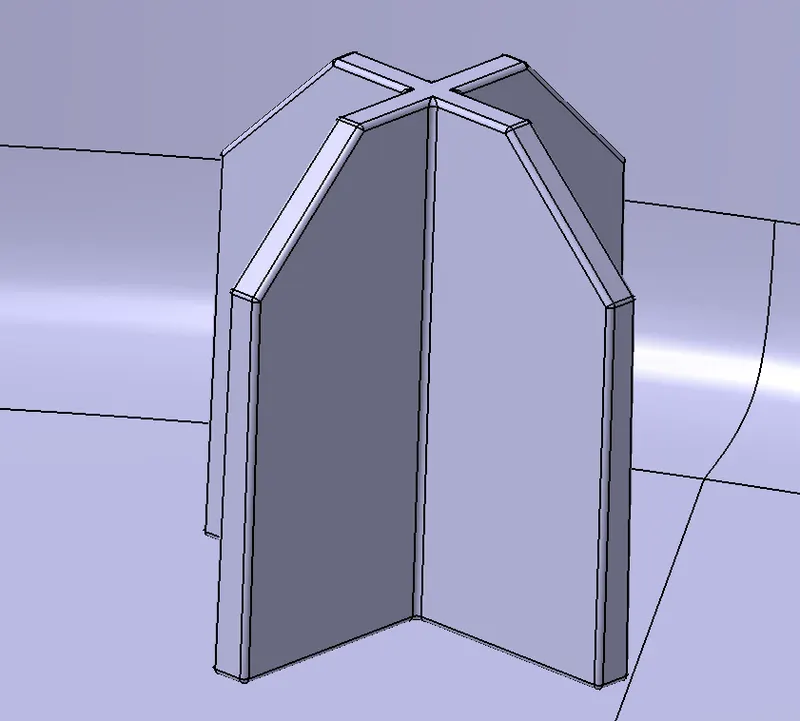
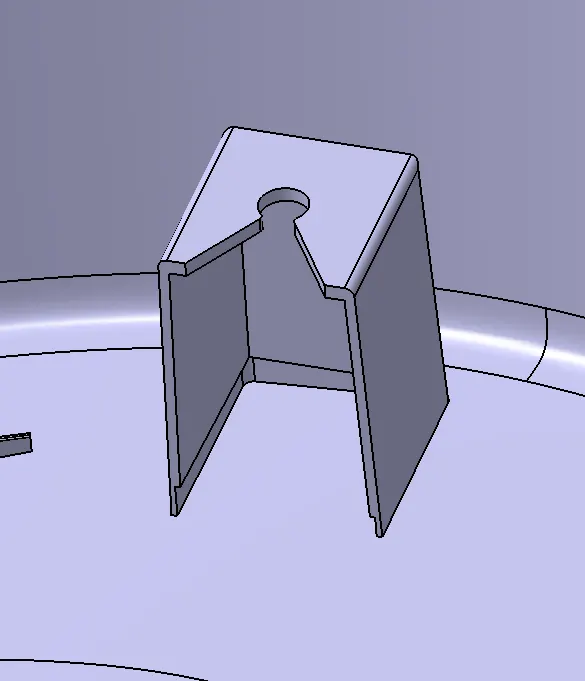
- Dog house is an engineering feature used in plastic trim design.
- Dog houses are used as supporting feature. Sometimes other engineering features like snaps; locators etc. are mounded on them to increase their strength.
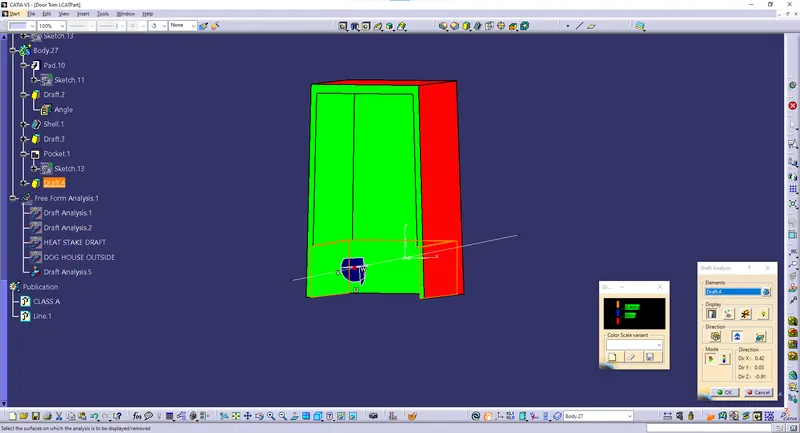
- Dog houses are subjected to draft analysis to prevent breakage of the component during ejection from mould cavity. Dog house and other engineering components are built on B-surface.
DOG HOUSE DRAFT ANALYSIS:
LOCATORS:
2 WAY LOCATORS:
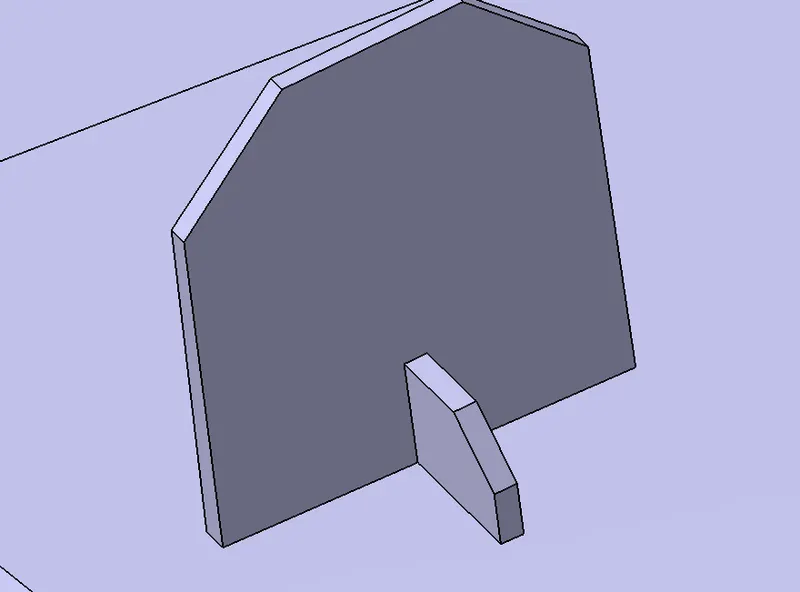
A 2-way locating pin restricts motion along 1 axis (or 2 degrees of Freedom), like a round pin in a slot. Likewise, a 4-way pin restricts 4 degrees of freedom along 2 axes. A round locating pin located concentrically in a hole is a common application of a 4-way pin, and helps to further secure the piece.
4-WAY LOCATORS:
A round locating pin located concentrically in a hole is a common application of a 4-way pin, and helps to further secure the piece. 4-WAY LOCATORS: 4-way mean you prevent movement at 2 axes (+X, -X, +Y and -Y) on the plane. Generally, you have cylindrical pin on the fixture and circular hole at workpiece part.