Week 8 - Challenge 4 - Bumper
BUMPER
AIM:
- Create the Bumper Plastic component through the given Class-A surface.
- To begin with, the tooling axis for the given Class-A Surface should be created meeting the requirements of the draft angle and at the end perform the Draft analysis on the model.
OBJECTIVES:
CLASS-A SURFACE:
the class-A surface is used in the automotive design industry.it the describes the final production surface data for the aesthetic parts of the car.
CLASS-B SURFACE:
The Class B finish is a quality finish with only minimal imperfections.
CLASS-C SURFACE:
The interior surfaces not readily visible, surfaces that will be covered by another part when assembled, or surfaces which the Customer feels do not need to meet a high cosmetic finish.
DRAFTING ANALYSIS:
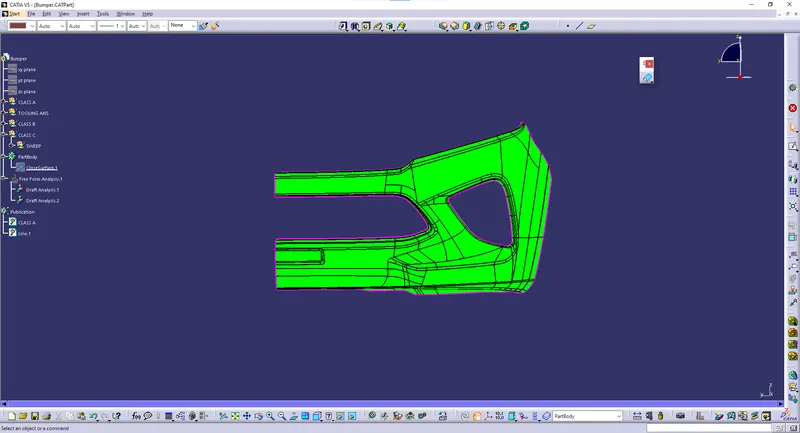
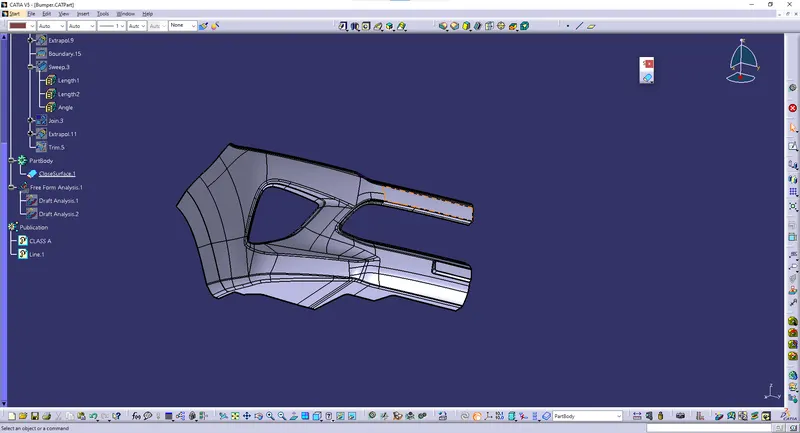
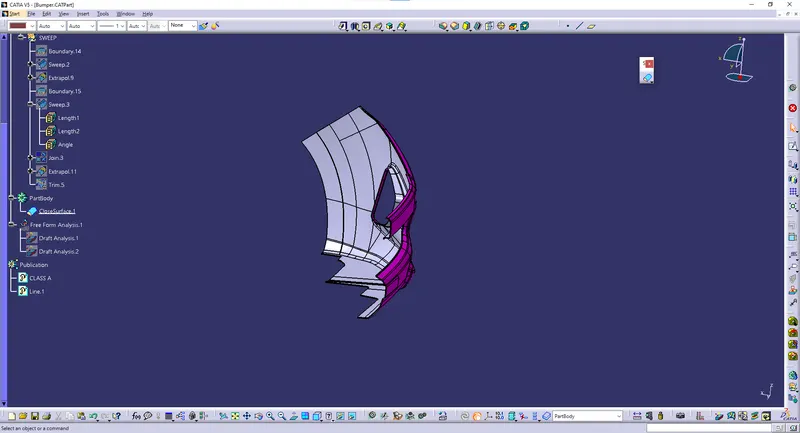
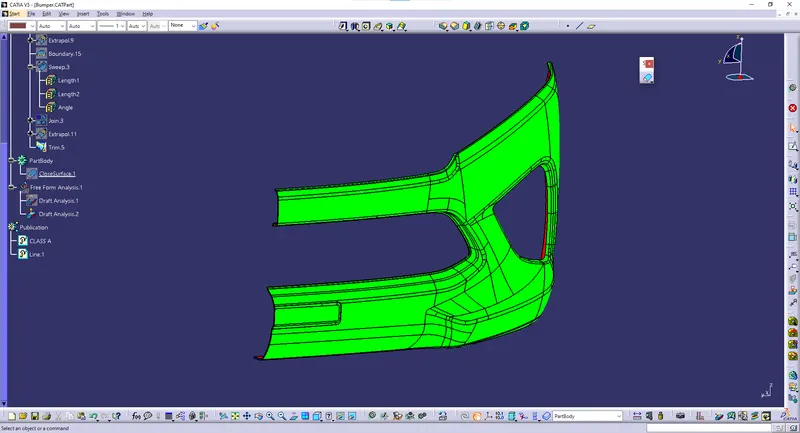
- Draft analysis is performed on the components where the ejection of materials happens after the material is made inside the tools.
- In the case of automotive sheet design manufacturing, the blank sheet after turning into automotive panels like Hood, Fender, Roof, Side Doors, Back Doors,bumpers need to be removed from Panel Dies.
- If a considerable amount of draft angle is not provided, the removal of components from the tool will be difficult.
- It’s the same in the case of mold(plastic component) after getting filled inside the core and cavity, it needs to get ejected easily with the help of ejectors.
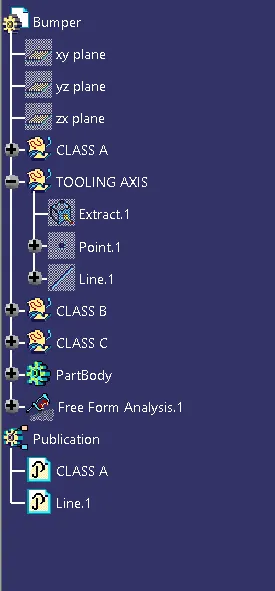
Creating tooling axis:
- The ejection from the mold after manufacturing the interior trim must have the nominal 3-degree draft angle.
- hence the tooling directions created by considering the above factor and bisecting method is used.
- The base surface of the class-A was extracted to create a reference point on the surface using the point, create a line in the z-direction and an axis system was inserted to the point
- Tooling direction is the main consideration for plastic part and mould parts because it defines the movement of the mould part and the possibility of the plastic part coming out from the mould part (Core and Cavity).
MATERIAL USED IN BUMPER:
ACRYLONITRILE BUTADIENE STYRENE(ABS):
High Rigidity:
- ABS has high rigidity and impact resistance. Even in low-temperature conditions or over long periods, ABS plastics will retain these characteristics.
- Its tensile strength is around 35-44 Mpa and because of its plastic yield at high strain rates, the impact failure of ABS is ductile rather than brittle.
- It is used in Instrument-Panel, Door-trims,Coin holder etc. As it has good impact resistance, it is used in creating bumpers as well.
Excellent Insulation:
- It has very good insulating properties, both acoustic and thermal.
Highly Weldable:
- It is a good weldable material as it is an amorphous material
- It is usually measured in terms of stiffness or modulus.
High Dimensional Stability:
- It remains mechanically strong over time.
Good Surface Characteristics:
- High Surface brightness and excellent surface finish. ABS is an ideal material whenever superlative surface quality, color fastness, and luster are required. ABS is a two-phase polymer blend.
- A continuous phase of ‘Styrene-Acrylonitrile’ co-polymer(SAN) gives the material rigidity. Hardness and heat resistance. The toughness of ABS is the result of microscopically fine polybutadiene rubber particles uniformly distributed in the SAN matrix.
- Hence, ABS is also used in Wheel-covers, IP substrate, etc
Good Abrasion & Strain Resistance
CLASS A SURFACE:
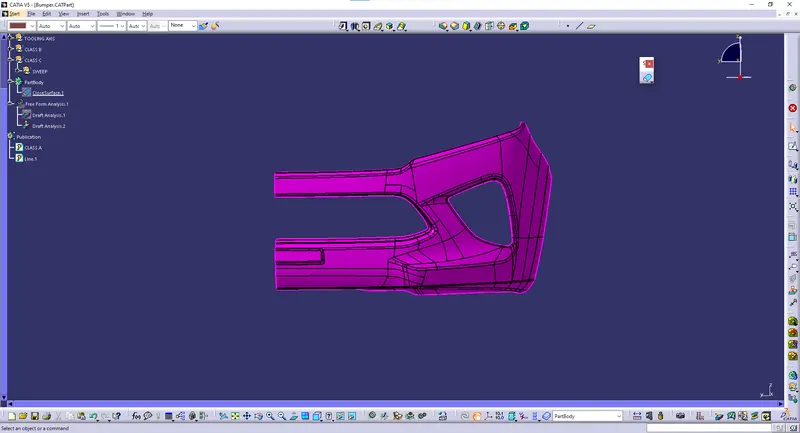
- In automotive design application Class A surfaces are created on all visible exterior surfaces (ex; body panels, bumper, grill, lights etc.) and all visible surfaces of see-touch in interior (ex: Dashboard, seats, door pads etc.)
- class A surface should be given and we dont make any dimension changes.
CLASS A DRAFT ANALYSIS:
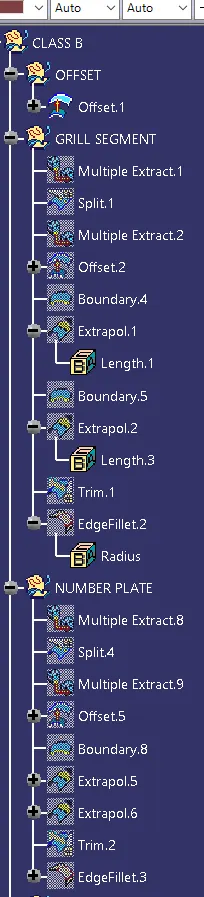
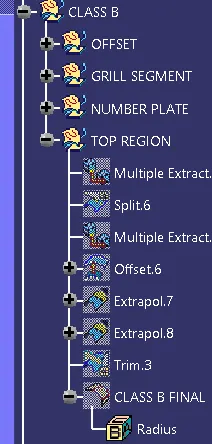
CLASS B SURFACE:
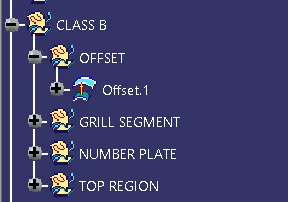
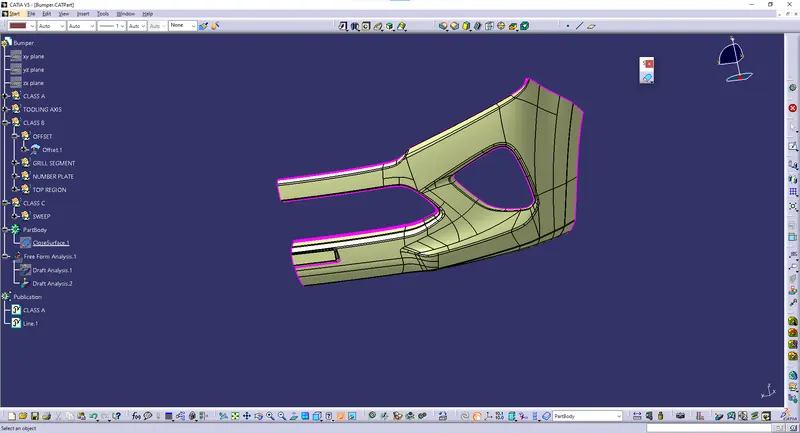
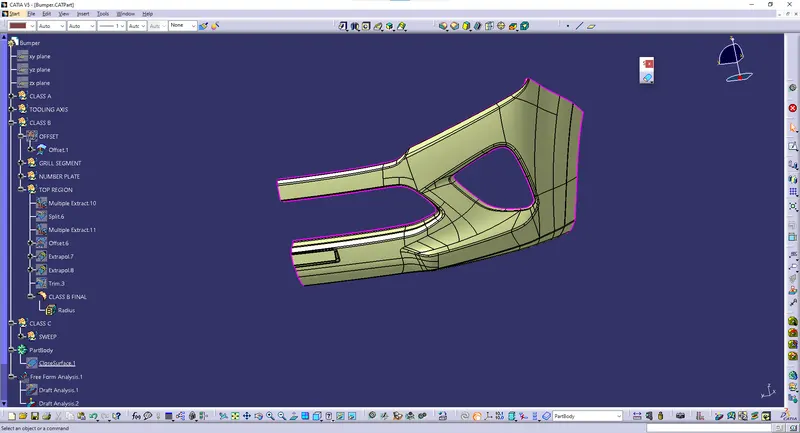
- Offset the class-A surface to 3mm inward direction.
- Rework on the patches and discontinuity of the offset surfaces using the features like extract, multi-extract, sweep, multi-section surfaces, extrapolate.
- To ensure the continuity of the Class-B surfaces check the boundary command to find out the boundary.
- Hence class-B surface creation is done.
CLASS B OFFSET SURFACE:
CLASS C SURFACE:
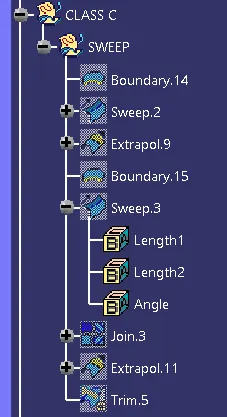
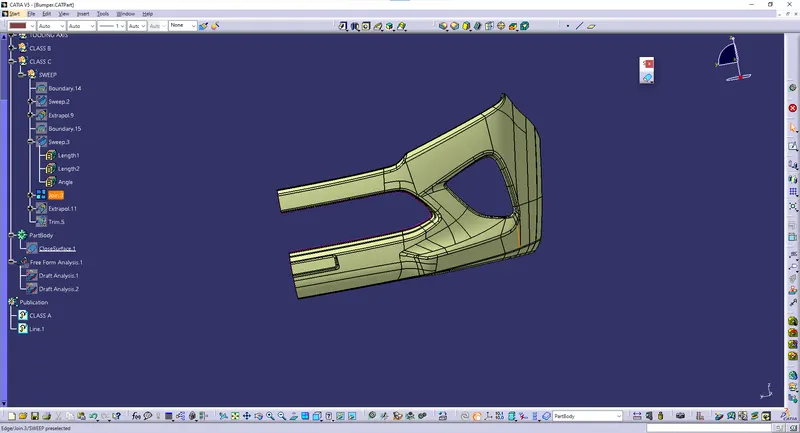
- Surface that joins class-A and class-B surfaces is class-C surface. Class C is often specified for interior surfaces not readily visible, surfaces that will be covered by another part when assembled
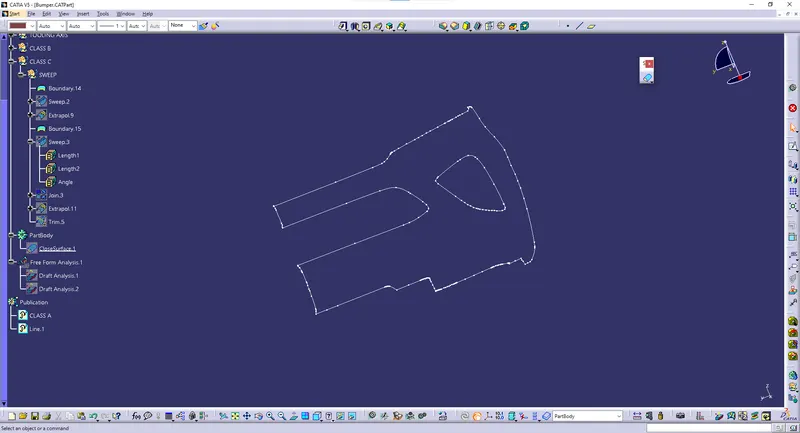
- Since it is a complex class-A surface, we cannot simply create the class-A boundary curve and sweep it at one shot.
- Hence, we need to create smaller curves using multi-extract command and then create sweep of 90 degree with reference to the surface option. sweeps at the midportion of the bumper should have a 90 degree value to pass the draft analysis.
CLASS C SURFACE BOUNDARY:
CLASS C AND A:
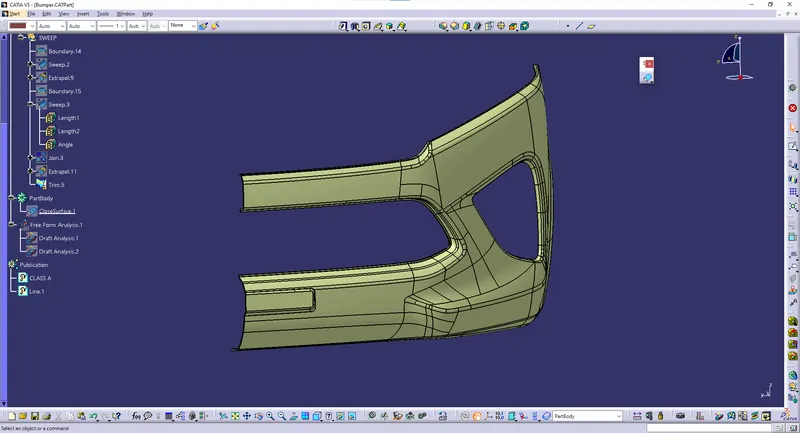
Creating the final surface of Bumper
- First step is to join the CLASS-A surface with CLASS-C surface.
- Then Trim the Joined surface with CLASS-B surface to achieve the final Bumper surface.
SOLID:
FINAL DRAFT ANALYSIS:
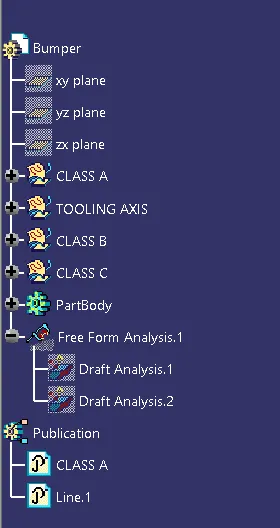
TREE STRUCTURE: