Week 9 - Project 1 - Door Trim Lower with Engineering Features
AIM:
- To analyse the given Class A surface using draft feature analysis.
- To create B and C surface and form closed surface with Class A surface.
- To form solid part body from the closed surface.
- To create heat stakes and locators for assembly with design guidelines on B side
- To analyse the part body with draft feature analysis.
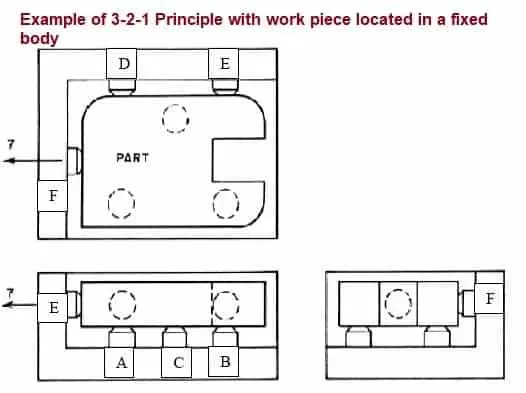
3-2-1 Locating principle:
The 3-2-1 principle states that the six locators are sufficient to restrict the required degree of freedom of any workpiece. In this, motion is restricted using clamps and locators. A three-pin base can restrict five motions and six pins restrict nine motions.
- The workpiece is resting on three pins A, B, and C which are inserted in the base of the fixed body.
- The workpiece cannot rotate about the axes XX and YY and also cannot move downward.
- In this way, the five degrees of freedom 1,2,3,4 and 5 have been arrested.
- Two pins D and E are inserted in the fixed body, in a plane perpendicular to the plane containing pins A, B & C.
- Now the workpiece cannot rotate about the Z-axis and also it cannot move towards the left.
- Hence the addition of pins D and E restrict three more degrees of freedom, namely 6, 7, and 8.
- Another pin F in the second vertical face of the fixed body, arrests degree of freedom 9.
The above method of locating a workpiece in a fixture is called the 3-2-1 Principle.
- 3 points in one plane: The “3” in 3-2-1 refers to 3 locators (passive fixture elements) on the primary locating/datum surface.
- 2 points in another plane: The “2” in 3-2-1 refers to 2 locators on the secondary locating/datum surface.
- 1 point in a third plane: The “1” in 3-2-1 refers to 1 locator on the tertiary locating/datum surface
Heat Stakes:
Heat Staking is a pulsed-heat process to join two or more parts out of which one at least is made of plastic. The process is to deform the plastic material using heat and force at a set process time. The bond is made by partially de-forming the plastic part in order to fix the other.
Heat Staking makes it easy to bond metal to plastic and is commonly used in high volume/low cost applications such as automotive, IT and consumer appliances.
Heat staking can be performed using wide range of plastics including polypropylene, ABS, polycarbonate and many others.
Advatages of heat staking process
- Similar and dissimilar materials may be joined: metal to metal, plastic to plastic, metal to plastic
- Accurate control operating within a small process window
- Local heating resulting in no damage to surrounding materials
- Processing of glass-filled materials
- No mechanical vibration
- Many heat-stake shapes possible through custom designed tools.
Locators:
4-way mean you prevent movement at 2 axis (+X, -X, +Y and -Y) on the plane. Generally you have cylindrical pin on the fixture and circular hole at workpiece part.
2-way mean you prevent movement only at 1 axis on the plane. And generally you have cylindrical pin on the fixture and slot hole at workpiece part.
Tooling axis:
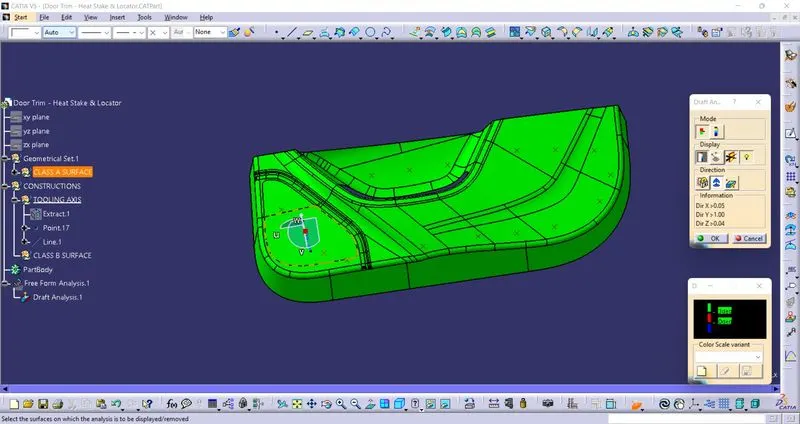
- To create tooling axis,given class A surface is viewed in XY,YZ & XZ plane.
- Choose the view from one among the three views,most of the surface can be viewed.
- From the plane,a flat surface is choosen and centre point on the surface is taken as reference point and line passed through point is taken as tooling axis.
- Using tooling axis line,draft analysis is applied and drafting angle is cleared.
Draft analysis:
- From the tooling axis line as reference,draft analysis is applied.
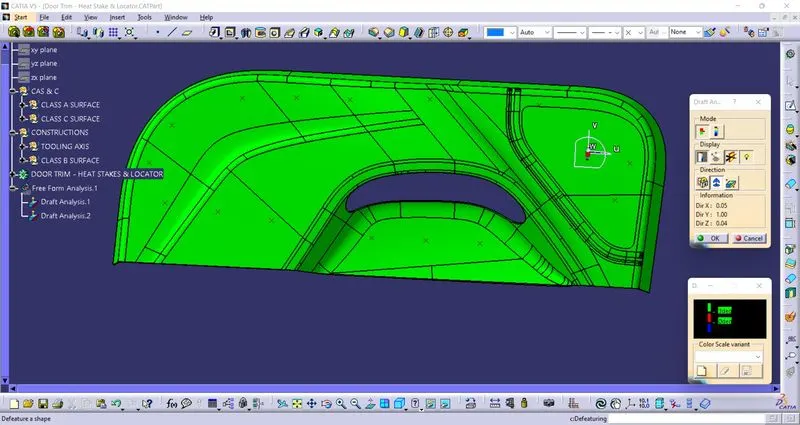
- All areas of the surface is cleared at 3 degree drafting angle.
B surface creation:
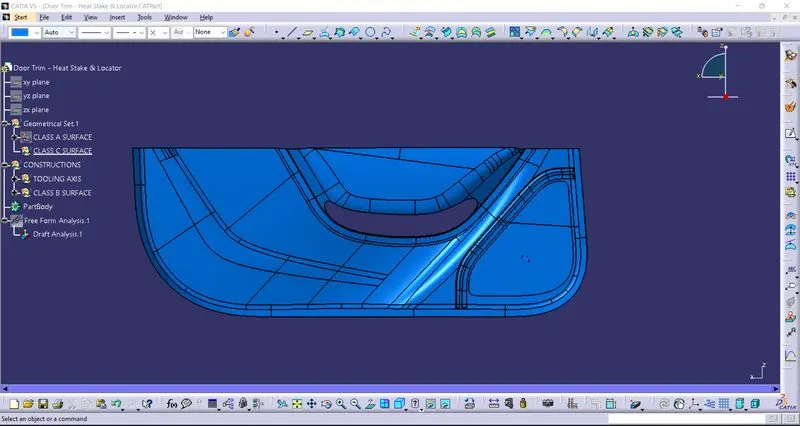
- From the given class A surface,B surface is formed by offsetting the surface.
- Missing patches in fillet areas are patched using tools like mutlisection,boundary,extract.
- Finally extrapolate the edges 1mm for intersection with the C surface.
C Surface Creation:
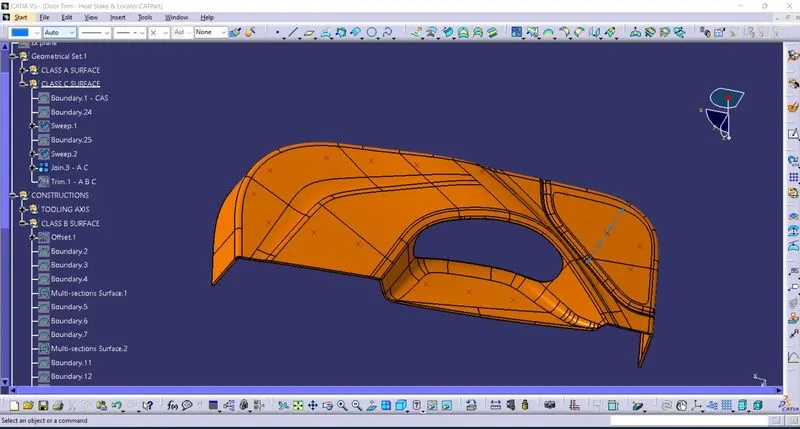
- Using class A surface,C surface is formed using sweep tool with drafting angle.
- Joint class A surface and C surface.
A B C surface:
- Joined A & C surface is trimmed with B surface.
- Finally,a closed surface is formed and it is checked by applying boundary tool.
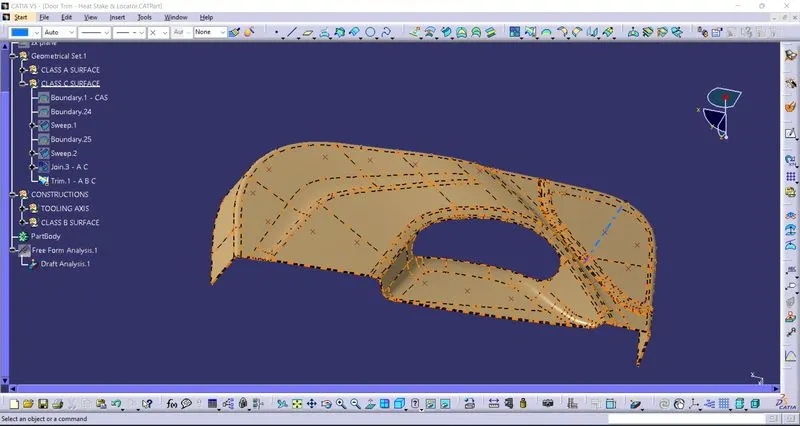
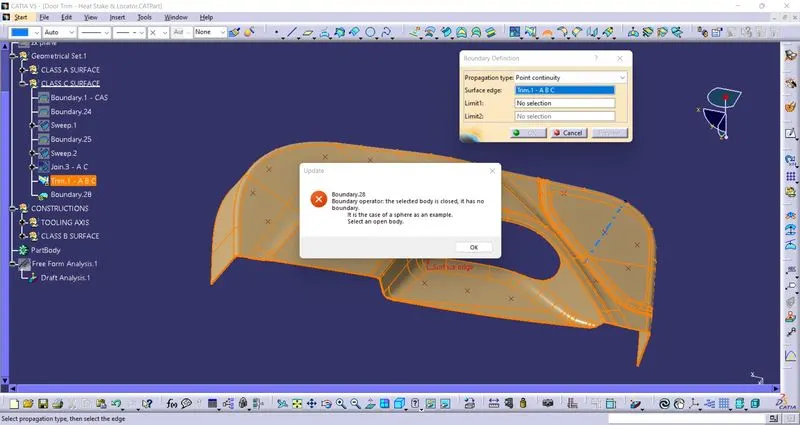
Part creation:
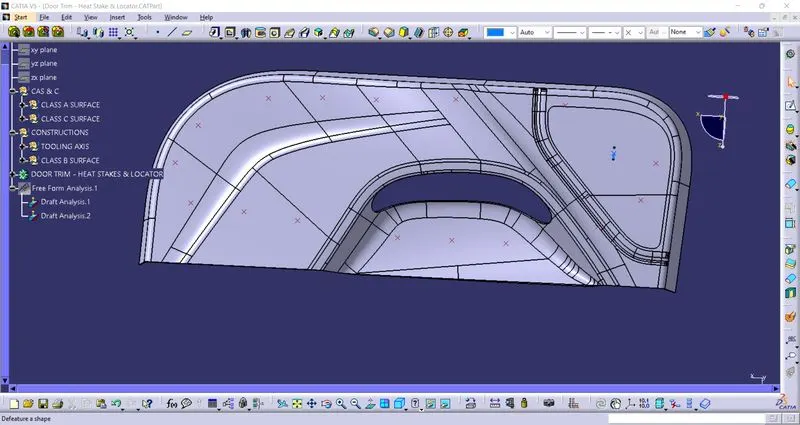
- From the closed surface,part body is formed and it is analysed by draft analysis.
Heat Stake and Locator creation:
- Heat stakes are formed on B side of the part as per design guidelines.
- 0.5 degree drafting angle is given on outer side of the heat stake inclining towards top i.e., drafting angle is applied as cutting towards top of the part.
- Fillet is given as 0.25mm radii maximum.
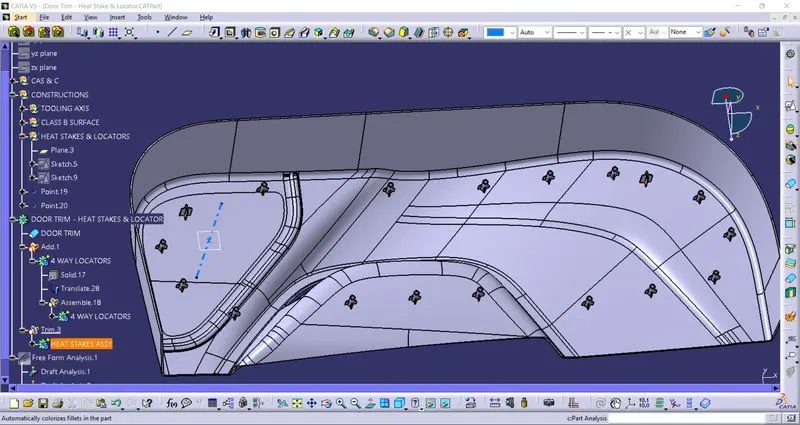
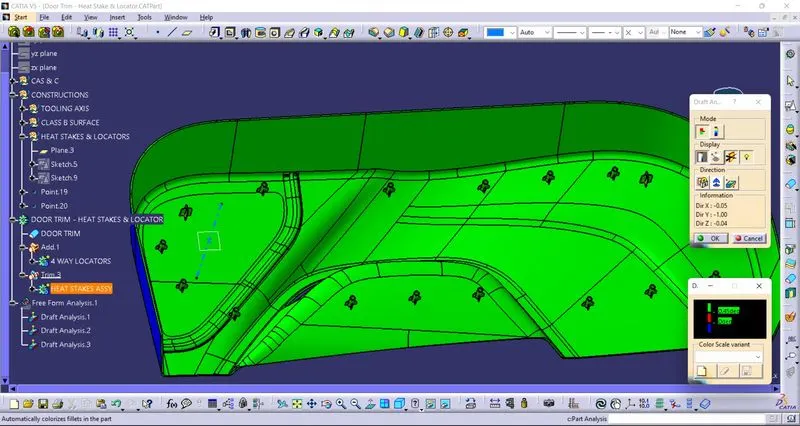
Due to uneven surface,heat stakes and locators are not getting cleared at 0.5 degree as drafting angle.
From Final draft analysis,drafting is good at 0.45 degree as drafting angle.
RESULT:
- Given class A surface is analysed with draft feature analysis and tooling axis is created.
- B and C surfaces are created and trimmed with A surface and formed as closed surface.
- Part body is formed and heat stakes are