Week 9 - Project 1 - Door Applique Design with Engineering Features
Door Applique Design with Engineering Features
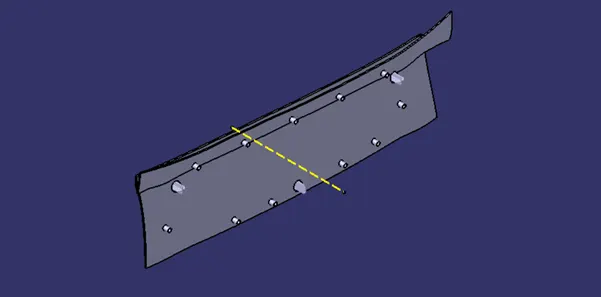
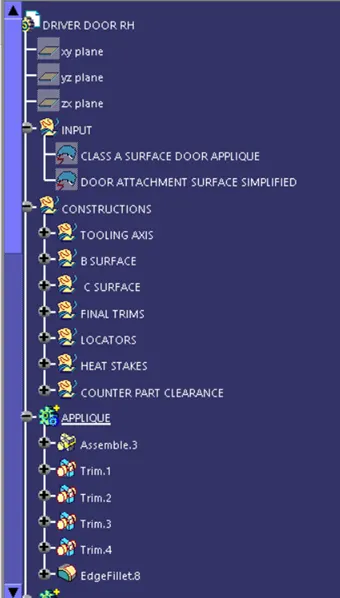
AIM: Create the Base Bracket Plastic component through the given Class-A surface. To begin with, the tooling axis for the given Class-A Surface should be created meeting the requirements of the draft angle and at the end perform the Draft analysis on the model.
Create the Heat Stakes and the locators considering the design rules mentioned in the video for the door applique.
THEORY:
To locate a part to be machined and restrict its motion to accurately do the machining and constraint its motion 3-2-1 principle of location is used.
3-2-1 Principle:
To completely specify the position in space of a three-dimensional
object (such as the cube that’s shown), we refer to six coordinates:
- Translational position along the X-axis
- Translational position along the Y-axis
- Translational position along the Z-axis
- Rotational position about the X-axis
- Rotational position about the Y-axis
- Rotational position about the Z-axis
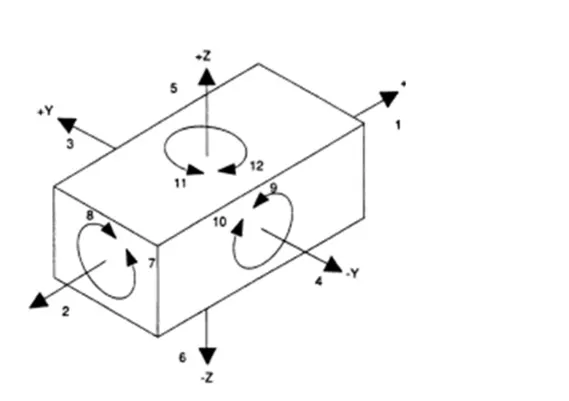
It is a 3 step process of introducing 3-2-1 point locators in a plane for best support and constraint.
For example, let's say we use 3 points at the bottom of the cube above, which restricts the translational motion along Z(Z+ and Z-), Rotational motion along Y and X(7, 8, 9, 10) This way three degrees of motions have been restricted.
Now we use 2 points from the Y+ the direction of the cube to restricts the Translational motion along with Y(Y+ and Y-), Rotational motion along with Z. This way two degrees of motions are restricted.
Finally to restrict motion along the only remaining degree of freedom that is the Translational motion along the X(X+ and X-) a single point is used along the X+ direction of the cube to restrict all the motion.
Locators:
To Restrict the Degree of freedom of a 3D plastic component Locators used.
There are various types of locators but for this application, we will use the following:
- 4 Way locator:
A 4-way pin restricts 4 degrees of freedom along 2 axes.
- 2 Way locator:
A 2-way locating pin restricts motion along 1 axis (or 2 degrees of Freedom).
Heat Stakes:
Heat Staking is a pulsed-heat process to join two or more parts out of which one at least is made of plastic. The process is to deform the plastic material using heat and force at a set process time. The bond is made by partially de-forming the plastic part to fix the other.
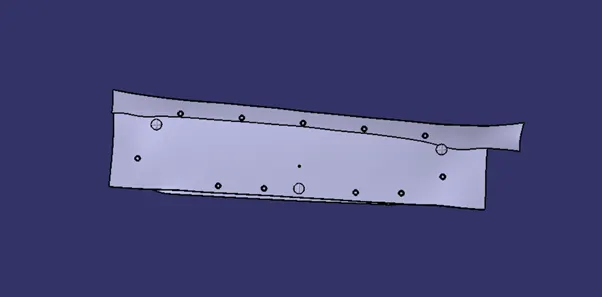
GIVEN SURFACE:
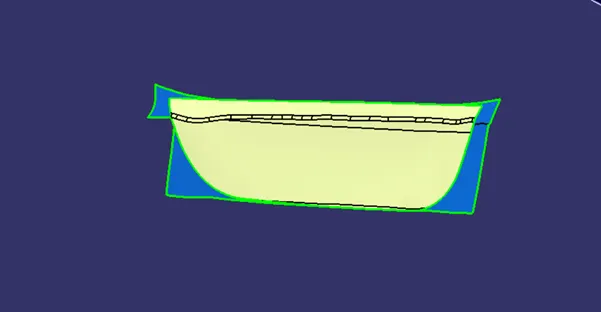
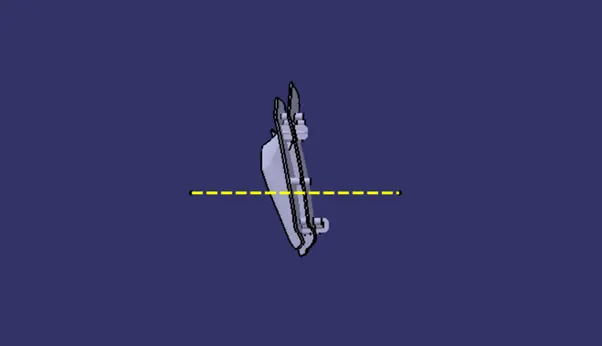
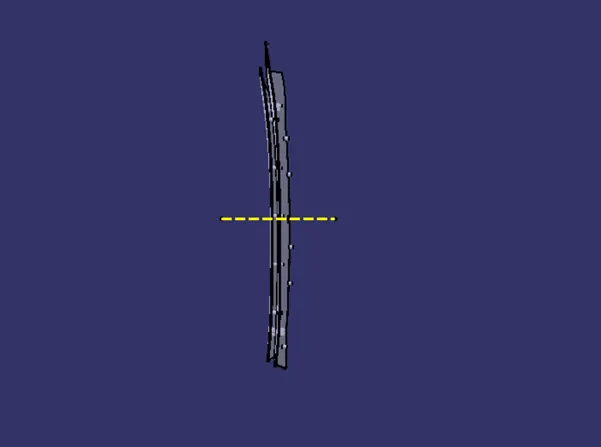
TOOLING AXIS
The given Class A input is analysed to envision the part to manufacture and Tooling axis or Tooling Direction or Die line is the direction that molds pull apart in injection molding. There are two mold pieces names core and cavity. Thus tooling direction determines Mold separation and also becomes vital in developing the plastic product drafted to desired nominal angle for feasible clearance and ejection of final part from the mold.
The Steps Followed in creating Tooling Axis
- A Reference Point is created along the Surface zero and new Axis system is created
- The X Direction along the Class A and Y direction along the Class A were used to create Tooling direction
- Finally the Tooling axis is created by bisecting the two lines and it is published. Class A Surface as input using surface operation commands Class B is developed
- The tooling Axis determines the direction of Class C boundary swept with draft direction.
- When viewing from tooling direction normal all the parts that are drafted should be visible so it gives a rough idea to determine product manufacturing in Injection molding
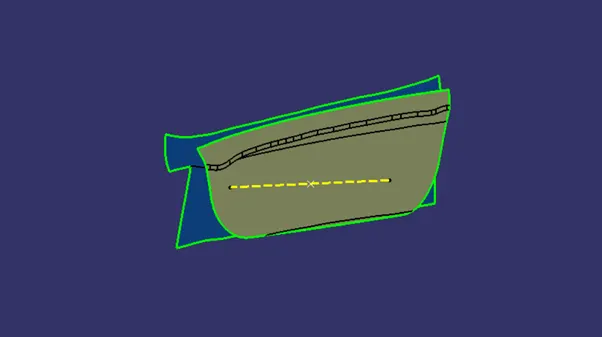
CREATION OF B AND C SURFACE:
Using Class A Input the surface is extracted ,extrapolated and offset to 2.5mm and the C surface is formed which is drafted along the Tooling Direction using sweep with reference surface and guide curve and a closed surface is formed which is developed to form part model in part design workbench
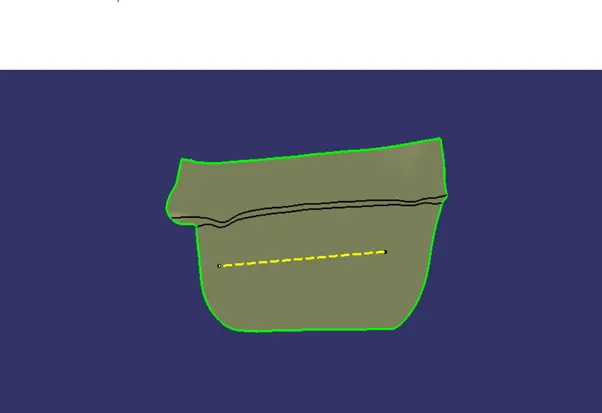
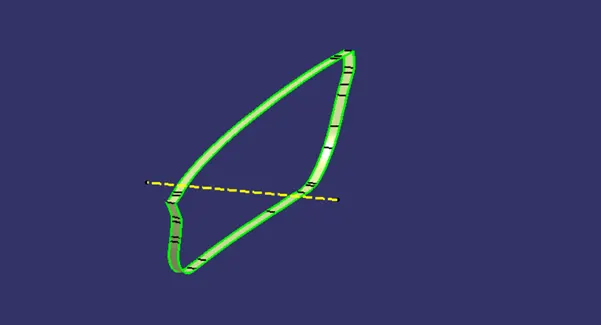
FINAL TRIMS:
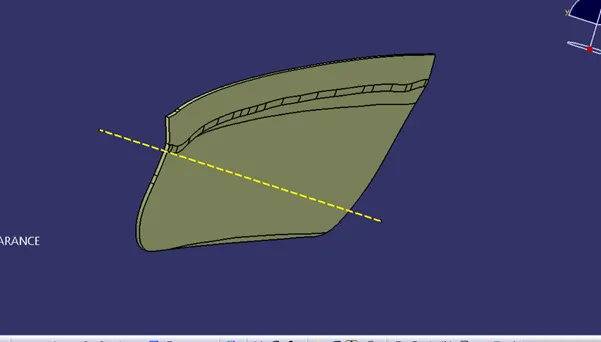
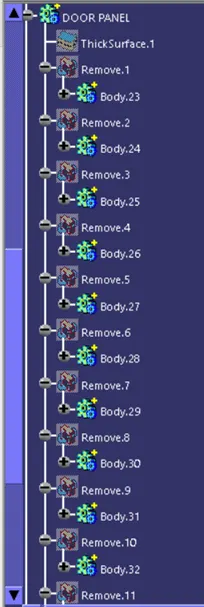
PART BODY AFTER CLOSED SURFACE FEATURE:
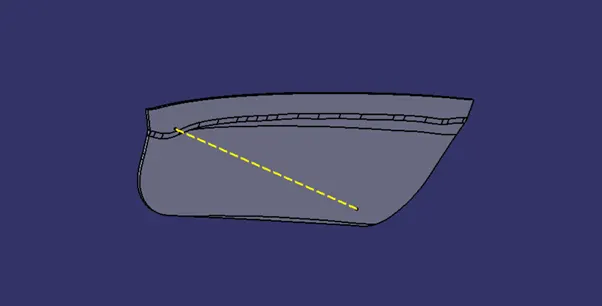
ATTACHMENT FEATURES
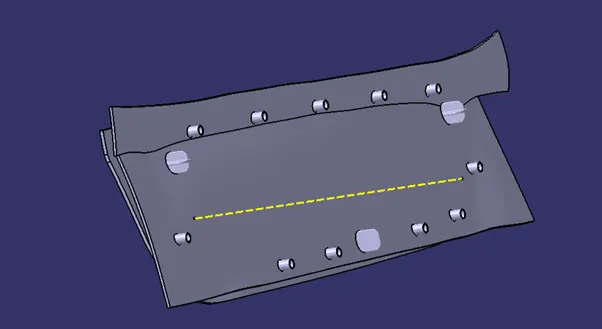
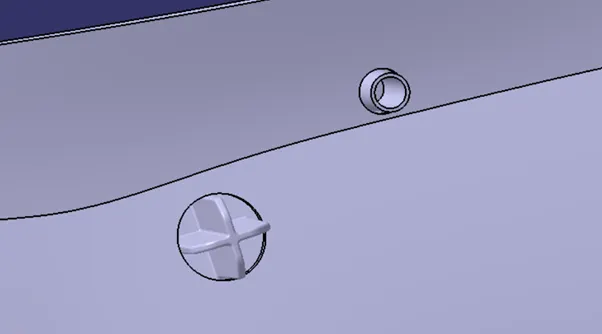
The Applique part has two 4 way and one two-way fixtures that constrains 11 degrees of freedom. The only permissible freedom is mating direction along Y which will be fixed using heat stakes and thus all 12 doff are controlled
DESIGN RULES
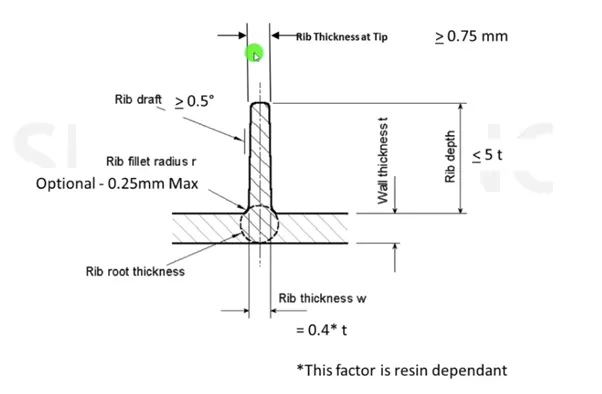
The Design Rules for two way and four-way fixtures are
Rib Wall Thickness should be 0.4 times of Thickness of the part
The Drafted walls of rib should be within 0.5 degrees
The top height of rib should be at least 0.70 mm thick to allow the molten plastic to reach the top.
- The height of the locators should be on same plane and should be well attached to the part.
- An entry chamfer is provided on the top to provide the feasible fixation mechanism
- The locators are added to the main part using Boolean operation
- The Heat stakes should be provided along the boundary at variable fastening locations and the height of heat stakes should be lower than the locators.
- Using parallel curves and pattern point along the curve suitable heat stakes are developed and ensured that they are not interfering with Locators.
- The Locators and heat stakes are drafted min 0.5 degree along the neutral face.
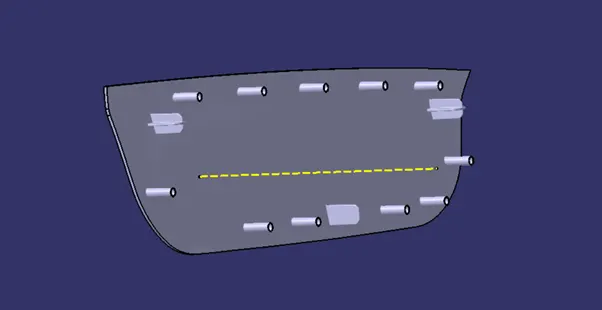
- A sample attachment door substrate is developed using Class A surfacing methods and then clearance for the part is cutout to provide the entry of locating features.
- A minimal clearence of 0.1 mm is ensured for locating features and 0.5 mm is desired for heat stakes
- Finally the Heat stakes are welded and the mating parts are fixed
- The Design Rules followed ensures that plastic defects produced aftermath manufacturing are avoided to improve the quality of the part.
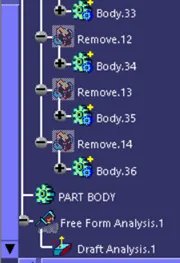
DRAFT ANALYSIS
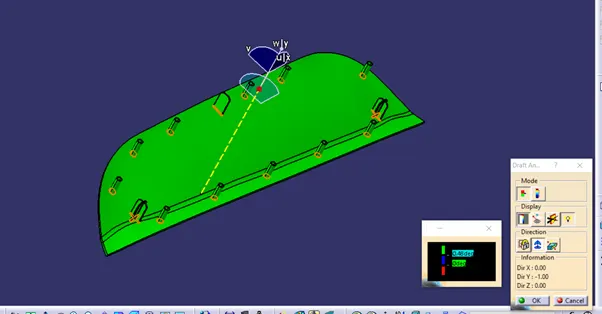
The Draft Analysis is done to measure the drafted value of the component. The Ideal Draft angle for plastic part is 3 degrees and the ribs are provided with 0.5 degree draft on both sides.
CONCLUSION
Thus a Applique part is developed from Class A Surface and the fixation features are developed along the B side.
The Tooling Axis is created and Class b, Class C are extrapolated and trimmed to form closed body surface and Draft analysis is performed to validate the drafted walls within limits and Attachment features are created carefully adhering to the Design guidelines.