Week 9 - Project 1 - Door Applique Design with Engineering Features
AIM: To create 4-way locators, 2 way-locators, and Heat stakes.
INTRODUCTION:
3-2-1 PRINCIPLE:
A workpiece free in space can move in an infinite number of directions. For analysis, this motion can be broken down into 12 directional movements or "degrees of freedom" these must be restricted to ensure proper referencing of a workpiece.
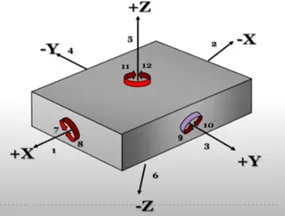
Degrees of freedom all relate to the central axis of the work-piece as shown above. Notice the 6 axial degrees and 6 radial degrees of freedom. The axial degrees of freedom permit straight-line movement in both directions along the 3-principle axis shown as X, Y & Z. The radial degrees of freedom permit rotational movement, in both clockwise & counter-clockwise radial directions around the same three axes.
4-WAY LOCATORS:
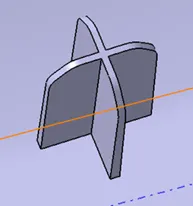
4-way prevents movement at 2 axes (+X, -X, +Y, and -Y) on the plane. Generally, you have a cylindrical pin on the fixture and a circular hole at the workpiece part.
2-WAY LOCATORS:
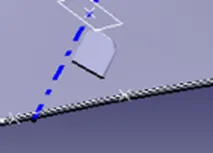
A 2-way locating pin restricts motion along 1 axis (or 2 degrees of Freedom), like a round pin in a slot. Likewise, a 4-way pin restricts 4 degrees of freedom along 2 axes. A round locating pin located concentrically in a hole is a common application of a 4-way pin and helps to further secure the piece.
HEAT STAKES:
Manufacturing operations currently use many different combinations of attachment methods to keep components together. Common fasteners such as bolts, screws, and rivets can be used to form permanent attachments, but there are attachment methods that don’t require secondary hardware. One of those methods is heat staking, which doesn’t require additional fasteners.
WHAT IS HEAT STAKING?
Heat staking is the process to attach two separate components together by melting the base plastic material into a shape that will hold the secondary component. It’s a permanent attachment method that does not require any additional material such as an adhesive or a solvent to make the permanent bond. The only addition is the heat applied to melt the plastic and a tool to shape the plastic to form the mechanical connection.
Heat staking can be done with a precise and rapid operation that also offers repeatable results every cycle. A manufacturing machine can be developed to complete multiple heat staking operations at once to decrease cycle time. The stakes don’t have to be parallel which makes the design options limitless.
Heat staking is a great option that is comparable in strength and durability to other operations involving secondary fasteners without extra cost. These connections can also resist corrosion in harsh environments.
REASONS FOR HEAT STAKING:
- Multiple staking shapes for different benefits.
- Excellent durability.
- No extra materials are needed.
- Increased efficiency.
- Easy Maintenance.
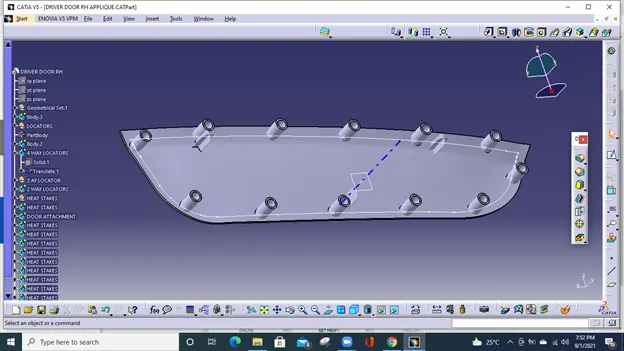
CONCLUSIONS: The 4 way and 2-way locators, heat stakes have been created following all the plastic design guidelines.