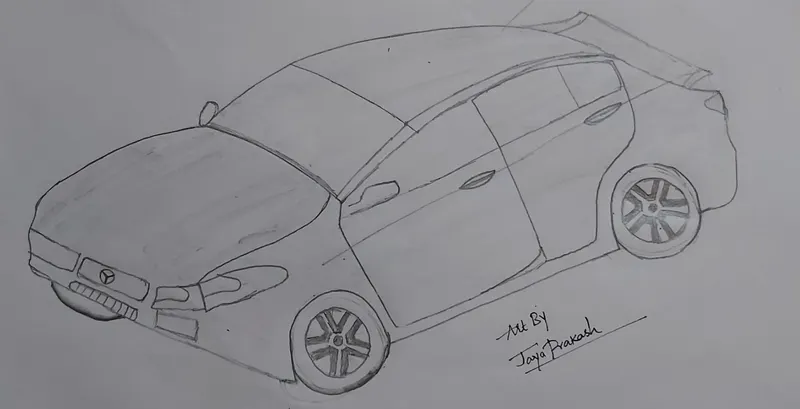
Brief on Product life cycle of the automotive industry in ambience of Product Design
AIM: - To study the Overview of Automotive Life Cycle in Product Design phase. This mainly brief the Product Designer involvement from concept phase to mass production.
DESCRIPTION: - Overview on Automotive Industry
- Product Life Cycle: The demand for a product, its market acceptance, generally tends to follow a predictable pattern is called the Product Life Cycle. The following are the 10 stages of Product Life Cycle in Automotive industry are: -
- Concept Sketching: -
- Concept’s Sketching is a flexible space to think, plan and create free hand sketching.
- Concept Sketches provide a visual example of the basic design composition and layout and allow designers to brief feedback and approval prior to creating detailed illustrations or CAD models.
2. Styling Class A: -
- In Automotive Design Application Class, A surfaces are created on all visible exterior surfaces (ex; body panels, bumper, grill, lights etc.) and all visible surfaces of see-touch & feel parts in interior (ex: Dashboard, seats, door pads etc.). This can also include beauty covers in the engine compartment, mud flaps, trunk panels and carpeting.
- Class A Skin is developed through a software such as Autodesk Alias. In this phase the initial 2D Sketches from concept design get transformed in to 3D using a Design software such as Autodesk Alias.
3. Feasibility Check: -
- The Feasibility Check is carried out at a point in time when only the part geometry is available but no information regarding the tool or the process is known. Based on the part geometry, an attempt is made to represent how the forming process will take place later on in the series production. The Feasibility Analysis enables the quick identification of problem areas such as, for example, splits, improper thinning and possible wrinkles in the part and provides the best possible alternative solutions to correct the problems.
- This phase starts the Design Engineering process and the received class A surface is validated for further stages of production feasibility.
- Feasibility study involves carry over designs for some parts from previous models and can be used in the new models.
- This stage incorporates the feedbacks from the customers like to increase space for seating and add a holder for a water bottle and it will be passed on to the downstream processes to ensure it is attainable.
4. Concept Validation: -
- We test if a particular product or service concept is interesting, inviting, and functional for the client.
- In this phase initial concept validation of perceived model is done. This is where all the design rules are validated like interior trims, meter visibility study and tachometer reading within the visibility range of the rider and all parts are started building around it.
5.New Product Design: -
- The New Product Design is the process by which a new product taken through the design process and work within the specified rules and design engineering standards of the organization.
- The major work of the product designer starts from this phase. The designer starts developing the CAD sketches of every component in the car.
- The main objective of the product designer is to incorporate all the inputs from the previous stages and ensure the product is manufacturable in the upcoming stages.
6. Development: -
- This is the stage in between the Design and Manufacturing team. Development team is to collaborate with the manufacturers to ensure the design is feasible to manufacturers and feasible to Assemble.
- They work with the tool makers, mould and fixtures and also with various outsourced vendors and stakeholders to kick start the manufacturing of the designed part.
7.Proto build: -
- A Prototypeis an early sample, model, or release of a product built to test a concept or process.
- A complete Prototype is built to study the feasibility of the Manufacturing process and materials used in the components.
8.Design validation: -
- Demonstration and/or inspection may be used to validate requirements and other functionality of the product.
- Tests are performed on the final design that validates the ability of the system to operate as per the specified design.
- In this phase dimensional tolerances will be decided and also if any rectifications are needed in the processes and materials being used.
9.Pilot Production: -
- The production of a product, process, or piece of equipment on a simulated factory basis. In mass-production industries where complicated products, processes, or equipment are being developed, a pilot plan often leads to the presentation of a better product to the customer, lower development and manufacturing costs.
10.Mass Production: -
- Mass production is the manufacturing of large quantities of Standardized products, often using assembly lines or automation technology. Mass production facilitates the efficient production of a large number of similar products.
- In Mass Production, mechanization is used to achieve high volume, detailed organization of material flow, careful control of quality standards, and division of labor.
2. Automotive Designer involvement: - In the following stages the Automotive designer’s involvement is needed
- Feasibility Check
- Concept validation
- New product Design.
- The Autodesk Alias is the software used by the majority OEM to develop the class A surfaces.
- Feasibility Check: -
- Feasibility check validates all the Concept Sketches and collaborate with the Concept Validation and New Product Design to make the product feasible to manufacture.
- This is the stage were carryover activities are done from the previous car versions to reduce the lead time and also this is the stage where all Feedback and market studies involved from customer are incorporated to the automotive life cycle.
- For an instance if there us feedback about an arm rest console about the lack of width for bottle holders. Those will be added to this newer version and it is the role of the feasibility check to inform the new product design team to make it corrected.
- The following are the stages of the Design Life cycle: -
1. Concept sketches: -
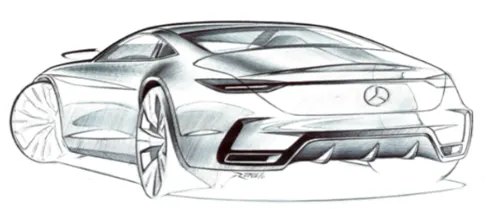
- Concept sketching is an excellent way to quickly explore design ideas. Product designers spend a lot of time sketching as a quick way to evaluate design ideas to see if they are worth developing further. Concept sketches provide a visual example of the basic design composition and layout and allow designers to solicit feedback and approval prior to creating detailed illustrations or CAD models.
- Below image shows free hand sketch of Benz.
2.Class A surface: -
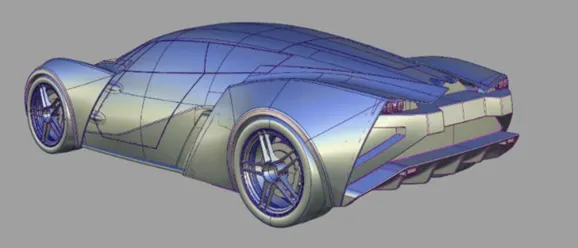
- In this stage the skin of the free hand model is done using 3D software like Autodesk Alias.
- In automotive design, a class A surface is any of a set of freeform surfaces of high efficiency and quality. Although, strictly, it is nothing more than saying the surfaces have curvature and tangency alignment.
3.Clay modelling: -
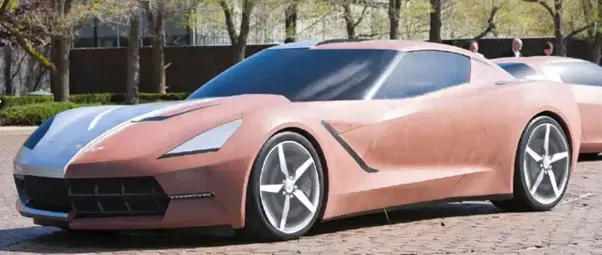
- Clay models are a miniature model made from industrial clay. They are a way to transform a sketch drawn by a car designer into a three-dimensional object so it can be studied and reviewed.
- The class A surfaces are validated through clay modelling and this gives the real visual representation of components that will be used to create input for the CAD Engineers to create 3D sketches of automotive components
- Clay models are chiselled by hand to get the realistic experience by leading OEM and some of the interior components are done through machines
- The role of this stage is to create a model as per the concept sketch and scan using photometry to create 3D CAD model.
4.NPD Design: - The final stage of the design cycle is performed by the CAD engineers who start Modelling the parts in the software with the design guidelines and ensures the functionality and feasibility of the manufacturing and assembly. If there is any difficulty in machining the designed parts then suitable steps will be taken to resolve the same.
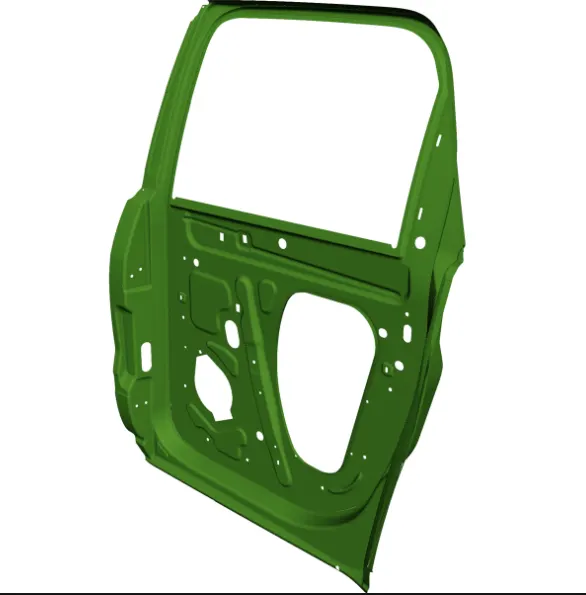
- Concurrent Engineering: - Concurrent engineering is a work methodology emphasizing the parallelization of tasks (i.e. performing tasks concurrently), which is sometimes called simultaneous engineering or integrated product development (IPD) using an integrated product team approach. It refers to an approach used in product developement in which functions of design engineering, manufacturing engineering, and other functions are integrated to reduce the time required to bring a new product to market.
- Clay Modelling: -
- Clay models are a miniature model made from industrial clay. They are a way to transform a sketch drawn by a car designer into a three-dimensional object so it can be studied and reviewed.
- The class A surfaces are validated through clay modelling and this gives the real visual representation of components that will be used to create input for the CAD Engineers to create 3D sketches of automotive components
- Clay models are chiselled by hand to get the realistic experience by leading OEM and some of the interior components are done through machines
- The role of this stage is to create a model as per the concept sketch and scan using photometry to create 3D CAD model.
- The main advantage of the clay modelling is to reduce the rework of the product by finding problems during the clay modelling.
8.Functional requirement and Functional Reliability:
1.Functional requirement: - A functional requirement is nothing but when we provide the inputs to the system the desired results must obtained. The following are the stages of functional requirement;
- Design intent: Design intent is a method used in computer-aided design that defines relationships between objects, so that a change to one propagates automatically to others. In other words the designed component should fit exactly in the desired location.
- Environment consideration: - Placing of the part in the interior. Let consider arrangement of seats in the car there should be free to and fro motion of seats.
- Material Thickness: - Proper material thickness to be decided. Thickness should not be more or less than required thickness the selected thickness should withstand the internal and external loads on the vehicle.
2.Functional Reliability: - is defined as the probability that a product will perform its intended function adequately for a specified period of time, or will operate in a defined environment without failure. Following are the factors of it-
- Purpose
- Strength
- Resistance
Let us consider the function of a car door handle is used to open and close the doors so it must be reliable in its every form and it should have good strength and resistance to be functionally reliable.
9.Design for manufacturing and design for Assembly (DFM&DFA): -
- Design for manufacturability is the general engineering practice of designing products in such a way that they are easy to manufacture. The factors considered will be the
- Minimum wall thickness: For a plastic component the desired thickness will be 2.5 mm anything above will lead to higher cost of the final product.
- Draft angle: - If there is a plastic component to be manufactured in injection moulding so the designer should validate the draft analysis of the part with respect to tooling axis or else wearing will occur in the manufacturing.
2.Design For Assembly: -
- Is a process by which products are designed with ease of assembly in mind. If a product contains fewer parts it will take less time to assemble, thereby reducing assembly costs. In addition, if the parts are provided with features which make it easier to grasp, move, orient and insert them, this will also reduce assembly time and assembly costs.
- DFA is the feasibility study to reduce the interference of different mating parts while assembly.
- Economic factors: -
The product designer should consider the economic aspect for both the producer and consumer. He should consider the life cycle cost of the product which is the total cost occurring over its entire life span (i.e. procurement cost plus ownership cost). There are many ways during design to reduce a product life cycle cost while at the same time improving its reliability/maintainability/availability such as the following:
- Minimise the number of components in the product during design.
- Reduce design errors by using design reliability checklists.
- Perform failure modes, effects and criticality analysis (FMECA) to identify redesign, research, and development areas.
- Use improved and more compatible materials.
- Integrate reliability engineering/product assurance program in development, engineering, purchasing, manufacturing, testing,
- installation, and so on.
- Allocate scientifically required product reliability/ maintainability/ availability down to all associated parts/components.
- Perform reliability design reviews.
- Use manufacturing reliability checklists.
- Avoid the abuse of the product/equipment in the field by including mechanisms such as load and speed limiters, warning labels, and so forth.
- Assure the proper and adequately burned-in/broken-in/debugged/ stress-screened of parts prior to their shipment and use.
The product designer should particularly be conscious of cost of manufacture and distribution.
FREE HAND SKETCH