Injection Molding and Injection Mold Nomenclature
- Draw the freehand sketching of the Injection molding machine and name its parts. Explain each part in detail.
HAND SKETCH: -
- Injection molding is a process in which a thermoplastic polymer is heated above its melting point, resulting in the conversion of the solid polymer to a molten fluid with a reasonably low viscosity.
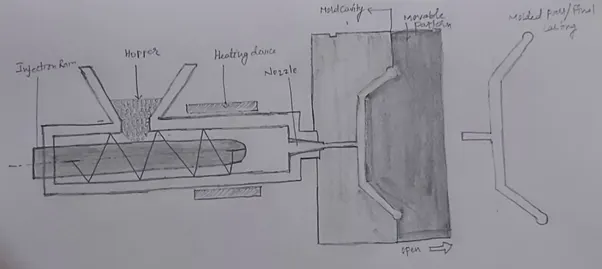
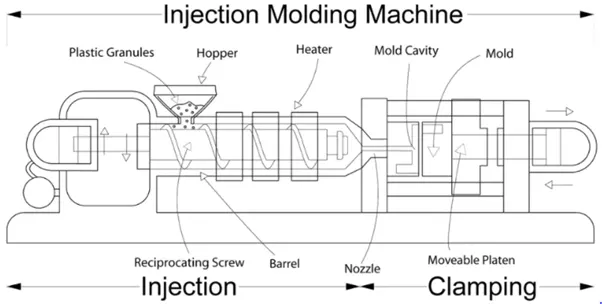
Function of Each Part of An Injection Molding Machine.
Hopper:
Here we insert the ingredients of plastic material for the molding process.
Screw Motion or Archimedean Screw:
It pushes the ingredients of plastic material in a forward direction.
Heaters:
It is used to increase the temperature of the system to prepare the product in a good finished and We can say that the heater works is to melt the ingredients of plastic polymers.
Nozzle:
The material temperature increases to such an extent it quickly enters into the mold cavity.
Extraction Pin:
It works like split molds and the shape formed to remove from it and further process to be carried out.
Split Mold or Cooling channels:
Cooling of the product done into the system.
Clamping unit:
It is used to clamp the tool.
Injection unit:
In the Injection unit, it can be used to inject the mold (Plastics).
Drive unit:
The driving unit is used to ram the mold in the cavity.
Hydraulic system:
Raming the mold by the press.
- What is the core? What is a Cavity? Explain in detail with free hand sketches.
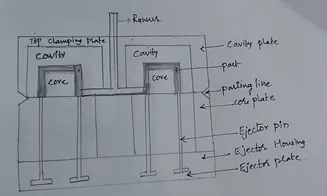
Cavity:
The machined shape within a mold which created the form of the plastic part. The plate used to fit the cavity insert, the cavity insert will have gap of the details to fill the plastic material and form plastic component Cavity plate usually of mild steel material cavity.
Core:
A protrusion or set of matching protrusions, which form the inner surface of a plastic part. They are often considered they “male” side of the part. The plate used to fit the core insert, the core insert will have projection and will create hallow portion in plastic component.
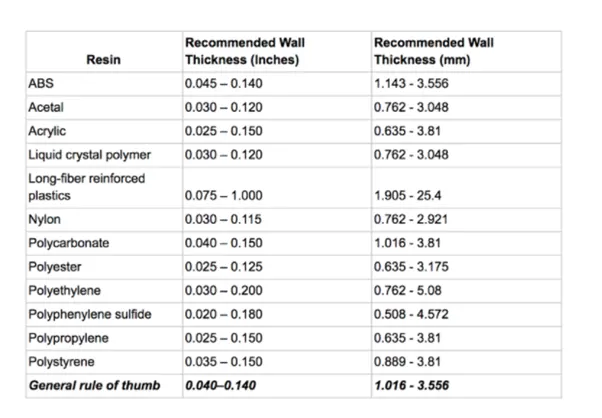
- What is the ideal wall thickness of an injection molded component?
Ans: The ideal wall thickness of an injection molded component is the uniform thickness thorough out the molded component. Following are some of the thickness suggested for a particular material of the mold.
- What is the minimum precision that can be expected of an injection molded component?
Ans: The precision of the mold mainly depends on the high precision of the mold cavity size, accurate positioning of the cavity or whether the precision of the parting surface meets the requirements. The dimensional tolerances of the general precision injection moulds should be controlled below 1/3 of the dimensional tolerance of the products.
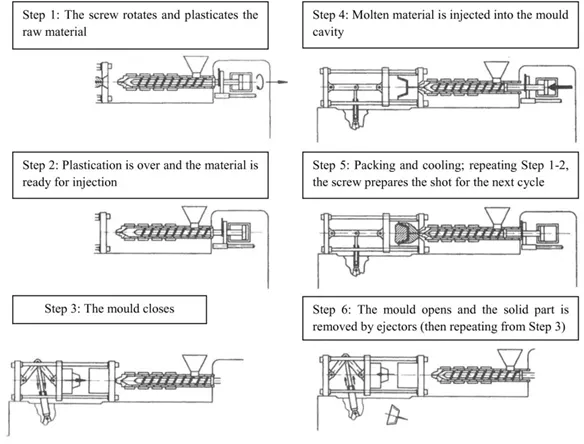
5.What are the Stages of injection molding? Explain the stages of injection molding in detail with clear sketches of the same.
Injection molding process step by step:
- Material particles are nourished into a hopper then from hopper it comes into the system.
- There is an Archimedean screw which works is to rotate and sends forward the present material.
- Now it comes to the heated area here it gets heated between ingredients plastic polymer.
- At the nozzle, the temp having high at such extent it send fast to the Mould cavity and
- Here the cooling process is done.
- Now Extraction pin removes the mold cavity parts and then formed the product.
6. Draw the free hand sketch of an injection molded component of your own (Along with Sprue, runner, etc.) Explain the parts in detail.
Sprues,runners and gates fulfil the function of conveying the plastics melt from the nozzle of the injection unit to the individual cavities.
1.A sprue is the vertical passage through which liquid material is introduced into a mold and it is a large diameter channel through which the material enters the mould. It connects pouring basin to the runner. In many cases it controls the flow of material into the mold.
- The sprue may be considered the continuation of the mold to the nozzle of injection machine.
- Single-cavity molds where the sprue links directly to the molded part are said to have direct sprue gating.
- Very often, the performance of a single-cavity injection mold is determined by the cooling time of this sprue.
- In addition to providing adequate cooling of the sprue bushing, the diameter of the smallest opening in the sprue bushing should be kept as small as possible and permitted by proper filling of the cavity.
- No universally applicable rules can be given here,since filling of the cavity depends on very many factors.
- The sprue should have 1.5° draft.
- Greater draft may simplify removal from the sprue bushing, but function of the length of the runner,since it may be assumed that the pressure lost in a runner increases at least proportionally with the length.
- In all likelihood it will probably increase more than proportionally,since the cross section is reduced by solidification of the melt along the walls,and the more so the greater the distance from the sprue.
- Because the sprue and runner system represent lost material and lost plasticating capacity, the runners should be designed to be as short as possible and with the smallest possible cross section.
- The length of the runners is determined by the number of cavities in the mold and the geometrical arrangement of the individual cavities.
Runner
Runners follow channels cut into the parting line, as opposed to sprues, which deliver material into the center of the mold plate. Their design affects part quality and molding efficiency.
Thicker runners can make filling pressures too high and cause unwanted long cycle times. Conversely, thick runners can cause unnecessary lengthening of cycle time and increases in costs associated with regrinding. The optimal runner design must strike a balance between mould feasibility and filling pressures.
During mold filling, freezing occurs as the heat of the melt is transferred to the mold. The result is less melting material flowing through the runner and a large pressure drop. The smallest cross-sectional area of the frozen wall is created by the round runners.
A trapezoid runner can be an alternative more effective to round runners, because it only requires machining in one mold half. Round runners require the matching and low flow restriction of two mold halves.
Runner Cross Sections
More than 35% of the pressure required to fill the mold is often attributed to the runner system. In order to eliminate this additional pressure drop, optimize the route to each gate. For example, substitute diagonal paths or reorient the cavity to shorten the runner.
Factors such as runner thickness, packing density, and runner volume have a direct impact on filling pressure and cycle time.In order to determine the optimum runner diameter, a number of factors have to be considered. These involve parts volume, filling velocity, filling pressure, runner length, and material viscosity.
- Make runners that are at least the same thickness as the nominal wall thickness of the part to ensure adequate packing.
- For runners that are long and subject to high volumetric flow rates, increase the runner thickness.
- For semicrystalline resins, runners must be smaller than for amorphous resins.
Runners for Multicavity Molds
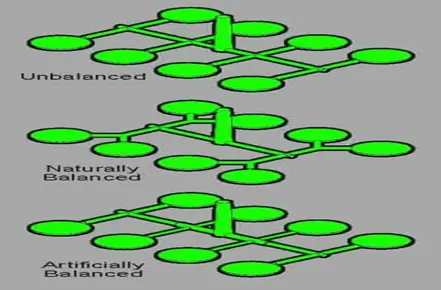
Runners for multicavity molds are particularly important. A runner must be designed well so that each part is filled at the same time during a single shot in a family mold.
By adjusting gate locations and/or runner section lengths and diameters, you can achieve balanced flow to each cavity while reducing over-packing and flash in the cavities that fill first.
-
In addition to providing balanced flow between the each cavity, molds producing multiples of the same part should also ensure an equal distance between the injection machine nozzle and gate on each cavity.
The spoked runner is normally a choice.However, a spoked runner may not be very efficient as the number of cavities increases due to cavity spacing, or as the size of cavities increases.
When possible, it is preferable to arrange cavities in rows rather than circles.runners are typically divided into rows consisting of main feed channels, and sub feed channels at the ends of the flowing path..
Generally, the diameter of the runner increases as the increase in number of cavities on that runner segment, since the flow path to each cavity must be of equal length and make the same number.
If the mold feed rate is constant, flow-front velocity between each cavity will remain constant. If the press cannot maintain an adequate flow-front velocity, the number of cavities that can simultaneously be molded may be limited.
An artificially balanced runner can produce an evenly filled runner, thereby reducing the volume of the runner. These runners may have segments of varying diameter that are adjusted to compensate for the length differences of the runners’ segments.
A ladder runner, one of the most commonly used artifi-cially balanced runner designs, contains two rows of cavities in a primary runner that is fed by equal-length secondary runners.
Typically, the sub runners of these cavities are made progressively smaller for the flows which have the shortest distance between the sub runners. These designs require sufficient sub runners to balance the flow using reasonable sub runner diameters.A runner for three-plate molds burrows through the middle plate perpendicularly to the cavity parting line after conveying material along the runner-split parting line.
Projecting from a main runner, tapered drops are usually set on the part surface via pinpoint gates .
The drops in the mold reduce in size as they go toward the gate at a rate of approximately 0.5 inches per foot. Avoid the use of long drops, since the taper can cause excessive thickness at the runner junction.
Gate
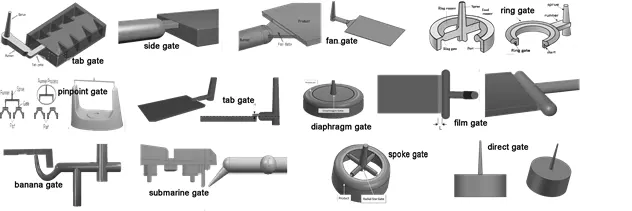
The gate is a narrow intersection between the main runner and the mould cavity, and the intersection is also the shortest part on the whole mold.
Its function is to make the molten plastic enter into the mould cavity quickly, which is beneficial to the rapid filling of the cavity.
After filling, the gate is condensed first to block the cavity, prevent the melted plastic from falling and avoid the pressure drop of the cavity too fast