Week 9 - Project 1 - Door Applique Design with Engineering Features
DOOR APPLIQUE DESIGN WITH ENGINEERING FEATURES
AIM:
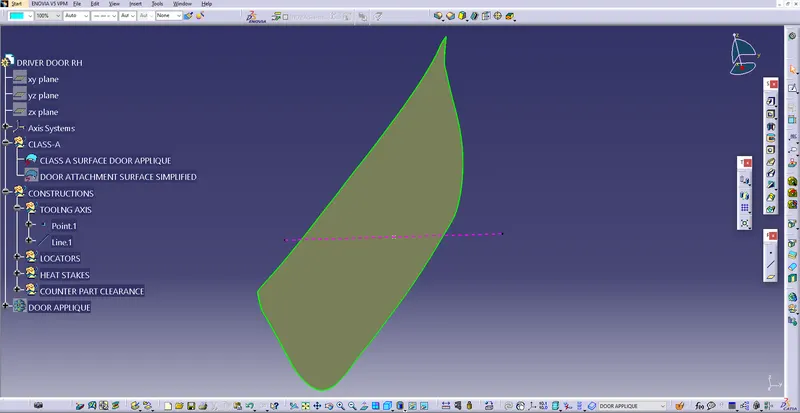
Creating the Driver Door RH Applique plastic component through the given Class-A Surface. To begin with, the tooling axis for the given Class-A Surface is created to meet the requirements of the draft angle and at the end perform the draft analysis on the model.
Creating the Heat Stakes and the Locators considering the design rules mentioned in the video for the door applique.
The Thickness of the component is considered as 2.5 mm
INTRODUCTION:
DRAFT ANALYSIS:
- Draft analysis is performed based on color ranges identifying zones on the analyzed element where the deviation from the draft direction at any point, corresponds to specified values. The draft is required on all parts in the direction of mold movement in order to allow parts to release or eject from the property.
- The draft is the angle at which the parts are tapered to allow them to release. As the part cools, it tends to want to shrink to the core side of the mold. The draft allows the parts to release easily from the mold without creating friction between the surface of the component and the core and cavity plates.
- Most applications require a minimum draft angle of around 5-degree to 1-degree, however, 3-degree draft angles are widely accepted for cost-saving purposes. 7-degree draft angles are given to textured surfaces like instrument panels. Minimum possible draft angles are given to screw bosses, ribs, and stiffeners due to their critical nature.
CLASS A SURFACE:
In automotive design, a class A surface is any of a set of freeform surfaces of high efficiency and quality. Class A surfacing is done using computer-aided industrial design applications. Class A surface modelers are also called "digital sculptors" in the industry. Industrial designers develop their design styling through the A-Surface, the physical surface the end-user can feel, touch, see, etc.
Design check on Class A Surface:
- After receiving class for the fan cover check for the connectivity of the surface on it. If there is any disconnectivity, use joins operation, boundary operation, and disassemble.
Join operation:
- Go to the join command to join the disconnectivity of the surfaces.
- When they're not connected, after receiving Class A, delete only the boundary operation and disassemble, When there are connected delete join operation, boundary operation, and disassemble after the check. The check is over if any disconnectivity does not arise.
TOOLING AXIS:
It is the direction in which the mold opens or core & cavity open. Part drafts are given along this axis.
Tooling operation:
- To decide the tooling axis, the component should be completely clearing the Tooling axis in the given specific direction. Analysis of the components, the fan cover components have two walls.
- The first one visually checks. We can check, which one is possible for Tooling Direction. We can check all x, y & z-direction. If you have a hole, what will happen, you have a separate side core for a specific hole. In this draft analysis of fan cover Z – direction is possible of Tooling direction.
PUBLICATION:
- Publish it using INSERT – PUBLICATION – Select the Class A Surface & Tooling Axis.
- To make sure that easily visual to work on the draft.
DRAFT ANALYSIS:
- Click the Insert - Analysis -- (Feature) Draft Analysis icon
- If material is not on there will be a warning message is shown and then we need to select the material
- The Draft Analysis dialog box is displayed. it gives information on the display (color scale), the draft direction, and the direction values
The Heat stake and Locators to the Door Applique trims:
3-2-1 PRINCIPLE:
- It is also known as a six-pin or six-point location principle. In this, the three adjacent locating surfaces of the blank (workpiece) are resting against 3,2 and 1 pin respectively, which prevent 9 degrees of freedom
- The rest three degrees of freedom are arrested by three external forces usually provided directly by clamping.
Methodology of 3-2-1 principle:
For this refer to the below figure:
- The workpiece is resting on three pins or locators l1,l2, and l3 which are inserted in the base of the fixed body.
- The workpiece cannot rotate about the axes xx and yy and also cannot move downward.
- In this way, the five degrees of freedom 1,2,3,4, and 5 have been arrested.
- Two pins l4 and l5 are inserted in the fixed body, in a plane perpendicular to the plane containing pins l1,l2 & l3.
- Now the workpiece cannot rotate about the z-axis and also it cannot move towards the left.
- Hence the addition of pins l4 and l5 restrict three more degrees of freedom, namely 6,7 and 8.
- Another pin l6 in the second vertical face of the fixed body arrests degree of freedom 9.
The above method of locating a workpiece is called the 3-2-1 principle.
4-way and 2-way locators:
- 4-way means you prevent movement at 2 axes (+x,-x,+y, and –y) on the plane.
- 2-way means you prevent movement only at 1 axis on the plane.
HEAT STAKING:
- Thermal heat staking is an assembly method that uses the controlled melting and reforming of a plastic stud or boss to capture or lock another plastic or metal component of an assembly in the plane.
- The plastic stud protrudes through a hole in the component to be locked in place
- The heated thermal tip contacts the top of the stud which melts and fills the volume of the tip cavity to produce a head locking the component in place.
ADVANTAGES:
- Simplification of machinery
- Reduced cost of machinery
- Multiple fastening points
- Allows higher density of welds compared to hot air cold form or ultrasonic welding.
HEAT STAKES COUNTER CLEARANCE
Driver door RH applique plastic component with locators and heat stakes:
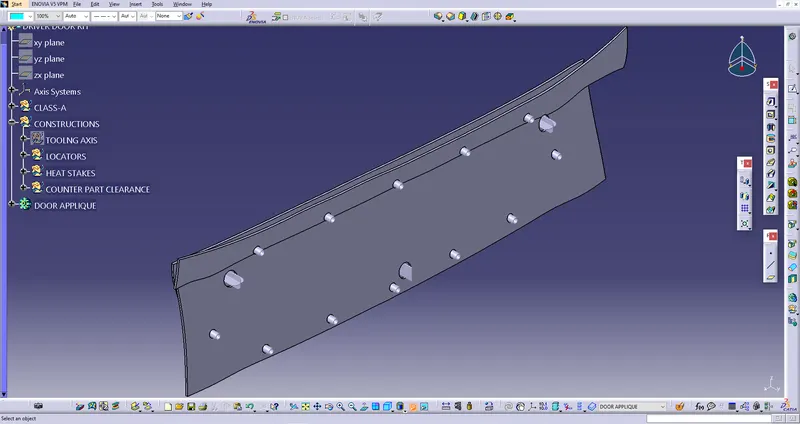
DOOR APPLIQUE:
ISOMETRIC VIEW
SIDE VIEW
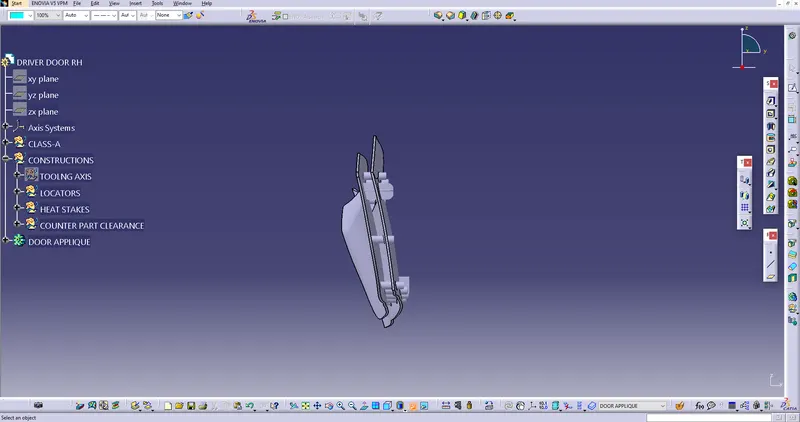
TOP VIEW
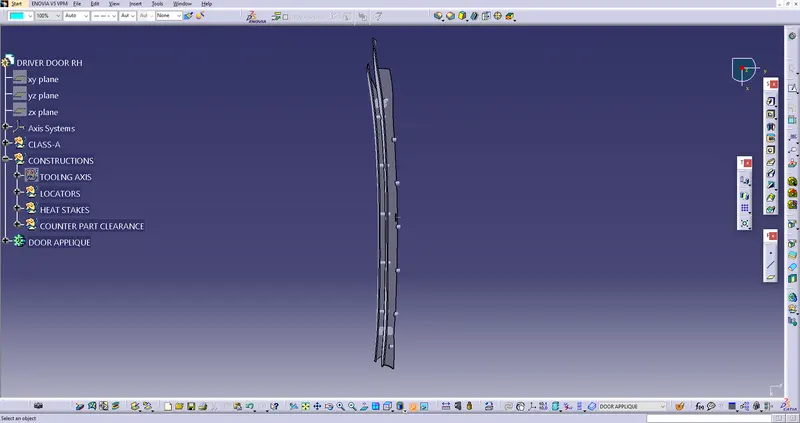
FRONT VIEW
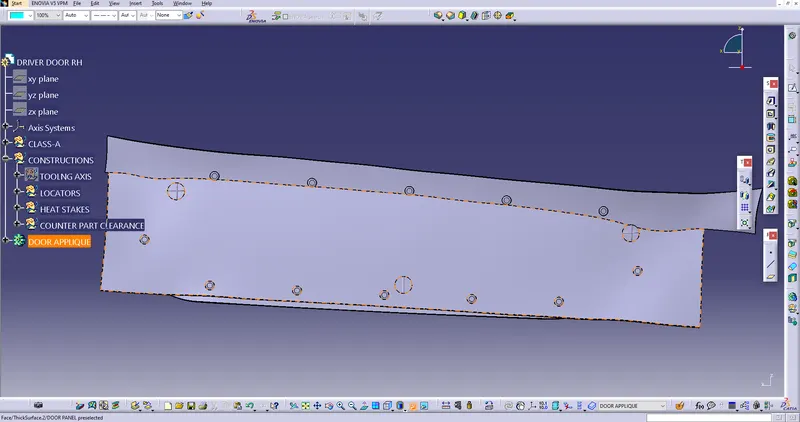
TREE STRUCTURE:
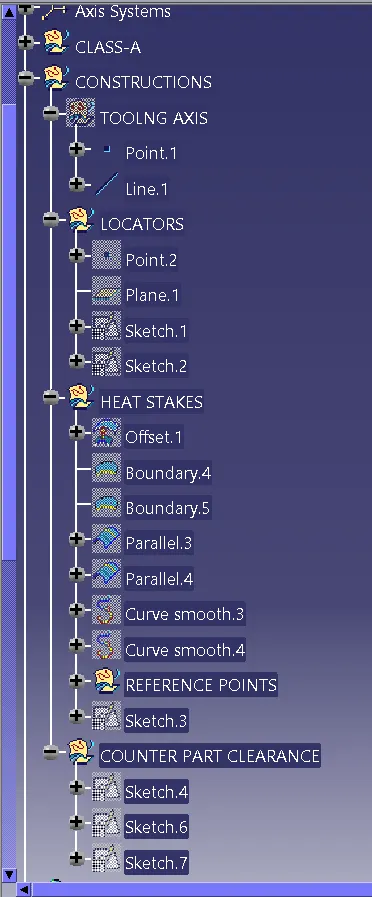
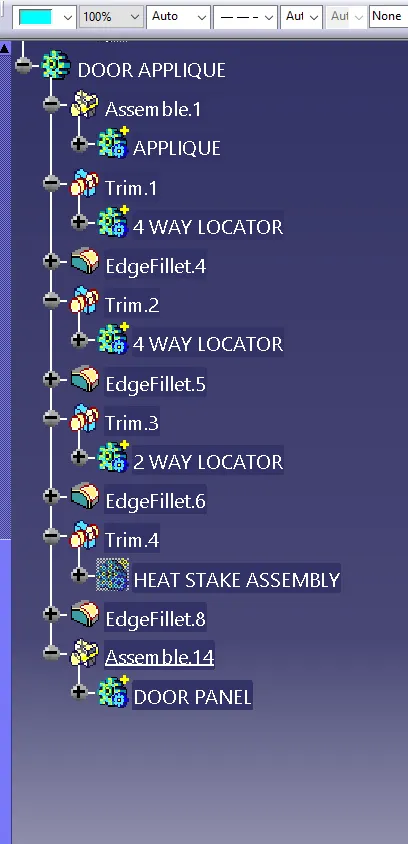
DRAFT ANALYSIS:
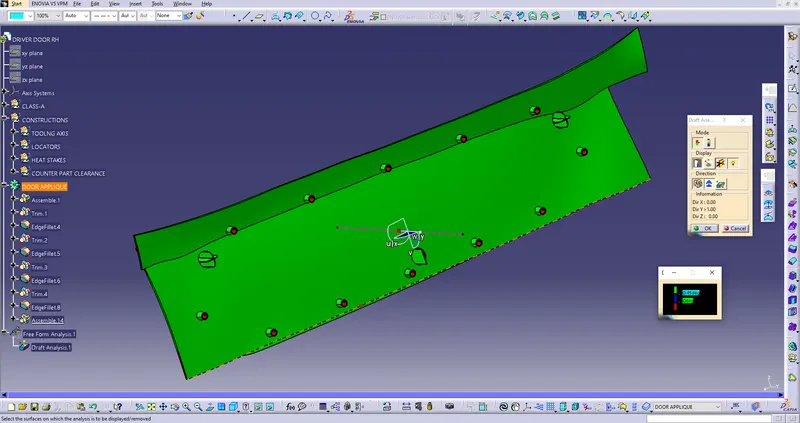
CONCLUSION:
- Thus the door applique design has been developed by using the given class a surface.
- 2 and 4-way locators have been designed in order to fix the position of the applique with the mating door panel and also designed the heat stakes which are used to fix the component with the mating panel by melting.