Week 9 Machining with Planer Challenge
Objective
To perform an explicit dynamics simulation to find out the Equivalent Stress, Total Deformation and also insert a User defined result to calculate the temperature of the body. The simulation is performed in two cases with two different cutting velocity.
Procedure
Preprocessing
An explicit dynamic analysis is carried out for simulating a planar machine cutting a workpiece. The objective is to find the stress and total deformation for two different tool travel speeds. To begin with, the geometry is imported and it is checked for any irregularities in the spaceclaim. If not, the spaceclaim is closed and the geometry is updated in the model scheme. The explicit material Steel 1006 is taken for workpiece and usual structural steel for the tool.
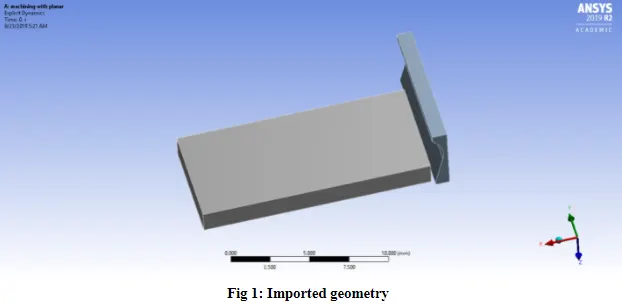
If there are inbuilt contacts, those contacts are deleted as contacts are not allowed in explicit dynamics. The meshing is carried out. Linear order of elements with an element size of 0.3 mm. A tetrahedron mesh is employed for the tool using the patch conforming method and the workpiece is edge sized by dividing the mesh of the workpiece into 10 divisions.
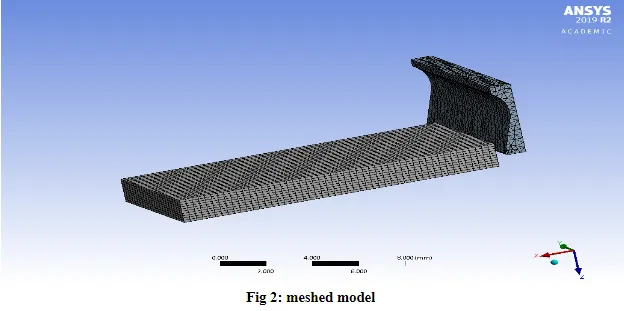
The analysis settings are inputted as given below
Step Controls
Number Of Steps 1
Current Step Number 1
End Time 7.5e-004
Resume From Cycle 0
Maximum Number of Cycles 1e+07
Maximum Energy Error 0.1
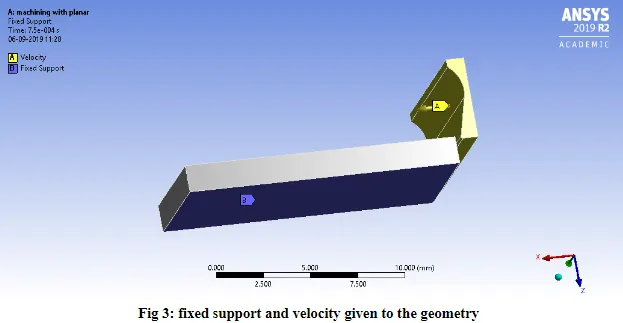
The workpiece is going to be fixed, hence a fixed support is given to the workpiece by selecting the bottom face of the workpiece. The velocity of the tool is given by selecting tool body.
Solution
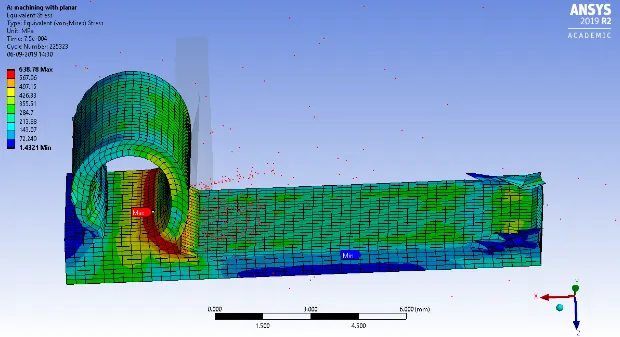
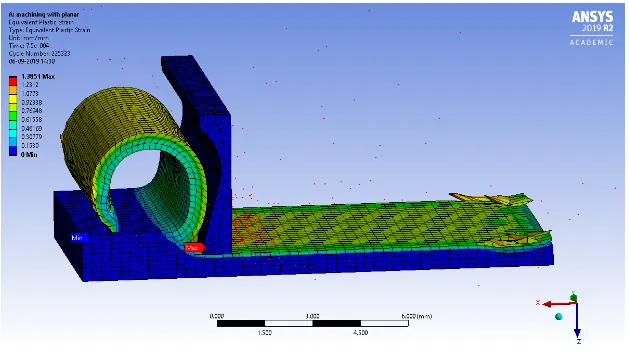
The simulation is solved for two different velocities: 15000 mm/s and 20000 mm/s. The results are obtained and compared.
For velocity=20000 mm/s Directional deformation: 29.757 mm Max
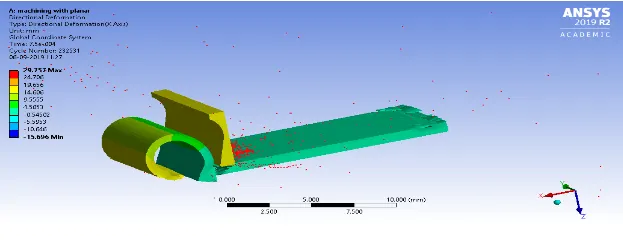
Equivalent stress: 645.4 MPa Max
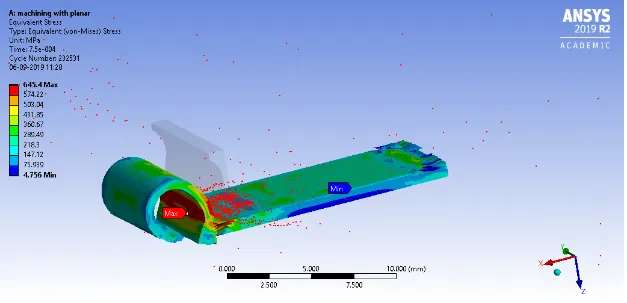
Equivalent Strain: 1.4045 Max
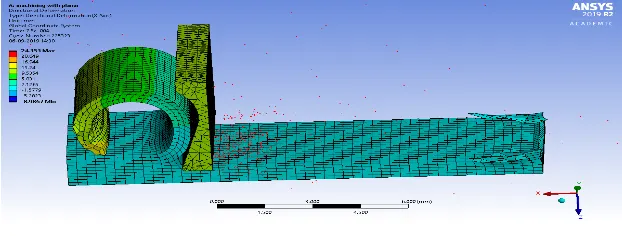
For velocity=15000 mm/s Directional deformation: 24.353 mm
Equivalent stress: 638.78 MPa Max
Equivalent Strain: 1.3851 Max
Conclusion
The simulation was successfully carried out and the results were tabulated as given below,
|
Solution |
20000 mm/s |
15000 mm/s |
|
Directional deformation |
29.757 |
24.535 |
|
Equivalent stress |
645.4 |
638.78 |
|
Equivalent strain |
1.4045 |
1.3851 |
|
Temperature |
334 |
308 |
As the velocity increases, the stress related to cutting, cutting distance and temperature increases. From the table of results, it can be seen that the directional deformation is less for 15000 mm/s when compared to the 20000 mm/s velocity. It can be concluded that as the velocity increases, all the other parameters increases including the damage to the workpiece.