Week 9 - FVM Literature Review
1. Finite Volume Method and differences between FDM and FVM:
The finite volume method (FVM) is a method for representing and evaluating partial differential equations in the form of algebraic equations. This method is applied over entire volume and properties are concentrated at the geometric centre of the volume concerned. In the finite volume method, volume integrals in a partial differential equation that contain a divergence term are converted to surface integrals, using the divergence theorem. These terms are then evaluated as fluxes at the surfaces of each finite volume. Because the flux entering a given volume is identical to that leaving the adjacent volume, these methods are conservative. Another advantage of the finite volume method is that it is easily formulated to allow for unstructured meshes.
In this method, the properties at the centre of a particular cell volume depend on the value of those properties at the faces of that cell which are shared by adjacent cells. So basically property value at cell's centre depends on the property value at shared surfaces of that cell. The value at these shared surfaces is calculated using interpolation techniques. The finite difference method approximates derivatives using nodal values. In contrast a finite volume method evaluates exact expressions for the average value of the solution over some volume, and uses this data to construct approximations of the solution within cells. FVM is preferred over FDM because it is robust and can be applied to complex geometries as compared to FDM which is mainly used when the grids are aligned. FVM conserves the flow quantities better than FDM.
2. Need for Interpolation:
The need for interpolation will be demonstrated using 1D linear heat conduction equation as an example. The equation for steady state 1D heat conduction with a source term is as follows:
`del/(delx)(alpha(delT)/(delx))+S=0`
where T is temperature, S is source term and `alpha` is thermal diffusivity.
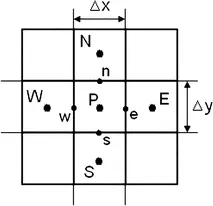
Consider the above figure. W,P,E,N,S depict the centroids of the volume elements. n,s,w,e depict the shared faces of 'P' cell with N,S,W,E respectively. For a 1D case, only cells W, P and E are considered. Consider an infinitesimal volume dV in P cell. Now the heat conduction equation for this cell P can be obtained by integrating the heat conduction PDE for an infinitesimal volume over the entire volume of cell P:
`int[del/(delx)(alpha(delT)/(delx))+S]dV=0`
`intdel/(delx)(alpha(delT)/(delx))dV+intSdV=0`
`intdel/(delx)(alpha(delT)/(delx))Adx+intSdV=0`
`[alphaA(dT)/dx]_e-[alphaA(dT)/dx]_w+barSdV=0`
`alpha_eA_e[(dT)/dx]_e-alpha_wA_w[(dT)/dx]_w+barSdV=0`
Now in the above equation we need the values of `alpha`, A and dT/dx at both right and left face. A will be known. dT/dx is the temperature gradient along x-direction. We can use any of the different schemes like forward difference, backward difference, central difference, etc for finding temperature gradient. However, the value of `alpha` at right and left face cannot be obtained directly. To find it, we need to interpolate the values of temperature at W,P or E cell depending on the interpolation scheme. So interpolation schemes are required to solve the temperature equation for a particular cell. Interpolation is done using the values of the required cell and adjacent cells to obtain `alpha` at common surfaces.
3. Some Common Interpolation Schemes:
The value of property (`phi`) at the right common surface (east) is shown as example:
1. First Order Upwind: Upwind interpolation scheme is similar to forward or backward difference for the first derivative and mainly depends on the flow direction of flux through the mesh.
`phi_e=phi_P`
2. Central Differencing: The value of the flux in this scheme is given by linear interpolation of the centre point of the control volume. It is second order accurate. It is used in diffusion term. It cannot be used for convection term.
`phi_e=(phi_P+phi_E)/2`
3. Linear Differencing: Here linear approximation is done between the two adjacent control volume centres to obtain value at the face. It takes into account the distance of centroid from the face and is more accurate than upwind and central difference scheme.
`phi_e=phi_Elambda_e+(1-lambda_e)phi_P` where `lambda_e=(x_e-x_P)/(x_E-x_P)`
4. Second Order Upwind: In this scheme, the value of the flux at the interface is determined from two points upstream of the direction of flux rather than just one point like upwind scheme. It is linearly interpolated.
`phi_e=(3phi_P-phi_W)/2`
5. Quadratic Upwind Interpolation for Convective Kinematics (QUICK): In this scheme, the value of the flux at the interface is determined from two points upstream of the direction of flux and a point from downstream direction of flux. Hence it is third order accurate and follows a quadratic interpolation rather than linear.
`phi_e=3/4phi_P+3/8phi_E-1/8phi_W`
4. Flux Limiters:
For convective fluid flow it has been observed that low order schemes are usually stable but quite dissipative in nature around points of discontinuity or shocks while the higher order schemes are unstable in nature and show oscillations in the vicinity of discontinuity. Flux limiter functions are used to tune high and low order schemes in such a way that the resulting scheme gives high order accuracy in the smooth region of flow and maintains first order accuracy in the vicinity of shocks and discontinuities. The flux limiters are limited between 0 and 1. When it is equal to 0, flux is represented by a low resolution scheme. When it is equal to 1, it is represented by a high resolution scheme. These limiters help in the convergence of solution.
Common flux limiter functions are CHARM, HCUS, HQUICK, SHARP, COSMIC, Koren, minmod, etc.