Week 9 - FVM Literature Review
FINITE VOLUME METHOD (FVM) LITERATURE REVIEW
Objective: To study and understand
- The difference between FDM and FVM.
- Interpolation schemes in FVM
- Flux limiters in FVM
Finite Volume Method (FVM) is a discretization method for the approximation of a single or a system partial differential equation (PDE) expressing the conservation, or balance, of one or more quantities.
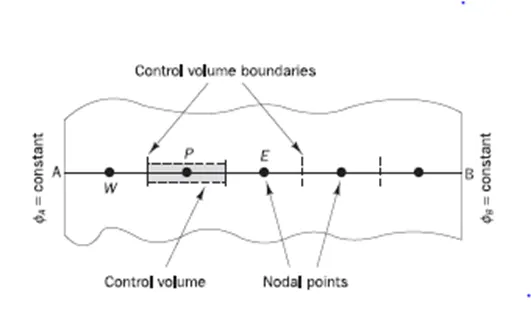
A finite volume method (FVM) discretization is based upon an integral form of the PDE to be solved. The computational domain is discretized into finite volume and then for every volume the governing equations are solved. The basic advantage of this method over FDM is it does not require the structured grid, and the effort to convert the given mesh into structured numerical grid internally is completely avoided. In any case, the values of field variables at non-storage location (e.g., vertices) are obtained using interpolation.
The Major difference between FVM & FDM are
- FDM uses partial differential equations
FVM uses discretization technique.
- FDM is a differential scheme, that is approximation of a Taylor series expansion. We try to write first order, second order differential in terms of difference between two-point values. This may bring in some approximation error.
FVM is an integral scheme. Since we are integrating across the area, chance of error is minimized.
Types of interpolation schemes
1) Upwind differencing scheme: -
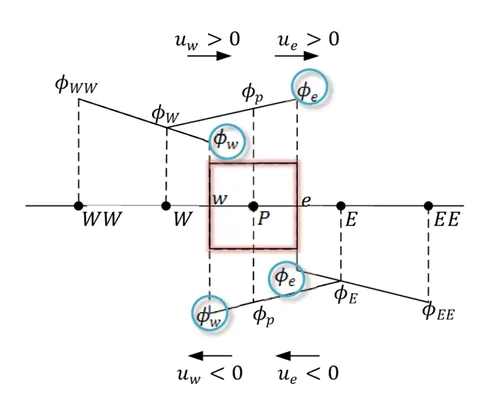
This type of scheme is used for convection dominated problems. They use an adaptive or solution sensitive finite difference stencil to numerically simulate the direction of propagation of information in a flow field. This scheme is almost equivalent to forward differencing scheme and backward differencing scheme depending on flow direction.
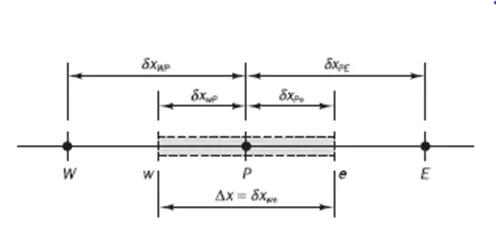
The upwind interpolation scheme for approximating the value of a variable f at the east face of a control volume is given by,
f_e={ f_p, if 〖(u.n)〗_e > 0
Or
f_e= f_E, if 〖(u.n)〗_e < 0
Or
If the flow is along −X direction, then the values for this at the interface is given by
for v>0 ; u_(i-1/2) ≈ u_(i-1); u_(i+1/2) ≈ u_i
I_c ≈v (u_i-u_(i-1))/∆x which is equivalent to Backward Difference Scheme
If the flow is along +X direction, then the values for this at the interface is given by
for v>0 ; u_(i-1/2) ≈ u_(i-1); u_(i+1/2) ≈ u_i
I_c ≈v (u_(i+1)-u_i)/∆x which is equivalent to Forward Difference Scheme
It is said to be equivalent because all these three methods are of order of accuracy 1.
- Linear interpolation (CDS)
Approximate values of the variable at the control volume face centre by the linear interpolation of the values at the two nearest computational nodes.
f_e= f_E λ_e+f_p (1-λ_e)
Where
λ_e= (x_e-x_p)/(x_E-x_P )
It is simple and most widely used.
The linear interpolation is equivalent to the use of central difference formula of the firs order derivative and hence this scheme is also termed as Central Differencing Scheme (CDS).
Average interface values are given by
u_(i-1/2) ≈ (u_(i-1)+u_i)/2 and u_(i+1/2) ≈ (u_i+u_(i+1))/2
I_c ≈v.(u_(i+1)-u_(i-1))/2∆x which is equivalent to CDS.
It is said to be equivalent because both these methods are of order of accuracy 2.
- Hybrid interpolation scheme
It is the blend of UDS and CDS. The hybrid difference scheme exploits the favourable properties of the
upwind and central differencing schemes. It switches to upwind differencing when central differencing produces inaccurate results at high Pe numbers.
The scheme is fully conservative and since the coefficients are always positive it is unconditionally bounded. It satisfies the transportive requirement by using an upwind formulation for large values of Peclet number.
f_e= γf_CDS+(1-γ) f_UDS
- Quadratic Upwind Interpolation for convective kinematics (QUICK)
It approximates the values of the variable at the CV face centre by Quadratic Interpolation of the values at three nearest computational nodes (1 Downstream node D & 2 Upstream nodes U, UU).
Quadratic - As it uses 3 nodes
Upwind - As it uses two upstream
Convective Kinematics - As it is used for convective domain problems
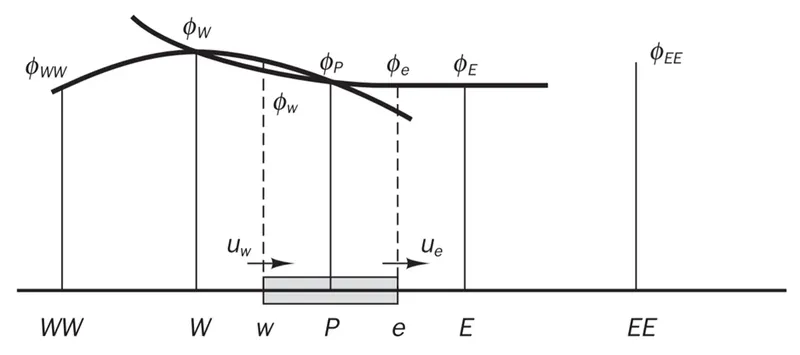
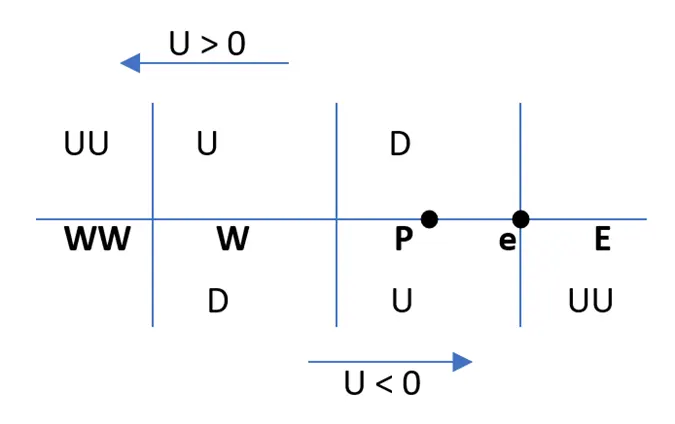
f_e= f_E+g1(f_D-f_U )+g2(f_UU-f_U)
Where,
g1= (〖(x〗_e-x_U)(x_e-x_UU))/(〖(x〗_UU-x_U)(x_UU-x_D))
g2= (〖(x〗_e-x_U)(x_e-x_D))/(〖(x〗_UU-x_U)(x_UU-x_D))
It is the better version of UDS and CDS because it is more accurate than UDS and more damping in nature than CDS as it uses 3 nodes to solve. It is of 3rd order accurate.
Flux limiter:
For convective fluid flow, it is observed that low order schemes are usually stable but quite dissipative in nature around the points of discontinuity or shocks while the higher order schemes are unstable in nature and show oscillations in the vicinity of discontinuity or shocks. Highly accurate and oscillation free schemes are known as High Resolution Schemes.
In order to make the scheme TVD, we must constrain or limit the range of possible values of the additional convective flux f_e=f_p+1/2 ψ(r)(f_E-f_(P)), which was originally introduced to make the scheme higher-order. Hence, the function is called a flux limiter function.
Flux Limiter functions are used to fine tune the higher order and lower order schemes in such a way that the resulting scheme gives a higher order accuracy in the smooth region of the flow and maintains first order accuracy in the vicinity of shocks and discontinuities. For such a scheme TVD scheme is employed.
F(u_(i+1/2) )= f^low ((i+1/2)-ψ(r_i)(f^low (i+1/2)-f^high (i+1/2))
F(u_(i-1/2) )= f^low (i-1/2)-ψ(r_i-1)(f^low (i-1/2)-f^high (i-1/2))
where,
f^low is low precision flux (first order)
f^high is high precision flux (higher order)
Conclusion:
Finite Volume Method (FVM) is really a powerful approach to solve the CFD problems. With the help of proper interpolation schemes and the accurate use of flux limiters in case of any discontinuities present, we can solve a wide range of CFD problems.
Though it may be difficult to code and implement it in the computer it gives an added advantage of its robustness.